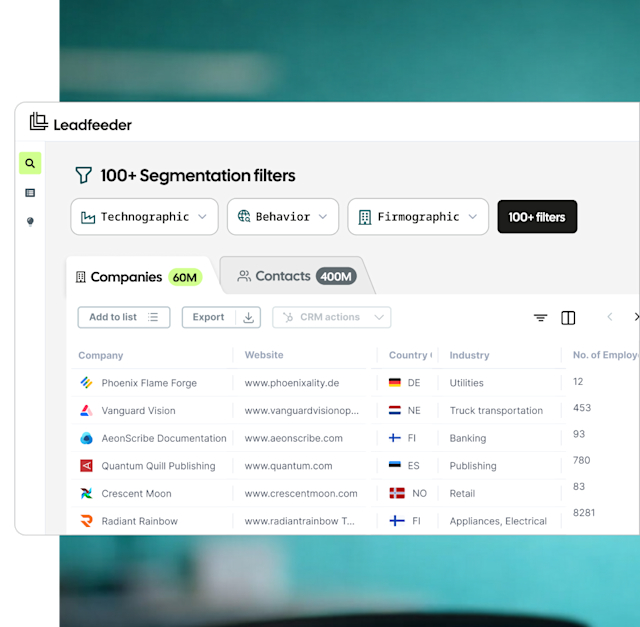
Apollo.io and Leadfeeder take different approaches to solving this. Both platforms help teams find prospects, enrich data, and support outreach, but they are built on very different strengths. One prioritizes scale and outbound volume, while the other focuses on intent data and accuracy.
In 2026, choosing between Apollo.io and Leadfeeder comes down to a clear trade-off: balancing maximum reach and speed with higher-quality, intent-driven opportunities that reflect real buying interest. This article compares Apollo.io and Leadfeeder to help revenue teams understand which platform best fits their growth strategy.
Why compare Apollo.io and Leadfeeder
Both Apollo.io and Leadfeeder promise to give sales and marketing teams what they need most: qualified opportunities at the top of the funnel. The better the platform, the stronger the chances of consistent pipeline growth.
Think of it like cooking: the ingredients you start with matter more than the recipe you follow. If your data is stale, incomplete, or poorly matched to your ideal customer profile (ICP), no amount of clever outreach will turn those contacts into revenue.
That’s why businesses weigh up these two platforms. Apollo.io is often favored by US outbound teams looking for volume, while Leadfeeder positions itself as the go-to for European coverage and intent-driven prospecting, helping revenue teams spot buyers already in-market.
And the stakes are high. Recent B2B marketing research shows that intent-based marketing can deliver a 70% lift in conversion rates, underscoring its power for revenue teams seeking to build a more dependable pipeline. In other words, better data and smarter targeting are growth levers when implemented in your pipeline-generation strategy.
The impact on pipeline growth
Pipeline growth isn’t about collecting as many email addresses as possible. It’s about creating a flow of high-fit opportunities that steadily move through the funnel, from website visitor, to lead, to opportunity, to customer.
For sales and marketing teams working together, the right platform doesn’t just improve efficiency; it also drives alignment. If marketing generates leads that sales doesn’t trust, the pipeline stalls. If sales chase contacts without context, conversion rates drop.
That’s why platform choice matters. A strong pipeline-generation platform serves as the connective tissue between marketing campaigns and sales conversations. The question is: which one, Apollo.io or Leadfeeder, does it better?
Key features comparison
When choosing a pipeline generation platform, it’s not just about ticking feature boxes. The real question is: how do these features affect how revenue teams attract, qualify, and convert leads into revenue?
Here’s how Apollo.io and Leadfeeder stack up across the most important areas:
Feature | Apollo.io | Leadfeeder |
Data Enrichment | Email and phone data using public sources | Verified firmographic and intent-based data |
Sales Prospecting Tools | Multi-step sequencing with basic personalization | Workflow automation with real-time ICP targeting |
Website Visitor Tracking | Pixel-based with limited matching | IP-based with firmographic matching |
Discover accounts that are ready to buy
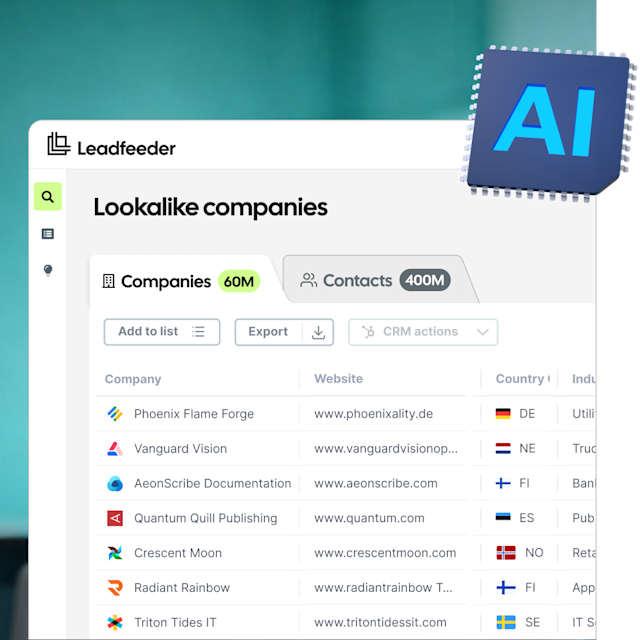
Prioritize your outreach when you notice buying signals from your prospects and expand your target list using machine learning.
Boost your sales1. Data enrichment capabilities
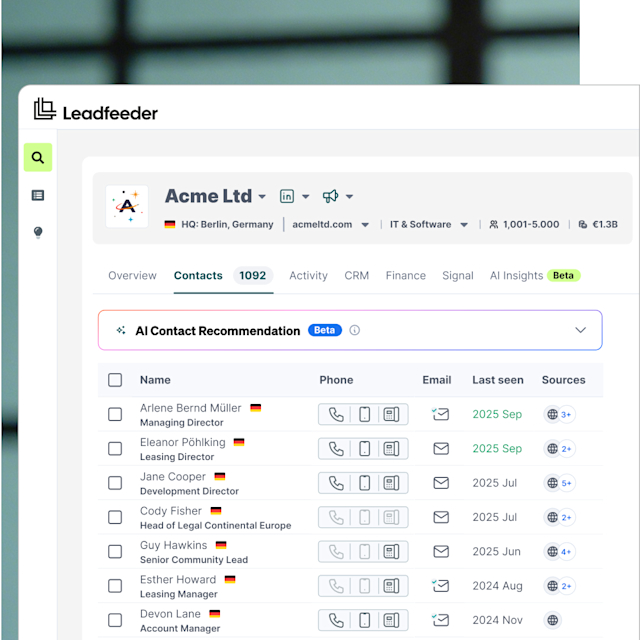
Enrichment is the difference between a half-filled jigsaw puzzle and the complete picture. Without details like job titles, company size, and tech stack, sales and marketing teams risk wasting energy on the wrong people.
Apollo.io’s approach relies on a vast database of public and user-contributed contacts. It uses a credit-based system, meaning every lookup or enrichment “costs” you. While the breadth is appealing, the model can make scaling expensive.
Leadfeeder’s approach is rooted in verified, company-level data sourced from official registries and fully compliant providers. For European markets especially, this translates into higher reliability and fewer dead ends for your teams.
2. Sales prospecting tools
For sales development reps (SDRs) and marketing teams alike, automation isn’t about cutting corners. It’s about freeing humans to do what machines can’t: build trust.
Apollo.io offers email sequencing with time delays and task reminders. It also has a Chrome extension for LinkedIn prospecting, though LinkedIn restricted this functionality in early 2025, limiting one of its popular use cases.
Leadfeeder goes further by linking prospecting activity to intent signals. If a target account suddenly starts researching your product category or shows signs of a job change, Leadfeeder automatically triggers alerts and workflows. This ensures both sales and marketing can respond at the right moment, before competitors do.
Effectively, Apollo.io is like setting a sprinkler system that runs at fixed times; Leadfeeder, however, acts more like a smart irrigation system that waters when the soil is dry. One works on a routine, the other is more intelligently responsive.
3. Website visitor identification
Imagine running a busy store where half the customers browse without speaking to staff. Without visibility, you’re blind to genuine buying interest; that’s where website visitor identification makes the invisible, visible.
Apollo.io uses pixel tracking to detect visitors, but company-level matching is limited. You’ll often know “someone was here,” but not necessarily who.
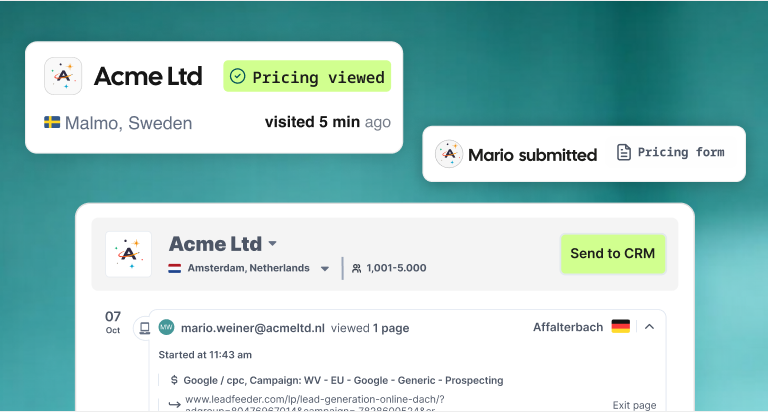
Leadfeeder combines IP intelligence with detailed firmographic data, giving marketing teams clear insights into which companies are showing interest, even without a form submission. This is particularly valuable in Europe, where first-party data and GDPR compliance are critical.
Data coverage and accuracy
When it comes to data, bigger isn’t always better. A database boasting 200 million contacts might sound impressive, but if one in three bounces, the cost is more than just wasted credits. It’s wasted time, damaged deliverability, and even lost credibility with prospects. For marketing, high bounce rates can hurt email sender reputation; for sales, dialing bad numbers erodes morale and efficiency.
Apollo.io claims coverage of 200M+ contacts, with particular strength in North America. The breadth is undeniable, but user reviews often cite bounce rates between 19–26% and phone numbers as being “usually outdated”. This means a large portion of outreach risks falling flat, forcing teams to spend time filtering signals from noise.
Leadfeeder, on the other hand, emphasizes precision. Its data is built upon official trade registers and public sources, enriched with firmographic details to provide highly compliant, Europe-standard data, and stored and processed entirely within the EU. Instead of volume for its own sake, Leadfeeder emphasizes quality and compliance; two things that become more valuable as pipelines grow.
You might be wondering, ‘Does this actually matter?’ And the answer is yes - because accuracy translates directly into trust. Sales trusts the data they’re dialing; marketing trusts the segments they’re targeting. And when both teams are confident in the data, alignment follows naturally.
It’s the difference between running a race with a clear map versus sprinting through fog; you cover more ground, with less wasted effort, and with far greater confidence that you’re heading in the right direction.
Pricing structure
Pricing often reveals the philosophy behind a platform. Is it about selling as many credits as possible, or about enabling teams to grow without hidden costs?
Apollo.io uses a tiered, credit-based pricing model. Plans include a set number of credits for lookups and enrichment, but once those are gone, teams need to buy more. This can make budgeting unpredictable, especially as marketing and sales usage scale. Meanwhile, Leadfeeder offers custom pricing based on team size and use case.
For startups, Apollo.io’s entry-level pricing might feel like a lighter lift, but for scaling revenue teams, Leadfeeder’s model often proves far more cost-effective in the long run, as there are no penalties for your team’s success.
Integration capabilities
No tool works in isolation, and for revenue teams, a pipeline generation platform is most powerful when it plugs seamlessly into the systems you already rely on: think of your CRM, your outreach tools, and even your internal communication channels. Poor integrations can turn a promising platform into yet another silo, while strong integrations act like connective tissue across the revenue engine.
1. CRM compatibility
If your CRM is the heartbeat of your revenue operations, integrations are the arteries. Data needs to flow in both directions, accurately and in real-time, so sales and marketing aren’t working with outdated or incomplete records.
Apollo.io connects with Salesforce, HubSpot, Pipedrive, and Zoho CRM. The syncing is functional but relatively basic, often requiring manual oversight to ensure data consistency.
Leadfeeder integrates with HubSpot, Salesforce, Microsoft Dynamics 365, and Pipedrive, but with a sharper focus on real-time data syncing and activity tracking. That means when a prospect engages, both sales and marketing see the signal instantly, reducing lag and increasing alignment and speed to action.
2. Outbound sales and marketing coordination
Outbound isn’t just about cold calls and sequenced emails anymore. For modern revenue teams, it’s about orchestration—making sure sales touches and marketing campaigns complement each other, rather than collide.
Apollo.io keeps most functionality inside its platform: built-in email sequencing, Gmail/Outlook connectivity, and some integrations with sales engagement tools via Zapier. This works well for lean teams who want one contained environment.
Leadfeeder takes a different approach. Rather than trying to do everything internally, it focuses on triggering actions in the systems you already use. For example, when a target account shows intent, Leadfeeder can send alerts to Slack or kick off an automated nurture sequence in your email platform.
Compliance and data privacy
Data privacy boils down to a matter of trust. If customers suspect their data is mishandled, they’re less likely to buy from you. And if regulators find fault, the cost can be severe: since the General Data Protection Regulation (GDPR) came into force in May 2018, a total of around €5.65 billion in fines have been imposed as of March 2025, an increase of €1.17 billion compared to the previous year.
Apollo.io states its compliance with GDPR and CCPA and notifies individuals in certain regions. However, it collects both business and personal emails. Since personal emails are treated differently under GDPR, this should raise red flags for companies with strict compliance standards.
Leadfeeder, however, takes a GDPR-first approach. It only includes B2B data from official public sources, avoids processing personal email addresses altogether, and keeps data stored within the EU. For European operations or any global team focused on privacy-first growth, this significantly reduces compliance risks.
For US-focused teams with fewer regulatory hurdles, Apollo.io’s broad data pool may be sufficient. But for European companies or global enterprises with privacy commitments, Leadfeeder offers peace of mind baked into the platform’s DNA.
Real-time insights for pipeline growth
In pipeline generation, timing is everything. Acting on a lead a week late can mean chasing someone who’s already signed with a competitor. Real-time data flips that script: instead of working with stale reports, revenue teams get visibility into what’s happening right now.
According to McKinsey, companies that act on real-time customer insights are more than twice as likely to outperform peers in revenue growth. For sales, that means being first in the inbox or on the call. For marketing, it means serving content that meets prospects exactly where they are in their journey.
1. Buyer intent signals
Buyer intent signals are like footprints in the sand; they reveal not just who passed by, but where they might be heading. The challenge is spotting those signals early enough to act.
Apollo.io focuses on engagement with your outreach: email opens, clicks in sequences, or CRM task completion. It’s useful for tracking who’s responding to your outbound efforts, but the signal only appears after you’ve reached out.
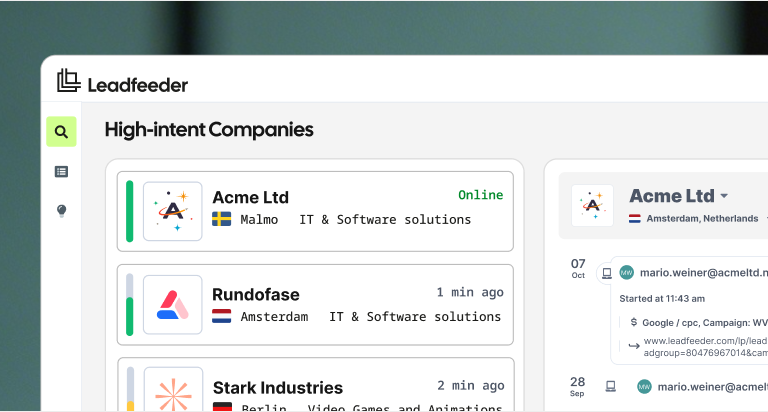
Leadfeeder, conversely, takes a wider-angle view by tracking external behaviors such as repeat company visits, time spent on your site, page views, and even technology changes. These signals show when a company is researching solutions, sometimes before they’ve ever spoken to you.
The difference is that Apollo.io tells you when someone is reacting to your message, while Leadfeeder tells you when someone is already looking for a solution like yours. For pipeline predictability, the latter creates a more proactive approach.
2. Lead generation approaches
Both platforms support B2B lead generation, but they measure “quality” differently. Think of it as two kinds of fishing nets:
Apollo.io scores leads based on their responses to your emails and calls. The more they engage, the higher their score; this helps prioritize contacts who are already interacting with your outreach.
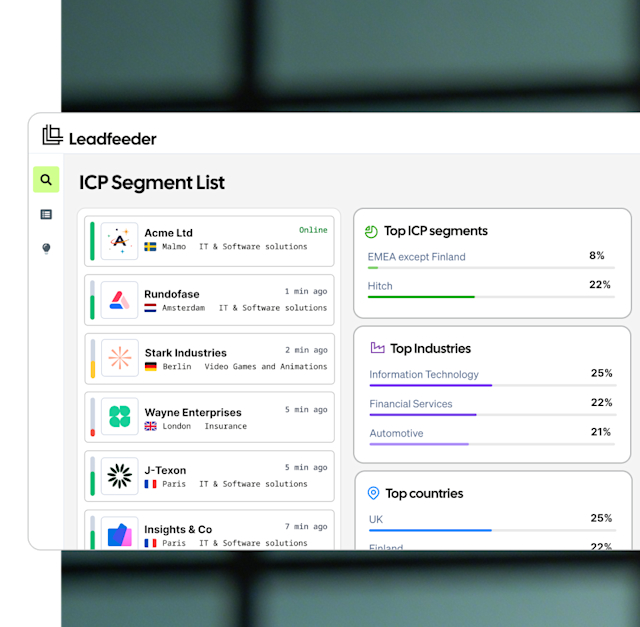
Meanwhile, Leadfeeder scores leads at the company level, looking at behavior (site visits, frequency, time on page) alongside firmographic fit (size, industry, geography). It highlights accounts that are showing intent before any direct contact.
For marketing, that means knowing which companies to target with ads or nurture campaigns. For sales, it means calling on companies that are already “warm,” even if they’ve never replied to an email.
Platform scalability
As businesses grow, prospecting needs evolve. What works for a five-person startup rarely holds up for a global revenue team running account-based strategies.
Apollo.io is well-suited for smaller teams starting with outbound prospecting. Its credit-based model lowers the barrier to entry, but costs scale quickly as outreach volume increases. It’s popular with startups and SMBs looking for speed over depth.
Leadfeeder scales based on team size and regional focus, rather than the number of credits used. Its features support enterprise sales prospecting with account-level tracking and stronger compliance controls. This makes it suitable for companies expanding into regulated markets or adopting account-based strategies.
The main difference is that Apollo.io scales with user count and credit consumption, while Leadfeeder scales with team complexity and market coverage.
Making the right choice
When picking your prospecting platform, it can be tempting to go with the option with the longest feature list. But remember, you should pick the tool that best aligns with your market, sales motion, and compliance environment. Both Apollo.io and Leadfeeder help revenue teams generate pipeline, but they do so with very different philosophies.
Apollo.io is built for speed and volume. Its strength lies in helping smaller teams quickly spin up outbound activity, particularly when targeting US-based markets. The credit-based pricing and built-in sequencing make it appealing for fast-moving teams who need basic contact discovery and outreach under one roof.
Leadfeeder, on the other hand, is designed with precision and trust in mind. By sourcing verified, GDPR-compliant data and layering in behavioral intent signals, it gives sales and marketing teams a more reliable foundation for account-based strategies.
For companies selling into European markets, or any business where compliance, accuracy, and integration depth matter, Leadfeeder becomes more than just a prospecting tool; it becomes the connective tissue between marketing insights and sales execution.
In short:
Apollo.io works best when you need high-volume outreach and want everything bundled in one platform.
Leadfeeder works best when you need accuracy, compliance, and account-level intelligence to support long-term growth.
Ultimately, the choice comes down to your pipeline philosophy. If your business is built on casting wide nets, Apollo.io can help you do that, fast. But if your goal is to build predictable revenue with trusted data, deeper insights, and stronger alignment between sales and marketing, Leadfeeder is the platform that takes you there.
To see how Leadfeeder works with your specific needs, you can book a demo at Leadfeeder's website.
FAQs about Apollo.io and Leadfeeder
Apollo.io vs Leadfeeder: which has more accurate sales data?
Apollo.io relies on a large database of public and user-contributed contact information, but reviews cite email bounce rates of 19–26% and lower phone accuracy. Leadfeeder sources verified company data from official registries and intent signals, achieving over 90% accuracy in its core European markets.
Which is better for small business ROI: Apollo.io or Leadfeeder?
Small businesses targeting US markets may find Apollo.io cost-effective for quick outbound campaigns. However, Leadfeeder often delivers higher ROI for SMBs and scale-ups selling into Europe, thanks to its intent-based targeting, which reduces wasted outreach on low-quality leads.
Can Apollo.io and Leadfeeder integrate with my CRM?
Yes. Both platforms integrate with major CRMs such as HubSpot, Salesforce, Pipedrive, and Zoho. Apollo.io offers basic two-way syncing depending on plan level, while Leadfeeder provides real-time two-way sync and activity tracking for tighter CRM alignment.
How do Apollo.io and Leadfeeder differ in prospecting automation?
Apollo.io focuses on built-in email sequencing, task reminders, and LinkedIn prospecting. Leadfeeder automates workflows triggered by buying intent, such as website visits or technology changes, sending alerts and syncing actions into CRM, Slack, or Teams.
Is Apollo.io GDPR compliant compared to Leadfeeder?
Apollo.io claims GDPR and CCPA compliance, but includes personal emails and user-submitted data, which may pose additional risks. Leadfeeder is GDPR-first, storing all data in the EU, focusing strictly on B2B information, and sourcing only from official public registries.
How do Apollo.io and Leadfeeder pricing models compare?
Apollo.io uses a credit-based system where costs increase with contact lookups and email sends. Leadfeeder offers custom, usage-based pricing without credit restrictions, often making it more predictable and scalable for growing teams.
Which platform identifies website visitors more effectively, Apollo.io or Leadfeeder?
Apollo.io uses pixel tracking with limited company matching. Leadfeeder combines IP intelligence with firmographic data to identify visiting companies with greater accuracy, especially in European regions.