



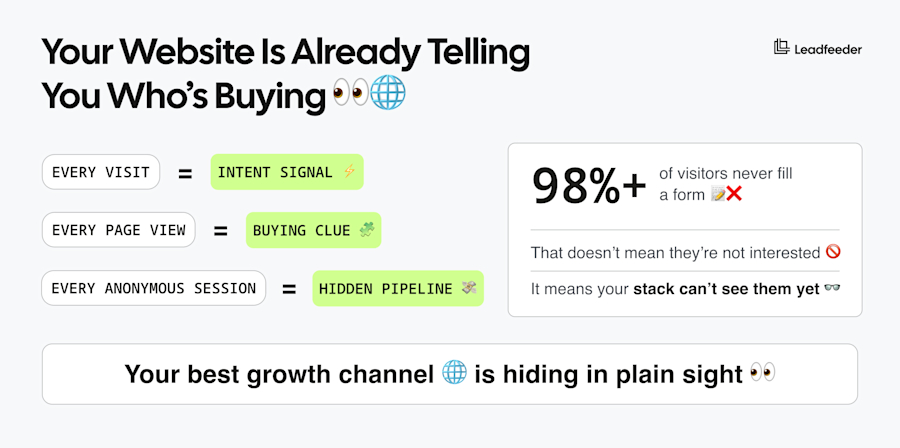
And yet, for most teams, the website remains a passive asset. You drive traffic to it, measure page views and bounce rates, and then hope your forms do the heavy lifting. Meanwhile, the vast majority of your visitors, the 98% or more who never fill out a form, leave without a trace.
That’s your opportunity. Those are your most valuable prospective customers, and they’re slipping through your fingertips.
That gap between what your website could tell you and what it actually does today is where we've been focused here at Leadfeeder. It's why we've spent the past several months fundamentally rethinking what Leadfeeder should be, and I’m excited to share how we’ll be moving forward to help our customers identify the currently-invisible prospects that are already interested in you.
The Problem Is Workflow, Not Data
When I joined Leadfeeder as CPTO, one of the first things that struck me was the distance between what our product could identify and what teams could actually do with that information.
We were strong at the core. We could reveal which companies visit your website, match them to real business profiles, and surface intent signals that matter.
But identification alone isn't enough. Demand gen professionals don't just need to know who showed up, they need to be able act on it quickly and in the context of their broader campaigns and pipeline.
The real bottleneck was never the data. It was the workflow around the data.
Teams were exporting lists, manually cross-referencing CRM records, building audiences in spreadsheets, and stitching together integrations just to get from "interesting visitor" to "targeted action."
Instead of seeing actual growth motion, they were saddled with overhead. Despite having some of the right pieces in place, the needle wasn’t moving.
Building for The Demand Gen Workflow
This realization shaped our product direction. We asked ourselves a simple question:
What if Leadfeeder didn't just identify visitors, but helped you do something meaningful with every signal your website produces?
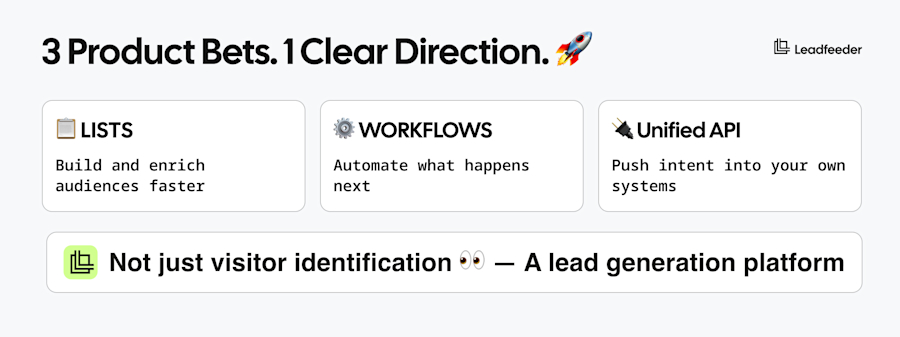
That question led us to three product investments we're bringing to market.
The first is what we call Lists.
This a flexible workspace for building, refining, and enriching audience lists directly inside Leadfeeder.
Instead of exporting raw data and wrangling it elsewhere, you can now segment visitors, layer in contact-level enrichment, and build actionable lists that plug straight into your outreach and ad platforms. It's designed to work iteratively, cross-functionally, and fast, exactly how demand gen teams work themselves.
The second is Workflows.
These are configurable workflows that let you automate the actions that follow identification.
When a target account visits your pricing page for the third time this week, you shouldn't need to check this manually. Workflows let you define the triggers and the responses so the right signal reaches the right person or system at exactly the right moment.
And the third is our unified API.
This opens up Leadfeeder's intelligence layer to teams that want to integrate website visitor data directly into their own tools and models.
Whether you're feeding intent signals into a scoring model, enriching your CRM programmatically, or powering a custom ABM workflow, the API gives you full access to our identification and enrichment engine without being constrained by any single UI.
These aren't incremental features.
Together, they represent a shift in what Leadfeeder is. We’re moving from a visitor identification tool into a lead generation platform that’s built around your website to help you find and nurture high-intent prospects.
AI as an Accelerant (Not a Gimmick)
We're investing heavily in AI, but not in a superficial way. We’re not bolting on features that sound flashy but don’t actually make an impact.
Instead, we want to make Leadfeeder smarter and more efficient when it comes to the things that matter most to demand gen and growth professionals. These are the changes we’re making:
AI-powered onboarding that gets you to value faster
Intelligent enrichment surfaces the right contacts and company insights without manual research.
Proactively recommending actions instead of just reporting on what happened
Investing in capabilities like MCP server development to make Leadfeeder's intelligence natively accessible to third-party AI tools and LLM-based workflows
The goal is to help you move from insight to action faster, with less friction along the way.
The Foundation: Data You Can Trust
None of these changes matter without a strong data foundation.
Over the past year, we've made meaningful improvements to our IP match rates. We've introduced waterfall enrichment for contact data, and we've declared a clear data strategy that spans IP identification, company intelligence, contact data, and behavioral signals.
This compounds for demand gen teams:
Better identification rates mean more of your traffic becomes actionable.
Richer company and contact data means your audiences are more precise.
Stronger behavioral signals mean you can time your outreach to moments of genuine interest (and not arbitrary cadences).
We're not done here. Data quality and coverage is a long game, and we're playing it with the discipline it deserves.
What this means for you
If you're running demand gen or growth for a B2B company, here's the shift I'd encourage you to think about:
Your website isn't just a conversion point. It's a real-time signal of market intent. Every visit, page view, and pattern of engagement is invaluable information. That should feed directly into how you build audiences, prioritize accounts, and allocate budget.
The tools we're building at Leadfeeder are designed to close that loop. From signal to action, without the manual overhead that slows most teams down.
We're entering a new chapter at our company, with a singular brand, platform, and direction forward. And at the center of it is the conviction that your website deserves to be treated as the growth engine it already is.
We're excited to make sure the product lives up to that potential.