



I originally joined the Dealfront team as Chief Revenue Officer three years ago. Late last summer, I transitioned to become CEO with a mandate for change. By the end of the year, we made a decision that would reshape the company coming into 2026. Not because a new CEO needed to put their stamp on things, but because the business needed a different direction and the market wasn’t going to wait.
Here's how - and why - we arrived at Leadfeeder.
Context
Dealfront emerged from the merger of two strong European businesses in 2022. Echobot (of Germany) built one of the deepest sales intelligence and contact databases in the DACH market. Leadfeeder (of Finland) pioneered company website visitor identification across Europe and North America. Our shared ambition was to build a go-to-market (GTM) platform for European sales and marketing teams. We wanted to build a real alternative to the US-centric incumbents who didn’t understand European markets or didn’t have the data quality or coverage.
The new business was branded as Dealfront. Leadfeeder remained as a product and sub-brand within the new Dealfront platform.
What Changed Around Us
As we moved into 2023 integrating the companies into one business, two external developments reshaped everything.
First, B2B SaaS moved from “growth at all costs” to sustainable, profitable growth. Higher interest rates crushed lofty valuations, revenue growth slowed, and investors and buyers demanded real unit economics and efficiency over sheer ARR expansion. It was a shock to the system. Across the industry budgets were cut, teams were reduced, and operating teams struggled to focus on profitability and efficient growth.
Second, AI introduced a paradigm shift unlike anything since the early days of the internet. Cloud computing was arguably close, but it just changed how systems were deployed, designed, and distributed. AI is changing how business itself is done. How we work, how we build, how we go-to-market, how we differentiate.
Within the realm of GTM technology for B2B sales and marketing teams, what used to feel proprietary and differentiated quickly became standard. AI dramatically lowered the cost and time required to build, launch, and scale software. Much of B2B data became commoditized. Every sales intelligence vendor started looking the same. Company data, contact data, intent signals with integrations and workflows were all table stakes. More and more AI-native players entered the increasingly crowded space.
AI was also impacting the channels that sales and marketing teams rely on.
Organic traffic declining. Paid ads getting more expensive and less efficient. Outbound flooded with AI-generated slop as sales teams reached for the “easy button”. And marketers facing more pressure than ever to show impact and prove ROI.
The old growth playbook had expired. And with it, much of what GTM technology companies had been selling was suddenly less valuable, less differentiated, and less defensible than it had been even two years earlier.
An Honest Look Inwards
While the market was shifting, so much of our energy was focused on ourselves. We were busy integrating the two companies -- combining products, teams, systems, and cultures. All while working hard to show up for our customers.
We had two brands in market (Dealfront and Leadfeeder) with two websites, two narratives, two identities. We were trying to serve sales, marketing, and operations teams equally. In doing so, our story became broad, generic, and undifferentiated.
A couple months after becoming CEO, I was in a meeting with a potential business partner. I struggled to clearly articulate what we stood for -- or why a customer would select us over the countless alternatives in the market. We lacked a clear perspective and our broad platform story diluted our ability to differentiate. And the story was further complicated by the existence of both the Dealfront and Leadfeeder brands. We had created unnecessary complexity in an already difficult market. In that moment it became clear to me that our direction and strategy needed to evolve.
And strategy requires focus. And focus requires clarity.
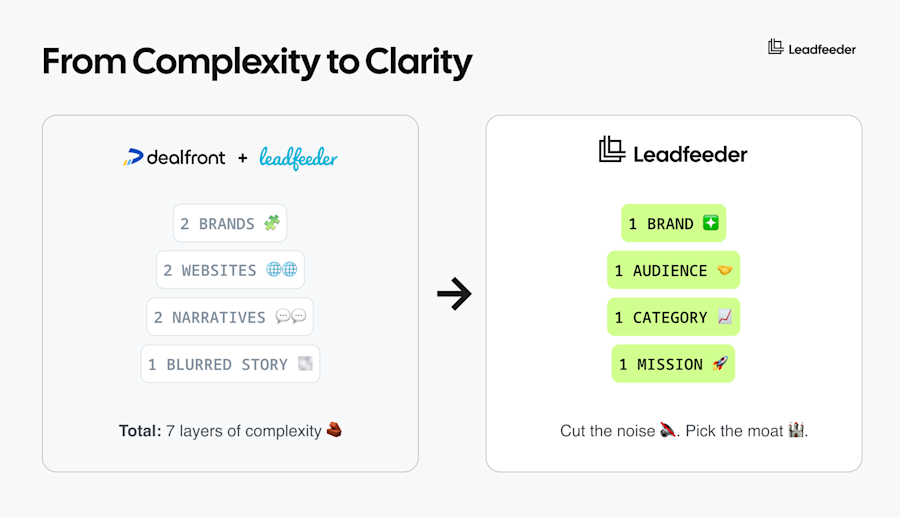
From Complexity to Clarity
With AI making everything easier to build and replicate, what is truly differentiated? What is proprietary? What is defensible? And if it’s defensible and unique -- does it help bring value to a problem customers will pay for?
So we asked a simple question: Where do our customers see the most value across our platform and data?
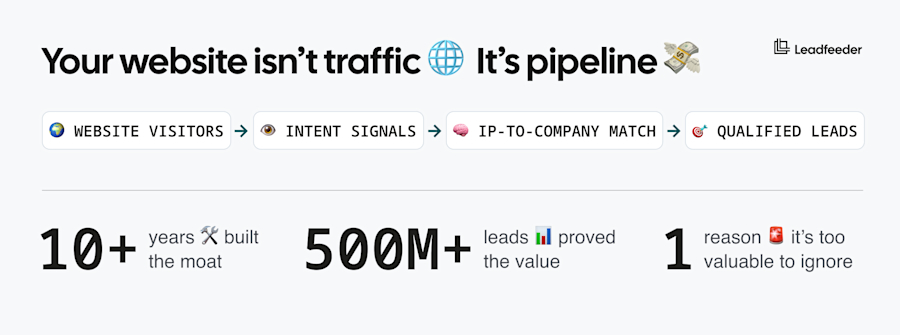
The answer was clear -- using website signals to drive better lead generation. Now more than ever, B2B marketers simply cannot afford to let intent signals from the website go ignored.
And this is anchored in our IP-to-company database built by the “original” Leadfeeder for website visitor identification. It is a differentiated asset built and refined for 10+ years. We’ve surfaced more than half a billion leads for our customers over this time. This is not something AI or our competition can replicate. And so much can be built around this signal and data.
From this insight, our strategy fell into place:
B2B marketers are under more pressure than ever to prove impact, and their website is where buyer intent is most visible. That's the opportunity.
Our IP-to-company database is the differentiated asset that unlocks it. This is our “moat”.
Marketers own the website. They become our primary customer.
Marketers care about demand and leads. Lead generation becomes our category and shapes our mission.
Leadfeeder is the brand that best carries that mission. It's in the name.
And that mission is: We turn b2b websites into lead generation engines. Backed by our proprietary IP-to-company database and leading B2B company and contact data, we help marketers drive real impact with leads that convert.
One of the most powerful validations of this direction is how universal the problem is. In any given week, I speak with customers ranging from manufacturers, to distributors, to B2B software companies. What connects all of them (regardless of industry, size, or geography) is that their website is central to how they go to market, and they need better visibility into the demand and intent flowing through it.
What’s Ahead
The Leadfeeder brand is the most visible expression of our refined direction and new positioning. But a rebrand doesn't generate value for our customers. That’s not lost on our team.
What will generate impact is the output of what went into arriving here.
Getting to a singular brand and a refined strategy aligns our company around one mission. That alignment changes how we build product, how we go-to-market, how we serve customers. If our company is pointed at the same problem, the output will improve and deliver a better experience.
It’s not just about identifying anonymous web visitors. We convert website intent signals into leads. We help optimize marketing campaign efforts. We help marketers and sales build audiences across the funnel.
What we build gets sharper. What we deliver gets more valuable. So ultimately the bet is that this moment of clarity means our customers will be the ones who benefit the most.

Kevin McIntyre CEO, Leadfeeder Boston 🇺🇸 and Turin 🇮🇹

CEO
Kevin McIntyre is CEO of Leadfeeder, where he leads the company’s strategic direction and go-to-market vision. With more than 15 years of experience in B2B technology, he has held senior leadership roles across revenue, operations, and GTM strategy at Leadfeeder, EnterpriseDB, ZoomInfo, and IBM.
Kevin has spent his career helping B2B companies sharpen positioning, improve execution, and adapt to changing market dynamics. His experience leading Leadfeeder’s evolution from Dealfront gives him a firsthand perspective on category strategy, market differentiation, and why website intent has become a critical signal for modern lead generation.