



Instead of relying on fixed campaigns, growth marketing uses insights from customer behavior and testing to identify what drives results. This allows marketers to refine targeting, optimize channels, and scale what works.
It is especially effective in fast-changing markets where customer needs and behaviors evolve quickly. By continuously testing and iterating, businesses can avoid guesswork and focus only on strategies that produce measurable impact.
In this piece, you’ll learn:
How growth marketing works and how to implement it
The difference between growth and traditional marketing
Best practices for effective growth marketing
Real-world case studies of companies applying these strategies
What is growth marketing?
Growth marketing is a data-driven, experimentation-based approach to increasing business growth. Growth in this context could mean more revenue, extra leads, or increased brand awareness.
This type of marketing shifts the conversation from “How do we attract prospects?” to “How can we retain acquired customers longer?” It uses insights gained through marketing campaigns to:
Build customer relationships
Reduce churn
Increase customer lifetime value
Additionally, growth marketing aims to generate more than one-off results. It’s not just about putting an irresistible offer in the hands of a customer and then watching revenue explode over the weekend. Instead, it’s a long-term play that involves:
Rigorous testing of what works and what doesn’t by creating hypotheses, testing them, making edits, and retesting
Learning quickly from patterns
Adapting effectively
Growth marketing embraces the trial-and-error approach, meaning marketers run their campaigns with an experimental mindset. And then, they leverage data to streamline the entire customer journey—not just the top of the funnel. The goal is the long-term, sustainable growth of startups and growing brands.
Growth marketing vs. traditional marketing
You may wonder how growth marketing is different from traditional marketing. Traditional marketing focuses on improving lead generation and client acquisition. However, it doesn’t concern itself with what happens after a prospect makes the first purchase.
On the other hand, growth marketing focuses on guiding potential customers through the entire customer journey. It steers them from awareness to retention and beyond.
Growth marketing aims to attract, engage, and convert prospects into returning customers. The goal is to create loyal brand ambassadors instead of one-time buyers. Growth marketing achieves that through excellent customer experience.
As traditional marketing emphasizes customer acquisition, growth marketing focuses on customer retention. You could also say that traditional marketing is generally company-centric, and growth marketing is customer-centric.
Core components of growth marketing
Growth marketing seeks to extend and expand upon traditional marketing, benefiting both you and your business. But what does that look like?
Key components of growth marketing include:
Acquisition concentrates on streamlining how prospects discover your brand or products. Here, companies focus on strategies to increase visibility, including search engine optimization (SEO), content marketing, advertising, and building a presence on social media platforms where prospects congregate.
Activation involves helping your target audience to take the next steps after their first encounter with your brand. Examples include signing up for a free trial and subscribing to your newsletter.
Retention involves monitoring prospects engaging with your company after being “activated.” It also comprises the implementation and optimization of loyalty programs. These efforts help maintain engagement and decrease acquisition costs. As a result, e-commerce and SaaS brands can increase their customer lifecycle.
Referral focuses on encouraging customers to spread word of mouth about your products. Growth marketers looking to increase referrals use incentives like discounts and free upgrades.
The revenue stage involves optimizing revenue generation. It includes testing pricing strategies, upselling techniques, and payment methods to skyrocket revenue.
Key growth marketing principles
Here are growth marketing best practices to streamline your strategy and get the most out of your B2B marketing campaigns.
1. Data-driven decision making
Successful growth marketing campaigns don’t rely on instincts or guesswork. Concrete data and test results should be at the heart of your actions and strategic moves. Basing your campaign on robust data yields more accurate insights and faster decision-making.
Also, data plays an essential role in customer acquisition and retention. For instance, growth marketers can create highly targeted campaigns that address prospects' needs and interests by collecting and analyzing customer behavior and preferences.
Additionally, you should leverage tools to collect and analyze data. Here are 3 types of tools you can use:
Website data collection tools:
Google Analytics can help you review the demographic and geographic characteristics of your web visitors. Engagement data, such as traffic source, page views, time on page, and bounce rate, is also available to improve low-converting web pages on your website.
Use advanced tools like Leadfeeder to gain insights into the companies visiting your website. Leadfeeder helps you identify which growth initiatives are attracting and engaging companies from your ICP on your website. For example, you can track company behavior, gain insights into their interests, and use that data to set your sales team up for effective prospecting.
Social media listening tools:
Use social media listening tools to monitor, track, and analyze conversations about your company. For instance, you can monitor direct mentions of your brand and discussions related to a topic, industry, or competitor.
Gathering data through social listening and analyzing helps you determine the best ways to improve your social media strategy and presence. Popular social media listening tools include Sprout Social, BuzzSumo, Hootsuite, and Buffer.
Data analytics tools:
Data analytics tools track and analyze data, then present actionable reports and dashboards. By helping growth marketers understand data analytics, these tools are essential in making better decisions about how to price products and where to allocate digital marketing resources. Examples include Microsoft Power BI, Zoho Analytics, Tableau, Klipfolio, and Looker. After collecting and analyzing data, let that information serve as the guiding compass for your growth marketing strategy. Use it to make data-driven decisions and expect massive results. Businesses have proven time and time again that data-driven decisions are positively effective.
So, let’s take a look at a real-world scenario:
Case Study: How Dropbox used and won with data-driven decision-making in growth marketing
Dropbox is a cloud storage service provider. Before implementing growth marketing efforts through its referral program, the organization spent between $233 and $388 on paid ads to acquire one new customer. Surprisingly, the new customer generated only $99 in annual revenue for the company.
Dropbox’s leaders knew that those numbers were not sustainable. So they dug into their data and realized that over 30% of Dropbox customers came from referrals. Leveraging this insight, the company began offering additional file storage to current and new users who participated in its referral program.
The results? In less than two years after making that data-driven decision, Dropbox grew from 100,000 users to four million without spending on ads or other paid promotions. This is a classic example of how growth marketers can use data to make decisions and drive sustained growth.
2. Experimentation and A/B testing
When result-driven growth marketers design call-to-action buttons, write email copy, or design landing pages, they don’t rely on intuition to anticipate what will make customers click and connect. Instead, they conduct experiments and A/B tests to determine the best approach to optimize their marketing plan and maximize conversions.

With A/B testing, you create two versions of a piece of marketing content and share them with different segments of your target audience to determine which performs better. The goal is to test how version A of something compares to version B of the same thing.
For example, you can email half of your selected contacts with the subject line A. Then send the same email with the subject line B to the remaining half. After a specific timeframe, the subject line with the highest open rate wins the contest.
Some of the things you can A/B test in growth marketing include:
Ads (copy, images, and color used)
Website landing pages and call to action
Marketing emails (subject line, body content, call to action, and links used)
Note: Be sure to choose specific key performance indicators to measure performance after the tests.
Case Study: How Thrive Themes used A/B testing to find the best-performing version
Thrive Themes wanted to optimize its sales page. Initially, the company used a banner highlighting product features on its landing page without testimonials. Thrive Themes decided to test whether having testimonials on its sales page could improve conversion rates.
The organization ran a 6-week A/B test with two versions of the sales page. Variant A of the experiment was the original sales page without testimonials. Variant B had two testimonials as the only difference compared to variant A. The sales page variants resulted in a 50-50 split among web visitors.
The results were quite revealing. The version with testimonials got a higher conversion rate (2.75%) than the one without (2.2%). Additionally, overall sales increased by 25%.
The key takeaway?
Never base your marketing decisions on instincts, feelings, or guesswork. Successful growth marketers rely on tried-and-tested solutions. So experiment, gather meaningful insights from the tests, and use the collected data to improve your campaigns and products.
3. Customer retention and loyalty
Most agree that retaining a customer is cheaper than acquiring a new one. Specifically, acquiring customers costs a business 6 to 7 times as much as keeping existing customers.
Investing in strategies to retain your current customers translates to a massive revenue boost. According to Hubspot, increasing customer retention by 5% can skyrocket revenue by 25–95%. That’s because retained and loyal customers spend more and buy more often than new ones. They are also more likely to recommend the business to others.
These figures justify the significance of improving customer retention. And there are many ways to achieve that:
Implement a customer loyalty program: Properly designed and managed, loyalty programs can unlock significant value, turning customers into loyal fans. For instance, Starbucks attributes 55% of its US operating revenue to its Rewards Program. The program creates value for customers through benefits like free drinks on a member’s birthday. Customers also earn rewards (stars) that they can redeem for free drinks, food, and merchandise.
Create a positive customer experience: About 94% of customers are more likely to buy from the same company after a positive user experience. So, remove friction in customer touchpoints. Ensure your website is fast and easy to navigate. Additionally, serve customers across social channels where they are engaging. Make sure customer experience is consistent in all those marketing channels.
Case Study: Sephora’s Beauty Insider Loyalty Program
Companies increasingly use customer retention strategies, like loyalty programs, because they work. Take Sephora’s Beauty Insider, for example. It’s a loyalty program that has gained significant popularity since its launch in 2007. Customers earn rewards for each purchase and can choose how to use the reward points.
People can redeem rewards for gift cards and discounts to offset purchase prices. The program offers so much value that it has over 25 million loyal members, accounting for as much as 80% of Sephora’s annual sales.
4. Personalization and targeted marketing
Businesses that understand customer behavior and prioritize personalized marketing can deliver tailored experiences that prospects truly care about. Eventually, this will increase customer acquisition and skyrocket retention.
Personalized growth marketing ensures that highly targeted campaigns meet individual customers’ interests, preferences, and needs. This helps you reach an audience genuinely interested in your offer.
Case Study: How Hulu successfully personalized its marketing
Unsurprisingly, personalization is a priority for most B2B brands. Hulu is a good example of a brand that has ramped up its personalization. The streaming platform gathered huge amounts of customer data, such as what people watch and when they stream movies, to provide the most accurate recommendations.
Hulu used the information to create a curated feed of personalized content for each user rather than recommending a random list of shows.
How to implement growth marketing in your business
Now that you understand growth marketing best practices, how exactly do you implement them in your business?
1. Build a growth marketing team
A growth marketing team helps a business use data-driven strategies to acquire, convert, and retain customers efficiently. Typically, it comprises people with expertise in marketing, data science, analytics, design, and technology. Examples of roles in a growth marketing team include:
Growth marketing manager: This position involves managing activities across all stages in the customer journey, including customer acquisition, activation, retention, and up-selling. This person is the team leader.
Growth marketer: The person in this role is also known as a growth hacker, performance marketer, or growth scientist. Responsibilities include developing new strategies and evaluating existing ones to identify opportunities for improvement. Growth marketers also conduct A/B testing, experiments, and collaborate with sales and marketing teams to brainstorm growth campaigns.
Data analyst: This person collects and analyzes data across growth marketing campaigns to help team members and leadership make informed decisions.
When building your team, you want someone with a good understanding of most marketing facets and profound knowledge in one or more areas. The skills to look for in growth marketing team members include:
Data analysis
Solution-focused
Critical thinking
Experimental skills
Creative/visual design
2. Choose the right tools for growth marketing
The marketplace is rich with marketing tools, giving businesses dozens of options when looking for software. When shopping for the right solution, consider the one that fits your workflows and growth needs.
A few popular growth marketing tools include:
Lead enrichment tools help you better understand your leads and provide valuable information for reaching them. For example, Datacare helps B2B brands review, cleanse, enrich, and optimize customer data records.
Sales prospecting tools like Target help create company profiles and lead lists. The tool allows you to access the contact information of prospects who match your company’s ideal customer profile, which can help increase sales opportunities. However, not all sales prospecting tools are created equal, so do your due diligence and choose the one that meets your needs.
Website tracking tools help you understand and interact with your website visitors in real time. You can track their behaviors on your site, gain insights into their interests, and use the data to improve prospecting in your business. Leadfeeder is an example of such a tool.
SEO (Search engine optimization) tools optimize content for search engines like Google. They can aid in keyword research, keyword optimization, and the detection of technical website issues. Examples include Ahrefs, Clearscope, and Semrush.
A/B testing tools help you design, automate, and analyze experiments in your growth marketing campaigns. Examples include Google Optimize, AB Tasty, and Adobe Target.
Email marketing and automation tools help you build lists, create campaigns, and deliver the message to your audience. Examples include Mailchimp, Constant Contact, and ActiveCampaign.
Examples of successful growth marketing
Earlier, we looked at Dropbox to discuss what successful growth marketing can look like. The company had difficulty acquiring new customers affordably (paid ads were too expensive). However, by investing in a referral program, the company's customer base grew from 100,000 to millions in just 15 months.
Miro, a digital whiteboard tool, is another good example. The company leverages growth marketing strategies to personalize and streamline the onboarding process.
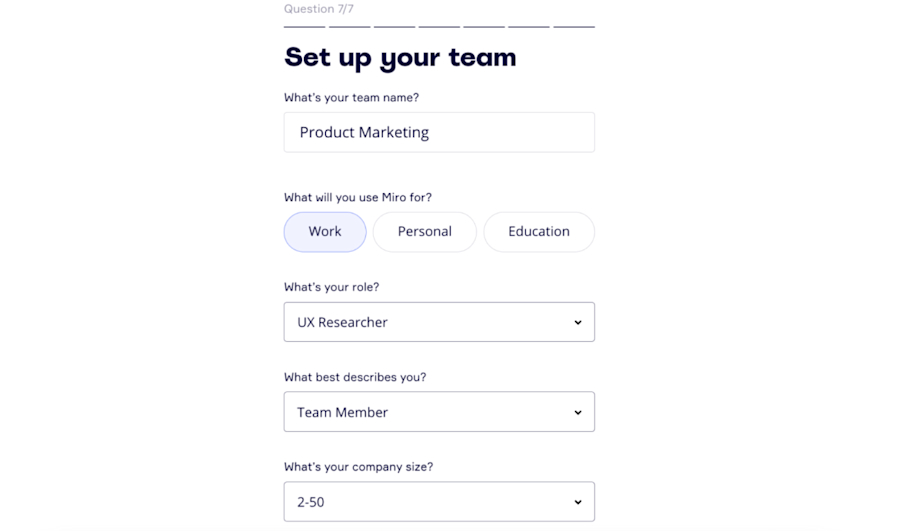
Image source: Miro
When using the tool for the first time, users get questions about their team, role, company, and how they’ll use Miro. Based on the users’ answers, Miro recommends the best templates to get started with quickly.
That way, people start using the tool immediately and finish their initial project quickly. As a result, the company increases the chances of retaining new users.
How you can move forward with growth marketing
In a nutshell, growth marketing focuses on getting customers to spend more in a single transaction or to buy more often from a business, which boosts customer lifetime value. It achieves that by building long-term customer relationships, as we mentioned before. But, for these growth marketing strategies to work, you must implement them correctly.
Growth marketing strategies, such as prioritizing customer retention, deliver better results than traditional marketing practices. Once you implement strategies that truly serve your customers and ensure they continue to serve them when their needs change, there should be no barriers to your business growth.

Win leads and close deals
Discover how the Leadfeeder platform helps build successful sales and marketing teams.
Start Free Trial
CMO
Jillian Als is Chief Marketing Officer at Leadfeeder and a B2B SaaS marketing executive with nearly two decades of experience leading global go-to-market teams. She specializes in revenue-driven marketing strategy, demand generation, and aligning marketing and sales organizations.
Throughout her career, Jillian has helped SaaS companies scale marketing-sourced revenue and build high-performing marketing teams across international markets. Her leadership experience shapes her perspective on marketing strategy, attribution, and the systems modern revenue teams use to drive sustainable growth.