Buyers today are doing their own research, forming opinions in private channels, and often are making their shortlist before you’ve even had a chance to say hello. Attention is fragmented, buyer trust is earned slowly, and sales cycles begin long before your CRM catches wind of it.
That’s where the revolution is happening. Today, go-to-market teams are having to change how they generate pipeline, shifting from noise to nuance, and from capture to creation. They’re investing in brand as much as performance, leaning into content that actually helps, and showing up where their buyers are (not just where it’s easy to measure).
“Pipeline is no longer a funnel you fill, it’s a relationship you build.” – Sam O’Brien, VP of Marketing at Dealfront
In this post, we’ll break down the top pipeline generation strategies for 2025, from modern SEO and demand gen to partnerships, PPC, and everything in between. Whether you’re refining your revenue engine or rethinking it from scratch, these are the ideas worth putting into motion.
"Leadfeeder helps us determine how our content resonates with top accounts and new companies we want to develop relationships with. It validates that our audience and industry targeting is working, and where we could invest more effort. It’s a very handy tool to have in your marketing toolset!"
1. Lead with value: content that builds trust and pipeline
There’s a quiet shift happening in the world of B2B content. The era of gated PDFs and vague thought leadership is fading and in its place helpful, honest, long-form content that solves real problems and earns real trust is rising. This isn’t content for the sake of awareness, it’s content built to accelerate pipeline, shorten sales cycles, and start meaningful conversations with the right buyers.
“Trust is the true currency of B2B marketing, and content is the tool that establishes trust”.
Jamie Pagan, Director of Brand & Content.
To cut through the noise and actually influence buying decisions, content in 2025 needs to do more than educate; it needs to earn trust, spark dialogue, and create momentum. This kind of ungated content doesn’t just build awareness, it builds goodwill. It signals confidence, generosity, and a deep understanding of your audience’s pain points. When a potential customer lands on your blog or watches your explainer video and feels seen, they’re far more likely to lean in.
This is H3
What’s more, that same insight can (and should) travel. A single helpful piece, perhaps a how-to blog or a teardown of a successful campaign, can be sliced and repurposed into social posts, short-form video, sales enablement assets, email series, or podcast segments. It’s what some content teams call “one idea, many moments.” They’re answering the exact questions their buyers are asking, then repurposing that content across blog posts, videos, social carousels, and podcasts.

“With Leadfeeder's Google Ads integration, we are not just tracking form fills but every account our ads touched—even the ones that didn’t convert right away”
And the best bit is, by doing this you’re not just filling the top of the funnel, but you’re creating a steady pattern of value that keeps your brand top of mind until the buyer is ready to engage.
2. Social proof at scale: why micro-stories outperform whitepapers
Customer stories are becoming shorter, sharper, and more authentic. Modern buyers don’t want to read a 15-page PDF to know if your product works, they just want to see it. There’s still a time and place for in-depth customer case studies, but in 2025 with fast-moving buyer journeys, short, sharp, and authentic stories are doing a lot of the heavy lifting. These human moments generate trust far faster than polished decks ever could.
We’re seeing a shift from traditional whitepapers to what you might call “micro-stories”:
A quick LinkedIn post from a delighted user
A 2-minute video capturing a real customer’s ‘aha’ moment
A screenshot of praise embedded in a product update
A quote from a Slack message turned into a carousel or testimonial tile
These moments don’t require heavy production or polish, and that’s exactly why they work; they're real, relatable, and easy to digest. For busy buyers scanning for social proof, these snippets often carry more weight than a gated 10-page PDF ever could.
We’re seeing a shift from traditional whitepapers to what you might call “micro-stories”:
A quick LinkedIn post from a delighted user
A 2-minute video capturing a real customer’s ‘aha’ moment
A screenshot of praise embedded in a product update
A quote from a Slack message turned into a carousel or testimonial tile
That matters because research shows the average B2B buyer interacts with 3-7 pieces of content before engaging with a brand. Your ability to serve up quick, credible proof points across varying channels and formats, can be the difference between being overlooked and being shortlisted. Micro-stories act as subtle nudges, building familiarity and trust over time until a prospect is ready to take the next step.
How to Engage With Open Opportunities Visiting Your Website

3. AIO is the new SEO: blending AI speed with human substance
There was a fear that AI would replace marketers, but in reality, it’s just improving them. AI is helping content teams do more and faster, but the standout marketing teams are blending automation with their human insight. They're using AI to accelerate research, ideation, and structure, then applying a human layer of experience, empathy, and editorial judgement.
“We published a short, ungated blog about a niche use case in Q1. Three months later, it landed us the largest deal of the quarter. Why? Because it spoke directly to a problem one decision-maker had, which nobody else was addressing.” – Jamie Pagan, Director of Brand & Content
Artificial intelligence optimisation (AIO) helps make that possible. Because when you're publishing with speed and substance, you create more chances to speak directly to real buyer pain, at the most optimum time.
This balance of speed and substance is fast becoming a competitive advantage. In fact, the majority of B2B marketers say they are increasing investment in AI to enhance content creation and performance. And what does that really mean? Essentially, those who are blending automation with authenticity, and creating content that feels less like a machine and more like a meaningful conversation, are putting themselves a clear step ahead of their competition.
4. Brand-led growth: buyers choose companies they know
In B2B, “brand” often gets mistaken for logos, fonts, and slide decks. But real brand power lives in something far less tangible; it’s how your buyers feel about you. It’s the reputation you build through every touch point from your content, to your team’s presence online, your tone of voice, and how consistently you show up with clarity, relevance, and value.
This is a H4 Heading Text
It can often feel that trust is scarce and noise is everywhere, and as a result, brand has become a pipeline channel in its own right. Brand isn’t just what gets you noticed, it’s what gets you shortlisted and as a result, B2B teams are having to think and act more like media companies than traditional marketers. They’re not just broadcasting polished product updates, they’re sharing consistent, meaningful perspectives on LinkedIn that buyers can relate to. They’re launching podcasts that showcase their people, not just their products, and create space for honest conversations. They’re hosting community events, AMAs, and webinars that invite participation and build trust in real time. Basically, they’re earning attention by repeatedly showing up and offering substance.
TL;DR
Only a small fraction of your market is actively buying at any given time, and chasing MQLs won’t help you reach the rest. Programmatic demand generation flips the model: it’s an always-on, account-based strategy designed to create demand, not just capture it. This article breaks down what programmatic demand gen is, why it works, how to implement it, and why it’s becoming the future of B2B marketing.
And the data backs it up: companies with strong, consistent branding see three times higher customer acquisition rates than those without a clear brand presence. But this isn’t about chasing vanity metrics or vague notions of “awareness”, it’s about building trust and familiarity long before the first sales conversation ever happens. When a buyer already recognises your voice, understands your values, and connects with your perspective, they’re far more likely to believe you can solve their problem because you already feel familiar, credible, and considered.
This is a H5 Heading Text
This is a H6 Heading Text
The takeaway? Don’t just build a brand, build a reputation. The former gets you noticed, but the latter gets you chosen.
5. Smarter PPC: personalised, precise, and pipeline-focused
In 2025, B2B performance marketing is about driving the right people to the right experience at the right time. And that means the old playbook of broad audiences and static creative just doesn’t cut it anymore. Platforms like Google Ads, LinkedIn, and paid social are more competitive than ever. Cost-per-clicks are rising, attention spans are shrinking, and buyers are savvier. Generic ebook ads and standardized landing pages don’t resonate any more, they’re just seen as old news: repetitive and ineffective.
The high-achieving teams are the ones quick to adapt. They’re embracing precision over reach and are using firmographic targeting, intent data, and behavioural insights to build hyper-relevant campaigns that speak directly to where each buyer is in their journey. This means they can:
Narrow audience criteria to focus only on high-fit, high-intent accounts
Continuously update ad creative to reflect fresh messaging, timely offers, or evolving customer pain points
Use dynamic landing pages tailored by persona, industry, or funnel stage for more relevant experiences
Align messaging to the buyer journey, ensuring consistency across awareness, consideration, and decision touchpoints
The results speak for themselves:
ROI Amplified, a PPC and marketing agency, used Dealfront’s intent and firmographic data to identify and track 60–70% of website visitors, even before they submitted a form. By integrating visitor insights with their CRM, they could refine ad targeting, prioritize high-intent accounts, and boost conversions . At scale, this meant smarter spend, more qualified traffic, and a leaner path to pipeline.
But perhaps the biggest shift of 2025 is that paid and organic strategies are finally starting to work together. Enter Search Experience Optimisation (SXO). Rather than treating SEO and PPC as separate efforts, SXO unifies them to create a seamless journey: your LinkedIn ad sparks interest, your organic search result reinforces trust, your product page seals the deal.
Buyers don’t think in channels, they think in moments, so when every touchpoint feels connected, consistent, and tailored, they move through the funnel faster. Performance marketing today isn’t about brute force, it’s about building smart systems that convert curiosity into action, and clicks into conversations.
6. Partnerships and communities: unlocking pipeline growth
We live in a hyper-connected world where growth doesn’t happen in isolation. Today it’s important to remember that building with others, through partnerships and communities, is a game changer for pipeline generation. It’s no longer just about pushing messages through your own channels but creating opportunities through co-marketing, strategic alliances, affiliate relationships, and niche communities.
"The future of B2B growth isn't about competing for attention, it's about combining forces to create something neither partner could achieve alone," says Camilo Bejarano, Associate Marketing Manager at HubSpot. "The most powerful co-marketing happens when both brands become champions for their shared customers' success."
Collaboration can be hugely powerful and even a small, focused partnership can open doors you didn’t even know existed. The real value of partnerships isn’t just reach, it’s relevance. By working with communities, resellers, and influencers, your brand gains trust and credibility through those who already possess it. When you work with people or platforms your audience already trusts, your message carries more weight. That’s why co-marketing campaigns with aligned brands often outperform standalone ones: they come with built-in credibility.
A standout example of this is the PandaDoc and Hubspot integration. PandaDoc built a deep product partnership with Hubspot’s CRM platform, making it easy for Hubspot users to create and send proposals directly within their workflows. But, beyond the technical integration, the partnership was powered by smart co-marketing with joint webinars, shared case studies, and marketplace visibility, which significantly expanded PandaDoc’s reach and pipeline within Hubspot’s user base.
"Partnerships like PandaDoc and HubSpot stand out because they represent a fundamental shift in how to think about business growth. Instead of forcing customers to adapt to disconnected tools, great partnerships adapt technology to the customer journey. When two companies unite around the principle of making business more human and efficient, they create solutions that genuinely work for how teams operate today." – Camilo Bejarano, Associate Marketing Manager at HubSpot
The rise of micro-communities on platforms like Slack, Discord, and LinkedIn presents an unprecedented opportunity for B2B marketers. These are intimate spaces where potential buyers gather, not to be sold to, but to learn, share, and connect. Showing up authentically and consistently in these environments can create genuine relationships that translate into pipeline momentum.
Here’s a simple but powerful tip to keep in mind: think of pipeline growth as pipeline through proximity. When you consistently show up where your prospects already gather, in places such as trusted communities and collaborative spaces, you build familiarity and credibility over time. This approach often proves far more effective than traditional outbound campaigns that try to interrupt or push messages from the outside.
As the proverb goes, “If you want to go fast, go alone. If you want to go far, build with others.” This wisdom perfectly captures the heart of partnership-driven growth. By investing in genuine community and collaboration, you’re not just broadening your reach, you’re cultivating a sustainable, trusted ecosystem where pipeline growth happens naturally and endures.
7. Customer marketing strategies: turn your fans into your strongest pipeline
Your existing customers are often your most undervalued and powerful sales channel. They’ve already bought in, experienced your product, and, when treated like true partners, they can become enthusiastic advocates who fuel your pipeline with high-quality leads.
Here are some proven customer marketing strategies that amplify this effect:
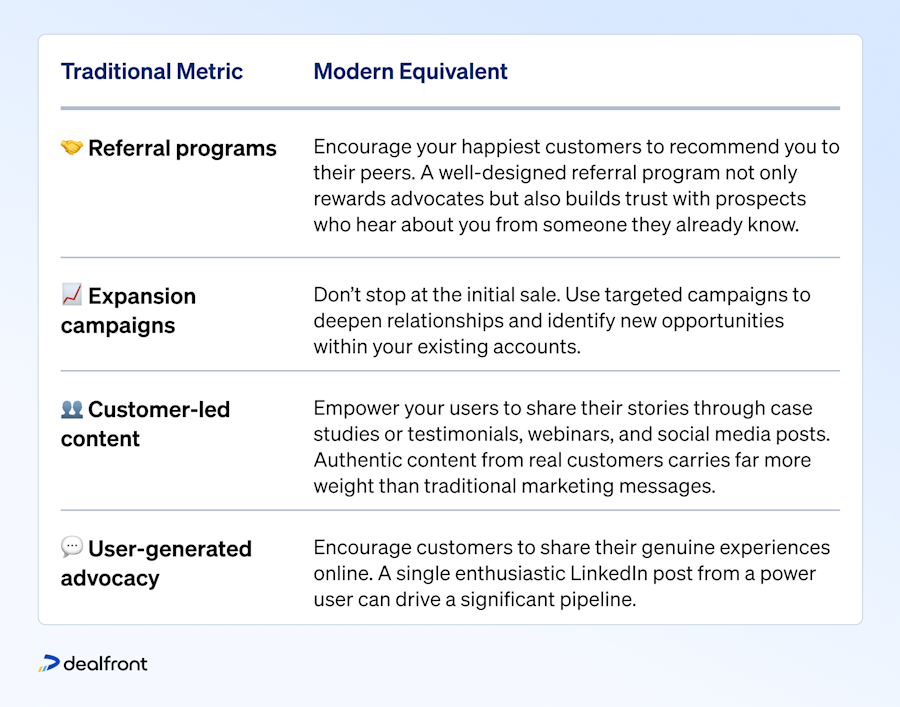
Referral programs - encourage your happiest customers to recommend you to their peers. A well-designed referral program not only rewards advocates but also builds trust with prospects who hear about you from someone they already know.
Expansion campaigns - don’t stop at the initial sale. Use targeted campaigns to deepen relationships and identify new opportunities within your existing accounts.
Customer-led content - empower your users to share their stories through case studies or testimonials, webinars, and social media posts. Authentic content from real customers carries far more weight than traditional marketing messages.
User-generated advocacy - encourage customers to share their genuine experiences online. A single enthusiastic LinkedIn post from a power user can drive a significant pipeline.
Caption: Testing image caption
Why does this work so well? According to Nielsen, referred customers are four times more likely to convert than other leads. This makes sense because recommendations from trusted peers carry an authenticity that no sales pitch can match.
Example code block:
<!DOCTYPE html>
<html>
<body>

<h1>My First Heading</h1>

<p>My first paragraph.</p>

</body>
</html>
As Nina Lampela, Customer Success Manager at Dealfront, told us, “Our customers advocate for us because we treat them like partners, not just accounts. That trust makes them want to share their success, and when they do, it brings in the kind of leads money can’t buy.”
By nurturing your customers and giving them the tools and incentives to share their enthusiasm, you’re not just boosting the pipeline, you’re creating a loyal community that grows as you do.
8. Demand generation: create demand before you capture it
Most B2B marketers now understand that there’s a crucial difference between lead generation and demand generation, but too often they’re still treated as the same. Think of it like this: lead gen is fishing with a net, trying to catch what’s already swimming by. Meanwhile, demand gen is like farming where you plant seeds, nurture them over time, and create the conditions for sustainable growth.
In 2025, to be a high-performing team you need to be investing in creating demand long before you ever try to capture it. Make sure you’re showing up with helpful, entertaining, or thought-provoking content that resonates, even before a prospect realises they have a need. Stop thinking about conversion forms, and start thinking more about connection and consistency.
Here’s how you can do it:
Social storytelling at scale - demand starts with visibility. The brands that are winning are consistently using social platforms, podcasts, and newsletters to share smart takes, behind-the-scenes thinking, and customer success stories. These aren’t hard pitches, they’re narrative breadcrumbs that build trust over time.
Owning the narrative in dark social - some of your best marketing is happening where you can’t see it: in Slack groups, WhatsApp chats, LinkedIn DMs, and private communities. This is ‘dark social’, and while it’s nearly impossible to measure directly, it’s a huge driver of influence. By creating memorable, share-worthy content, you spark conversations in these spaces, even if you’re not in the room.
Intent data: surfacing demand early - while you can’t track every share or mention, intent data can help you identify signals earlier in the buying journey. Whether it’s researching competitors, visiting your pricing page, or engaging with your brand anonymously, these subtle behaviours reveal warming interest, long before you’d ever see a form fill.

To tie it all together, here’s a simple demand gen framework that works:
In this model, you’re not chasing leads, you’re guiding momentum, and when you’re doing it right, prospects won’t need to be convinced to buy, they’ll come to you. Better yet, they’ll already be warmed up, educated, and trusting that you understand their world.
9. SEO in 2025: mastering AIO, GEO, AEO, and SXO for maximum inbound growth
SEO has evolved far beyond just keywords and backlinks. Today we’re witnessing a new era where AI and user experience shape everything. To navigate 2025 successfully, it’s essential to understand the four key pillars that are transforming search:
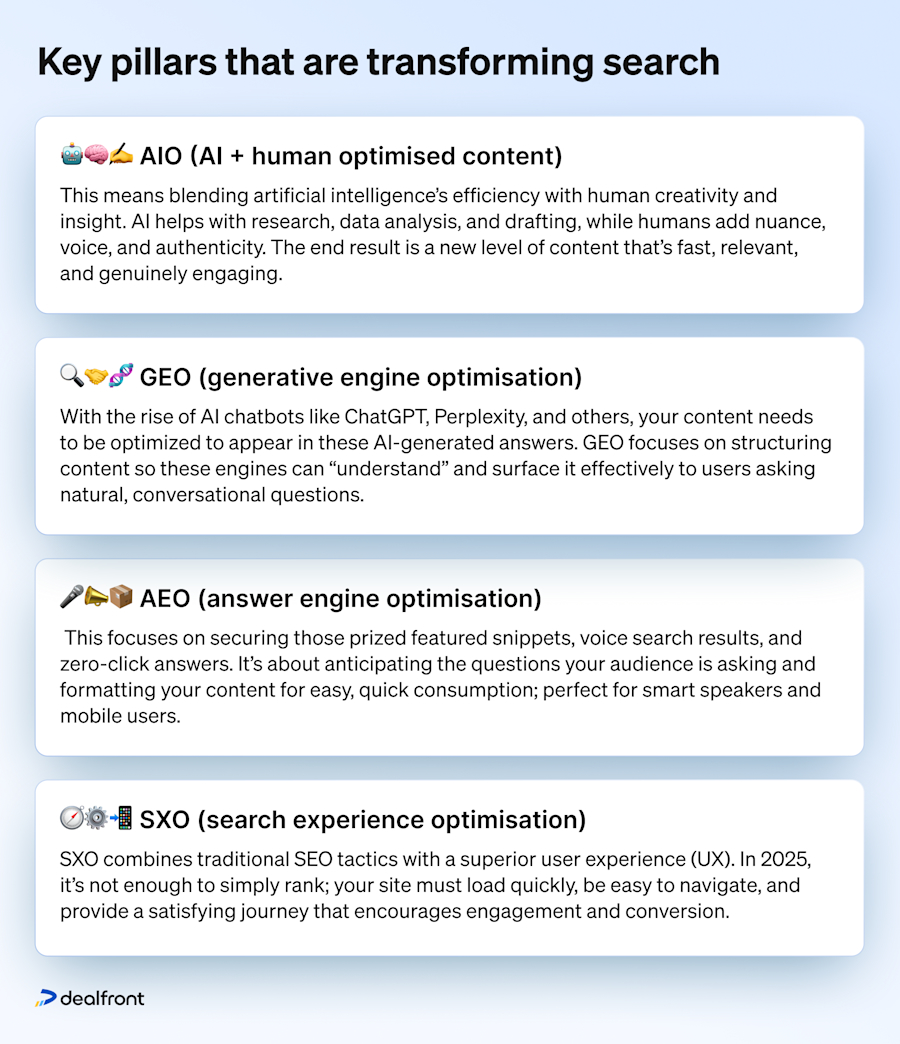
AIO (AI + human optimised content) - this means blending artificial intelligence’s efficiency with human creativity and insight. AI helps with research, data analysis, and drafting, while humans add nuance, voice, and authenticity. The end result is a new level of content that’s fast, relevant, and genuinely engaging.
GEO (generative engine optimisation) - with the rise of AI chatbots like ChatGPT, Perplexity, and others, your content needs to be optimized to appear in these AI-generated answers. GEO focuses on structuring content so these engines can “understand” and surface it effectively to users asking natural, conversational questions.
AEO (answer engine optimisation) - this focuses on securing those prized featured snippets, voice search results, and zero-click answers. It’s about anticipating the questions your audience is asking and formatting your content for easy, quick consumption; perfect for smart speakers and mobile users.
SXO (search experience optimisation) - SXO combines traditional SEO tactics with a superior user experience (UX). In 2025, it’s not enough to simply rank; your site must load quickly, be easy to navigate, and provide a satisfying journey that encourages engagement and conversion.
The key takeaway? SEO today isn’t about keyword stuffing or trying to outsmart algorithms. Instead, it’s about becoming the best, clearest, and most trustworthy answer for your audience’s questions, delivering valuable content that’s easy to find, understand, and act on. When you focus on this, both your rankings and your pipeline will follow naturally.
10. Buying signals are everywhere: act on the data you have
Not all leads announce themselves. In fact, your best opportunities are often the ones quietly circling; they’re probably comparing you to competitors, re-reading your blog posts, or lurking on your pricing page for the third time this month. These buyers are already in motion, but the question is: are you noticing them? To capitalize on these opportunities you need to stop thinking about just generating leads and start thinking about recognizing intent.
From anonymous web visits to job changes, buying signals are everywhere. But the difference lies in what you do next, how quickly you notice them, and how intelligently you respond. Dealfront customers are seeing real results by acting fast on intent. For example, Jennifer McKeon, Senior Business Development Director at JMJ, claimed:
“Additional to new business we also use Leadfeeder [Dealfront] to recognize intent signals within our existing customer base. This gives our account executives the necessary intelligence to reach their up-sell targets.”
This approach turns passive browsing into proactive conversations. To turn signals into sales momentum, ensure you’re:
Tracking high-value anonymous traffic (and enriching it with tools like Dealfront)
Setting up alerts for key intent triggers (like ICP hiring sprees or tech stack changes)
Using firmographic and behavioural data to personalise outbound outreach (not just personalise emails, but personalise entire buyer journeys)
In a saturated market, it’s important to remember that making lots of noise won’t win you the day, but being aware, agile, and first to reach out, will. You need to ensure your timing is right, your message is relevant, and the buyer is already halfway down the funnel, regardless of whether they’ve filled in a form or not.
Remember: winning in 2025 means playing the long game
There’s no single silver bullet when it comes to pipeline generation in 2025. The teams that are winning aren’t just chasing leads, they’re doing so much more. They’re building trust, momentum, and systems that scale. From content and community to SEO and customer marketing, the magic lies in alignment; every strategy you implement should work in harmony to earn attention, create demand, and nurture relationships.
If there’s one action to take after reading this post, it’s this: audit your current pipeline strategy and ask honestly:
Where are we adding real value for our buyers?
Where are we just shouting louder and hoping it works?
The companies that are winning in 2025, and the ones that will continue to win next year, won’t be the ones making the most noise. They’ll be the ones being the most helpful, the most human, and the most consistent. So, remember this: 2025 is the year we stop chasing leads and start building momentum.
FAQs: pipeline generation strategies in 2025
What’s the difference between lead gen and demand gen?
Lead gen focuses on capturing contact details (often gated), while demand gen is about creating awareness and desire for your solution, often before a prospect is ready to buy. Think of lead gen as harvesting and demand gen as cultivating.
What does AIO mean in SEO?
AIO stands for AI + human optimised content: blending the efficiency of AI tools with the nuance, experience, and trustworthiness of human storytelling and insight. It’s a growing best practice for content marketers in 2025.
Why is community important for pipeline?
Trust is the new currency in B2B. Being present in niche, trusted spaces (like Slack groups or LinkedIn communities) builds familiarity and influence far earlier in the buyer journey, often before someone ever visits your website.
How do you track pipeline from content or community?
While attribution can be murky, especially in “dark social,” you can use a combination of intent data, self-reported attribution ("How did you hear about us?"), and engagement metrics to understand what’s driving interest and conversion.
How is AI changing content marketing in 2025?
AI is reshaping content workflows, from research and ideation to optimization and repurposing. But most of the standout brands are using AI as an assistant, not a replacement. They’re pairing machine efficiency with human creativity to produce content that’s both scalable and authentic.
What’s “dark social,” and why does it matter?
Dark social refers to word-of-mouth sharing that happens in private or untrackable channels such as DMs, Slack groups, or WhatsApp threads. It’s hard to measure, but incredibly powerful. B2B buyers trust peers more than ads, so earning mentions in these spaces often leads to high-quality, high-intent pipeline.
What’s the most overlooked pipeline channel right now?
Your existing customers. Many B2B companies pour resources into cold outreach or ads but miss the opportunity to turn happy customers into advocates. A single customer testimonial or LinkedIn shout-out can generate more trust (and demos) than a month of paid campaigns.
That’s why measuring the true impact of Google Ads in a B2B context is so challenging. Clicks and conversions only tell part of the story, and that story is often incomplete. Valuable engagements go untracked. Marketing teams can’t see which accounts are warming up, let alone tie ad spend to pipeline or revenue with confidence.
This is where Dealfront comes in. With its Leadfeeder integration for Google Ads, B2B marketers gain the ability to identify anonymous website visitors, uncover buying intent, and connect ad interactions with actual business outcomes. The result? Clearer insights, smarter optimization, and a far stronger case for ROI.
The problem with B2B Google Ads tracking
B2B marketers face a fundamental mismatch between how Google Ads tracks performance and how B2B buying actually happens. While the platform is designed to deliver quick, conversion-focused insights, B2B journeys are anything but linear, or short.
B2B ad attribution falls short
Google Ads typically uses first-touch or last-touch attribution models. That means it either gives all the credit to the first click or the final conversion step, ignoring everything in between. But in B2B, those “in-between” touchpoints often represent the most meaningful moments: the display ad that sparked curiosity, the second search that drove a return visit, or the landing page read by someone else on the buying committee.
To make matters worse, Google's default 90-day attribution window simply isn’t long enough for B2B. Sales cycles can span months, or even years, and involve multiple return visits across different channels and devices. By the time a deal closes, much of the digital trail has gone cold or disappeared entirely from standard reporting.
Invisible touchpoints cost pipeline
In a typical B2B sale, multiple stakeholders will visit your website at different times. Maybe one downloads a whitepaper, another watches a demo video, and a third fills in the form. But Google Ads only logs the final form submission as a conversion, leaving every prior touchpoint unrecognized and unattributed.
Worse still, ad-driven interest often spreads via dark social channels like Slack, email forwards, or internal chat threads. These actions rarely leave a trace in your analytics, even though they’re a direct result of your campaign.
And what about the conversions that happen offline? Sales calls, product demos, or even in-person meetings that were sparked by an ad click won’t show up in your reports unless the prospect happened to complete a tracked form. That means missed attribution and a skewed understanding of what’s truly driving engagement.
Redefining B2B Google Ads Attribution with Dealfront
Traditional Google Ads tracking falls short in the B2B world—but Dealfront’s integration changes the game. By connecting your Google Ads campaigns with Dealfront’s rich account intelligence, you can finally see the full picture: who’s engaging, what’s working, and how your ads influence pipeline and revenue.
Here’s how Dealfront helps you track what really matters:
1. Identify all companies engaging with your ads
Go beyond anonymous clicks. Dealfront reveals the actual companies visiting your website after interacting with your ads, whether or not they convert. This lets you connect ad spend to real buyer interest and uncover hidden engagement from high-value accounts.
2. Discover the keywords attracting your ideal buyers
Understand which search terms are driving visits from your target accounts, not just from any user. Dealfront helps you focus budget on the keywords that attract quality traffic and real buying intent.
3. Track the full B2B customer journey
Get visibility into the entire path your prospects take, from the first ad click through to multiple site visits, content engagement, and offline interactions. Dealfront fills in the gaps that Google’s attribution models miss, especially across long, multi-touch buying journeys.
4. Monitor the behavior of multiple stakeholders
In B2B, buying decisions involve more than one person. Dealfront detects repeat visits from different people at the same company, giving you a fuller picture of stakeholder engagement and showing you when interest is building behind the scenes.
5. Extend tracking beyond Google’s 90-day limit
Your sales cycle doesn’t end in three months, and now, neither does your tracking. Dealfront links visits and activity over a much longer time frame, helping you understand the long-term impact of awareness and nurture-stage campaigns.
By bridging the gap between ad clicks and actual business outcomes, Dealfront empowers both in-house B2B marketers and agencies to prove the value of their campaigns, not just in traffic, but in revenue. With clearer attribution and deeper insight, you can optimize your Google Ads strategy for what really counts: driving growth.
How Dealfront and Google Ads Work Together to Unlock True B2B Attribution
Integrating Dealfront with Google Ads gives B2B marketers visibility they’ve never had before. It connects your ad campaigns directly with real company-level website visits, so you can finally tie clicks to pipeline.
Here’s how the integration works and how to get the most out of it.
Step 1: Connect your Google Ads account
To get started, head to Dealfront Settings → Integrations → Google Ads, and connect your Google Ads account. Within minutes, your data will begin to sync.
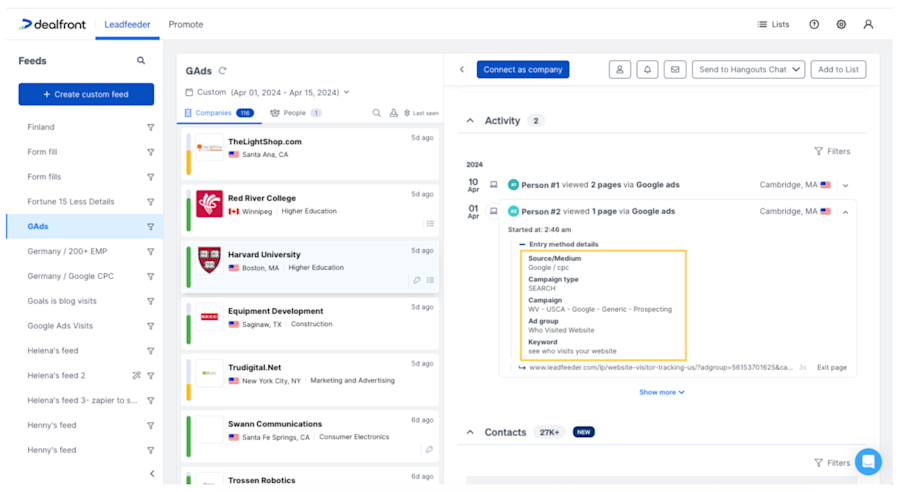
Once connected, you’ll start to see enriched campaign data like campaign name, ad group, keyword, and medium, appearing directly inside your Dealfront dashboard.
This integration allows you to:
Track how your paid campaigns influence account-level activity
Identify which companies are engaging with your ads
Use ad engagement as a powerful signal of buying intent
For any visits that originated from a Google Ads campaign, Dealfront shows:
Campaign Type (e.g. Search, Display)
Campaign Name
Ad Group
Keyword Used
You have integrated Leadfeeder with Google Ads, now what?
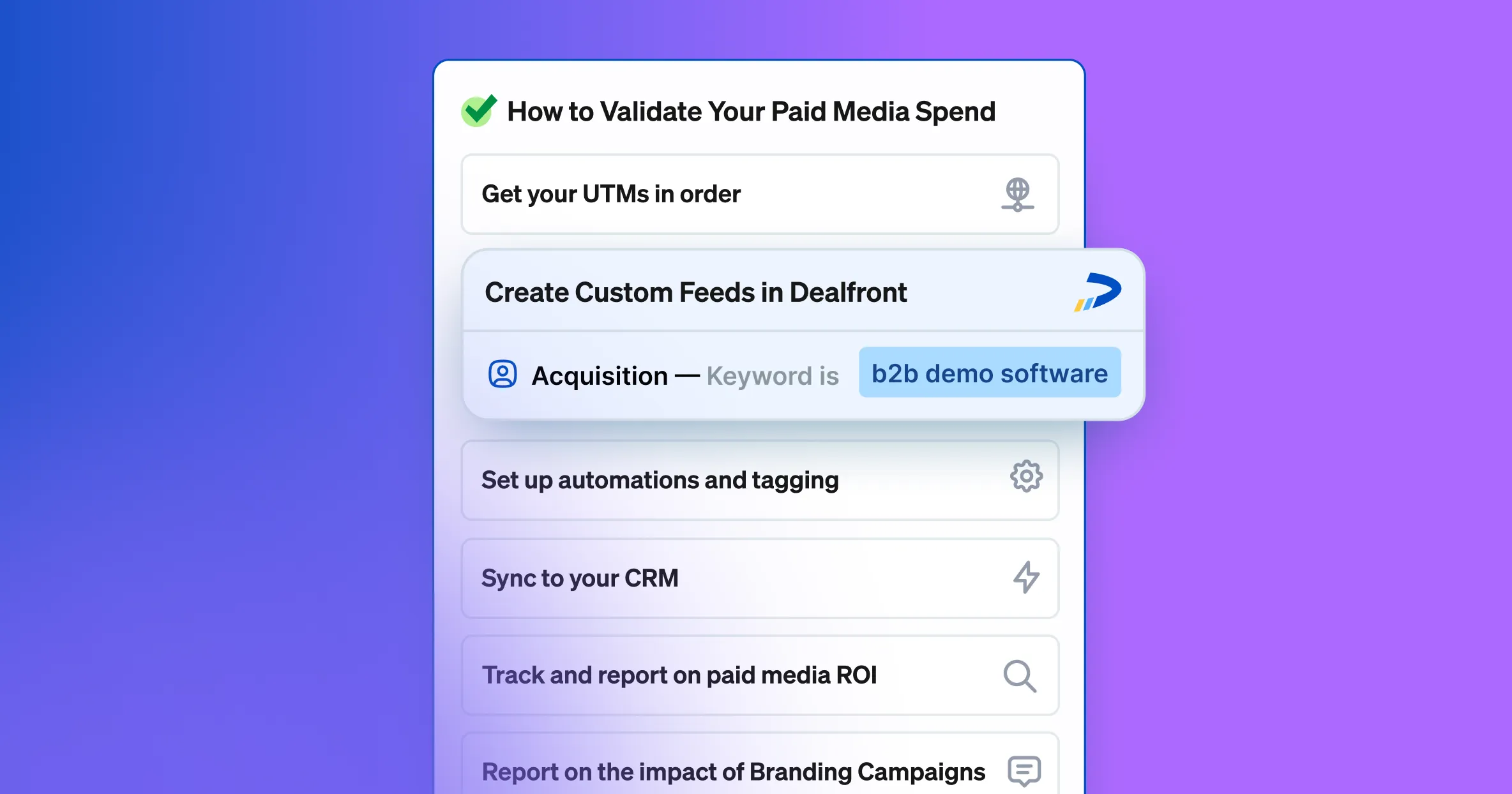
Step 2: Create custom feeds to segment Google ads traffic
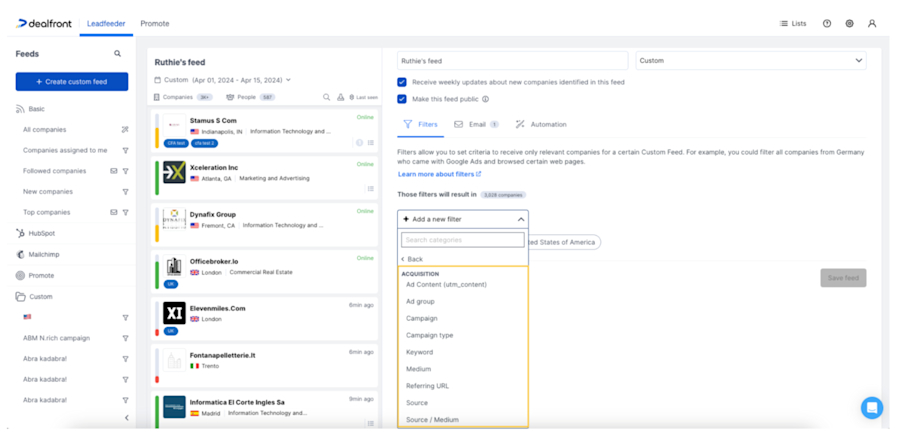
Once your data is flowing, the next step is to build custom feeds to make sense of the activity. Dealfront allows you to segment traffic using the ‘Acquisition’ filters.
Create feeds by:
Campaign Name – to track specific campaigns
Keyword – to identify high-intent search terms
Medium – to differentiate between Search, Display, and other channels
This reveals:
Which companies your ads are attracting
What content or pages they explore
Whether they return, convert, or drop off
Which campaigns drive high-fit traffic that actually moves down the funnel
Because this activity is tied to real companies, you can assess campaign quality with much greater precision.
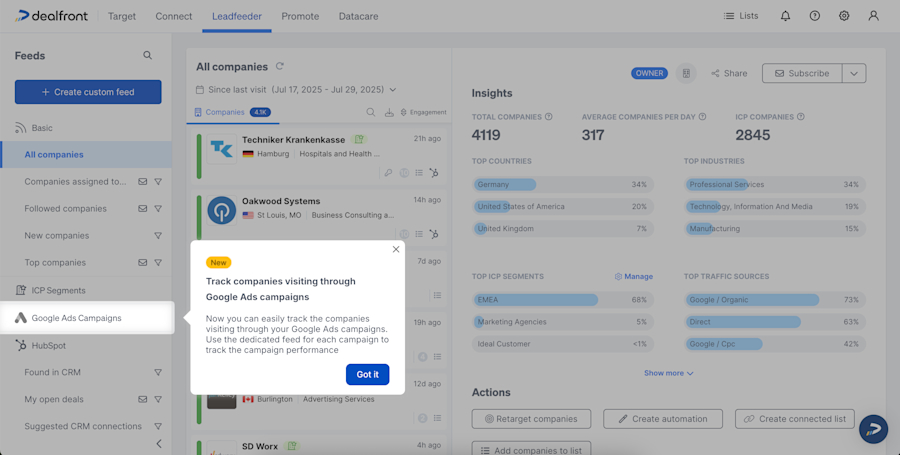
You don’t need to manually create custom feeds for every campaign. Leadfeeder will automatically generate a custom feed for each Google Ads campaign you track using the exact campaign name. This means you can instantly see which companies are engaging with specific campaigns, assess lead quality, and analyze audience fit by location, industry, and ICP segment all in one place. Access your Google Ads Campaigns folder on the left side as shown in the screenshot below.
Step 3: Four common Custom Feeds to try in Leadfeeder
Step 3.1: See if campaigns are reaching the right accounts
Problem: PPC Manager currently can only see the companies that their ads are reaching when they submit a lead. They have no visibility if their ads are reaching the right accounts so they cannot optimize the campaigns so they reach more of their target audience.
Solution: Get visibility on all the companies that are clicking on your Google Ads so you can optimize your ad spend to the ad groups and keywords that are reaching your target accounts
Feed Name: All Google Ads companies
Feed filters: All companies Leadfeeder identified with any visit from Google Ads
Step 3.2: Generate additional leads from Google Ads spend
Problem: Companies spend huge amounts of money on Google Ads but the only return they get is from the ~5% of visitors that submit a lead form. They pay for the other 95% but get no value from them.
Solution: See the companies that click on your ads but don’t convert. Send them to your sales team to follow up with, generating a secondary revenue stream from your Google Ads spend. Improving ROAS (Return On Ad Spend).
Feed Name: Non converters
Feed filters: All companies with a visit from Google Ads that did not submit a form
Step 3.3: Monitor your pipeline generated by Google Ads
Problem: In most companies the PPC manager has very little visibility of what happens to a lead once they convert on their Google Ads landing page. Even though they are responsible for return from ad spend, they often can’t track how the leads are progressing through their CRM. On top of this attribution is generally done on last click so if the Google Ads campaigns assisted in the conversion they are not given any credit
Solution: Monitor all the open opportunities in your CRM that Google Ads has influenced, even if the lead is submitted by a different person in the company or on a different device.
Feed Name: Open opportunities
Feed filters: Companies with a visit from Google Ads that have an Open opportunity in CRM
Step 3.4: Identify revenue generating keywords/ad copy
Problem: PPC Managers never have the ability to track revenue generated by won deals back to the ads and keywords that attracted in that customer. This makes it very difficult to find out which ads are generating revenue and which are generating leads that don’t convert to paying customers
Solution: With Leadfeeder you can track won opportunities right back to the campaigns/ad groups and keywords that reached that account. Giving you key insights on the buyer journey that allows you to optimize your campaign to generate more revenue.
Feed Name: Won deals
Feed filters: Companies with a visit from Google Ads that have an Won opportunity in CRM
Step 4: Go beyond Google’s 90-day attribution window
In B2B, buying journeys are rarely linear, and rarely short. It can take weeks, months, or even longer for a potential customer to go from initial click to closed deal. But Google Ads has a hard limit: it only attributes conversions that occur within 90 days of the first ad click.
This is a huge blind spot for B2B marketers. If a prospect first clicks your ad, visits your website, and then comes back three months later via a direct visit or email link, they disappear from Google Ads attribution entirely.
Dealfront solves this. By identifying the companies behind anonymous website visits, Dealfront gives you visibility well beyond Google’s 90-day window. It continuously tracks returning visits from the same company, even if the user didn’t convert the first time, enabling you to:
See the full buying journey from initial ad engagement to eventual conversion
Connect multiple touchpoints across time, channels, and decision-makers
Attribute long-cycle conversions back to the original ad campaign or keyword
For example, if a company first finds you via a Google Search ad in January, comes back in March via an organic visit, and finally fills out a form in April, Dealfront connects the dots. You can trace that conversion all the way back to the first paid click.
This extended attribution allows you to:
Prove the value of top-of-funnel campaigns that don’t convert immediately
Allocate budget more confidently to long-term plays that influence pipeline
Report on true ROI using data Google Ads simply doesn’t provide
All the usual campaign data (campaign type, campaign name, keyword, and ad group) remains accessible and filterable via Dealfront’s Acquisition filters. That means you’re never in the dark about what triggered a visit, even long after the standard 90-day clock has expired. This is an attribution that actually reflects how B2B buying works.
“Forget the obsession with MQLs and channel-specific reports. True B2B marketing effectiveness comes from understanding which companies are engaging, how they're moving through the funnel, and ultimately, how your paid spend translates directly into pipeline and revenue. We, as marketers, have to stop chasing volume and start owning our contribution to real business growth. That's the core of what Dealfront enables.” – Sam O'Brien, VP of Marketing, Dealfront
Step 5: Push ad engagement data to your CRM
Take your attribution further by syncing identified companies and ad touchpoints directly into your CRM. This allows you to:
Attribute pipeline and revenue to specific ads and keywords
Track influenced deals, not just direct conversions
Uncover offline or multi-touch influence from Google Ads
Alert your sales team in real-time when high-fit companies engage
Use CRM fields to tag and report on ad-driven opportunities
With these insights, marketing and sales teams can collaborate more effectively, focusing their efforts on the accounts showing clear intent.
By integrating Google Ads with Dealfront, you're no longer flying blind. You gain the tools to:
Uncover who’s really clicking and why
Follow complex buyer journeys across time and teams
Attribute real business outcomes to your campaigns
It's time to stop guessing and start proving the true impact of your B2B Google Ads.
What happens next: 11 ways Dealfront supercharges B2B Google Ads attribution
Integrating Google Ads with Dealfront is just the beginning. Once connected, you unlock a full suite of powerful attribution enhancements tailored specifically for the complexities of B2B marketing.
Below, we break down 11 common B2B attribution challenges and look at how Dealfront helps you solve each one. Consider these your Play for smarter optimization, better reporting, and more revenue-driven campaign decisions!
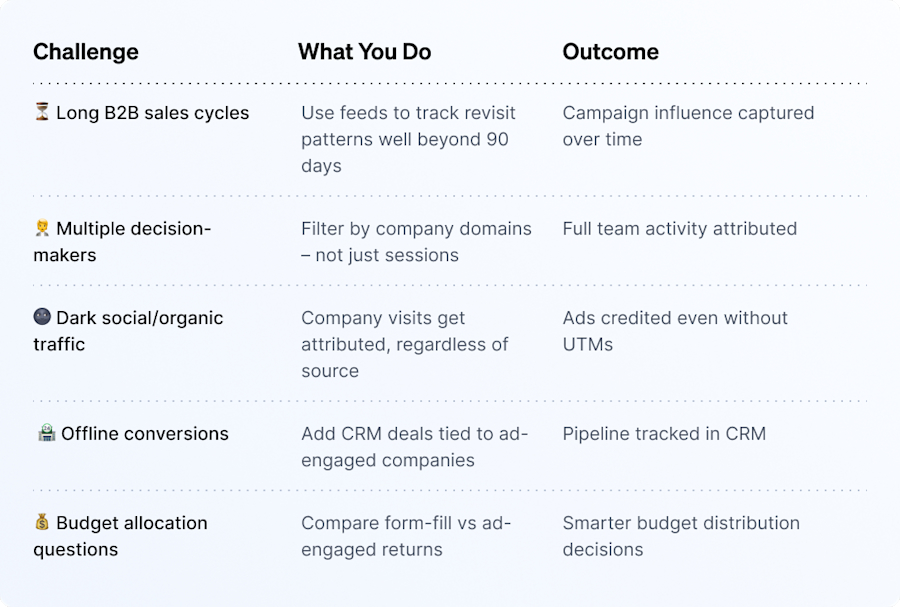
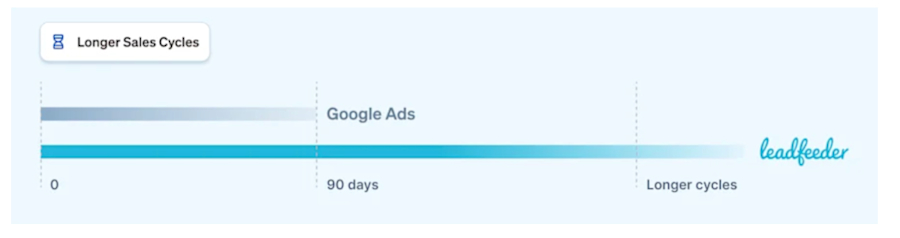
1. Longer Sales Cycles
The problem: Google Ads only attributes conversions that happen within 90 days of an ad click. That’s far too short for most B2B journeys, which often span months.
How Dealfront helps: Dealfront extends attribution far beyond Google's 90-day window. If a buyer clicks an ad in January and converts in June, you can still trace that journey back to the original touchpoint, and see every visit in between.
2. Revenue from Influenced Deals
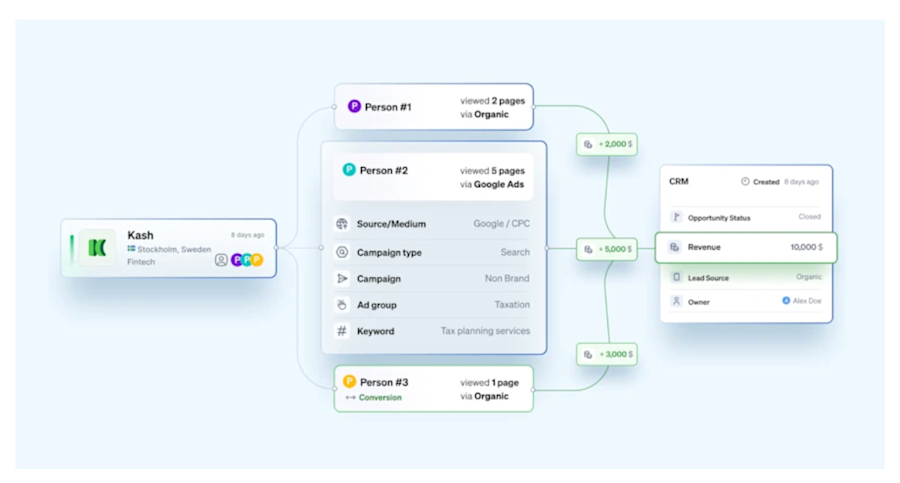
The problem: CRMs often only credit the first or last touch. If your Google Ads campaign created initial interest but wasn't the final touchpoint, it’s invisible in your attribution reporting.
How Dealfront helps: Dealfront tracks multi-touch journeys and flags ad-influenced visits. You’ll finally be able to prove the value of early-stage campaigns and how they contribute to pipeline, even if the deal closed through another channel.
3. Campaign Optimization
The problem: Google Ads data alone doesn’t tell you which campaigns are attracting the right leads, only that someone clicked.
How Dealfront helps: With company-level identification, you can see which keywords, campaigns, and landing pages bring in your ICP. Filter by industry, location, company size, or any firmographic data to focus only on what matters.
4. Multiple Decision-Makers
The problem: Most tracking is user-level, operating off one device, one cookie data. But B2B deals often involve entire buying committees.
How Dealfront helps: Dealfront shows all website activity from across the same company, even if different users visit from different devices or locations. You’ll get a full picture of buying interest from across the org.
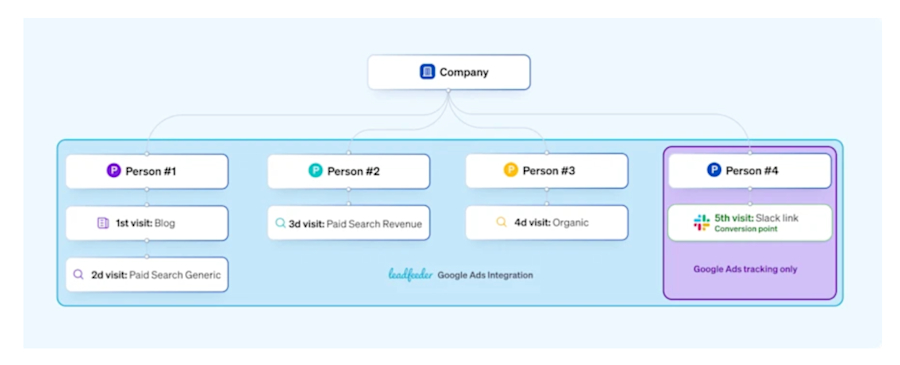
5. Multiple Touchpoints
The problem: B2B buyers rarely convert on the first visit. Instead, they research across channels and over time.
How Dealfront helps: Dealfront consolidates all visits by company, capturing the entire decision journey, from first click to final conversion. Understand which touchpoints actually move deals forward.
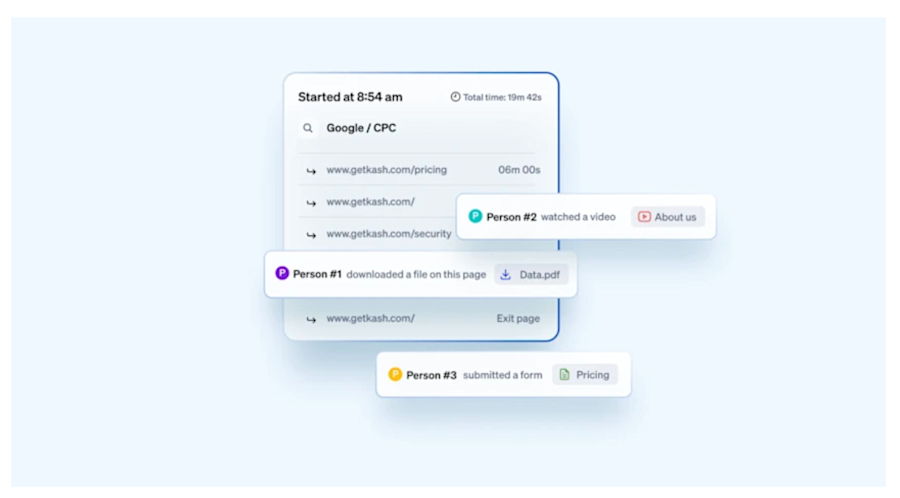
6. Data Privacy Regulations
The problem: Cookie consent banners and GDPR compliance limit traditional tracking methods.
How Dealfront helps: Dealfront uses IP-based company tracking, fully GDPR-compliant and effective even without cookie consent. That means more reliable attribution, even in regulated regions.
7. Offline Conversions
The problem: Some high-value leads don’t fill out a form. Instead they call, book a demo directly, or engage offline.
How Dealfront helps: Dealfront syncs with your CRM, matching offline deals with prior website activity, even if that activity started with a Google Ad. That way, you can still attribute revenue to the right campaign.
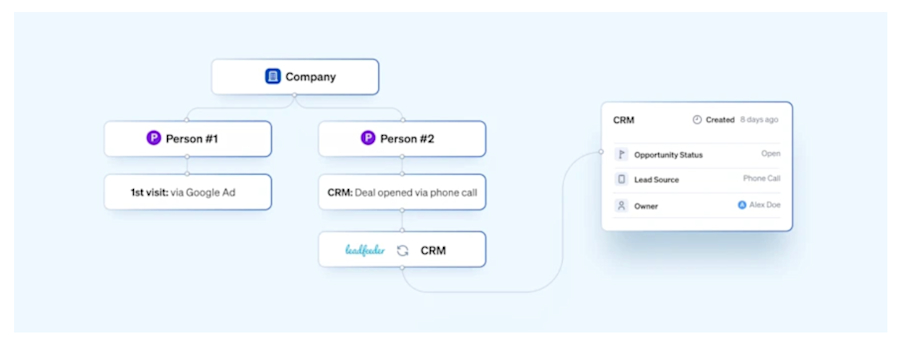
8. Low Quality Leads
The problem: Google counts all conversions equally, even if it’s a student, job seeker, or spam bot.
How Dealfront helps: Use custom feeds to filter out non-ICP traffic and focus on the companies that actually match your buyer profile. Stop wasting budget on irrelevant clicks.
9. Cross-Device Tracking
The problem: Unless a user is logged into their Google account, tracking across devices is patchy at best.
How Dealfront helps: Dealfront uses company-level IP identification, so even if a buyer starts on mobile and later returns on desktop, it’s all stitched together into one journey.
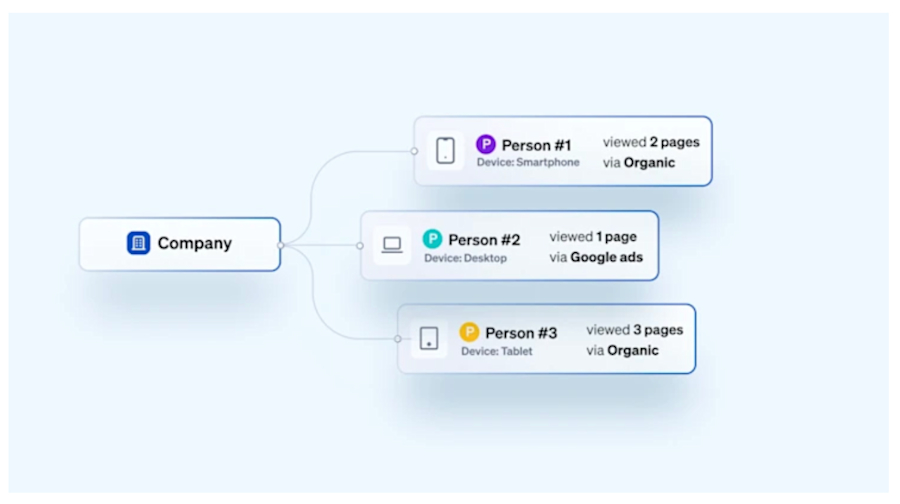
10. Awareness Campaigns
The problem: Display and YouTube ads don’t always lead to direct conversions, but they build awareness and drive future traffic.
How Dealfront helps: Even if someone doesn’t convert, Dealfront shows you which companies visited after seeing your ad, so you can measure awareness impact and retarget effectively.
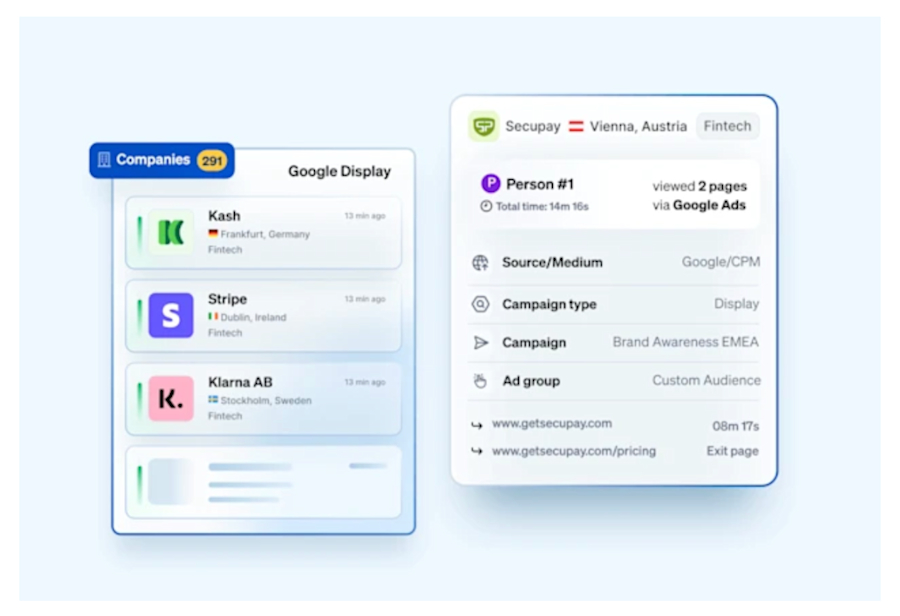
11. Outbound Sales Alignment
The problem: If a lead clicks your ad but doesn’t convert, your sales team stays in the dark.
How Dealfront helps: Surface companies that clicked on your ads but didn’t fill out a form—and send them straight to your outbound team for timely follow-up.
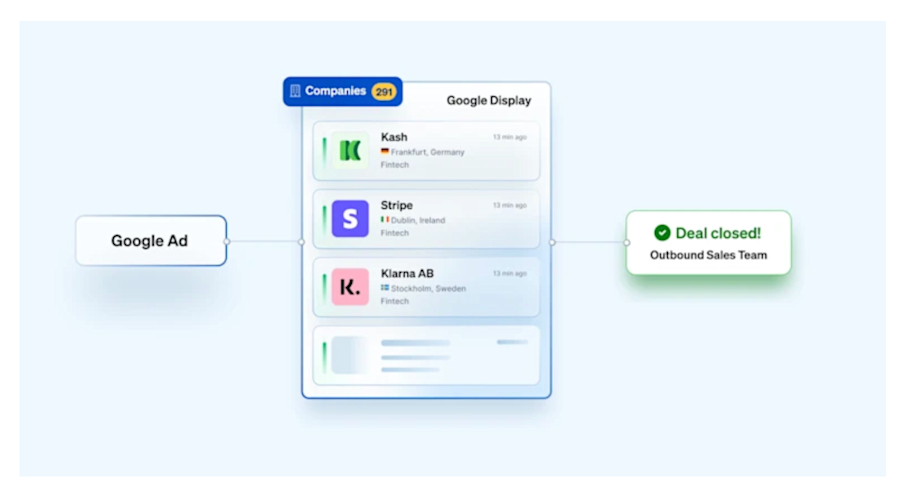
Steal these ready-made templates for B2B attribution
When a company engages with your Google Ads and visits key pages (like pricing or product pages), that’s a signal worth acting on, especially if they’re a match for your ICP. Use these alert templates to notify sales the moment it happens.
Real-Time email alert templates for Sales teams
Email 1: Follow-up after a high-intent visit from a Google Ad
Subject: Noticed your interest in [Your Solution] – thought this might help
Body:
Hi [First Name],
I saw that someone from [Company Name] recently clicked one of our Google Ads and spent time exploring our [product/service]—especially the [landing page or feature page].
If [challenge or opportunity] is top of mind, I’d be happy to send over a relevant case study or walk you through how others in your industry are using [Your Product].
Let me know if you’re open to a quick 15-minute chat.
Best,
[Your Name]
Email 2: Multi-visit engagement from the same company
Subject: A few visits from your team—can I help?
Body:
Hi [First Name],
Noticed some interesting activity from [Company Name] on our site recently—multiple visits over the past few days from your team via Google Ads.
It looks like there’s interest in [specific product/topic] based on the pages visited. If you’re currently evaluating options, I’d love to answer any questions or share tailored insights.
Would a quick call this week make sense?
Thanks,
[Your Name]
Email 3: Resource follow-up after specific keyword engagement
Subject: Resources on [Keyword Topic] for [Company Name]
Body:
Hi [First Name],
Saw that your team found us via a Google search for “[Keyword]” and spent some time exploring our [related landing page or feature].
If that’s a current focus area, here’s a resource that might be helpful:
→ [Insert link to a case study, guide, or demo video]
Happy to chat if you'd like a personalized walkthrough or have questions.
Best regards,
[Your Name]
Email 4: High-fit company clicked awareness campaign
Subject: Noticed [Company Name] engaging with our latest campaign
Body:
Hi [First Name],
Your team recently landed on our site from one of our Google Ads campaigns promoting [solution or theme]. Great to see interest from [Company Name]—you’re a great fit for what we offer.
Would you be open to a quick conversation about how we’ve helped [similar company] solve [specific pain point]?
Looking forward to connecting,
[Your Name]
Email 5: Light nurture after Display Ad click
Subject: Thanks for stopping by—something useful for you
Body:
Hi [First Name],
I noticed someone from [Company Name] visited our site after seeing one of our Google Ads recently. I wanted to share a quick resource that might help if you're exploring [topic]:
→ [Helpful asset link – not gated]
No pressure to connect, but if you'd like more info or want to chat, I’m here!
Warm regards,
[Your Name]
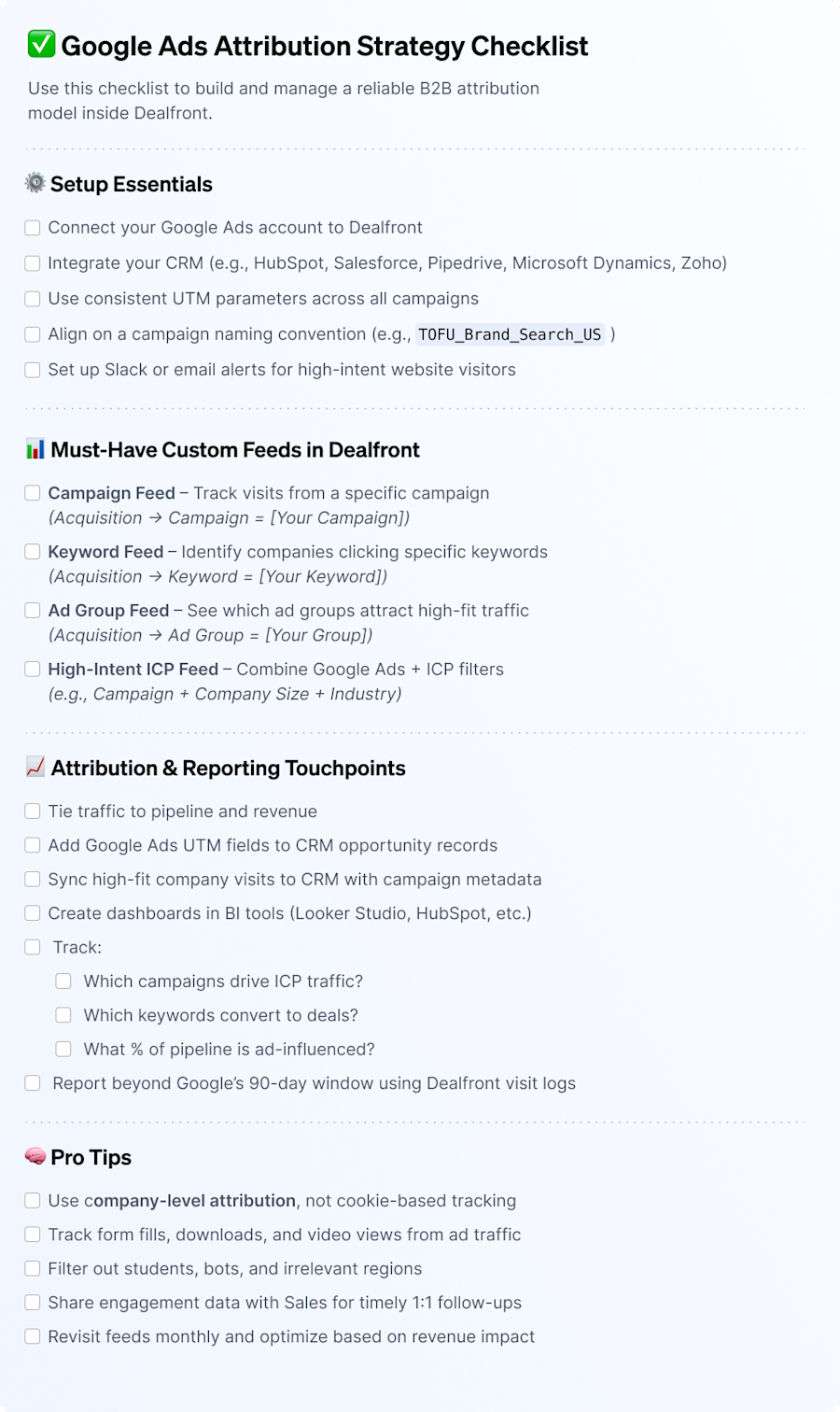
2. Google Ads attribution strategy checklist
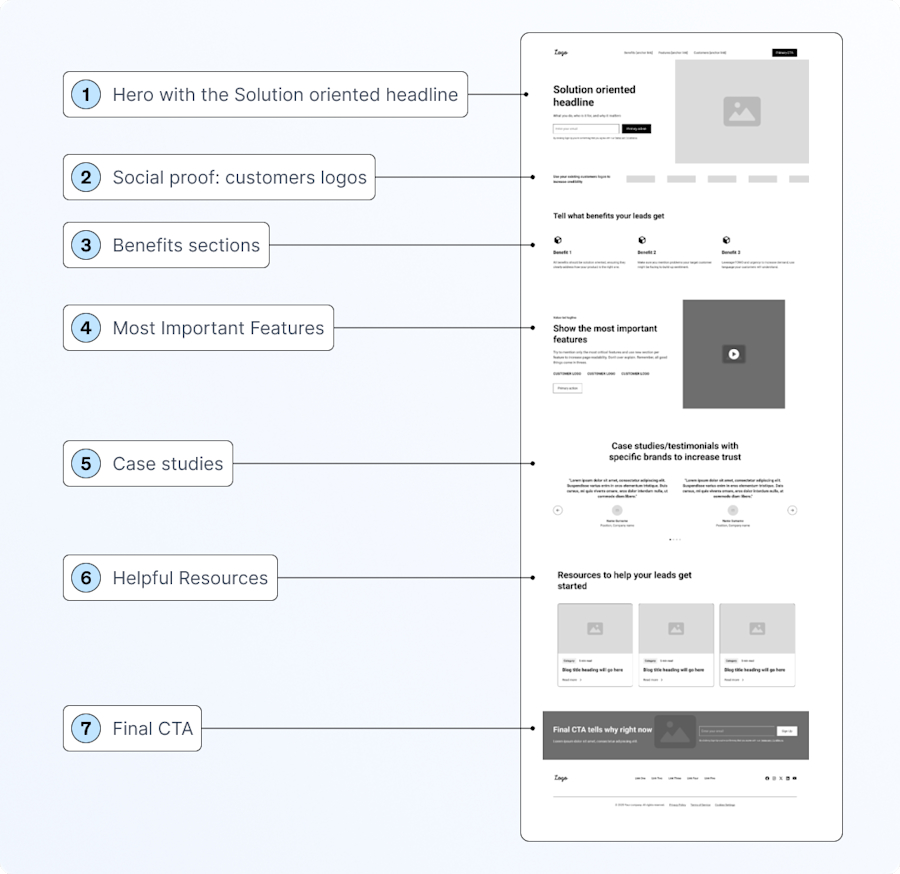
3. PPC landing page wireframe
A high-converting layout built for B2B Google Ads campaigns.
This wireframe is designed to capture qualified demand, ideal for demo requests, form fills, or hand-raisers. It follows best practices for paid search and display, balancing clarity, urgency, and trust.