60-Second Summary
B2B tech buying has gone private, multi-stakeholder, and pre-qualified by AI and peer channels—meaning traditional lead volume and form-first funnels no longer work. Focus on intent signals, role-specific proof, and measurement that ties marketing to sourced and influenced pipeline.
Key takeaways: Buyers evaluate vendors privately (AI summaries, dark social) and buying committees are large—CFOs sign 79% of deals—so prioritize intent over raw lead volume and measure both sourced and influenced pipeline.
Standout strategies & tactics: Signal-triggered outbound (intent events, pricing visits, hires), role-level content hubs (security docs, ROI models, integration guides), ABM tiering, SEO by intent clusters, and signal-based email segmentation; use tools like Leadfeeder for anonymous intent.
Real-world lessons & frameworks: Map buying committees by role, adopt a messaging hierarchy (category → value pillars → proof), align marketing-sales-product with shared SLAs and revenue plans, build a KPI tree, and favor multi-touch + self-reported attribution over chasing perfect models.
90-day action framework: Month 1 — audit ICP, buying committee, messaging and metrics; Month 2 — run one integrated, signal-triggered pilot; Month 3 — scale winners, lock dashboards, SLAs, and enrichment. Or start small: fix ICP, test one outbound signal, or activate Leadfeeder.
*This summary was created with AI assistance, using our original content.
Welcome to B2B technology marketing, where 79% of purchases need CFO sign-off, and 10-11 stakeholders have to agree before anything moves forward.
At the same time, prospects are using AI to vet vendors and hitting up private Slack groups for peer recommendations long before they ever land on your site. If they do show up, they’re already deep into their evaluation, and your marketing team is playing catch-up.
Relying on old-school lead volume doesn't work when the buyer's journey is intentionally anonymous. This guide will show you how to adapt your B2B marketing strategy to meet the new reality: focusing on intent signals to trigger outbound, building funnels that respect a buyer's desire for privacy, and proving impact even when attribution is harder than ever.
B2B Tech Buying Has Changed (And Your Marketing Must Too)
Before diving into the tactics, it’s worth looking at why the 2022 playbook is failing marketers today.
First, prospects use AI to summarize reviews and build shortlists before they click your site, the vendor evaluation phase happens without you.
Second, the buying committee is largely invisible. 70% of your traffic is anonymous thanks to cookie deprecation and privacy tools. If you're only optimizing for the people who fill out forms, you're ignoring the majority of the decision-makers.
Finally, the real vetting happens in dark social. Decisions are made in private Slack channels and WhatsApp groups where attribution can't follow. If your brand isn't being discussed there, you don't exist to them.
If you change one thing this quarter, make it this: Prioritize intent over volume. Signal-triggered outbound is the only way to stay relevant.
Long, Multi-Stakeholder Buying Cycles in Tech
The days of one decision-maker are behind us; now, modern B2B tech purchases involve more than five stakeholders on average. In large enterprises, nearly 30% of deals involve 10 or more people.
And each person at the table has different priorities; for example, IT focuses on integration and data security. Finance wants ROI. Interestingly, the CFO holds final decision-making power in 79% of purchases.
To map the decision makers you’ll be marketing to, create a buying committee map for each segment. It’s important to not let this matrix gather digital dust because it will serve as the foundation for how you build campaigns going forward. You'll know exactly what each stakeholder needs to say yes to.
Once you understand who's in the room, the next question is: how do you know if marketing is actually reaching them?
Lead Volume, Revenue & Influence
CMOs think they have a channel problem when they actually have a prioritization problem.
Nobody wants to waste time chasing a lead who downloaded a whitepaper 6 months ago. MQL-to-SQL conversion averages just 15-21% across B2B tech; top performers hit 25-35%. Which means most marketing budgets and time are spent on leads that will never convert.
This is where most funnels break: Marketing sends every form-fill to sales as an "MQL," but sales only works accounts showing real buying signals. The problem isn't lead quality, it's that sales and marketing haven't agreed on what "ready to buy" actually means.
Marketing needs to own this definition. In 2026, you set the rules for who gets sales attention using intent and enrichment data. You define the criteria:
Brands showing repeated interest across multiple touchpoints
High-intent actions like pricing page visits, multiple sessions from the same account
Trigger events like funding rounds, big hires, tech stack changes
Role-level engagement from multiple stakeholders
Sales executes within that framework, they work the accounts that meet your criteria.
Then marketing measures sourced versus influenced pipeline. Sourced means you created the opportunity from scratch - the account didn't exist in your CRM. Influenced means you touched the account somewhere in their journey, even if sales started the conversation.
Tools like Leadfeeder reveal which companies are on your site right now, even when visitors are anonymous. This lets you prioritize accounts showing buying behavior today.
So you're tracking the right accounts and measuring influence. But what are you saying to them?
Content Overload and the Need for Real Expertise
You may think more content is the answer to get more leads, but it's not. 55% of B2B content marketers struggle to create content that actually helps buyers make decisions. If your content can't answer the questions your prospects are asking their peers in private Slack channels, it won't influence deals.
One way to move the content strategy from generic to insightful is to involve your internal subject-matter experts in the content creation process. Your sales, customer support and product teams know the technical details and the questions asked in late-stage deals.
Armed with insights, your content can include specifics like security considerations and integration complexity. It’s also beneficial to learn tradeoffs because no product is perfect for every use case and pretending otherwise makes your content look naive or dishonest.
What makes B2B tech content credible:
Numbers and real scenarios
Proof (benchmarks / before-and-after comparisons/data)
Tradeoffs (when your solution does and doesn't fit)
Technical constraints (integration requirements/prerequisites/limitations)
Real examples (customer stories with implementation details)
Foundations of an Effective B2B Tech Marketing Strategy
Now you understand how your buyers think and what they need to see. Next, you need the foundation that connects your strategy with positioning, and the wider company.
Define Your ICP and Buying Committee
You can’t sell to everyone, so identify who your product is built for. Start with company size, industry, and region. Then, understand what other products are likely in their stack and their current way of solving the problem you’re trying to solve.
You also want to consider where your ICPs are in their journey. For example, first-time buyers are still deciding whether their problem is worth solving, so they need education. Switchers already know the pain, they need proof you won't create more bottlenecks.
Use the template as a start point: ICP Template:
Must-haves:
Company size: [e.g., 200-2,000 employees]
Industry: [e.g., B2B SaaS, fintech, healthtech]
Tech stack: [e.g., uses Salesforce, modern data warehouse, cloud-native]
Budget authority: [e.g., $50K+ annual software budget]
Pain severity: [e.g., current solution causing measurable revenue loss]
Disqualifiers (examples that don’t match your offering):
Heavy on-premise infrastructure (we're cloud-only)
No dedicated IT resources (needs technical implementation)
Looking for the cheapest option (we're premium positioning)
Custom development requirements (we're standardized product)
Trigger events (signals they're ready to buy now):
Just raised Series A/B funding
Hired a new CTO or VP of Engineering
Competitor announced a feature that makes them look behind
Regulatory change requiring new compliance
System migration or tech stack consolidation is underway
Messaging and Positioning Complex Tech
Your messaging and positioning should be able to explain complex tech jargon in a way that even your grandma could understand. It should also be grounded in real tangible outcomes.
Use a messaging hierarchy to help structure this:
Category narrative - (why does the world need this solution now?)
Value pillars - (the 3-4 core benefits e.g., Speed, Security, Compliance)
Proof points - (the technical specs and customer stats that back up the pillars)
Here’s an example:
Feature: "AES-256 Encryption."
Business outcome: "Eliminate data breach liabilities and pass enterprise security audits in half the time."
Align Marketing with Sales and Product
Getting everyone in the same room is nice, but real alignment will only happens when Marketing builds the infrastructure and Sales executes within it. You should act as the architect and define the logic that governs the entire revenue engine.
Once a structure is in place, Sales and CS get a roadmap to follow. Sales can focus on accounts that meet your criteria, CS leans on the post-sale content you produce, and Product loops insights back to your content and product marketers to fuel the next content cycle.
To get everyone on the same page, create:
Shared revenue plan: Define X opportunities with Y criteria
Clear SLAs: Set response times and lead quality standards
Monthly revenue meetings: Review pipeline & plan campaigns
Content feedback loops: Share case wins and buyer insights
Unified goals: Use common KIPS and terms for leads & stages
Closed loop reports: Track results and share updates
But strategy and alignment will only get you so far if your funnel doesn't match how buyers, well… buy. Let's fix that.
How to Design Your B2B Tech Marketing Funnel
We've all seen the classic B2B marketing funnel diagram: a triangle where leads fall in at the top and revenue pops out at the bottom. The old model assumes you can see and track every interaction. In 2026, you can't.
Most of your buying committee evaluates you anonymously, like using AI to compare vendors and making decisions in dark social channels you'll never access. Your leads only reveal themselves when they're ready to talk to sales, which means your funnel needs to influence buyers you can't even identify yet.
Here's how to build a funnel that works when 70% of your traffic is invisible and buyers self-educate before you know they exist.
Awareness & Problem Education
In the beginning, buyers are just figuring out they have a problem and they’re not looking for your product yet - they're trying to understand if this pain point is even worth solving.
Content to create:
Trend pieces
Guides that diagnose problems
Research reports with benchmark data
Podcasts with credible experts
Short-form social that demonstrates expertise
Distribution channels:
SEO for problem-based queries e.g. "how to reduce [pain point]"
Paid social to reach cold audiences
PR for third-party credibility
CTA best practices: Don't ask for a demo at this stage, that's too big of an ask, go for newsletter sign-ups, benchmark downloads, webinar registrations.
Consideration & Solution Exploration
Now your ICP knows that they have a problem and they're exploring solutions.
Content to create:
Comparison pieces (you vs alternatives)
Technical explainers
Webinars demonstrating expertise
ROI calculators
Interactive demos that they can explore alone
"Here’s how to choose" assets like requirements checklists, evaluation scorecards
Orchestration:
If a high-intent account watches your webinar, you need to:
Retarget them with related content
Add them to a nurture sequence
Alert your SDR if they're from a target account
Remember: all your content should have the same messaging, rather than feel like a series of random touchpoints from different departments.
Evaluation, Validation & Proof
We have to accept that a huge chunk of the buying journey is invisible, prospects are doing their research in private channels like Slack and Discord long before they fill out a form and late-stage buyers need ammunition to get their buying committee on board.
In 2026, your marketing mantra is: let's stop obsessing over perfect attribution and start obsessing over shareability.
We need to produce shareable content that a champion can drop into a team chat to prove a point. We might be blind to the specific conversation, but by watching for spikes in intent traffic, we can still time our outreach to hit right when those internal debates are heating up.
So, create content like:
Case studies from similar organizations
Reference calls with real customers
Security docs
Integration guides that show how you fit their stack
Clear POC plan
Prospects need an easy way to share content, so create a hub page with all proof assets organized by role.
Security teams want compliance docs
Finance teams need ROI analysis from similar customers
IT teams need integration guides and API docs
At this point, your content is where your alignment work pays off. Work closely with your technical team because they're in the conversations that close deals. Your content should answer the questions that get asked in those calls.
Onboarding, Adoption & Expansion
Closing the deal is really just the starting line, if you want to shed the cost center label, we have to treat retention and expansion with the same intensity as net-new business. The difference between average SaaS retention (around 74%) and elite performance (90%+) usually boils down to if Marketing packs up after the sale or stays to build the system.
Instead of leaving Customer Success to scramble for resources, Marketing should be architecting the entire post-sale journey: building onboarding flows, educational content, and automated expansion triggers.
The old playbook meant pouring leads into a leaky bucket; in 2026, marketing fixes the bucket.
Enough about funnels. Where and how do you publish this stuff?
Core B2B Marketing Channels for Technology Companies
Now that you have your content produced, you need to make it ready for distribution across your core channels.
Email & Marketing Automation
Email still works - if you stop batch-and-blasting. The average B2B email open rate is around 36%, but generic emails will get ignored or marked as spam.
Fix this with signal-based segmentation:
Persona and role (a DevOps engineer needs different content than a VP of IT)
Funnel stage (awareness, consideration, and evaluation all need different approaches)
Product interest (which solutions or use cases are they exploring)
Intent level (multiple pricing page visits vs downloaded a whitepaper six months ago)
Next, build core nurture flows, here are some examples: - Content leads who aren't ready for sales yet get funneled into educational sequences
- Trial users need onboarding and activation emails
- Dormant opportunities might respond to new insights or product updates Best practices: Time email outreach with the Sales team as to not bombard people and make sure emails are simple with plain language, role-specific proof, and a clear CTA
Social Media and Community in B2B Tech
Executives see your LinkedIn ads. But the engineers who actually vet your product get recommendations in private Slack channels and Discord servers you'll never find unless you look for them. Show up with a pitch, and you'll get kicked out. Show up to contribut,e and you might earn trust.
What works:
Slice one asset into many; turn a research report into LinkedIn carousels, short videos, and forum posts
Encourage your team to post because dev explaining how they solved a gnarly problem builds more trust than a curated brand account
Track which target accounts engage with your content and whether those touchpoints show up in closed-won deals
SEO & demand
If you only pick one channel to nail in 2026, make it SEO. Why? Because someone actively searching for a solution is infinitely more valuable than someone passively scrolling social media.
The key is to organize your keyword strategy around intent:
Keyword strategy
Don't chase bottom-of-funnel terms because that’s where everyone's competiting. Instead, cluster your keywords into:
Problem ("how to reduce X")
Solution ("tools for Y")
Category ("what is Z")
Competitor ("A vs B")
Implementation ("how to set up X")
Broad content costs less to rank for and reaches buyers before they start comparing vendors.
On-page basics
Make content scannable; nobody reads walls of text. So, include clear definitions, comparison tables, FAQs and internal links. And keep your content fresh by doing a once over of key pages quarterly.
Events, Webinars & Field Marketing
Trade shows are expensive. A booth, flights, swag, you're dropping serious budget to stand around hoping the right people walk by. Top marketers treat events as deal acceleration. The metric that matters is how many sales-accepted opportunities came out of it.
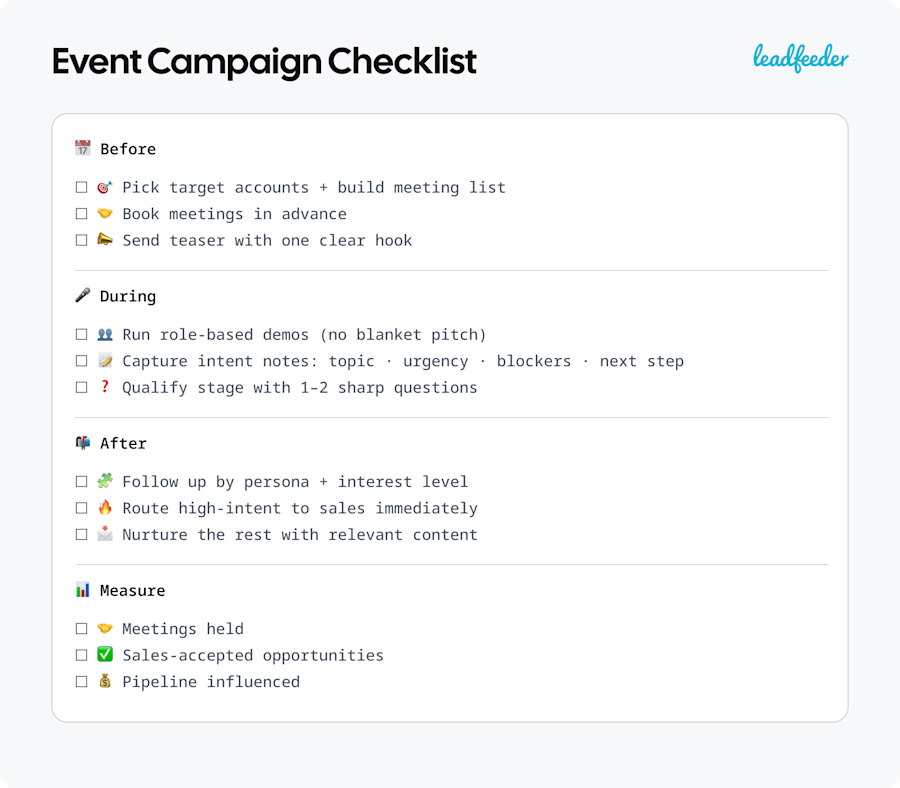
Event campaign checklist
Before
☐ Pick target accounts + build a meeting list
☐ Book meetings ahead of time
☐ Send a teaser with one clear hook
During
☐ Role-based demos (not one blanket pitch)
☐ Capture intent notes (topic, urgency, blockers, next step)
☐ Qualify stage with 1-2 questions
After
☐ Follow up by persona and interest level
☐ Route high-intent to sales fast
☐ Nurture the rest with relevant content
Measure
☐ Meetings held
☐ Sales-accepted opportunities
☐ Pipeline influenced That covers the fundamentals of your 2026 tech marketing strategy. If you're past the basics and ready to scale, here's where it gets interesting.
Advanced Plays for High-Growth Tech Companies
ABM, partnerships, and PLG all generate more data and complexity. So how do you manage it without losing control?
Account-Based Marketing (ABM)
Your ABM aim for 2026 is to treat it as a resource-allocation mode, you don’t wan to make the mistake of overinvesting in small deals or underserving whales.
To drive ROI, your team must match output to the account's potential contract value:
1:1: Reserved for your must-win accounts, you create custom landing pages, run hyper-targeted ads to their employees and coordinate highly tailored out reach.
1:Few: You create content for a segment rather than a single company, but it is still more targeted than generic marketing. Technology companies in financial services, healthcare organizations above a certain size, or companies using a specific competing product might each be a cluster.
1:Many: Applies account-based thinking to a broader target account list. You still focus on named accounts, but the level of customization is lower and automation does most of the work.
A target list based only on company size is a recipe for wasted spend. So to build a high-conversion list, layer four data points:
Firmographics - Does the company’s scale and industry match your high-value wins?
Technographics - Does their current tech stack (e.g., AWS vs. Azure) make your integration a plug-and-play or a rip-and-replace?
Intent signals - Are they actively researching your category on third-party review sites?
Trigger events - Have they recently hired a new CTO or announced a massive digital transformation?
An account-level view will change how you score leads. An individual from a high-fit, high-intent account with multiple engaged stakeholders deserves immediate sales attention, even if their actions don’t meet your MQL thresholds.
Measure your engaged accounts, opportunity progression, deal velocity and win rate.
Partner & Ecosystem Marketing
Here's what most B2B marketers miss: buyers aren't just evaluating your product, but how well it fits their existing stack. If you're not leveraging partnerships, you're making procurement harder than it needs to be.
Cloud Marketplaces: Essential for bypassing long procurement cycles by using a buyer's existing cloud credits.
ISVs & OEMs: Software partners you integrate with to create a better-together value proposition.
Channel Partners & SIs: The consultants and resellers who are already in the room advising your target accounts.
How to activate your partnerships:
Build integration landing pages
Co-create case studies featuring customers who won because of the joint solution
Treat your marketplace listing like a product page; optimize for the keywords buyers search when looking for add-ons
Before you launch anything: Agree on lead sharing, attribution, and pipeline reporting upfront to prevent confusion.
Product-Led Growth & Hybrid Go-to-Market
The right go-to-market strategy depends on how customers get value and how they buy.
65% of B2B SaaS buyers want both self-serve and human help in the same buying process. So most B2B tech companies land on hybrid eventually.
The hard part with hybrid is to get marketing and sales to coordinate on who gets the white-glove treatment and what behavior should trigger a sales follow-up. If you haven't answered those questions, your teams will step on each other, so sort this early. Finally, make sure your in product and website CTAs reflect your decisons.
Using AI, Data and Automation to Scale B2B Technology Marketing Responsibly
72% of B2B marketers say they frequently use AI tools but are figuring out where it helps most. AI won't fix a broken strategy or bad data but AI can help you move fast and reveal patterns in your data.
Where AI Works
AI is awesome for content ideation and intent detection. But don’t use it to replace thinking. 62% of frequent AI users say they "always or very often" fact-check info. Your buyers are skeptical. Your content needs human review before it goes out.
Build a Lean but Effective Tech Stack
AI only works if the foundational data it works with is harmonized otherwise, garbage in means in garbage out. A bloated tech stack will accelerate this.
Seed to Series A should keep the marketing stack minimal. Focus on CRM hygiene and one solid marketing automation platform. Adding tools before you have the processes and people to use them creates cost without return.
Growth-stage can add intent data, enrichment tools, ABM platforms and advanced measurement because they have the scale and sophistication to actually use these capabilities. For example, platforms like Leadfeeder provide intent data and visitor identification to help you activate account targeting when the buyer is most engaged.
Guardrails, Governance and Data Quality
But your AI and automation initiatives will only reap rewards with governance in place.

Cover all bases:
Data hygiene
☐ Clear ownership for each data field
☐ Standardized naming conventions
☐ Defined lifecycle stages
☐ Regular QA checks
Compliance
☐ GDPR-ready consent management
☐ Documented retention policies
☐ Answers ready for enterprise security questions
AI usage policy
☐ What content can be fully generated
☐ What requires human review
☐ What data is off-limits in prompts (especially for outbound personalization)
But all of this is useless if you can't prove it to your CFO.
Measurement: Proving Marketing's Revenue Impact in B2B Tech
Marketing budgets have shrunk to 7.7% of company revenue on average because leadership wants proof that every dollar drives pipeline. The old MQL reports won't cut it anymore. So, how do you show marketing's impact to seure next quarter's budget?
Define the Right KPIs by Stage
Different funnel stages need their own metrics:
Build a KPI tree that connects the layers:
Activities lead to leading indicators, which lead to pipeline, which leads to revenue.
Then, agree on success metrics before you launch:
Every campaign should have KPIs that leadership agrees on upfront.
What does a win look like? What's the target pipeline contribution? What's an acceptable cost per opportunity? If you debate these questions after the campaign ends, you'll lose credibility.
Attribution in Long, Complex Cycles
The average B2B journey takes 192 days and 62 touchpoints. So, which touches actually drove the sale?
One thing to leave behind this year is the pursuit of perfect attribution.
With anonymous buyers and dark social, you'll never have it anyway.. Instead, combine multi-touch data with directional insights and self-reported attribution ("How did you hear about us?"). It's low-tech but reliable.
Build a Marketing Dashboard Your CFO Trusts
Your CFO doesn't care how many impressions you got, they want to know how marketing contributed to pipeline and revenue, which means your reports need to show the same numbers they track..
1. Standardize your definitions.
What's the difference between a lead and an MQL? When does an MQL become an SQL? If marketing and sales use different definitions, your numbers will never match and nobody will trust them.
2. Enforce CRM discipline.
Required fields, stage updates, campaign association rules.
3. Build views for different stakeholders:
Not every company needs every tactic in this guide. Here's what to prioritize based on where you are right now:
Role Playbook: Marketing Strategies for Tech Companies

Early-Stage (Pre-Series B)
You can't do everything, so don't try.
Focus: Your first marketing hire should be a generalist. Bring in agencies for paid ads and SEO until you can afford in house specialists.
Content: have one ICP, offer, acquisition channel, and nurture path. Founder-led content and targeted outbound will suffice.
Scaling SaaS / Cloud Vendor
You've got product-market fit and enough data to kick things up a notch.
Focus: ABM tiers, partner motions, events, lifecycle marketing. Set up quarterly planning and campaign pods.
Content: Tie your content production to the product roadmap.
Hardware / Industrial / Deep Tech
You have long sales cycles and prospects want tech specs/compliance docs before a meeting.
Focus on: Field marketing, enablement and proof. Channel partners and SIs are a must because they're already in the room with your ICP.
Content: Translate technical specs into business outcomes without glossing over realities.
Wherever you're starting from, here's how to make progress in the next 90 days.
A 90-Day Action Plan to Upgrade Your B2B Technology Marketing
The good news is you don't need to overhaul everything to upgrade your B2B technology marketing strategy. Break it into phases:
Build a Resilient, Revenue-Driven B2B Tech Marketing Engine
Remember the MQL at the start who couldn't sign?
Use this guide so next time that happens, you've already established the relationships, content, and proof that get the whole committee jumping to say yes.
You don't have to overhaul everything at once. Pick one thing: fix your ICP definition, run one signal-triggered outbound test, or use Leadfeeder to identify which accounts are showing intent on your site right now.
Start small and see what works. Good luck!
Frequently Asked Questions
How many people are involved in a B2B tech purchase?
These days, there are 6-10 people on average weighing in on b2b ech deals: IT, security, finance, ops, procurement sometimes legal. Enterprise deals can hit 10+. Each one has different concerns and needs different proof. That's why a single decision-maker is mostly a myth now.
What's the difference between sourced vs influenced pipeline?
Sourced means that marketing brought in the account from scratch, they weren't in your CRM and sales wasn't talking to them. Influenced means marketing touched them somewhere along the way, even if sales started the conversation. Track both. MQLs alone won't tell you what's actually working.
What should a B2B tech funnel look like in 2026?
Four stages: awareness (figuring out a solution), consideration (exploring their options), evaluation (gathering proof for the buying committee) and post-sale (onboarding, adoption, expansion). Most funnels fail because they're built for how marketers want buyers to behave, not how they actually do.
Are ICP and buyer persona’s the same?
Nope. ICP is the company: size, industry, tech stack, budget etc. Persona is the person inside that company: role, goals, fears, what content they want. You need both. ICP tells you where to aim. Personas tell you what to say when you get there.
PLG, sales-led, or hybrid, how do I choose?
Depends on how fast someone can get value from your product. If they can sign up and see results in minutes, PLG works. Go for sales-led if your setup requires hand-holding. Most B2B tech companies end up hybrid: self-serve gets them in, sales helps them scale. Just make sure product and sales agree on who gets which treatment.