


Apollo.io is popular because it combines a contact database with outreach tools in a single platform. However, it isn’t always the best fit for every team. Some companies run into data accuracy issues, limited integrations, or rising costs as they scale, while others need more advanced capabilities such as buyer intent signals, account-level insights, or stronger international data coverage.
That’s why many organizations start exploring Apollo.io alternatives that better match their sales strategy and workflow.
In this guide, we compare the 10 best alternatives to Apollo.io for 2026, highlighting what each platform does well, where it may fall short, and which type of sales team it’s best suited for. Whether you’re looking for deeper prospect data, better cold outreach automation, or tools that support account-based marketing strategies, this list will help you identify the platform that fits your go-to-market motion.
Upgrade Your Sales & Marketing Skills with Dealfront’s Playbooks
Are you looking for strategies and tactical insights to elevate your GTM plays? Our Playbooks help you to sharpen your focus and drive results.
Discover Playbooks now10 Apollo.io Alternatives: A Comparison
Platform | Best For | Starting Price | Key Strength |
Leadfeeder | B2B pipeline generation | Custom | Intent data and real-time account insights |
ZoomInfo | Enterprise-level prospecting | Custom | Large database with buyer intent signals |
Cognism | GDPR-compliant international data | Custom | Mobile number accuracy and EMEA coverage |
Lusha | Budget-conscious SMBs | $36/user/month | Chrome extension and easy setup |
LeadIQ | Prospecting | $75/user/month | Real-time LinkedIn capture |
Saleshandy | Email outreach automation | $25/month | Scalable sending with deliverability tools |
RocketReach | Contact lookup and discovery | $39/month | Search filtering and export options |
Hunter.io | Email finding and verification | $49/month | Domain search and email verification |
Snov.io | Small teams with outreach needs | $30/month | Built-in CRM and affordable pricing |
Klenty | Multichannel sales engagement | $40/month | Email, phone, LinkedIn in one sequence |
1. Leadfeeder
If you're selling into Europe, chances are high you’ve had a colleague mutter something about GDPR headaches. That’s where Leadfeeder shines. If your sales team is serious about targeting the right accounts, respecting regional privacy laws, and acting on real buying signals, Leadfeeder might just be the best-kept secret in your sales stack, though not for long.
Built with a strong focus on European markets and GDPR-compliant outreach, Leadfeeder is more than just a data platform, it combines buyer intent signals, website intelligence, and account-level insights to help sales and marketing teams prioritize outreach with confidence. Unlike many tools that simply throw a big database at you, Leadfeeder helps you narrow in on your ideal customer profile (ICP) and reach your ideal customers at the right moment, with the right message.
Key features:
Intent data: Detects buying signals from web behavior
Account engagement tracking: Monitors key account activity
ICP targeting: Filters prospects based on profile fit and behavior
CRM & platform integration: Syncs cleanly with Salesforce, HubSpot, and other key tools
GDPR-first architecture: Built natively for compliant outreach in Europe
If Apollo.io is the multitool, Leadfeeder is the precision instrument, built for revenue teams who don’t want to spray and pray, but instead focus on meaningful, measurable engagement with the right companies. What really sets Leadfeeder apart is how well it supports account-based marketing (ABM) and sales-led strategies. You’re not just finding names, you’re understanding interest and readiness, then acting on it in a timely, compliant way. For go-to-market teams operating in EMEA, or any company looking for smarter, data-backed prioritisation, Leadfeeder is a standout.
Arguably, there are a few limitations; while priced competitively, there are cheaper solutions on the list, and its strongest data coverage is clearly in Europe (so if your TAM is primarily US-based, other tools might just edge it out in terms of breadth, although its US-data set is fairly comprehensive too). But what you get in return is focus, clarity, and compliance, which is a compelling trade for many modern teams.
For B2B teams that care about data quality, intent signals, and strategic targeting, especially in Europe, Leadfeeder is hands-down the best Apollo.io alternative available right now.
2. ZoomInfo
If Apollo is like a Swiss Army knife for sales teams, ZoomInfo is more like a power tool; fairly robust, precise, and built for scale. ZoomInfo is one of the best-known names in B2B sales intelligence and is geared toward larger enterprise organizations that want access to deep data and are willing to pay for it. From intent signals to predictive scoring, it’s designed to give sales and marketing teams the edge in targeting, prioritizing, and engaging accounts.
Key features:
Intent data: Tracks buyer research behavior across websites
Database size: Includes over 100 million company profiles
Enterprise features: Territory planning and predictive scoring
Contact accuracy: Uses AI and human verification methods
ZoomInfo also integrates well with platforms such as LinkedIn Sales Navigator, Salesforce, and Marketo, making it a strong option for sales motions with multiple touchpoints and high-volume outreach.
ZoomInfo has a few well-known drawbacks, particularly around cost, data freshness for smaller markets, and contract flexibility. ZoomInfo is one of the most expensive tools in the space, and pricing is custom, often requiring an annual contract, which can be a barrier for smaller or mid-market teams. Users frequently report rigid, long-term contracts that are hard to get out of. It’s also worth noting that while US data tends to be strong, accuracy in international markets, especially smaller or emerging regions, can be hit-or-miss, so European or APAC teams may not see the same value.
3. Cognism
Cognism is a sales intelligence platform focused on privacy regulations and mobile accuracy. Its database is strong in the EMEA region and includes verified mobile numbers through the Diamond Data® process. This process involves phone-based verification, so when you hit "dial," you know there's a real person on the other end.
Key features:
Compliance framework: Aligns with GDPR and CCPA requirements
Mobile data: Includes phone-verified mobile numbers
Sales acceleration: Supports outreach workflows with CRMs
Data freshness: Updates contact data on a rolling basis
Cognism is often recommended for teams that need to tread carefully with outreach laws while still wanting speed and accuracy. It works well for teams that prioritize compliant outreach and need accurate international contact data.
But remember, Cognism’s quality and compliance come at a cost. Pricing isn’t publicly listed and is typically quoted custom, but many users report it’s significantly more expensive than other tools. If you’re a smaller team or primarily selling in the US, the pricing might be harder to justify. With a more enterprise-focused approach, Cognism may be overkill for small teams or startups looking for a lightweight, budget-friendly solution.
4. Lusha
If you’re a small team doing a lot of manual prospecting on LinkedIn, Lusha might be your new best friend. It’s a lightweight contact data tool built for smaller teams that want to move quickly without overcomplicating things. Its Chrome extension makes it easy to reveal emails and phone numbers directly from LinkedIn profiles, which is perfect for SDRs living in their browser tabs.
Key features:
Chrome extension: Captures contact data from LinkedIn profiles
Contact verification: Uses a multi-step validation process
Credit system: Charges per contact reveal, with tiered limits
CRM integration: Connects with popular sales platforms
The Lusha Chrome extension is sometimes compared to the "apollo ai extension" due to similar LinkedIn functionality. Lusha works well for budget-conscious teams who primarily prospect on LinkedIn.
While Lusha is great for scrappy LinkedIn prospecting, it has a few trade-offs, including limited data depth. Compared to most of its competitors, Lusha offers fewer firmographic insights, fewer decision-makers, and less context. Similarly, it’s not built for ABM or signals-based outreach, but rather a contact grabber rather than a strategic sales engine. Be prepared for those credits to run out fast.
5. LeadIQ
LeadIQ is a prospecting tool designed to simplify lead capture and outbound outreach. It integrates with platforms such as LinkedIn, Salesforce, and Outreach to help sales reps build accurate lead lists more quickly. With features like real-time data validation and email sequencing, it’s a popular choice for SDRs looking to save time and improve efficiency during prospecting.
Key features:
Lead capture: Pulls contact data directly from LinkedIn
Real-time validation: Ensures emails are accurate before outreach
Integrations: Connects with Salesforce, Outreach, and more
Sequencing tools: Enable reps to start personalized outreach quickly
LeadIQ is ideal for sales teams that want to streamline the manual parts of prospecting and focus more on actual outreach. It helps reduce time spent on research and data entry while keeping your CRM up to date.
However, LeadIQ is more focused on top-of-funnel prospecting than deeper sales engagement or data enrichment. It lacks some of the broader intelligence features of platforms like ZoomInfo or Leadfeeder, and the contact database may be less extensive in certain regions or industries. Teams with global reach or advanced enrichment needs might find they need to pair LeadIQ with a more comprehensive data provider.
6. Saleshandy
If Apollo feels like too much platform for your needs, Saleshandy is a leaner, email-first option built for simplicity and speed. This cold email automation tool includes a B2B contact database and email sequence builder for outreach campaigns.
Key features:
Email campaigns: Send cold emails with scheduling options
Deliverability features: Includes email warm-up functions
Analytics dashboard: Tracks open rates and replies
Personalization options: Uses merge tags for customization
You won’t get massive datasets or ABM features, but if your primary goal is sending smart, effective emails without breaking the bank, Saleshandy gets the job done. It offers a free trial and affordable tiers, making it well-suited for small teams focused primarily on email outreach.
Saleshandy’s contact data isn't as comprehensive as that from platforms like Apollo, Leadfeeder, or ZoomInfo. It’s email-focused, so teams needing phone numbers, intent signals, or deep company insights will likely need to pair it with another tool. And while the UI is friendly, its feature set can feel a bit basic for larger or more advanced sales teams.
7. RocketReach
RocketReach is like the digital equivalent of flipping open a business card holder. Essentially, it’s a contact lookup platform with a database of email addresses and phone numbers. RocketReach is especially handy for reps doing ad hoc prospecting, as its browser extension works across LinkedIn, Crunchbase, and company websites, making it ideal for SDRs who like to research on the fly and grab verified contact info as they go.
Key features:
Contact accuracy: Provides verification scores for emails
Search capabilities: Filters by job title and location
Browser extension: Works on LinkedIn and company sites
Export options: Contacts can be exported to CSV files
RocketReach is often praised for its user-friendly experience and pay-as-you-go model, which is helpful for teams looking to avoid large annual contracts.
But, don’t forget, RocketReach’s focus is on contact lookup, not sales engagement. There’s no built-in sequencing, CRM syncing is limited, and some users say the data skews US-centric. For high-volume teams or those needing deep insights beyond just contact info, it might not go far enough.
8. Hunter.io
Hunter.io keeps it simple: it helps you find professional email addresses, verify them, and send basic outreach campaigns. No bells, no whistles, just clean, fast functionality that’s perfect for teams that want emails and nothing but emails.
It’s especially popular with recruiters, freelancers, and smaller marketing teams who are laser-focused on getting verified contacts without diving into full-scale sales platforms. You can search by domain, use the browser extension, or tap into their API to enrich other systems with email data.
Key features:
Email finder: Searches company domains for email patterns
Verification process: Confirms the deliverability of addresses
Campaigns feature: Sends basic outreach emails with templates
API access: Enables search from within other tools
For no-fuss contact discovery, Hunter delivers, and its clear pricing and free tier make it accessible even for solo operators. It's ideal for teams that primarily need email addresses rather than full contact profiles.
Hunter.io’s focus is very narrow, though; it’s built for email addresses only. That means, no phone numbers, no firmographics, no intent data. And while the built-in email campaigns work in a pinch, they’re not as sophisticated as the offerings you get from a full engagement platform. Great for what it does, but limited if you need more.
9. Snov.io
Snov.io is often considered the sales stack for startups. It combines a lead database, an email finder, CRM-lite features, and automation tools into a single platform, all at a price point that’s hard to beat. It’s a sales automation tool that combines a lead database, email finder, and outreach platform, and is often used by startups and small agencies.
Key features:
Email finder tools: Search by domain or individual name
Drip campaigns: Build email sequences with follow-ups
CRM features: Includes basic lead tracking functions
Technology tracker: Identifies tech used by prospects
Snov.io is one of the most frequently mentioned free or low-cost alternatives to Apollo.io. It works well for small teams that need an all-in-one solution at a lower price point and want an integrated experience without feature bloat.
However, Snov.io’s all-in-one approach means some tools are less powerful or polished than their standalone alternatives. The data quality can be patchy, especially outside common markets, and while it’s great for early-stage use, scaling teams may quickly outgrow it. It’s ideal as a starter kit, but you may soon need something more specialized.
10. Klenty
Klenty positions itself as a sales engagement platform that helps reps build multichannel sequences with smart personalization, task automation, and real-time tracking. It allows users to combine email, phone, and LinkedIn messages into a single workflow, making it a good fit for teams running account-based strategies or juggling multiple touchpoints in their outbound cadences.
Key features:
Multichannel sequences: Combines different contact methods
Personalization engine: Uses templates with dynamic fields
Team collaboration: Supports shared campaigns and roles
Analytics dashboard: Tracks engagement across channels
Klenty is especially popular with outbound teams who need flexibility, structure, and visibility. It also integrates well with CRMs like Salesforce, HubSpot, and Pipedrive, making it convenient.
But fair warning, Klenty’s data capabilities are limited. You’ll need to bring your own contacts or use a third-party tool for lead sourcing as it doesn’t offer its own contact database. Some users also find the learning curve a bit steep, especially when building more complex workflows. It’s a powerful engagement tool, but certainly not an all-in-one solution.
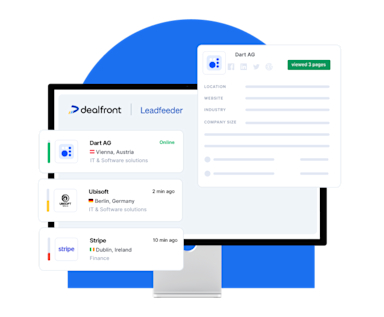
Discover accounts that are ready to buy
Prioritize your outreach when you notice buying signals from your prospects and expand your target list using machine learning.
Boost your salesHow These Platforms Compare to Apollo.io
Platform | How it Compares to Apollo.io | Potential Trade-Off |
Leadfeeder | More advanced buyer intent signals and website visitor tracking, particularly for European markets | Strongest data coverage in EMEA rather than the US |
ZoomInfo | Larger B2B database and deeper enterprise-level insights, such as predictive scoring and territory planning | Much higher pricing and long-term contracts |
Cognism | Verified mobile numbers and strong GDPR-compliant international data | Premium pricing and enterprise focus |
Lusha | Faster LinkedIn prospecting with a simple Chrome extension workflow | Less company intelligence and fewer ABM features |
LeadIQ | Real-time LinkedIn lead capture and simplified prospecting workflows | Smaller overall contact database |
Saleshandy | Better cold email automation and deliverability tools | Limited contact data compared to Apollo |
RocketReach | Flexible pay-as-you-go pricing for contact discovery | No built-in outreach automation |
Hunter.io | Best-in-class email discovery and verification tools | No phone numbers, intent data, or sales engagement features |
Snov.io | Affordable all-in-one platform with outreach automation for startups | Data accuracy can vary in smaller markets |
Klenty | Strong multichannel sales engagement across email, LinkedIn, and calls | Requires a separate tool for contact data |
Find the Platform that Fits Your Strategy Best
The right sales and marketing platform depends on the type of work a team does, the tools it already uses, and the level of detail it requires from data. Some teams rely on email outreach, others track buyer behavior across websites.
Smaller teams may choose tools that are simpler to set up and focused on email finding or outreach automation. Larger teams may look for platforms that offer data enrichment, account-level insights, or CRM integrations.
When comparing Apollo.io alternatives, it’s worth going beyond the feature list. Consider how well each platform fits into your existing workflows. Think about:
Integration options: Does it connect with the tools you already use?
Data freshness: How often is data updated?
Regional accuracy: Is it strong where your target buyers are?
Leadfeeder offers a platform that supports teams using buying intent signals and real-time account engagement. Book a demo to discover how our platform compares to Apollo.io and other alternatives.
FAQs about Apollo.io alternatives
Which Apollo alternative works best with less common CRM systems?
Platforms such as Dealfront, Saleshandy, and Snov.io offer broader integration options with niche CRM systems through native connectors or open APIs. These tools are often used by teams with custom workflows or specialized tech stacks.
How do these Apollo.io competitors handle EMEA privacy regulations?
Cognism applies GDPR and CCPA compliance frameworks, including Do-Not-Call list screening across multiple EMEA countries. Other platforms like Lusha and Dealfront also follow EU data privacy standards but with different levels of verification.
What is the best Apollo.io alternative for B2B lead generation?
Dealfront and Cognism are strong options for B2B lead generation. Dealfront excels in account-level insights and intent data for EU markets, while Cognism also offers good contact data and global compliance coverage.
Which platform is most suitable for a very small sales team with limited budget?
Snov.io, Saleshandy, and Hunter.io have straightforward interfaces and entry-level plans designed for small teams. These platforms offer basic contact discovery and outreach without requiring advanced setup or technical expertise.
What are the free alternatives to Apollo.io with meaningful features?
Hunter.io, Snov.io, and Saleshandy offer free plans that include limited email lookup, campaign tools, or contact reveals. These versions support small-scale prospecting or testing core features before committing to paid plans.
How does Apollo.io pricing compare to the alternatives mentioned in this article?
Apollo.io uses a tiered pricing model that increases with usage and feature access. Alternatives like Saleshandy and Snov.io start at lower monthly rates, while enterprise options like ZoomInfo and Cognism typically require custom contracts based on team size and data needs.
Are there Apollo.io alternatives that specialize in EU markets?
Yes, Dealfront is purpose-built for selling in Europe, offering GDPR-safe intent data and company-level insights tailored to EU businesses. Cognism also maintains strong European coverage and compliance practices.
Identify Your Total Addressable Market (TAM)
Unlock your market's full potential and prioritize the right opportunities by understanding your TAM.
Learn more
Director of Product Marketing @ Leadfeeder
Bernardo Véstia is Director of Product Marketing at Leadfeeder, where he leads product positioning, messaging, and go-to-market strategy for the platform. With more than 15 years of experience across SaaS, edtech, ecommerce, and travel technology, he specializes in translating complex products into clear market positioning and differentiated value propositions.
Bernardo has led product marketing, growth, and acquisition initiatives across global markets, working closely with product, sales, and marketing teams to define competitive positioning and market strategy. His experience evaluating marketing technology and shaping product narratives informs his perspective on how B2B teams assess tools, understand platform capabilities, and choose the right solutions for their go-to-market stack.