60-Second Summary
ZoomInfo remains a powerful sales-intelligence platform, but many teams switch due to cost, data accuracy concerns, or GDPR compliance. This roundup ranks 11 top alternatives for 2026 — led by Leadfeeder — and highlights pricing, best use cases, and where each tool outperforms ZoomInfo.
Key takeaway: Several competitors beat ZoomInfo on specific needs — intent-first workflows (Leadfeeder), GDPR-safe cookieless tracking, flexible pricing, faster time-to-value, or deeper regional coverage; choose based on whether you need real-time intent, volume, or enterprise-grade orchestration.
Standout strategies & tactics: Prioritize intent-driven platforms for real-time outreach (Leadfeeder, 6sense), layer AI scoring and enrichment (Apollo, Seamless.ai), validate GDPR status for EU sales, and lock integrations to your CRM for closed‑loop attribution and faster pipeline impact.
Real-world lessons & frameworks: Define must-haves (GDPR, integrations, budget), document what you dislike about ZoomInfo, run short trials/demos to test data freshness and setup time, and score vendors by ICP fit, TTV, data accuracy, and total cost of ownership before committing.
*This summary was created with AI assistance, using our original content.
ZoomInfo is a popular sales intelligence tool — but it’s not always the best fit in terms of pricing, data accuracy, or GDPR compliance.
Below are the 11 best ZoomInfo competitors for 2026, including Leadfeeder, Cognism, and Apollo, plus quick notes on pricing and best use cases. If Lead Forensics is on your shortlist, find out how much does Lead Forensics cost and how its pricing model compares with the best visitor identification software.
Who Are ZoomInfo Competitors? The 11 Best Alternatives for 2026
Each of the 11 tools listed below can either compete with or, in many cases, entirely outperform ZoomInfo. We’ve presented them in order, starting with the strongest overall alternative.
Disclaimer: This comparison is intended for guidance purposes only and has been provided in good faith and to the best of our knowledge using the information available at the date of publication.
All ‘Trademarks’ are property of their respective owners. We are not endorsed by, directly affiliated with, maintained, authorised, or sponsored by any trademark holder referenced herein.
1) Leadfeeder

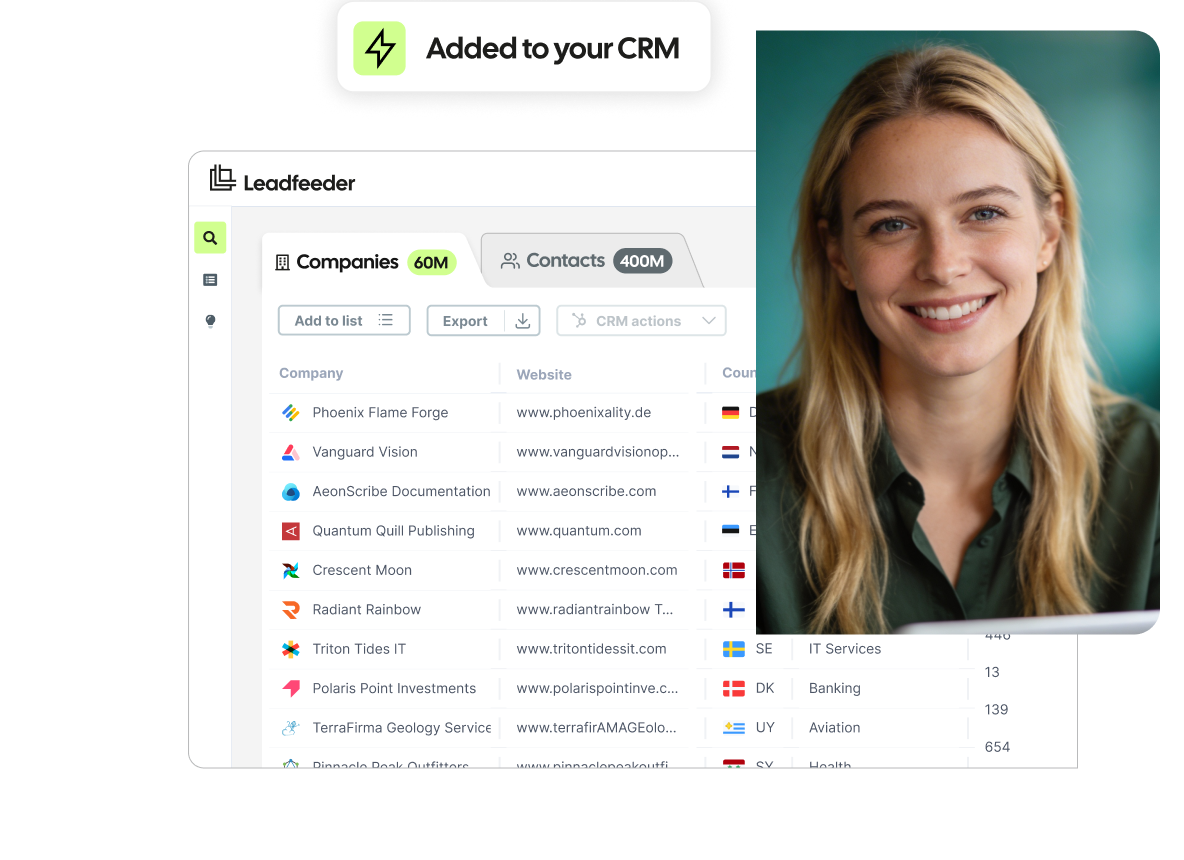
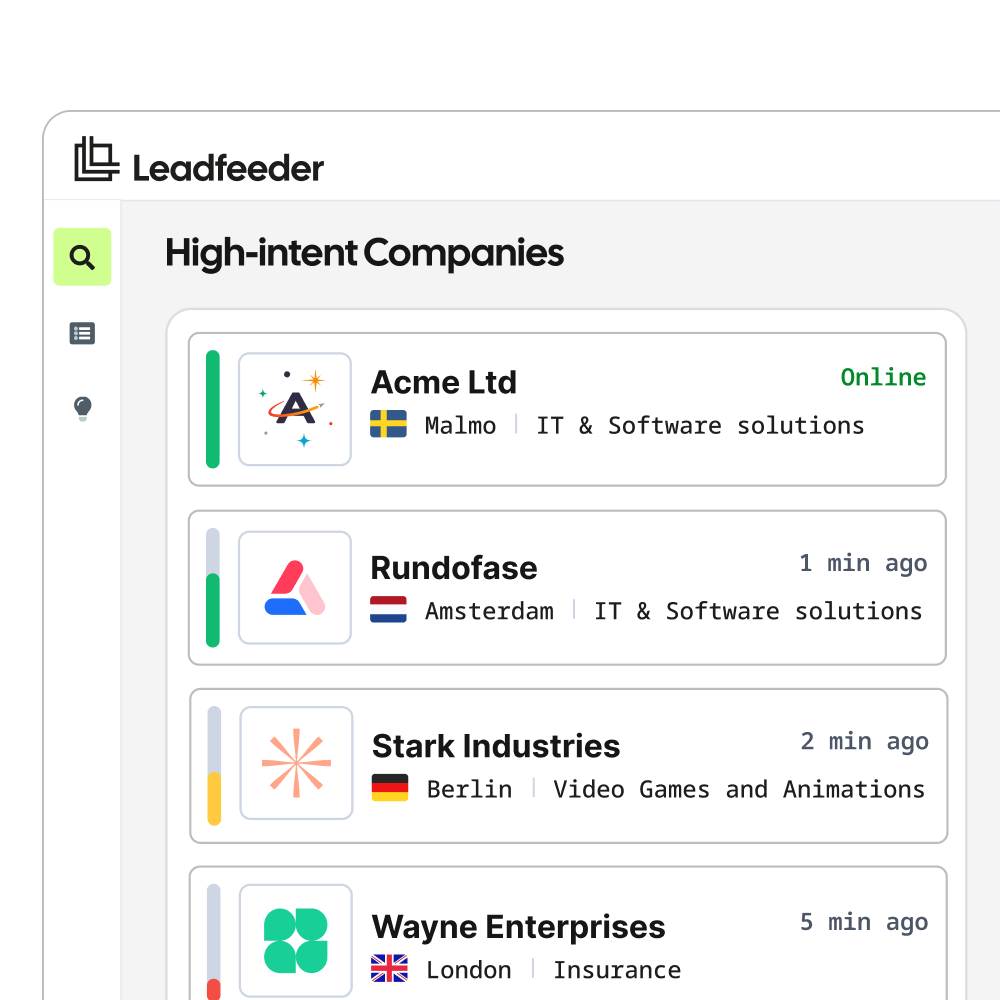
The best ZoomInfo alternative in 2026 is Leadfeeder — and not just because of the data. While ZoomInfo gives you a static contact database to prospect from, Leadfeeder takes a fundamentally different approach. It's an AI-enabled B2B website intent and activation platform — it identifies companies showing buying intent on your website, enriches them against your ICP, and turns that insight into action through automated workflows.
Here's the difference that matters: ZoomInfo tells you who you could contact. Leadfeeder tells you who's actively researching your product right now — and routes qualified leads to your sales team before the moment passes.
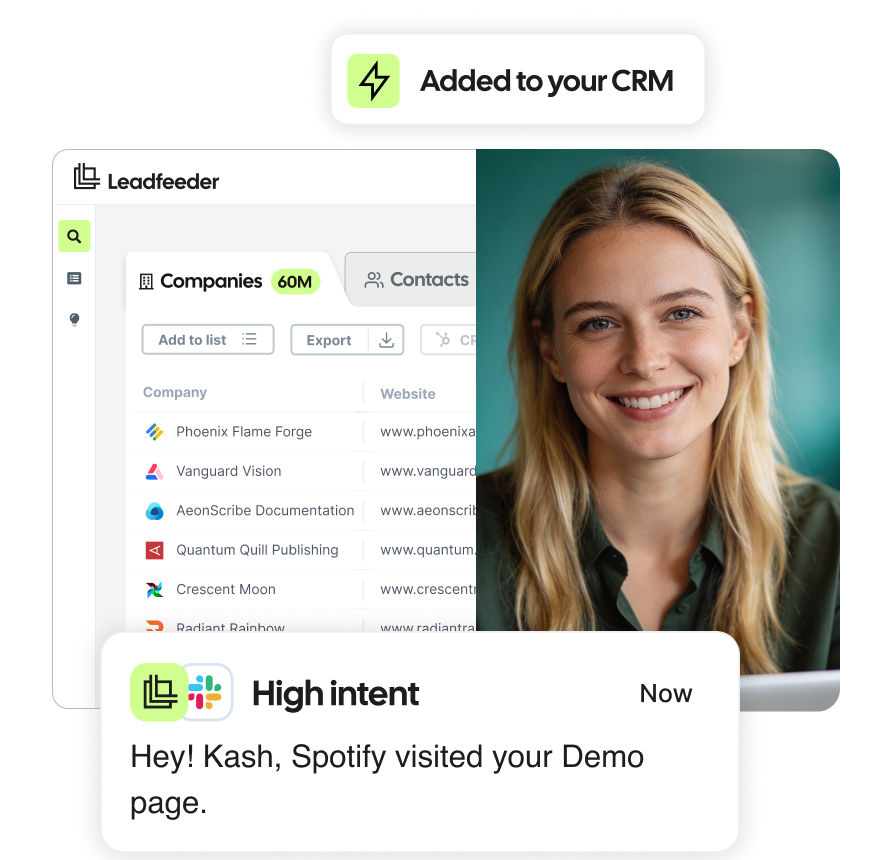
When a target account visits your site, Leadfeeder identifies the company, scores the intent with AI, enriches the profile with firmographic and contact data, and triggers the right workflow — whether that's a CRM task, a Slack alert, or an ad audience update. Your team acts on high-fit, high-intent signals, not stale lists.
Backed by a database of 500M+ leads spanning 60M+ companies and 400M+ verified contacts, Leadfeeder combines strong data foundations with an intent and activation layer that ZoomInfo simply doesn't offer. And where ZoomInfo requires lengthy enterprise onboarding, Leadfeeder delivers your first leads in under four minutes from signup.
Trusted by 15,000+ B2B companies, including Clay, Pipedrive, and Semrush.
Key Features:
Real-time website visitor identification — see which companies are on your site, even before they fill out a form
AI-powered lead scoring that ranks every visitor by buying intent
500M+ lead database: 60M+ companies, 400M+ verified contacts, 30+ trigger events
100+ ICP filters — firmographics, financials, personas, behavioral signals, and more
50+ integrations, including Salesforce, HubSpot, Pipedrive, Slack, and marketing automation platforms — with closed-loop attribution so you can prove which campaigns drive pipeline, not just traffic
Full support in 12 languages with data from multiple sources, including multilingual web crawling
Free Connect Browser Extension for prospecting directly from LinkedIn and company websites
Advantages vs. ZoomInfo:
Intent-first approach: See who’s researching you now, not just who exists in a database
4-minute time-to-value vs. ZoomInfo’s enterprise onboarding process
Fully GDPR-compliant with cookieless, privacy-first tracking — critical for teams selling in Europe or to privacy-conscious buyers
Data integrity across your entire GTM motion — clean, enriched, and automatically synced to your CRM
Flexible pricing without ZoomInfo’s long-term enterprise contracts
Multiple award winner across regions
Pricing: Plans start from €79/month (billed annually). Start with a free 14-day trial — no credit card required — or book a demo for a custom quote.
2) Cognism
Since it focuses on helping you connect with more prospects, Cognism often comes out ahead in the Cognism vs. ZoomInfo comparison.
This B2B data provider sources information from multiple markets to give you a complete overview of your potential future clients. Cognism also helps you reach out to your prospects with mobile numbers and similar details for easier connections.
Features:
Sales prospector that combines firmographic, technographic, and buyer intent data
Integrations with popular tools like Salesforce and HubSpot
Highly accurate mobile numbers
Advantages:
All data is manually checked, so you can rely on it
The volume of data available means you get a full picture of your targets
Great coverage of data
Disadvantages:
Much more geared towards B2B companies than B2C ones
Pricing: Much like Leadfeeder, Cognism offers custom pricing packages
3) Apollo.io
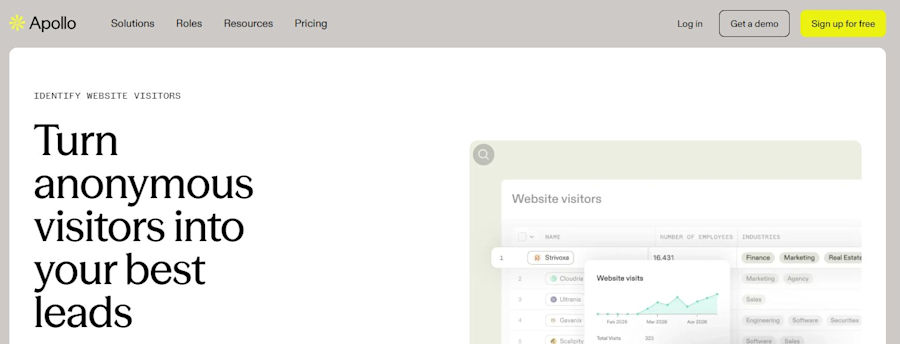
Plenty of people choose Apollo.io as their favorite alternative to ZoomInfo, largely because their databases are of a similar size (and that size is huge). Much like ZoomInfo, Apollo helps you connect with plenty of leads.
Apollo comes with a built-in AI that automatically sorts out the most promising leads. It does this by scoring leads against your ideal customer profile, so you can choose from the prospects that look the most likely to want to buy from you.
Features:
Predictive analytics that score leads so you know where to focus your efforts
Four CRM integrations to choose from
A Chrome extension for accessing Apollo from anywhere, anytime
Advantages:
Huge phone and email databases, meaning there’s potential for lots of customers
Multiple attribute-based search filters to let you search for exactly what you want in Apollo’s databases
AI support to help you shorten your sales cycles and focus on the best leads
Disadvantages:
Not as feature-rich as the top three options in this list
UI isn’t entirely intuitive; it takes time to master the more complicated features
Pricing: Apollo offers a free package, plus pricing plans at $49/month, $79/month, and $119/month, depending on your needs
4) Lead411
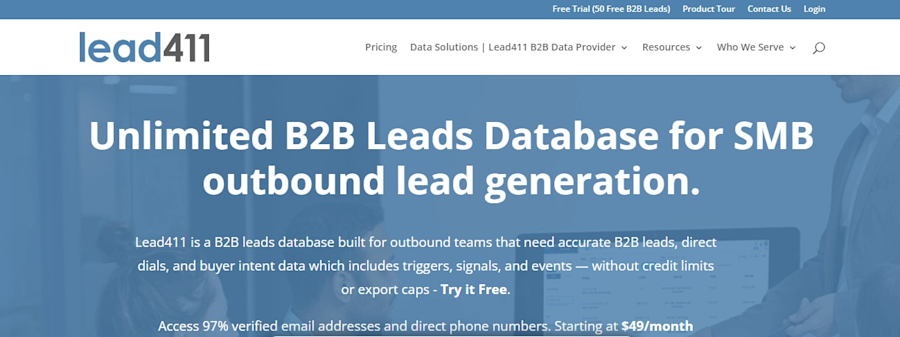
A popular and versatile sales intelligence platform, Lead411 is a robust alternative to ZoomInfo. In addition to being more cost-effective than ZoomInfo, Lead411’s data is more accurate, despite the fact that its total volume of data is less than ZoomInfo’s.
Features:
Data on customer intent is included with Lead411, letting you develop a richer understanding of your prospects
B2B email lists to connect you directly to the most valuable customers
28 CRM integrations for full flexibility
Advantages:
Lead411 has no limits on the availability of its B2B data
Offers growth intent data, outreach capabilities, and a seamless Chrome extension
More cost-effective than ZoomInfo, with flexible pricing options and a free trial
Disadvantages:
No readily available information on data security and/or GDPR compliance
Pricing: Lead411 offers a free trial and has updated its plan structure. The Spark plan starts at $75/user/month (billed annually) with 200 exports/month. The Ignite plan adds Bombora intent data and growth intent triggers at custom pricing starting around $3,000/year. Enterprise (Blaze) pricing is custom. (Verified April 2026)
5) Lusha
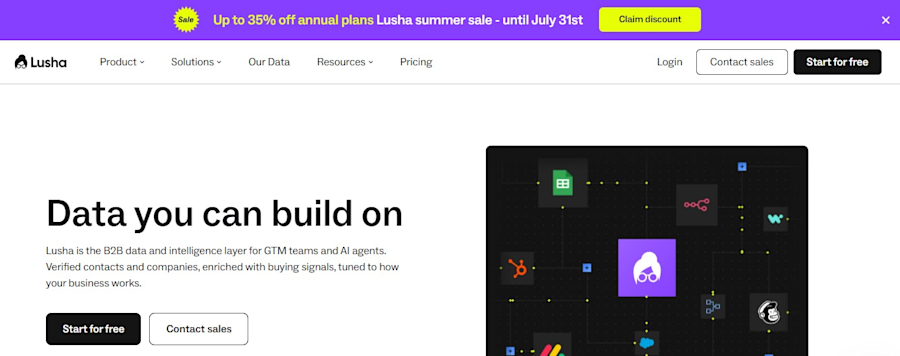
If you are mainly looking for a sales prospecting tool, Lusha is worth considering. This ZoomInfo competitor makes it easy for users to create custom lists of prospects, which include those prospects’ emails and phone numbers, so you can effectively target the people who are most likely to want to become your customers.
Features:
A Google Chrome extension that lets you crawl LinkedIn and company websites
Six CRM integrations
12 tracked contact attributes, so you can get rich insights into your future customers’ identities and preferences
Advantages:
Very cost-effective, especially compared to ZoomInfo
Data is global, with a particular focus on EMEA regions
Suitable for small businesses, not just major enterprises
Disadvantages:
Lusha isn't the most beginner-friendly option — it has a steeper learning curve than some alternatives on this list.
Advanced features are available on higher tiers or custom plans. e
Lusha is a US-based company. The French data regulator CNIL investigated Lusha in 2022 and found its extension fell outside the GDPR scope at that time. However, Italy's Garante launched a fresh investigation in April 2025 following complaints about unsolicited contacts linked to Lusha-sourced data. If GDPR compliance is a priority for your team, verify Lusha's current regulatory status directly before purchasing
Pricing: Lusha offers a free plan (70 credits/month), a Pro plan at $22.45/user/month (billed annually), a Premium plan at $52.45/user/month (billed annually), and a custom Scale plan. (Verified April 2026)
6) UpLead
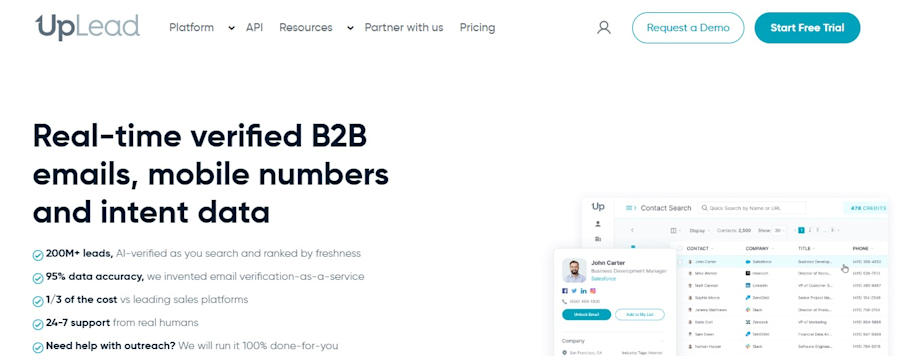
This B2B sales enablement tool is user-friendly and easy to master. It maintains accuracy through regular updates, which weed out old information and replace it with fresh data.
When comparing ZoomInfo vs UpLead, UpLead clearly stands out in terms of pricing. It’s more affordable and more transparent than ZoomInfo.
Features:
Nine CRM integrations so you can pick the one that best suits you
Over 50 search filters you can use to narrow down your list of prospects to the best of the best
Both AI and human data verification for maximum accuracy
Advantages:
UpLead’s free trial lets you figure out whether it’s the right solution for you before you have to make any payments
No-commitment plans make it easy to change your mind as and when you need to, so you’ve always got the right solution
Contacts cover over 200 countries—ideal for international sales
Disadvantages:
Less feature-rich than other ZoomInfo competitors
Less coverage in regions like Europe compared to others on this list
Pricing: UpLead offers a 7-day free trial (5 credits). Paid plans start at $74/month (Essentials, billed annually) with 170 credits/month, or $149/month (Plus, billed annually) with 400 credits/month. A custom Professional plan adds intent data, full API access, and team management. (Verified April 2026)
7) Seamless.ai
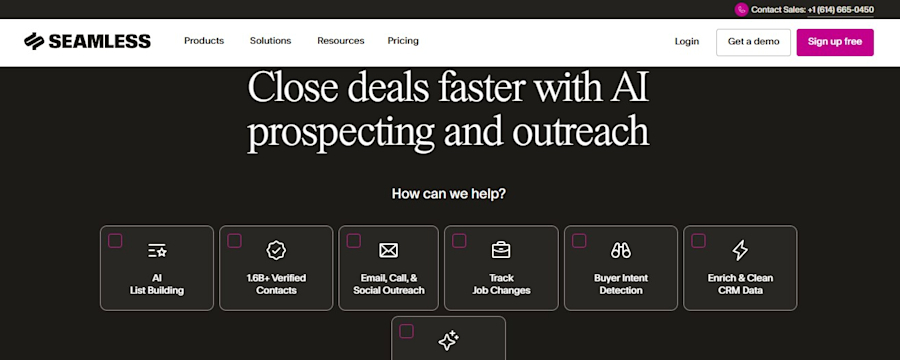
Seamless.ai puts a strong focus on artificial intelligence and advanced AI features. It is a search engine that delivers your results using AI for optimal outcomes.
This lead-generation platform is a good alternative to ZoomInfo for companies that aren’t particularly concerned with finding a one-to-one ZoomInfo substitute, as Seamless.ai is not a true database. They label themselves as an AI-powered real-time search engine instead.
Features:
Automated follow-ups to emails
Integrations with tools like Cloze, Zoho, and SalesLoft
Validation reports for every email address, so you know they’re reliable
Advantages:
Strong focus on email lets you get in touch with multiple leads at the same time
A free plan with 50 lifetime credits so you can test the platform before committing to a paid plan
The built-in copywriting tool makes it easy to create bespoke content for leads
Disadvantages:
Not as cost-effective as most other solutions in this list, despite the free demo
No stated GDPR compliance
Pricing: Seamless.ai offers a free plan (50 lifetime credits) and a Basic plan at $147/month (billed annually, 250 credits/month). Pro and Enterprise plans are custom-priced and require a sales quote. Note: credit-based limits and annual contract requirements mean total costs frequently exceed the headline price. (Verified April 2026)
8) 6sense
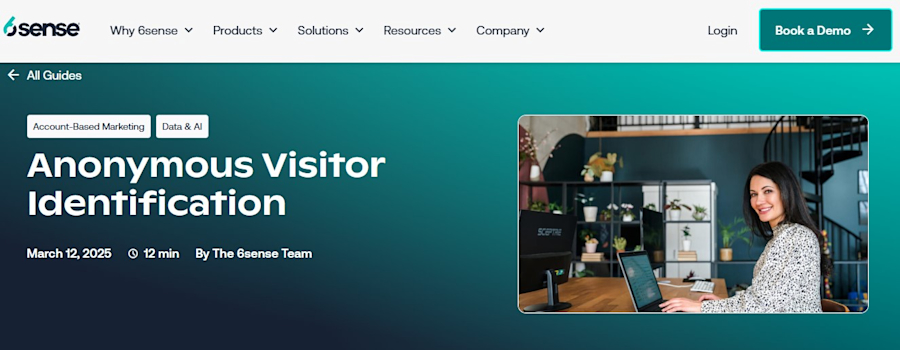
6sense uses AI and intent signals to identify companies in-market and helps align sales and marketing efforts around them.
Features:
AI-powered account identification and prioritization
Buying stage insights to time your outreach
Anonymous intent data capture
Campaign orchestration across channels
Advantages:
Strong intent data and predictive modeling help identify high-fit, in-market accounts before competitors do
Native orchestration features let you run multichannel ABM campaigns directly within the platform
Buying stage insights (awareness → decision) help tailor outreach and messaging based on where the account is in the journey
Disadvantages:
Smaller contact database compared to ZoomInfo, making it less effective for pure outbound or list-building
Requires significant setup and internal alignment to unlock full value—can be overwhelming for smaller teams
Higher price point, especially for full access to orchestration and AI-driven features
Less emphasis on contact enrichment and data cleansing compared to ZoomInfo’s robust data hygiene tools
Designed for enterprise teams running sophisticated ABM strategies, 6sense helps focus outreach on the accounts that actually matter, and helps users to reach them at the right time.
However, 6sense also has a steep learning curve and a high price. It’s usually too complex for smaller teams or for companies that don’t yet have a mature ABM setup. Some users report that setup can take a fair amount of time, and meaningful results often require tight alignment across sales, marketing, and RevOps.
Pricing: Typically costs $60K to $300K+ per year, depending on plan, credits, features, and size of your GTM team, often over $100K annually for enterprise-level deals.
9) Kaspr.io
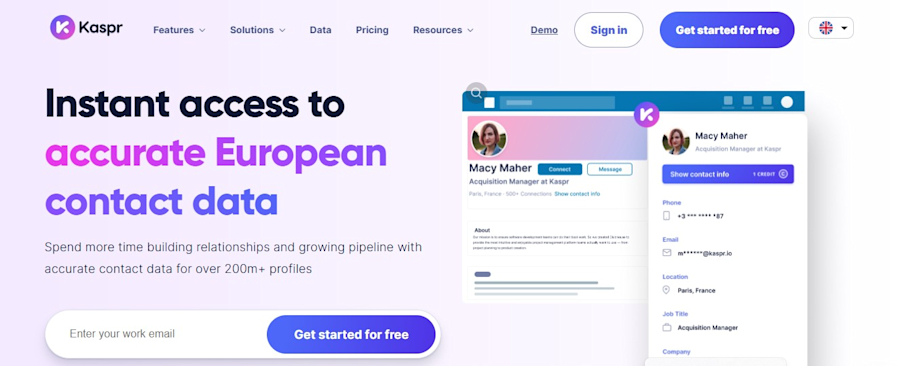
Kaspr.io is a decent choice for those whose key goal is to add more automation to their sales pipeline.
It works by having you set up your ideal sales profile. Kaspr’s AI then searches the web for good matches, which become your leads. After that, Kaspr helps you automatically draft relevant, personalized emails to help you turn those leads into loyal customers as quickly and efficiently as possible.
Features:
Integration within LinkedIn for easy use in the app
Wide, broad database for the price you’re paying
Up-to-date prospect information is available within a single click
Advantages:
Since it comes with a quick, easy setup process, you can start using Kaspr almost right away after purchase
The free plan gives you 50 credits each month, making it viable for small-scale sales and startups in particular
The power of AI means Kaspr is fast, saving you precious time in closing your valuable deals
Disadvantages:
No integrated CRM, data has to be exported to one instead
It’s mainly focused on LinkedIn, meaning the data will be more limited
You can’t use Kaspr to lead-build, since it technically has no platform
Pricing: Kaspr offers a free plan (unlimited B2B email credits, 5 phone credits/month). Paid plans include Starter at $49/month (billed annually) and Business at $79/month (billed annually). An Organization plan at $99/month (billed annually) is available for larger teams. Pricing is also available in EUR. (Verified April 2026)
10) D&B Hoovers
A sales acceleration solution that’s enjoyed some popularity, D&B Hoovers is a viable alternative to ZoomInfo for many companies.
Despite being less customizable and complex than some of the other tools in this list, D&B Hoovers’ platform is still a solid alternative to ZoomInfo. It’s a handy tool for teams looking to increase automation and spend more time selling.
Features:
Automated email sending at the perfect time
Full integration with Salesforce, bringing deeper insights to sales
Audience Builder that integrates first-party data
Advantages:
Powered by the intent platform Bombora, meaning you get access to intent data
Easy setup and a shallow learning curve
Connects you directly to decision-makers so you can close deals faster
Disadvantages:
D&B Hoovers doesn’t offer a Chrome extension, so you may have to adapt your workflows if you choose it
Simpler interface means less access to advanced features
Pricing: D&B Hoovers offers custom pricing plans.
11) Adapt.io
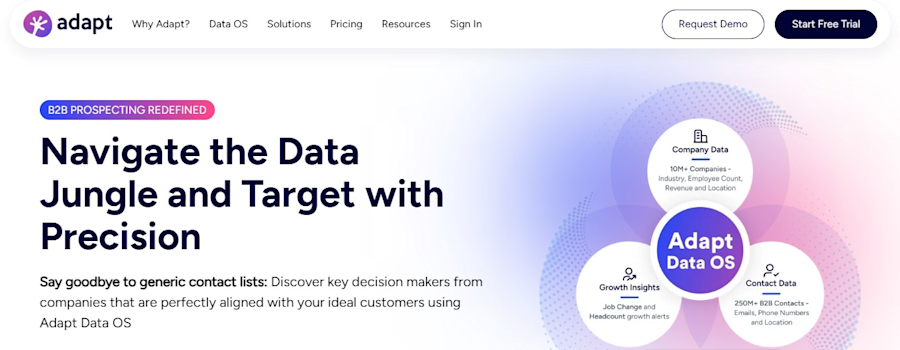
With its strong focus on detailed customer information, Adapt.io is a great ZoomInfo alternative for businesses that prioritize rich data above all else.
This platform is geared towards giving users a deeper understanding of their customers and prospects by providing tons of details. It also lets users set the parameters for the types of customers they’d like to work with, so you’ll only be recommended leads that fit your ideal customer profile.
Features:
A Chrome extension so you can do your prospecting from any device
Many prospecting filters, so you can properly target your audience
Strong support from customer success professionals
Advantages:
You can export your data directly to your CRM of choice
User-friendly design makes for an easy-to-deploy system
Lead coverage in plenty of industries
Disadvantages:
Limited native CRM integrations — Adapt.io supports CSV export to CRM but lacks the deep two-way sync offered by tools like Apollo or Leadfeeder. Check their current integration list before purchasing, as this area evolves frequently.
Less feature-rich than most other options in this list
Lesser-known than other ZoomInfo competitors
Pricing: Adapt exclusively offers custom pricing plans.
Quick Comparison of Top ZoomInfo Competitors
Why Do Companies Use ZoomInfo?
Teams typically use ZoomInfo for:
Prospecting (large database)
Enrichment + CRM workflows
GTM insights (module-dependent)
Is ZoomInfo Expensive?
ZoomInfo pricing varies by users and modules, but annual contracts often start around $15K/year and can scale significantly for larger teams.
This may suit large enterprises, but many smaller or mid-sized teams find that competitors offer similar or better functionality at a lower price, especially platforms with flexible, usage-based, or region-specific pricing.
Why Consider a ZoomInfo Competitor?
Here are the most common reasons teams choose alternatives:
1) It’s not cost-effective
ZoomInfo’s pricing is high, and there are plenty of cheaper alternatives to ZoomInfo offering similar features at a lower cost or with tailored pricing.
2) Competitors offer more or better features
Some tools offer stronger regional coverage, fresher data cycles, or niche insight ZoomInfo doesn’t provide.
3) More (and better) integrations
Many alternatives support a wider ecosystem of tools for sales, GTM, and RevOps teams.
4) You want an all-in-one platform
ZoomInfo focuses heavily on data sourcing, not on full-funnel lead nurturing. Competitors increasingly provide more complete workflows.
5) You want to try something new
Customer experience, data freshness, and support consistency vary widely, and some alternatives simply offer a better fit.
How to Choose the Best ZoomInfo Competitor
Yes, you can find free ZoomInfo competitors and solutions designed for SMBs that offer flexible pricing tiers and targeted data. These platforms help smaller businesses compete effectively by focusing on the most relevant leads without overextending their budgets.
So, you know all about ZoomInfo’s top competitors: what makes them great, where their weaknesses lie, why you should give them a try, and more. The next step is choosing the right solution for your specific needs.
We’re going to share some tips to help take you from simply knowing about the best ZoomInfo alternatives to having a clear plan for choosing the best one for your company. Follow these best practices, and you’ll be able to narrow down that ZoomInfo competitors list in no time.
Understand your needs: What’s essential, and what can you compromise on? Be clear about what matters most so you can choose the ZoomInfo alternative that truly fits your company. Listing everything you want and highlighting the must-haves can make this easier.
Know your priorities: Next, figure out your priorities. Maybe your goal is fewer, high-value B2B sales, or maybe budget matters most. List them in order, so you can find ZoomInfo alternatives that match your company’s needs.
Record your ZoomInfo complaints: What do you dislike about ZoomInfo, and how is the database platform not working for you? The more keenly aware you are of the things you’re unhappy with in ZoomInfo, the easier it will become to avoid those same traits and qualities in a new B2B lead database.
Clearly define your budget: If you know exactly how much money you’re working with, you’ll be able to eliminate options that fall outside of those numbers. You’ll also have an easier time discussing custom packages with companies that offer them.
Try free demos: As mentioned earlier, free trials are some of the best ways to test out a platform for yourself, so you can see which one is the best fit. A demo is a better option than a free version here, as demos typically give you the same experience as the full product. Free versions, meanwhile, usually have reduced features or functionality.
Talk to sales representatives: You’re the customer, so give ZoomInfo competitors a chance to show you what they offer. A direct conversation quickly reveals if the tool fits your needs.
Why Leadfeeder is the top ZoomInfo alternative for B2B teams in 2026
If you’re evaluating ZoomInfo alternatives, the question isn’t just "who has more contacts?" — it’s "who helps me reach the right accounts at the right time?" That’s where Leadfeeder stands apart. For a detailed head-to-head breakdown, see our full Leadfeeder vs ZoomInfo comparison.
While ZoomInfo gives you a database to prospect from, Leadfeeder reveals which companies are actively showing buying intent on your website right now. Combined with AI-powered lead scoring, 500M+ leads, and 400M+ verified contacts, your sales team gets higher-quality opportunities with less effort.
If your priority is volume over platform features, you might also explore the pros and cons of buying B2B leads directly.
When evaluating these tools, consider what matters most for your team -- whether that is a comprehensive B2B contact database or advanced intent signals.
Add in a 4-minute setup, full GDPR compliance, and flexible pricing without long-term enterprise contracts, and it’s clear why 15,000+ B2B teams have made the switch.
Start your free 14-day trial or book a personalized demo to see Leadfeeder in action.
Disclosure: This comparison was researched and published by Leadfeeder, a product of Dealfront Group GmbH. As a competitor in this space, we have a commercial interest in this topic and have aimed to present an objective, balanced analysis. All third party competitor pricing, features, and claims reflect publicly available information at the time of writing. Product details change frequently. We encourage you to confirm current information directly with each provider before making a purchasing decision. Trademarks and brand names referenced in this article belong to their respective owners and are used solely for identification.