60-Second Summary
Bigger budgets alone don’t guarantee better B2B results—what matters is the quality, integration, and use of data. Every touchpoint produces signals; turning them into ROI requires clean data, intent-driven prioritization, and aligned processes.
Key takeaways: B2B data spans contact, firmographic, technographic, intent, behavioral, engagement, and chronographic signals; prioritize intent and behavioral signals and maintain data quality, integration, and compliance to boost targeting and conversions.
Standout strategies & tactics: Combine internal, external, and emerging sources (CRM, web analytics, third-party providers, AI/ML, IoT); use intent-based ABM, anonymous visitor identification, enrichment, and automated scoring to engage warm prospects at the right time.
Real-world lessons & frameworks: Treat raw data like crude oil—cleanse, enrich, and refine it into actionable insights; appoint data stewards, align sales/marketing, and use analytics for forecasting and CX improvements.
Implementation & governance: Develop a clear data strategy, centralize via CRM/CDP, run regular cleansing and audits, enforce security and compliance (GDPR/CCPA), and consider tools like Leadfeeder/Datacare for enrichment and compliant automation.
*This summary was created with AI assistance, using our original content.
But bigger budgets do not automatically lead to better results. Many companies are already collecting vast amounts of B2B data through digital channels, yet still struggle to turn that data into meaningful ROI.
Every website visit, social media interaction, and customer touchpoint can generate valuable behavioral signals. The challenge is both collecting high-quality data and using it effectively to improve targeting, timing, and conversions.
What is B2B data?
B2B data is any information you gather about potential business customers. It shapes your marketing, sales, and revenue strategies.
Information collected includes personal details, firmographics, technographics, behavioral data, and buyer intent data. B2B data is critical for businesses to identify potential leads and understand their target audience's needs.
Think of the B2B sales process like oil production. B2B data is the petroleum you must unearth. In its natural state, it’s crude and not fit for purpose. You take the raw B2B data and process and clean it. You refine it for its real value: analytical insights that drive better decision making.
B2B data types
B2B data is generated constantly. Every customer interaction adds to the exponential growth of digital information. Trying to wrap your head around every gigabyte and terabyte can leave you lost on where to start.
Before diving into B2B data analytics, it’s best to understand the main types of B2B data.
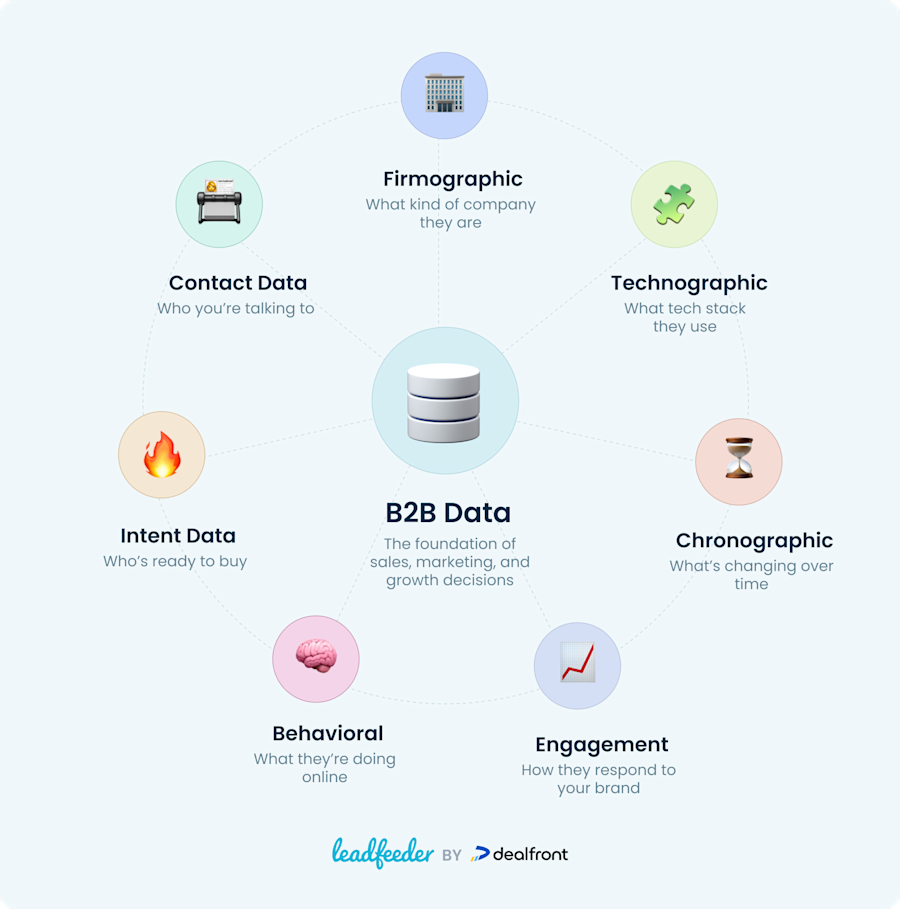
1. B2B contact data
B2B contact data is information about individuals who work at target firms. These people are the gatekeepers and decision-makers who inform your buyer personas. Contact data includes names, job titles, email addresses, phone numbers, and responsibilities.
Details about company contacts are vital for creating personas. They also help personalize sales outreach and improve lead qualification.
2. Firmographic data
Firmographics are the B2B equivalent of consumer demographics. They’re the characteristics that describe a potential business customer. Firmographic data includes industry, vertical, company size, revenue, and geographic location.
Firmographic information helps companies identify companies that meet their ideal customer profiles (ICPs). It enables you to tailor marketing and sales touchpoints. For example, you identify the prospect's niche. Now you tailor outreach using case studies and testimonials from the same industry and niche.
3. B2B technographic data
Technographic data is the specific details about the technology a company uses and how it implements it. Information on a prospect’s tech stack is especially crucial for B2B SaaS companies. If you offer a solution that doesn’t integrate with a lead's existing tools, what are the chances they’ll buy your product?
At the same time, you can use technographics to discover companies that are a good fit for your services based on the tech they use. It can also help inform competitive analyses when tailoring pitches for each prospect.
4. Intent data
B2B intent data is based on a company's online behavior and other buying signals. These indicate a genuine interest in specific products or services. This data focuses on specific actions that demonstrate readiness to buy.
An example would be collecting and analyzing a firm’s social media posts and engagement to determine how soon they’re likely to buy a product.
Buyer intent data helps shape account-based marketing (ABM) and other personalization strategies. You'll know which customers are ready to purchase, so sales development representatives can focus on the warmest leads.
5. Behavioral data
B2B behavioral data is generated when businesses interact with your brand. It’s the total summation of how they engage with your marketing emails, social media accounts, websites, and other online spaces. Analyzing B2B customer behavior helps you improve the overall customer experience (CX).
B2B buyer intent data is a specific type of behavioral data. A company’s behavior is defined by their website visit, where they click, and how they interact on your pages. Buyer intent comes from specific buying behaviors. Some of these include visiting a product page many times or signing up for an email newsletter.
Platforms like Leadfeeder help you identify anonymous website visitors. You can use 50+ behavioral and firmographic filters to find the best prospects and prioritize companies with high intent and a strong fit for your products and services.
6. Engagement data
B2B engagement data focuses on how a company interacts with your brand and its content. Are they reading social media posts on LinkedIn and clicking that like button? Engagement data you can track includes email opens, click-through rates (CTRs), page views, and downloads.
Use this information to qualify leads and tailor interactions. Read engagement data to identify which content types resonate most with your audience segments or prospects.
7. Chronographic data
Chronographic data is time-based and tracks changes or milestones within a company. These can be anything from leadership changes to expansions to funding rounds. By examining the life stage a company is at, you can more easily identify the best opportunities.
For example, let's say your ICPs are large global enterprises within your industry. It may be time to start engaging a prospect during a merger or acquisition when operations are being restructured or revamped.
Where does B2B data come from?
Alright, so we keep discussing this nebulous, ubiquitous, and seemingly omniscient data. Where does all of this digital information come from?
B2B data originates from a diverse mix of sources. Each can be as unique as your brand, your customers, and your sales funnel. However, B2B data can be broken down into three main categories: Internal, external, and emergent sources.
1. Internal sources
Let's start with the gold nuggets hidden under your nose; internal sources. These are the data points generated within your organization. First-party sources offer a wealth of insights into your existing customer base and operations.
Think of the tools you use to manage customer interactions daily. Platforms like your customer relationship management (CRM) system are a vault of information. CRM data includes purchase histories, touchpoints, and feedback. Each entry helps you to understand customer preferences and predict future behavior.
Other internal sources include website analytics, email marketing, lead capture forms, and surveys. Mine each of these data producers to better understand your current and potential customers. You can also use social media listening apps to track engagement, preferences, and firmographics.
2. External sources
External data comes from third-party sources, often through a B2B data subscription. These are external tools and platforms that provide a broader market view and help round out your marketing and sales strategies.
External sources include:
Company websites
Blogs
Social media profiles
News articles
Industry publications
Online public databases
Third-party data providers
Industry reports and market research firms offer insights into changing preferences and trends. Social media analytics reveal how your audience perceives and engages with your brand. Each of these sources adds a layer to your understanding, helping you refine your strategies.
Tools like Leadfeeder provide accurate, compliant B2B data for deeper insights. Our platform aggregates information from various channels. Some of these include national trade registers and chambers of commerce. It also compiles publicly available information to enrich your existing customer data—all while maintaining compliance with GDPR, CCPA, and other regulations.
3. Emerging sources
Emerging sources are new technologies that are at the forefront of B2B data. What types of tech do you expect to be leading the race? In HubSpot’s 2024 AI Trends for Marketers, it was reported that AI tool usage had increased by 74% from the previous year. AI-powered tech includes large language models (LLMs), machine learning (ML), and the Internet of Things (IoT).
Using these technologies, you can automate data analysis and process vast amounts of information. Tools like customer data platforms (CDPs) work together with your existing tools and centralize data.
Using ML, you can also glean predictive and prescriptive insights that shape your sales strategies. These insights help in anticipating customer needs. They make it easier to craft proactive strategies that can outpace the competition.
Collecting IoT data allows you to understand how your products are performing and how your customers use them. Use data analysis to improve products and increase customer satisfaction (CSAT) and loyalty.
B2B data use cases
A Marketing Week survey found that over 59% of marketers are being asked to deliver more with fewer resources. Harnessing B2B marketing data gives marketing and sales professionals a shot in the arm, helping them increase conversions.
Let’s explore some examples of how B2B analysis can help drive success for your business:
1. Identifying and defining TAMs and ICPs
You can’t develop a strategy until you identify your Total Addressable Market (TAM) and Ideal Customer Profiles (ICPs). TAM is the total number of potential customers in your target market. ICPs are your “dream” or ideal companies for sales outreach and proposals.
B2B data adds brush strokes to the TAM and ICP canvases, painting a clearer picture. By analyzing firmographic data, you can pinpoint your most valuable customers. You can focus your efforts on high-potential segments and prospects to improve efficiency and increase win rates.
Use data analytics tools to segment your market and identify patterns. Continually monitor the entire customer journey and regularly update your ICPs to reflect changes in market conditions and customer behavior.
2. Lead generation, enrichment, and qualification
As a sales professional, you know that success can be fleeting, with peaks and valleys. B2B data serves as your compass to navigate rough, rolling terrain. According to a 2024 LinkedIn report, 37% of businesses say building a high-quality pipeline is the highest priority.
Leveraging B2B buyer intent data and behavioral analytics, you can enrich lead profiles and improve pipeline quality. This ensures you engage warm prospects at the right time with relevant information.
Use tools like Leadfeeder to identify anonymous website visitors and enrich your CRM data. Our solution makes it a breeze to uncover unique leads with untapped potential. Analyze intent data and other information to inform and enhance your lead scoring system.
Using the right B2B data enrichment tools and channels empowers you to prioritize the warmest leads. You'll keep fueling the pipeline and facilitating more deal-closing pitches.
3. Sales forecasting and automation
How can a business make plans without any idea of what lies ahead? Sales forecasting is crucial for informing leadership and decision makers on how to shape the overall strategy.
Guess what? All of that Big Data you’re processing doesn’t just help improve performance. It also provides a galaxy of historical data for sales forecasting.
Think of B2B data as a magic eight-ball, revealing trends and patterns in your sales process. Automated data collection and analysis ensure that the eight-ball is freshly shaken and up to date. This foresight enables you to anticipate market shifts and adjust your strategies proactively.
When leadership knows how likely each prospect in the pipeline is to make a purchase, budgets can be efficiently allocated. SDRs and account executives can use real-time forecasting data to pivot tactics. For example, if projections look negative, sales can test new proposals or cold calling pitches.
Use information from internal sources and B2B data providers with sales enablement and forecasting tools. You can automate data collection to deliver accurate, real-time forecasts.
4. Analytics
B2B data analysis once represented a secret weapon wielded by powerful, massive enterprises. Today, even solopreneurs and small businesses can effectively lift the “sword in the stone.”
Analytics platforms help you understand customers. They guide you to optimize marketing campaigns, sales touchpoints, and customer success. They help you improve CX to increase retention and customer lifetime value.
For example, you can identify which account types are most likely to renew their subscriptions and which might need sales to sweeten the deal.
Data analytics also gives you foresight into market shifts, enabling you to adjust your strategies proactively. Use B2B sales data and analytics tools to ensure you’re always prepared and updated.
Challenges of using B2B data
B2B data presents a treasure chest of insights and opportunities to those who know how to find it. It’s not just about knowledge, though. You also have to put in the work to leverage gathered information and use it to your advantage.
During data collection, processing, and analysis, there are some pitfalls to avoid and obstacles to overcome:
Data quality and accuracy: One of the biggest hurdles is ensuring the data you collect is accurate and up to date. Inaccurate data leads to misguided strategies and wasted resources. Dirty CRM records can stop growth plans before they start. Frank Sondors, Co-Founder and CEO of Salesforge, saw it firsthand with a B2B sales team trying to pivot toward account expansion: "Their CRM data was full of gaps and the data was dirty and they weren't able to actually properly blueprint an account for any type of campaign... What we figured out was it would take about two hours per account just to piece together everything they're looking for." Regular data cleansing, verification, and validation are essential to maintain data integrity.
Data integration: It can be complex to integrate data from various sources into a cohesive system. Data silos can hinder your ability to get a comprehensive view of your customers. Invest in tools that facilitate seamless data integration to break down barriers.
Security and compliance: Navigating the regulatory landscape is crucial to any organization. Ensuring data privacy and security isn't only a legal obligation. It's also necessary to build credibility and trust with your audience. Implement robust security measures, stay informed, and use only tools and B2B data providers that are fully compliant with current requirements.
Vast amounts of data: The sheer volume can be overwhelming. It's easy for businesses to get lost in the noise and lose focus. Which data should you prioritize and how should you interpret it? Collect and analyze data that aligns with your strategic objectives. Use analytics tools to foster actionable insights for decision-makers and team members.
Misalignment among teams: Sales, marketing, and customer success teams also need to be aligned on processes and goals. Everyone should understand the sales cycle and its various touchpoints. The customer journey must stay consistent if you're to benefit from data insights. Use collaboration tools to keep everyone aligned and working toward common goals.
B2B data best practices
The general concept of leveraging B2B data seems simple at heart. Identify data sources, collect information, centralize data, and use the right tools to glean insights, right? Now, back to reality.
You’ve got a seemingly infinite amount of data from a growing number of sources. All you want to do is decode the hidden secrets about market and customer behavior. How do you accomplish this feat? By following some best practices for managing and leveraging B2B data:
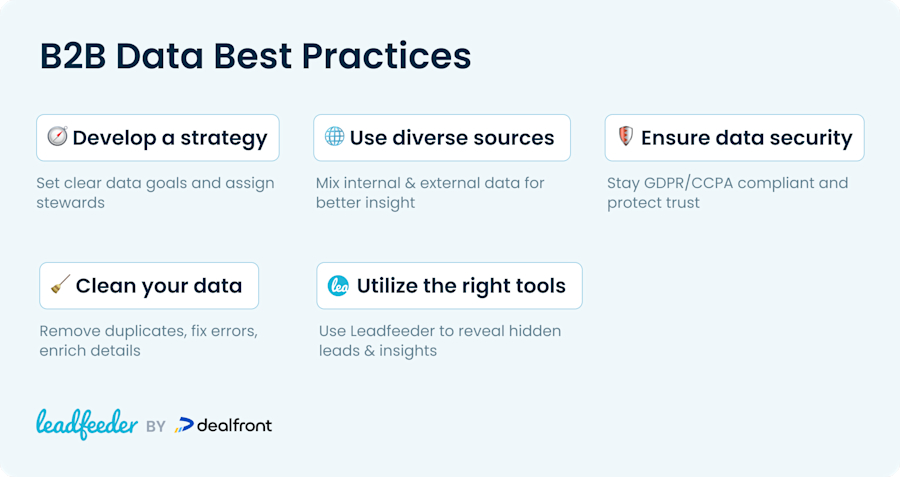
1. Develop a data strategy
Establishing a data strategy helps set a roadmap for how your organization collects, handles, and analyzes data.
What are your goals for using B2B data? Do you want to find unique prospects or focus on finding higher-quality leads? Are you looking to increase initial sales or improve retention and CLV?
Use your objectives to drive your data strategy. Define which data types are most relevant and which sources are most important. By setting goals, you can track the right metrics to assess the success of your data strategy.
Appoint data stewards for marketing, sales, customer service, and other teams. These individuals are responsible for overseeing data hygiene by monitoring and creating policies.
2. Gather data from diverse sources
While it’s good to know which sources have the most valuable data, you don’t want to hyperfocus on a few channels. Data analytics only get richer and more accurate with more information. (As long as you’re feeding the right information into analytical models and algorithms).
Leverage a combination of internal and external data sources. Use emergent technologies when applicable, such as using AI to automate data streaming and collection.
Of course, the more diverse sources you use, the more complex data integration becomes. Data silos can form like sand dunes in the desert under the right conditions. This is where tools like Leedfeeder step in to relieve the pain of managing Big Data.
Our platform doesn’t just identify anonymous warm leads. It also automatically syncs behavioral and firmographic data with your CRM for a seamless, tailored CX.
3. Always prioritize data security and compliance
Data protection and privacy laws aren’t recommendations or optional best practices. Laws like the CCPA, GDPR, and HIPAA require you to secure sensitive customer data at all times.
Every time information is transferred to or from the cloud, it’s at risk. Any time employees handle customer information, they can unintentionally expose sensitive business data.
Besides losing consumer trust, compliance violations will cost the company. IBM reports that the average cost of a data breach in 2024 was $4.88 million.
Start by implementing the security measures and tools to protect and encrypt all of your data. Only source data from an external B2B data provider, such as Leadfeeder, that is fully transparent and compliant. Maintaining sufficient data security and compliance also requires regular security audits and training.
4. Check and cleanse data regularly
Gathering enough data is only one consideration. A recent report from Mixology Digital found that accurate data collection is the number one challenge to generating high-quality leads. What do we mean by accurate? Having up-to-date names, job titles, and contact details is the bare minimum.
Data errors also originate from corrupted, improperly formatted, and duplicated data. Some basic best practices to regularly audit and cleanse B2B data include:
Identify data quality issues: What information is incomplete or out of date? Where is the poor-quality data coming from? Use data enrichment tools or manual updates to reconcile inconsistencies.
Standardize data: Establish consistent formats for company names, dates, addresses, and other fields. Create data governance controls to limit access and privileges to the right people.
Use the right tools: Leverage automation with B2B data platforms such as Datacare by Leadfeeder. Our service ensures your company data remains accurate. All of your CRM and sales databases are automatically checked, cleansed, enriched, and optimized right in the cloud.
Unless you’re Picasso, you likely won’t be able to take garbage and make something appealing. Use clean, beautiful data to distill actionable insights and create better customer experiences.
Access and utilize B2B data with ease thanks to Leadfeeder
B2B data isn’t some secret weapon that only industry leaders can equip. Your company and team members can use the same resources and techniques to keep up with or get ahead of the competition. The key to B2B data democratization is to create a sound strategy and use the right tools.
What are the right tools? Leadfeeder offers a wide range of data solutions to help you access valuable information. We guide you in identifying quality prospects by fit and intent.
Leadfeeder helps you discover unique, hidden leads in your industry. Connect by Leadfeeder ensures marketing and sales teams stay informed about target firms’ behavior and company changes through triggers and alerts.
Want access to the most accurate data on your ideal customers that is secure and compliant? Datacare cleanses your diverse datasets and enriches your pipeline with updated, verified lead information.
Try Leadfeeder today and find out how easy it is to leverage invaluable B2B data for your business!