60-Second Summary
Lead enrichment turns basic lead lists into qualified prospects by adding contact, demographic, firmographic, technographic, and behavioral data. When automated and integrated with your CRM and tech stack, enrichment speeds qualification, sharpens targeting, and shortens sales cycles.
Key takeaway: Enrichment is as important as lead generation — it standardizes messy data, improves lead qualification, and produces faster, higher-converting sales interactions.
Standout strategies & tactics: Automate enrichment (real-time where possible), use trigger events to surface hot leads, map technographic and firmographic signals, and integrate seamlessly with CRM/tools to enable action.
Real-world lessons & frameworks: Use enrichment for personalized event follow-ups, segmented campaigns, and warmer cold emails; continuously refresh data and prioritize compliant, high-quality sources to avoid stale or risky records.
Practical implementation framework: Clean and normalize data first, identify decision-makers, enrich with behavior and technographic signals, then feed enriched leads into CRM workflows for prioritized, personalized outreach.
*This summary was created with AI assistance, using our original content.
Your business may devote a good deal of effort to lead generation, in the hope of conducting new sales to whole swathes of new customers. However, lead generation isn’t everything. It’s important, but it’s not the whole shooting match.
What we’re talking about is lead enrichment, and we’re going to discuss what this means. Get ready to discover something that can transform your business performance at a stroke. Deep breath, and in we go.
Lead Enrichment Explained
Lead enrichment is a way of making sales leads more likely to give you conversions by gathering additional information and adding it to your initial lead data.
Simple as that. OK, nothing’s as simple as that. There’s quite a lot to it.
Leads can take all kinds of forms.
At the most basic level, you might have:
A purchased list of companies with minimal context
A list of event sign-ups
Or contacts who’ve shown some initial interest
These are useful, but incomplete.
At the other end of the spectrum, you have enriched leads:
With accurate contact details
Clear business context
Defined needs or intent
Lead enrichment is the process of turning lists like the first example into something more like the last example. This can happen as a result of a manual procedure (laborious and to be avoided if possible) or with the use of automated lead enrichment services (much better).
Types of Lead Enrichment Data
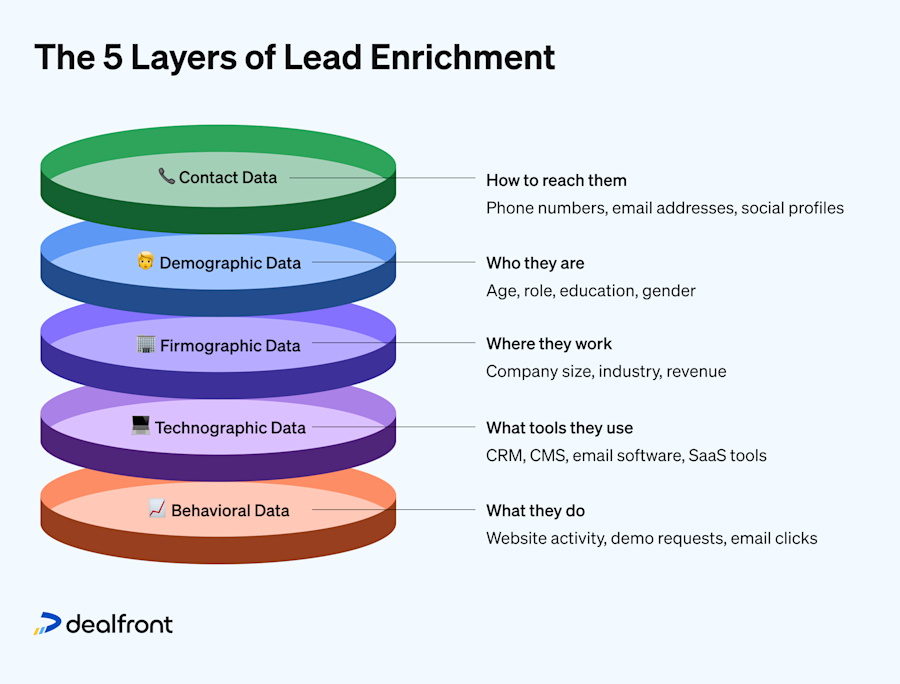
The data that can enrich leads takes several forms. Generally speaking, the following are five of the most common categories of lead enrichment data:
1. Contact data
This is what you’d want from your list, at the very least. After all, you may have a collection of leads that are red hot to buy from you, absolutely itching to get on board with your business. But wait, how do you actually reach out to set this relationship on course? Yes, contact data is what’s needed.
2. Demographic data
This is where you start to apply some details concerning the individual lead or prospect, including their role in a business. A business might be involved in some highly pertinent activity and may be ideally placed as a potential customer for your growth marketing business. It probably won’t do you much good, though, to be put through to the canteen supervisor.
Demographic data enrichment enables you to assemble a picture of the person who does the buying. Demographic information includes things like:
Age
Gender
Education level
Job role
Leadfeeder’s lead enrichment services include tools like Target, which helps you to identify the key decision-makers in a given company and start on your journey to enriching your lead with demographic data about them. This saves time and gets you places, fast.
3. Firmographic data
It helps further if you know something about the business this individual works for. Not just its area of activity, although this is of course massively important. We’re looking here also at business size and revenue. In addition, we’re considering brand identity and the business’ target customer. Using Leadfeeder’s Datacare, you can clean and enrich firmographic data in your CRM.
4. Technographic data
This is an area of lead enrichment that is concerned with the kinds of tech that the business in the frame is using. Why is this important? Because, if you know that your business leads are using a particular product in their work, you know how they complete certain processes.
You can then sell your product as a tool that can work with what they have already, meshing to produce something beyond the sum of its parts.
Or, you can sell it as an upgrade from what they’ve got. Indicating precisely where the shortcomings of their existing tech are hindering their performance, and where your product will overhaul things wholesale.
5. Behavioral data
When you have information about who a customer is, what position they occupy in a business, what that business delivers, and with what tools, it's possible to get a pretty-rounded idea of that lead.
However, to get into even more detail, it's good to know how the lead behaves.
In this context, we're talking about how they might engage with your website. Do they seem to be interested in any particular aspects of your business? Do they sign up for more information? Do they register for any demos? Do they attend any events (virtually or, come to that, in person)? As Andrei Zinkevich, co-founder of FullFunnel.io, puts it:
“You need to make tangible criteria. That should be, let's say, five repeated visits in the last 30 days from your buyers, and you are connected to one of them on LinkedIn. The key here is to make 'they are aware of us' criteria tangible.” - Andrei Zinkevich, FullFunnel.io
Behavioral enrichment only matters when you turn those signals into something measurable, not just something you watch. You can use the website visitor identification feature of Leadfeeder to help you do exactly that, keeping tabs on who's doing what on your site with the specificity those decisions require.
The Importance of Lead Enrichment: Tangible Benefits For Your Sales and Marketing Teams
So, lead enrichment can involve bolstering your leads with several forms of data. Now, let’s look at exactly why you’ll want to do it.
1. More consistent, standardized lead data
When you have lead information from all manner of sources, you can end up with messy data.
You know how things get, you have several different lists of potentials, as well as some scribbled-down notes from a phone call, not to mention some crumpled business cards you have stuffed in your pockets.
This kind of data smorgasbord can have some priceless nuggets within it, but things can get all too easily overlooked when random data management is allowed to dominate.
What’s needed in this case is a process that gives order and clarity to the data you have. This is where lead enrichment can really help.
It does this by putting all your lead data through the same rigor, which then results in everything being stored in a consistent fashion, with continuity across your datasets. Improved lead qualification
This is central to what we’re trying to achieve. Through lead enrichment, it’s possible to assist your sales team in a hugely important fashion.
Lead enrichment helps you assemble more information about your lead. You can understand them better, both in terms of their background and what they’re likely to want from you.
If a business seems to be interested in what you’re selling, and is engaged in finding out about your product, then your sales team can rate this very much as a qualified lead, and go after them before the customer goes elsewhere.
2. Better focused campaigns and sales efforts
One of the great things about lead enrichment is that it bestows advantages in all kinds of ways. Here’s an aspect that you might not have been expecting, but it’s a fundamental result of your lead enrichment efforts.
By going beyond B2B lead generation and really finding out about your customers—both potential and actual—and their behavior, you’re in a great position to begin understanding overall trends. The wise businessperson recognizes that the commercial landscape is never static, so a huge amount depends on the ability to spot developments and leap on them before your competitors do.
3. Marketing campaigns and sales activities can be shaped to take advantage of the insights thrown up by lead enrichment. Shorter sales cycles and more conversions
Finally, when you have more detailed data, you can close sales more quickly.
It’s like if you know all about a particular fish—where they like to spend their afternoons, what they like to eat, how strong a rod you’re going to need. You’re going to be reeling that fish in a lot sooner than if you just plop your hook in at a random spot with no idea about what you’re fishing for.
Of course, if you land that fish in short order, you’ll be in a position to follow up with more catches swiftly thereafter. In other words, if you can complete your sales cycles nice and quickly, you’ll be able to have your sales team moving nimbly on to the next interaction with more conversions accruing.
What to Look For from Automated Lead Enrichment Tools
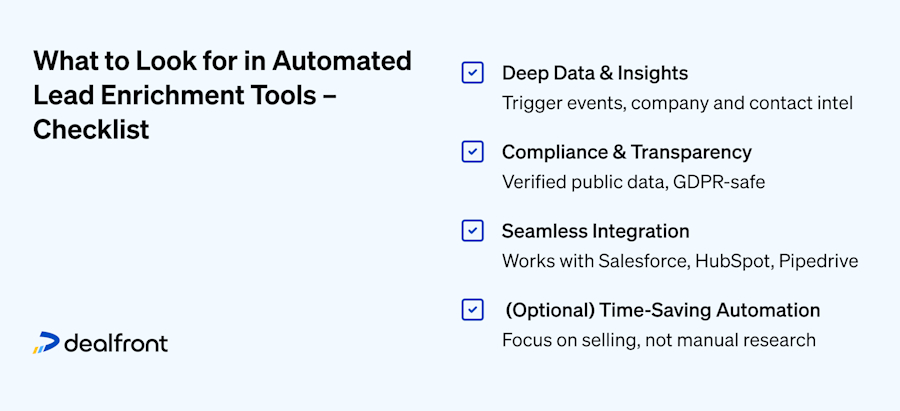
Lead enrichment can be a game changer. However, if you’re not careful, it can be time-consuming. That’s why using automated lead enrichment tools such as Leadfeeder’s Connect is an absolute must. The benefits that can follow from using these tools are significant, but what should any such solution offer?
1. Deep data and insights
The best lead enrichment automation tools should provide ready access to insights that can be hugely significant to your sales endeavors.
Leadfeeder’s Connect, for instance, can not only give you deep data that reveals all you need to know about a business and the relevant personnel within, it will also give you what’s known as trigger events.
These are events such as changes in management, expansion, and alterations in company direction. They can be hugely consequential in terms of a business’ qualification as a lead.
2. Compliance and transparency
Like it or not, we’re in an age of stringent compliance requirements. You should of course, like it: When it comes to data protection, such requirements are there to protect us all.
However, things can feel onerous for the beleaguered business just trying to make the most of its leads and stay afloat.
Not only should automated lead enrichment tools be simple to use, they must also take compliance and transparency seriously.
Leadfeeder’s applications take data on over 56 million companies from places such as official trade registers and public web data. In other words, nothing a regulating body will have the slightest issue with.
3. Seamless integration with your tech stack
A lead enrichment API or other kinds of pre-built integrations can enable enrichment tools to work in harness with a company’s existing array of tech. That’s crucial, as even though lead enrichment is important in its own right, it doesn’t exist in a vacuum.
You can hit the ground running with your Leadfeeder tools because they work straight from the box with your favorite sales, marketing, and CRM tools.
No fiddly customizations, no forcing incompatible packages together, no having to do without the features you’ve grown to rely on. Using tools like Leadfeeder, you can assimilate easily with popular packages such as Salesforce, Pipedrive, and HubSpot.
Lead enrichment can be a game changer. However, if you’re not careful, it can be time-consuming. That’s why using automated lead enrichment tools such as Leadfeeder’s Connect is an absolute must. The benefits that can follow from using these tools are significant, but what should any such solution offer?
B2B Lead Enrichment Use Cases
So, that’s the theory. Now the practical. Let’s look at how you can use lead enrichment to upscale your sales and muscle up your marketing.
1. Personalized follow-up after an event: Instead of sending one generic message, enrichment allows you to tailor follow-ups based on each lead’s interests, role, or location, making outreach more relevant and engaging.
2. Tailored campaigns: Use enriched data to segment audiences, understand behavior, and target leads with messaging that matches their needs, past interactions, or stage in the buying journey.
3. Warmer cold emails: Replace generic outreach with personalized emails that reference a lead’s company, context, or recent activity, making your message more human, relevant, and likely to get a response.
Get Lead Enrichment Right to Close More Deals and Build Better Relationships
“Getting to know you, getting to know all about you” sang Deborah Kerr in The King and I. If only she’d known about the lead enrichment services offered by companies such as Leadfeeder, it would have saved her a big song and dance.
Leadfeeder solutions make it so much easier to get the information you need to make your sales efforts really perform. With a range of tools, including Target to identify prospects, Connect to find out more, and Datacare to help keep your data up to scratch, Leadfeeder helps you really get to know your leads.
People love it when they’re the object of someone’s interest. It’s flattering, and it offers them the chance to talk a little about themselves, which, for a lot of us, is our favorite subject. An enriched lead is a nurtured lead. In effect, an enriched lead is a loved lead.
“Getting to like you, getting to hope you like me” Ms K continued. She could have been singing about lead enrichment.
FAQs about Lead Enrichment
1. How is lead enrichment different from data enrichment?
Lead enrichment is a specific type of data enrichment focused on improving information about potential customers. Data enrichment can apply to any dataset, while lead enrichment is used specifically for sales and marketing leads.
2. Can lead enrichment be done in real time?
Yes. Many modern tools offer real-time lead enrichment, updating lead data instantly as users interact with your website or enter your CRM, allowing teams to act on fresh intent signals.
3. Is lead enrichment only for B2B companies?
Lead enrichment is most commonly used in B2B, but it can also be applied in B2C, especially for high-value or complex purchases where understanding customer context improves targeting.
4. What are the risks of lead enrichment?
Potential risks include:
Using inaccurate or outdated data
Violating data privacy regulations
Over-relying on automation without validation
Choosing compliant, high-quality data sources helps mitigate these risks.
5. How often should you update or enrich lead data?
Lead data should be continuously updated or refreshed regularly (e.g., monthly or quarterly), especially in fast-changing industries where roles, companies, or tools frequently change.
6. Does lead enrichment require a CRM?
No, but it works best with one. A CRM allows enriched data to be:
Stored consistently
Shared across teams
Used in workflows and automation
Without a CRM, enrichment is harder to scale.
7. What’s the biggest mistake teams make with lead enrichment?
Focusing only on collecting more data instead of using it. The real value comes from applying enriched insights to:
Prioritize leads
Personalize outreach
Improve targeting
8. Can small teams benefit from lead enrichment?
Yes. In fact, lead enrichment can be especially valuable for small teams by helping them:
Focus on high-quality leads
Avoid wasted effort
Compete more effectively with limited resources

Senior Director GTM Execution @ Leadfeeder
Marvin Karis is a go-to-market leader at Leadfeeder with deep experience across sales leadership, revenue operations, and GTM execution. His work focuses on helping revenue teams turn data and buyer signals into structured processes that generate predictable pipeline.
Having worked closely with sales and marketing teams across the Leadfeeder platform, Marvin brings a practical understanding of how companies use lead data, enrichment, and automation to prioritize accounts and engage prospects more effectively.