Instead of starting from scratch every time, sales teams use structured templates to streamline outreach, maintain consistency, and improve reply rates through tested messaging.
The difference between ignored emails and revenue-generating conversations comes down to structure, personalization, and timing.
In this guide, you’ll find 14 cold email templates for B2B sales designed to help you book meetings, generate qualified leads, and increase reply rates. Each template includes clear use cases and practical tips to help you adapt it to your outreach strategy.
You’ll also learn:
When to use each cold email template
What high-converting B2B cold emails have in common
Data-backed best practices for improving reply rates
Common cold email mistakes that hurt performance
Use these templates as proven frameworks, then customize them to your prospect to drive more conversations and close more B2B deals.
Download the best cold outreach templates
Don’t have time to read all the templates right now or just want to have them ready to reference in your inbox whenever you need them? Then download our top cold outreach templates right here, right now.
DownloadNote: Starting a cold email outreach campaign? Try Leadfeeder free for 14 days to see which companies visit your website, the pages they visit, whether or not they’re in your CRM, and more.
Cold Email Subject Lines That Improve Open Rates
Subject lines often determine whether your cold email gets opened or ignored.
Outreach studies show that shorter subject lines, typically around 3–7 words — tend to perform best in cold outreach campaigns.
Examples:
Quick question about [Goal]
Idea for [Company Name]
Saw your recent growth
Suggestion for [Pain Point]
Thought this might help
Aim for curiosity and clarity without sounding clickbait.
Now that you know how to write B2B emails that will generate successful leads, let’s look at the best sales cold email templates for B2B sales:
1) The AIDA Formula
Attention — Hook the lead’s attention.
Interest — Relate to their interests to keep them engaged.
Desire — Show how they benefit from your offer to arouse desire.
Action — Ask them to click, reply, or purchase. The end goal is to secure a response.
AIDA is a century-old copywriting framework that dates back to the 1900s.
Best used when: You want a proven, all-purpose cold outreach email that moves a prospect from awareness to action.
Why it works: AIDA follows a natural buyer journey — grabbing attention, building interest, creating desire, and ending with a clear action.
Here is an example of AIDA being used in email copy from Vimeo.
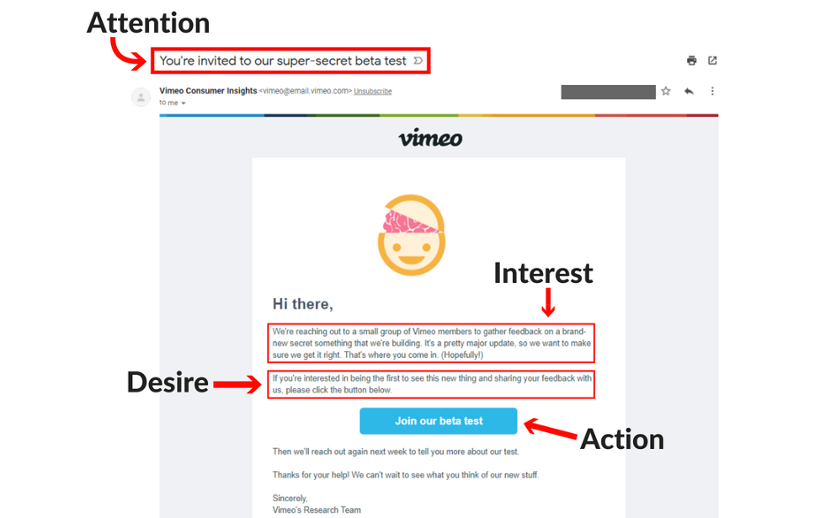
It powerfully distills the sales process, describing the journey of getting someone’s attention, all the way to getting them to take action.
Template:
Hi [Prospect Name],
If you’re like most [lead’s role], you know how hard it can be to [deal with the problem your company solves].
Our [product/service] eliminates the stress and improves this by [one-sentence pitch]. Here’s what [customer] has said about us:
[customer testimonial about the problem]
Would you also like to have [the benefit of your product]? If so, will you email me the best time to call you next week?
2) The BAB Formula
Before — Describe the current issue or problem a lead is facing.
After — Paint a picture of what having the problem removed or the situation improved looks like.
Bridge — Show how your offer solves the problem and betters their lives, and present your value proposition on the highest level.
What motivates you?
Money, success, or maybe the fear of failure?
Research has shown that our motivations stem from two primal drives:
Seeking pleasure
Avoiding pain
The before-after-bridge formula harnesses the power of motivation to create compelling B2B cold emails that trigger a response.
Best used when: You want to highlight transformation and show a clear before-and-after outcome.
Why it works: This framework leverages motivation psychology by contrasting pain with a better future and positioning your offer as the bridge.
Here is an example of a cold email using the BAB formula.
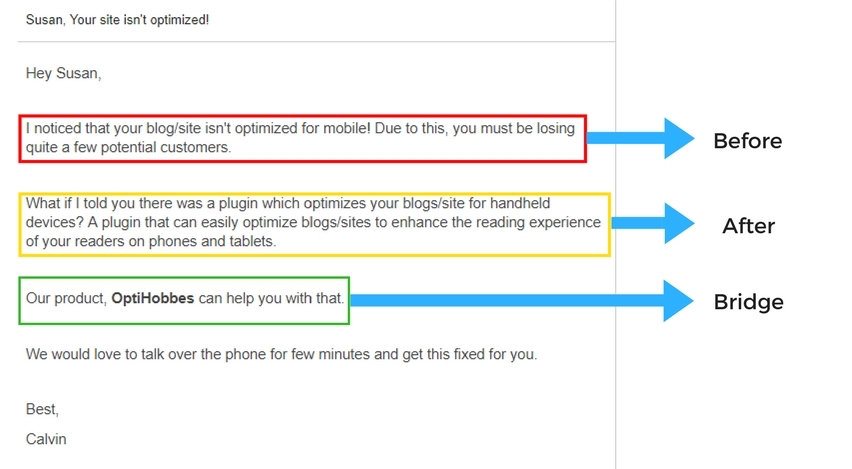
It highlights your product as the medium to the “pleasure” that is to be “sought”.
Here's our version of that B2B email template.
Template:
Hi [First Name],
What would you [or leads company] do with [the big benefit of your product/service]?
Does that seem unrealistic? Well, it’s happened to more than a few of our customers.
Including [your customer] who [insert benefit or success stats] when they used [your product/service].
As you might have noticed, both companies are similar in size and industry to [lead’s company].
I’m confident [your company] can get you similar results.
Would you have some free time next week for a personalized demo?
3) The PAS Formula
Problem — Vividly highlight a problem that causes the prospect’s pain/frustration.
Agitate — Agitate it. Explain the consequences of it happening.
Solution — Offer a solution to remove/avoid the pain points caused by said problem.
While the BAB formula has a positive approach, the PAS is the opposite. It relies on the “avoidance of pain” to motivate a response.
Best used when: Your audience strongly feels a specific problem or frustration.
Why it works: PAS focuses on pain avoidance — a strong motivator in B2B decision-making.
Here is an example of the PAS formula used in cold email outreach from the Salesfolk.
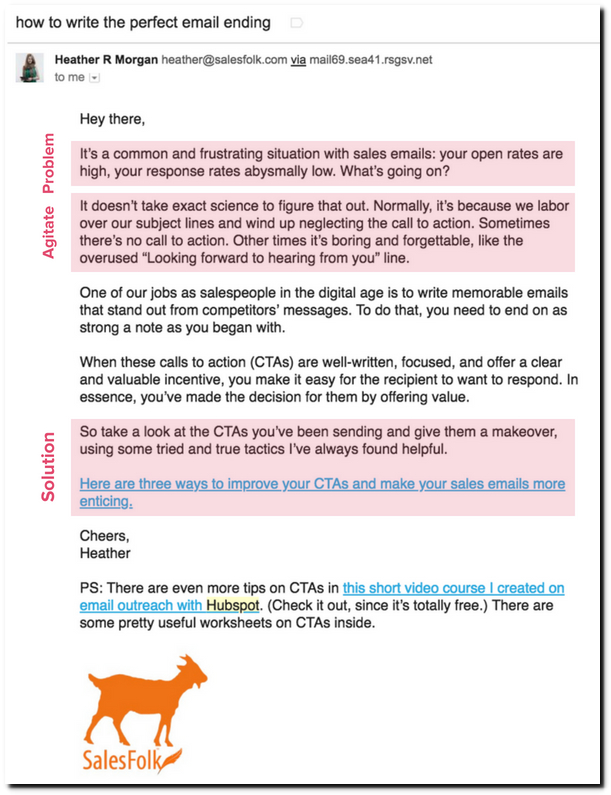
Here's the Leadfeeder version of that B2B email template.
Template:
Hi [First Name],
Does your [lead’s company] suffer from [painful problem]?
It’s a tough issue to overcome, and something most [companies in your lead’s industry] suffer from. And it can cost [stat or research to agitate a painful problem].
Our [product/service] helps you avoid this with [benefit /one-sentence pitch].
I’d love to show you more. Are you open to a call at [date and time] next week?
4) The SAS Formula
Star — Introduce the star of your story (remember, a good intro is 80% of success). This could be you, a customer, or another business or person.
Arch — Describe the star’s journey, who is —or should—be facing a similar problem to your lead.
Success — Reveal how the star wins in the end or is better off (linking back to your cold product/service of course).
Humans love stories. We thrive on them, use them to teach, caution, and entertain.When we’re involved in a story, the parts of the brain responsible for touch, sight, smell and sound fire up.
We feel the words we read and empathize with those who we read about.The SAS formula creates a story that strengthens your cold email template. It works particularly well with case studies, personal experiences, and success stories.
Best used when: You have a strong customer story or case study.
Why it works: Storytelling creates emotional engagement and helps prospects see themselves in the success narrative.
B2B email template:
Hi [First Name],
In the latter half of [year], the future was looking bleak for [star person/company].
With [cause of the problem/arch] [star] needed to [get results related to your product/service].
A tough task, considering [cause of the problem/arch]. So how did [star] win?
[Short sentence on the star’s triumph, (the triumph should relate to your product/service)].
[Your company] specializes in [product/service that helped star win].
We’ve helped [company 1] and [company 2] do this.
I have a personalized template to help you [benefit]. Can I send it to you?
5) The Relevant Question
Asking a quick question is a great way to quickly deliver a cold email.But generic questions don’t work.
A question-based B2B cold email must be specific and relevant to your lead.When done right, it works by:
Implying that the message will be low commitment and not excessively time-consuming
Piquing curiosity and promising an answer
If you know your buyer persona well, you should be able to easily come up with a question that zeros in on their key pain point.
Best used when: You want a low-friction opener that encourages quick replies.
Why it works: Questions trigger curiosity and imply a low-commitment interaction.
B2B email template:
Hi [First Name],
Want to see how you can instantly [benefit of your product]?
I know you’re busy working to [the end result your product/service helps with], so I’ll make this quick.
I’m the lead [role at your company], and I’ve got a few suggestions to help you immediately generate some quick wins with [area your lead is working on]. Here they are:
[Tip 1]
[Tip 2]
You might not have the time to do this though, and that’s where [your company] can help. Would you like a quick 15-minute session during the next week so I can walk you through the tips and discuss this further?
6) The “You’ve Been on Our Site” Sales Email
This is a simple cold email template to a lead who’s visited your site. Most of our users utilize this type of cold email template after signing up for Leadfeeder.
Given that they’ve already expressed interest and given you attention, their “warmth”, plus this B2B cold email template, increases the chances of a response.
Best used when: A prospect has already engaged with your website.
Why it works: It turns a cold lead into a warm one by referencing existing interest.
Here’s how to acknowledge someone’s been on your website without being creepy.
B2B email template:
Hi [First Name],
You recently visited [your website] and [took this action].
If you’re interested in [content topic/product page visited] then I can recommend the following additional resources:
[additional resource 1]
[additional resource 2]
Our company also offers [product/service] which could help you [achieve this specific result].
Are you free for a call at [date and time] to talk about this?
7) The “Better Way To” Email
If someone is looking for a product or service, it’s because they want to find a better way to execute a strategy that is causing them problems.
The “better way” cold email focuses on identifying the one issue or bottleneck your lead faces and showing how your product/service solves it. Simple, but very powerful.
The more relevant and timely this message is, the higher its chances of securing a response.
Best used when: You solve a known inefficiency or outdated process.
Why it works: Positioning your offer as a simpler alternative makes decision-making easier.
B2B email template:
Hi [First Name],
With the new Google updates and penalties, working around them by [better way to deal with problematic bottleneck or issue] is time-consuming.
Our [company app service] has developed a way that lets you [fix a bottleneck or issue] without [cost of a less-optimal way to fix a bottleneck or issue].
We’ve helped companies like [company name] achieve [results of the better way].
Are you able to lend me your ear for 15-20 mins this week? I would love to see if we can help you, too.
8) The Competitor Satisfaction
If your prospect is actively in the buying cycle, it means they’re already looking at your competitors, too. Don’t ignore this fact. Use it to your advantage.
This sales email template gives you the chance to show leads why you’re different/better than a competitor they’re using or researching.
Don’t make the mistake of bad-mouthing competitors. Combine a neutral tone with your USP to explain why you might be a better fit.
Best used when: Prospects are already using or considering competitors.
Why it works: It opens comparison naturally without sounding aggressive.
B2B email template:
Hi [First Name],
So I was browsing your website and saw that you are using [competitor’s product]. How is it working out for you? I work for [your company].
Our [product] is similar to [your competitor’s product], only our customers report we’re better with [key USP and differentiators]. This might work better for [lead’s company].
I would love to hop on a quick call with you and see if we could make [lead’s company] better.
How does [date and time] work for you?
9) The Valuable Resource
Not all of your cold emails will immediately ask for meetings and calls. You’ll often need to break the ice and generate trust first.
And that’s what the valuable resource email does.
This is especially effective with B2B cold emails because - when timed right - you have the chance to appear on your lead’s radar while they’re in the “research” phase.
Best used when: You’re nurturing leads early in the buying journey.
Why it works: Providing value first builds trust and lowers resistance.
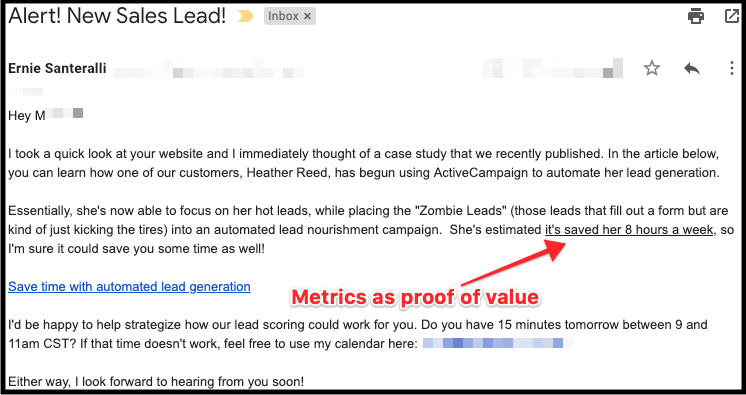
Here is an example of a cold email template pitching a resource.
B2B email template:
Hi [First Name],
I enjoyed your post on [site], and I found it very useful. It left me with some practical ideas to implement here at [your company name].
I thought I’d return the favor and give you something useful too. I found this article on [article topic] that may be beneficial to you.
Here’s the link to check it out [link].
I hope it helps you and your team.
10) The Gatekeeper/Wrong Person Bypass
Cold emails that ask for “the right contact” and “appropriate person” are often deleted and ignored.
To avoid the same fate, show you’ve done your research and have spoken to other colleagues your lead may know.
Why does this have a better chance of working?
Instead of appearing like you’re selfishly searching for a target to pitch, you mention familiar names and provide a valid reason as to why you’re contacting them specifically.
Best used when: You’re unsure who owns the decision.
Why it works: Shows research and reduces friction compared to generic “who handles this?” emails.
B2B email template:
Hi [First Name],
I’m [your name] and I [state your role] at [your company].
I know you’re busy, and you probably receive plenty of emails asking for the right person to speak to, but I really believe we can help [lead’s company]. We [insert one-sentence pitch on what your solution does].
Based on your profile at [link to, or mention profile], it seems that you might be the right person to speak to, or at least point me to the right person about [problem your product solves].
If that’s you, are you open to a quick 10-minute call on [time and date] to discuss how we can support your business? If it’s not you, will you kindly direct me to the right person?
P.S. I’ve also reached out to [relevant person 1] and [relevant person 2]. We’ve helped companies like [insert your customers] to [positive result you’ve helped achieve], and I would love to help [lead’s company] do the same.
11) The Recent News
The recent news cold email example helps you break the ice and establish first contact.
You email a prospect about a recent review, piece of news, or win they’ve had, then let them know who you are and why you’re emailing them.
The easiest way to find relevant news is to utilise Trigger Events from a product like Leadfeeder, or read more here about the most important trigger events that help you boost your B2B Sales.
Best used when: Your prospect recently achieved something noteworthy.
Why it works: Relevant timing makes outreach feel personal and natural.
Here is an example from Chris Bibey, a content specialist.
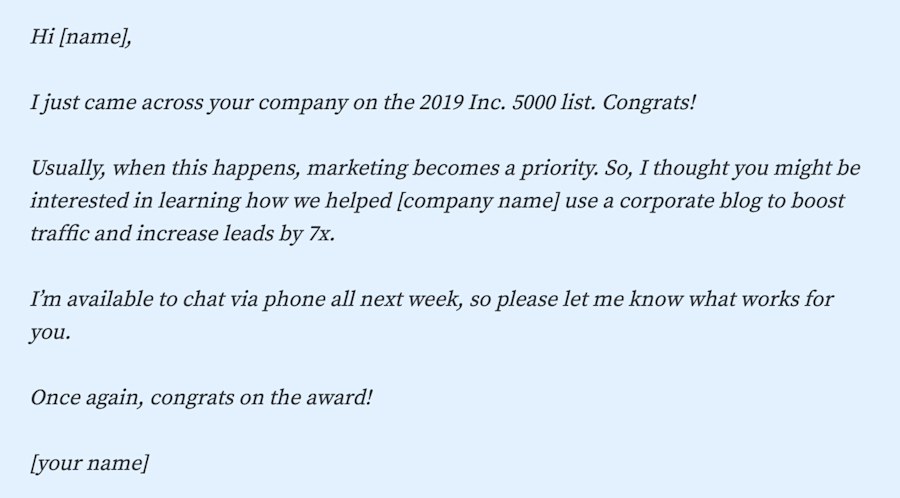
In the email above, Chris booked three calls and closed one deal. Not bad!
B2B email template:
Hi [First Name],
Congratulations on your recent round of funding!
Your shining reviews on [insert link or mention site] say a lot about your team. It’s clear that you’re going to make an impact on the [insert industry/market] soon.
I just wanted to say congratulations, and I look forward to more good news about [their company].
My name is [your name], I work at [your company], and we [one-pitch sentence]. If you need anything at all, just give us a shout.
12) The ‘We Help Famous “X”, We Can Help You’ Email
Social proof reduces friction and makes it easier for leads to take action. If you have high-profile customers that your prospect will relate to, use them as social proof.
Jake Jorgovan sent this email that landed him a $4,250 client.
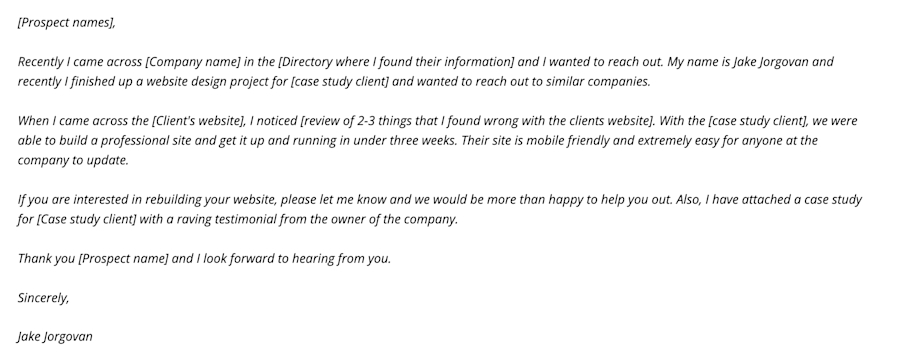
Show your numbers and how you’ve helped, then translate this into your ability to help your prospect's company.
It doesn’t have to be a Fortune 500 company; it could be a happy customer your prospect is familiar with. We already know that relevance is key to the best B2B cold email examples.
Best used when: You have recognizable clients or strong results.
Why it works: Social proof reduces risk and builds instant credibility.
B2B email template:
Hi [First Name],
I know you’re busy, so here’s the deal:
I recently helped [insert popular company you helped] to [result you helped achieve].
This is one of [your company ]'s biggest success stories to date.
We’ve also received glowing reviews from the likes of [company1] and [company2]. I’m emailing you because I think we can [insert benefit/pitch] for [lead’s company] too. How do you feel about a 5-minute phone call next week?
13) The “Love Your X” Email
Doing flattery wrong will get you nowhere — usually because it is an exaggerated and insincere style of flattery that signals an incoming sneaky sales pitch.
But, an honest credible compliment on something your lead created should definitely be part of your sales email template.
This is where good prospect research and real personalization will build rapport.
Best used when: You want to build rapport through genuine personalization.
Why it works: Authentic compliments lower sales resistance and humanize outreach.
B2B email template:
Hi [First Name],
I saw your content on [platform]. I loved it so much I shared it with my [team, boss, friend].
You guys are doing great things. I like how you [ specific compliment on something lead or lead’s company published or did]. And I know you’re busy, so I’ll make this quick:
We’ve spent over two hours creating a personalized demo for [company] on how to [achieve result]. I would love for you to have a look and let us know if you find it useful at all.
14) The “Up to You” Email
Do you know the number one turn-off for prospects?
Being pushy.
By relinquishing control completely to your prospect, this B2B sales email template encourages a response by silencing the “salesy” edge in your cold email outreach.
Best used when: You want a low-pressure, non-salesy approach.
Why it works: Giving control to the prospect reduces resistance and encourages responses.
B2B email template:
Hi [First Name],
I just found you through your [site/social media profile].
I see that you’re climbing the ranks on Google, and deservedly so :). I’m an [expert/job role] at [your company] and realized you could reach page 1 faster by implementing these 2 tips:
[Tip 1]
[Tip 2]
There’s a third tip, but I don’t want to overwhelm you. If the first two help, do you want me to send you the third?
If not, I understand. No hard feelings.
Key Components All the Best Cold Email Examples Share
So, there you have it: 14 cold email templates for any B2B firm to try out and personalize to their own needs. What if you want to try building your own templates, though?
In that case, you need to understand the four key components that every good cold email example shares:
An engaging subject line: Your subject line is what has to first captures your lead’s attention and persuades them to open your message.
Personalized and relevant copy: The body of your message must be highly relevant and tailored to its recipient. Keep in mind the need to provide value to them.
A clear call-to-action: You must make it obvious to your lead what their next step is after reading your cold email; whether that’s downloading a white paper, booking a sales call, or something else entirely.
Follow-ups: No cold email should stand alone. Make sure to define a strategy for following up on the messages you send — via further messages, social media contact, or a call.
Best practices: How to Make the Most of Any Cold Email Template for Business
Choosing the most effective cold email template and ensuring your message has the four components above is just the start. Then you have to tailor the content to fit perfectly. Here are some proven B2B cold email best practices to help you on your way:
#1: Write catchy subject lines
Your subject line determines whether your B2B cold email gets opened—or ignored. If it doesn’t spark interest, your chances of a reply drop to zero.
The key is making it clickable without sounding spammy. Here’s how:
Keep it short. Studies show that subject lines with three, seven, or eight words get the highest open rates. Shorter lines also avoid getting cut off on mobile.
Spark curiosity. Don’t reveal everything. “Meeting at 10?” is more compelling than “Are you willing to meet at 10 for a demo?”
#2: Keep it short, under 50 words is best
Just as with the subject line, the content of your messages should also be short and to-the-point. Brevity is key to successful cold emails; messages of fewer than 50 words often perform best.
Leads are busy, and their inboxes are inundated with pitches and offers. Articulating value with fewer words helps you win and keep attention.
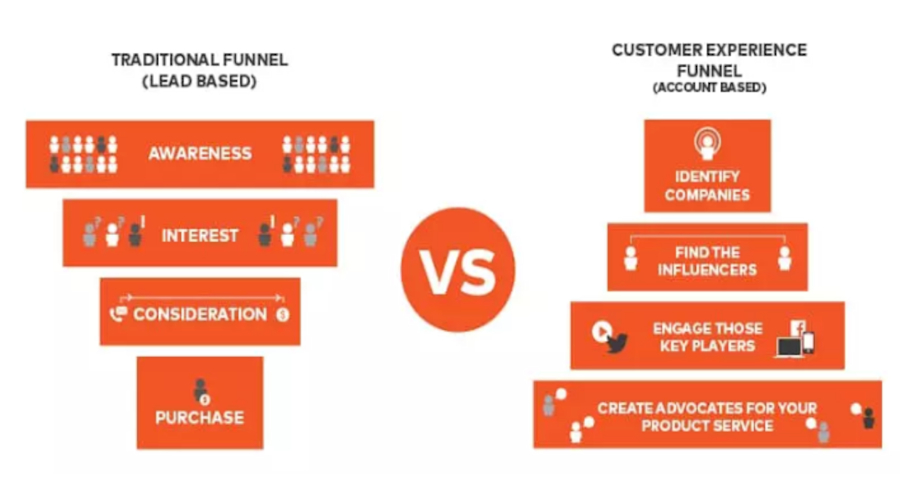
#3: Personalize, and lean towards an account-based marketing approach
“Dear customer” is the fastest way to get ignored. Generic greetings and copy-paste templates feel robotic and forgettable.
Instead, personalize your emails. Reference a prospect’s recent LinkedIn post, blog comment, company update, or even a hobby they share publicly. Small, relevant details make your message feel human and intentional.
To take it further, adopt an account-based marketing (ABM) approach. Rather than casting a wide net, sales and marketing align to target a select group of high-value accounts. Messaging, campaigns, and content are tailored specifically to those companies and key decision-makers, focusing on relevance over volume for stronger ROI.
#4: Use short paragraphs and sentences
Did you read every single sentence leading to this question?Your online reading habits are atypical compared to most people, who typically scan content, focusing only on information that’s relevant and useful to them.
To make your cold email easier to scan and digest, stick to 2-3 sentence paragraphs with short, simple sentences.
#5: Have a simple, single CTA
The more options you present, the harder it is for a lead to make a choice.This is known as "The paradox of choice."
Not only do excessive links and attachments flag your email as spam, but they also trigger the effects of too much choice, taking action becomes harder for the recipient.
Funnel your message down to one main point, and guide your lead to one call to action.
#6: Experiment with GIFs and emojis to emotionally engage
People buy from people they like. B2B emails can feel stiff and overly “corporate,” but there’s always a real person on the other side of your message. Adding a touch of personality can make your outreach more memorable.
Consider using a well-placed emoji, image, or lighthearted GIF to add warmth. For example:
“Let me know if there’s anything you need. I’m here to help.”
Supportive? Yes. But paired with a subtle, playful GIF, it becomes more engaging and human. Used sparingly and appropriately, visuals can catch the eye, reinforce your tone, and make your email stand out in a crowded inbox.
#7: Internalize the follow-up
80% of sales require an average of five follow-ups. But the shocking thing?After just one attempt, 44% of salespeople fail to follow up.
In recent research, the Woodpecker team found that the optimum number of follow-ups in a cold email campaign is two-to-three. Following up just once can boost a campaign's reply rate by 22%.
Prospects are busy, they may not have the time to respond promptly, and even if they intend to reply later, they may forget to do so.
#8: Proofread your cold email
Ensure you have the basics correct.
Fact-check the name, job role, and company of your lead. And, avoid basic spelling mistakes or incorrect information.
#9: Use a custom domain email address
A cold email from a generic address instantly looks like spam. Always send B2B outreach from your company’s official domain.
Here’s why it matters:
Stronger first impression: A domain-based email signals professionalism and credibility from the start.
Better brand recognition: Your company name appears in every message, making it easier for recipients to recognize and find your emails later.
Improved security: Custom domain emails typically include added protections like SSL encryption and private hosting.
Higher deliverability: Sending from your own domain reduces the risk of landing in spam and meets standard B2B expectations.
In short, a custom domain builds trust before your prospect even reads the first line.
#10: Comply with data and cold-outreach laws
While cold emailing is legal, you may breach laws such as the General Data Protection Regulation (GDPR) and Privacy and Electronic Communications Regulations (PECR), depending on how you obtain, process, and store your B2B data.
GDPR and PECR apply if your target email recipients are in Europe or your company is based in Europe. GDPR requires you to collect data legally and secure it from exploitation or misuse.
You must obtain your prospecting data legally, such as through extensive target market research or partnering with a B2B lead generation company like Leadfeeder. Avoid scraping email contacts from websites using random prospecting software.
PECR also prohibits you from sending unsolicited commercial messages. To comply with PECR, you must ensure your cold B2B outreach isn’t seen as spam. To clearly make this distinction, you must:
Personalize your cold emails
Send them to a curated email list, not as mass emails
Do not write clickbait subject lines
Focus your cold emails on the recipients’ pain points, not your product
#11: Provide verifiable, data-based proof of your claims
In B2B sales, credibility is everything. Decision-makers research thoroughly before committing, and the buying cycle is longer than in B2C.
If you make claims about your product or service, back them up with clear, verifiable data, such as metrics, case studies, results, or testimonials.
In a cold email, keep it concise. Add a link to a product page, case study, or proof point that validates your claims. This gives prospects an easy way to fact-check your message and evaluate whether your solution truly addresses their pain points.
How to use Leadfeeder to Improve Your Cold Email Templates and Boost B2B Sales
Leadfeeder is the B2B SaaS solution that identifies companies already visiting your website.
Using Leadfeeder, you can see what your prospects are interested in and begin to truly understand who they are. This will reduce your time prospecting and help you start a good conversation.
How? For starters, you can create more personalized cold email templates.
For instance, Leadfeeder shows how companies reach your website. So, you might see that a specific company visited Leadfeeder.com from a paid search campaign for the keyword “who visited my website”.
Sales reps can use this information to personalize their cold email outreach and connect the dots from the keyword the prospect searched to their current pain point and need.
Voila, a relevant and timely cold business development email!

Director of Content Marketing @ Leadfeeder
Jamie Pagan is Director of Demand at Leadfeeder, where he leads demand generation and pipeline growth initiatives. His work focuses on connecting marketing activity with revenue by combining intent signals, campaign performance data, and audience insights.
With experience building scalable demand engines and launching growth-focused campaigns, Jamie brings a practical perspective on how marketing teams generate and capture demand. His experience working with intent data and marketing analytics informs his approach to identifying high-intent buyers and converting interest into qualified opportunities.