60-Second Summary
Paid media is getting more expensive and B2B buyers have gone quiet, favoring independent research, peer recommendations, and dark social. Your website remains the owned, persistent asset where intent is validated and the only place that consistently generates the raw signals AI and other channels rely on.
Key takeaways: The website is the stable, owned channel AI hasn’t displaced—it's where buyer interest becomes proof. Visitors often leave no CRM trace, but their page behavior reveals company-level intent you can act on.
Standout strategies & tactics: Treat site activity as live intelligence—identify in‑ICP companies visiting high-value pages (pricing, case studies), build audiences from those accounts, and prioritize timely, contextual outreach rather than relying on form fills.
Real-world lessons & frameworks: Move attribution from anonymous clicks to account-level signals, measure which companies campaigns attract and how they behave, and apply the same site-intent signal across marketing, sales, and customer success to reduce wasted spend, improve outreach relevance, and spot expansion or churn earlier.
*This summary was created with AI assistance, using our original content.
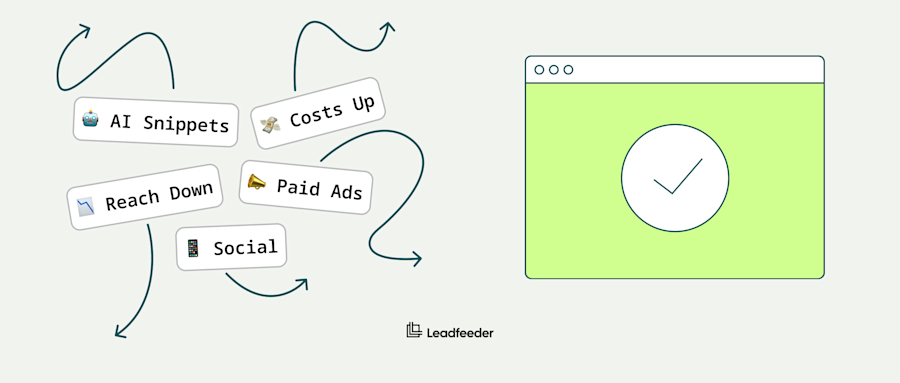
Social reach is pay-to-play. Paid media costs more and delivers less. And buyers themselves have gone quiet. Inundated with irrelevant outreach — 73% of B2B buyers now actively avoid suppliers who send it (Gartner, 2025) — they've retreated into independent research, peer recommendations, and dark social conversations that leave almost no trace.
If you're rethinking website strategy for B2B right now, it can feel like every channel you relied on is either getting more expensive, less reliable, or both.
But here's what nobody is talking about: one asset didn't move.
The B2B website growth strategy AI hasn’t disrupted
While paid, organic, and social were being rewritten, the website kept doing its job.
The website is where your campaigns land. Where your sales reps send prospects. Where your content lives, your proof points sit, and where interest quietly takes shape into something closer to intent. It doesn't matter whether your go-to-market motion is inbound, outbound, or everything in between — what I like to refer to as allbound — the website is always involved.
And unlike every channel in your stack, the website is real estate you own completely. It sits outside the reach of platform algorithm changes and third-party rule shifts. You control the message, the experience, and, critically, the data it generates.
AI didn't make the website less important. It only made it more important. The answers that AI tools generate — the ones reducing clicks on your organic listings — are largely trained on website content. Your website. Your competitors'. Your category's. The quality and authority of what lives on your domain is now shapes how AI describes your market, your product, and your value. That's not a reason to panic. It's a reason to take what you publish there more seriously than ever.
Bain & Company estimates that zero-click search is already reducing organic web traffic by 15–25% across industries. The irony is that the content feeding those AI answers still lives on websites.
And the website is still where buyer trust is validated. A potential buyer might first hear about you from a peer, a podcast, or an AI-generated summary. But before they take any action — before they agree to a meeting, share a budget, or put your name in front of their CFO — they go to your website. It's the moment of proof. The place where interest either becomes confidence or quietly disappears.
Your B2B website content strategy isn't the problem. It's what teams do with it.
The website is one of the most resource-intensive assets marketing owns. It's the time spent creating content. The budget behind campaigns, design, and development. The ongoing effort to keep pages updated, messaging sharp, and proof points relevant. Entire teams are built around producing and managing what lives there.
Then, on top of that, you pay to get people there — through paid media, SEO, social, partnerships, and outbound. So you're investing twice: once to build the destination, and again to fill it with visitors.
And yet, in most cases, the moment those visitors arrive and don't convert, the value stops there. Most teams build a marketing strategy for B2B website traffic that stops at the click, investing heavily in driving visitors, then waiting for a form fill that increasingly never comes.
That's the gap. And it's costing leads and pipeline.
Today's B2B buyer does not fill in a form until they're ready to talk. According to 6sense's 2025 buyer research, 83% of buyers mostly or fully define their purchase requirements before ever speaking to a sales rep. They research. They compare. They revisit. They share your pricing page with a colleague. They read your case studies at 11pm. They do all of this in near-total silence, leaving no CRM record, no lead, no trace as far as most teams can tell.
But they leave a signal. Every company that visits your website tells you something: what they care about, where they are in the decision process, and whether they're moving closer to a conversation. That signal exists whether you act on it or not.
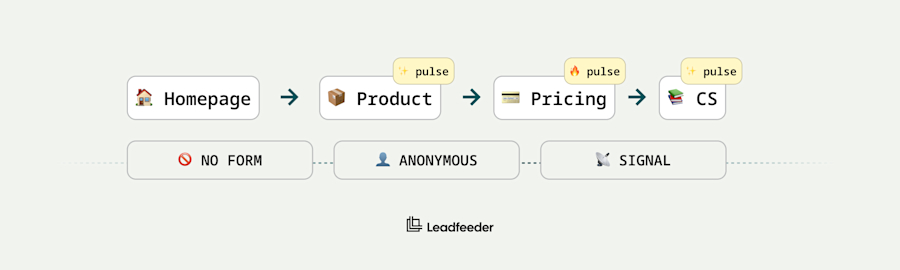
This is the missed opportunity: treating the website purely as a distribution endpoint, rather than focusing on what comes after. Because the real value isn’t just getting someone to your content. It’s what you do once they’ve engaged with it.
Most teams don't act on it — not because they don't want to, but because they never had a reliable way to read it.
What it looks like when you close the gap
When you treat website activity as live intelligence rather than a traffic report, three things become possible that weren't before:
1. Build better audiences. Instead of targeting broad job titles and hoping for the best, you're activating campaigns against companies already showing interest in your category. That's not just more efficient spend; it's fundamentally different targeting logic. We are doing this with our own team. Because not every visit is someone ready to buy, and our job in marketing is also to nurture those who are in the initial stages.
2. Prove campaign impact in a language the business understands. Not clicks and impressions, but which companies arrived at your site from which campaigns, whether they match your ICP, and what they did when they got there. Attribution that connects marketing activity to real accounts, not anonymous sessions. We are also looking at how this trends over time — are we getting fundamentally better or worse at attracting in-ICP traffic, and by which campaigns.
3. Convert intent into qualified leads. When a company in your ICP visits your pricing page three times in a week, that's not a coincidence. That's a signal worth acting on. And when sales reaches out, they're not reaching out cold. They know which company, which pages, how often, and when. That context changes the entire nature of the conversation from an interruption into relevant, timely outreach. Our sales teams know this use case inside and out — we’ve been doing it for years — but it doesn’t make it any less powerful, only more meaningful in today’s environment.
One signal that runs across the full revenue team
Most conversations about website intent start and stop at demand generation. Marketing captures the signal, passes it to sales, job done. But the signal doesn't stop being useful once someone becomes a customer.
An existing customer repeatedly returning to your pricing page might be re-evaluating their contract. One spending time on a product feature they don't currently use could be ready to expand. A customer who suddenly goes quiet on the site after previously high engagement is worth a check-in from CS before it shows up in churn data.
Website intent is one of the places where an allbound ethos comes to life in practice. The same signal, read differently by different teams, produces coordinated action across the full revenue cycle:
Marketing uses it to build audiences, optimize spend, and prove impact.
Sales uses it to prioritize outreach on accounts already showing intent, with the context to make that outreach relevant.
Customer Success uses it to spot risk early and find expansion opportunities before they're obvious.
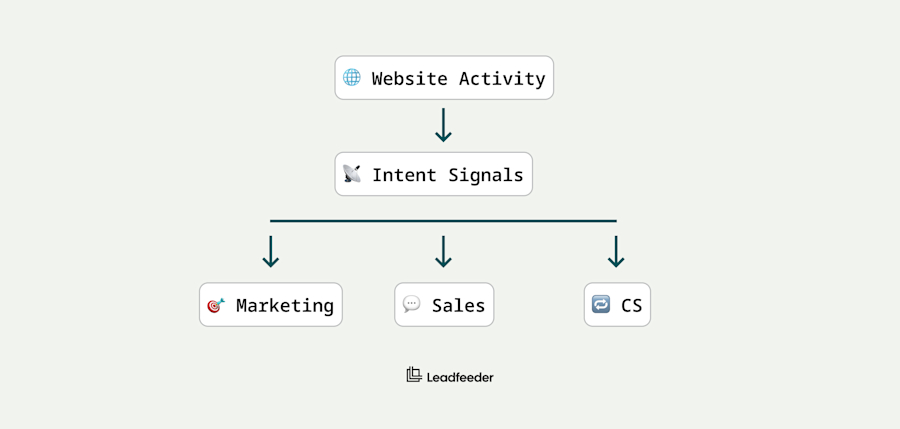
Same asset. Same signal. Applied with purpose across every team that touches revenue. That’s allbound, and marketers sit with the key. It’s giving marketers the clarity to help the entire organization drive growth.
Why we built what we built
This is why Leadfeeder exists, and why we've refocused the company around this thesis.
The website has always been the most reliable foundation for lead generation. What's changed is everything around it. With paid channels getting more expensive, organic increasingly mediated by AI, and buyers harder to reach than ever, the intelligence sitting in your own domain is more valuable than it's ever been — and still, by most accounts, being left on the table.
You already have the most intelligent asset that tells you what's working and who's ready — the signals on your website.
The question is whether you're listening.