60-Second Summary
B2B email still delivers exceptional ROI in 2026, but the playbook has shifted: opens are unreliable, authentication and corporate scanners matter, and AI noise makes relevance essential. Treat email as an interconnected system of lifecycle sequences, sales coordination, and technical hygiene rather than a single broadcast.
Key takeaway: Email remains the highest‑ROI B2B channel, but measure impact by clicks, replies, and pipeline influence (not opens); prioritize list quality, consent, and deliverability.
Standout strategies & tactics: Build parallel lifecycle programs (onboarding, nurture, ABM, PLG), coordinate timing with SDRs and ads, warm domains over 45–60 days, enforce SPF/DKIM/DMARC, and use separate domains for cold outreach.
Real‑world frameworks & lessons: Segment by account tier, role, lifecycle stage, and intent; map the buying committee and tailor messaging/CTAs for each role; use micro‑yes CTAs and 90‑day nurture/ABM sequences to move pipeline.
Measurement, compliance & operational playbook: Focus on CTR/CTOR/reply rate, meetings booked, and influenced pipeline; apply UTMs + CRM campaign sync and a documented attribution model; follow CAN‑SPAM/GDPR/CASL rules, prefer double opt‑in where required, and keep spam complaints <0.1%.
*This summary was created with AI assistance, using our original content.
In 2026, the inbox is harder to reach. Apple Mail Privacy Protection (MPP) has broken open rate tracking. Google, Yahoo, and Microsoft all tightened sender authentication enforcement. AI-generated content is flooding inboxes. And corporate security filters are clicking your links before any human sees them.
The good news: B2B email still works exceptionally well when you treat it as a system, rather than a broadcast channel.
In the following guide, you’ll get the full playbook of how to do email marketing in 2026, from strategy and compliance to deliverability, lifecycle architecture, and revenue attribution.
What is B2B email marketing today?
B2B email marketing is not just a newsletter you send once a month. It is a system that supports demand creation, demand capture, pipeline acceleration, and customer growth simultaneously.
That includes lifecycle emails, product onboarding sequences, sales-support touchpoints, re-engagement campaigns, and ABM outreach, all running in parallel and connected to your CRM.
93% of B2B marketers use email to distribute content, making it an infrastructure rather than a campaign type.
What makes B2B email marketing different from B2C
The mechanics may look similar, but the strategy is completely different.
Dimension | B2B | B2C |
|---|---|---|
Sales cycle | Weeks to months | Hours to days |
Decision makers | 3 to 10+ people | Usually 1 |
Primary goal | Pipeline and revenue influence | Conversion and purchase |
CTA type | Demo, download, call, benchmark | Buy now, shop, claim offer |
Segmentation | Role, company tier, deal stage | Behavior, purchase history |
Content depth | Educational, ROI-focused | Emotional, aspirational |
Fun fact: B2B emails have a 23% higher click-to-open ratio than B2C, which reflects the difference in intent. B2B recipients who open and click are more deliberate.
The role of email in inbound, outbound, ABM, and PLG
Email serves different purposes depending on how your business earns and expands its customer base.
Inbound nurture: Automated follow-ups keep leads warm after a download or demo request. Helpful content stays in their inbox until they show enough intent for a real conversation.
ABM sequences: Coordinated efforts focus on a handful of high-value accounts. Every touchpoint is personalized across email, LinkedIn, and calls to build a long-term connection.
PLG activation: Messages are triggered based on users' actions within the software. Nudges guide people toward their first aha moment, helping them quickly see the product's value.
Sales-assisted outreach: Marketing provides educational context and SDRs handles 1:1 outreach. Shared timing ensures the prospect gets a consistent story without feeling bombarded from all angles.
Is B2B marketing still effective in 2026?
The short answer is yes, but with caveats. The channel's fundamentals remain strong. What has changed is the way you measure results, protect deliverability, and differentiate your program amid an inbox full of AI-generated content.
Here’s what the current data shows.
Key stats on ROI, engagement, and channel preference
Email delivers an average ROI of $36 for every $1 spent, making it the highest-ROI channel in most marketing stacks
59% of B2B marketers rate email as their most effective channel for revenue generation
73% of B2B buyers prefer to be contacted via email, more than any other channel
81% of B2B marketers use email newsletters as their primary content distribution method
Automated emails generate 320% more revenue than non-automated sends
The catch: engagement measurement is broken.
Apple MPP accounts for roughly 50 to 60% of reported opens in many lists. Up to 64% of Apple Mail users now have MPP enabled, meaning Apple preloads email content and fires your tracking pixel before a human ever sees the message.
Open rate just isn’t a great signal of engagement anymore. But don’t worry, we’ll cover more on what to measure instead later.
Where email Works, and where it doesn’t
Use email for:
Long buying cycle lead nurture and education
Getting dormant contacts or churned customers to re-engage
Product onboarding and feature adoption
Warm contacts up before an SDR call or LinkedIn touchpoint
Customer expansion and renewal
Use other channels when:
You require fast, net-new awareness (paid, LinkedIn)
The compliance makes it quite hard to reach cold contacts
Real-time community engagement (like Slack and Reddit)
Common myths vs. reality
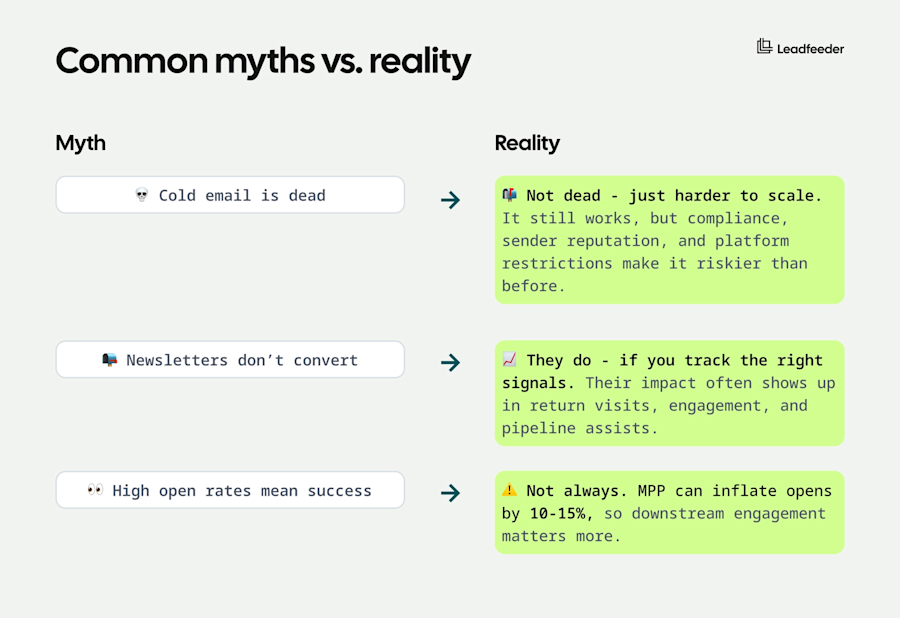
"Cold email is dead"
Emailing cold leads isn’t dead, but it’s riskier due to regional compliance rules, requirements for domain-reputation, and Gmail/Microsoft's increasingly unsustainable stance on high-volume cold outreach.
“Newsletters don’t convert”
They do, if you test them properly. Newsletters generate return visits, intent signals, and pipeline assists. The bulk of the value lies in measuring beyond direct conversions.
"High open rate means the campaign worked"
MPP inflates open rates by 10 to 15% on average. An impressive open rate without downstream engagement is a canary in the coal mine, not an indication of success.
Foundations: Strategy, ICPs, and Buying Committees
Most underperforming B2B email programs share the same root cause: they were built without a clear strategy underneath them. Before you write a single subject line, you need to know who you are reaching, what they care about, and what you need email to accomplish for the business.
Having three elements, your goals, your ICP, and your buying committee map, form the foundation for your B2B email strategy.
Clarify business goals for email
Before building any program, define what email needs to do for your business.
Goal | Example KPIs |
|---|---|
Pipeline creation | MQL volume, SQL rate, meetings booked from email |
Pipeline acceleration | Stage-to-stage velocity, win rate assist, deal influence |
Expansion and retention | Feature activation rate, renewal rate, expansion pipeline |
Connecting email to pipeline metrics (rather than just open and click rates) is what earns budget and credibility with leadership.
Create an email ICP
Your email ICP is not just a sales ICP. It includes an 'email eligibility' layer.
Core ICP dimensions:
This includes firmographics like company size, industry, revenue range, and geography
Technographics such as current tools, integrations, and probable use cases
Event-based buying triggers such as funding rounds, headcount increases, and compliance deadlines
Pain points, such as what is costing them time, money, or risk
Email eligibility layer:
Consent status (opt-in vs. cold vs. implied)
Quality of the data source (how was this record obtained?)
Regional compliance risk (slightly stricter rules for EU, Canada, UK)
Data freshness (stale records decrease deliverability)
Account-level intent signals can help prioritize which ICP-fit accounts are actively researching your category. Tools like Leedfeeder reveal this kind of behavioral data at a company level.
Map the B2B buying committee
Most B2B deals involve input from multiple stakeholders before they can pull the trigger. Your email program needs to reflect that.
Role | Core concern |
|---|---|
Initiator | Identifies the problem, starts the search |
User | Day-to-day workflow impact |
Buyer | Budget ownership, vendor approval |
Decider | Final sign-off |
Gatekeeper | Controls information flow |
Influencer | Shapes the decision without formal authority |
Tailor messaging to each role
A one-size-fits-all email won’t resonate with anyone, because each member of the buying committee has their own focus.
Personalize your email messaging by perspective:
CFO & Finance: Prioritize the bottom line. Focus on payback periods and ROI. They need to see the math and the risk mitigation behind the purchase.
IT & Security: Highlight security compliance and integration ease to prove your tool won't break their stack or create a second job for their team.
End users: Solve the daily grind and emphasize workflow shortcuts and onboarding ease to show them how you’ll save them time rather than adding a new task to their plate.
Executive sponsors: Lead with the big picture. Stick to competitive advantage and revenue growth to show how your solution helps them hit their annual strategic goals.
Designing the architecture of your B2B email program
Knowing your audience is not enough. You also need a program structure that delivers the right message at the right moment across the full buying journey. Next, we’ll map out the core lifecycle stages, a practical 90-day build plan, and how to coordinate email with the rest of your go-to-market plan.
Core lifecycle stages and email types
Lifecycle stage | Goal | Trigger | CTA | Example types |
|---|---|---|---|---|
Awareness and lead capture | Build interest | Content download, webinar signup | Read, watch, benchmark | Welcome, lead magnet delivery |
Onboarding and activation | Reach first value | Trial start, signup | Complete step, explore feature | Onboarding sequence, milestone nudge |
Nurture and education | Build trust | Time or engagement signal | Learn more, assess, compare | Newsletter, use case, case study |
Evaluation and sales acceleration | Remove objections | Demo request, pricing page visit | Book call, review ROI | Objection handling, social proof |
Expansion, renewal, advocacy | Grow the account | Usage milestone, renewal date | Upgrade, renew, refer | Upsell, QBR prep, NPS follow-up |
A 90-Day sample email program
Week 1 to 2: Onboarding or first nurture sequence (3 to 4 emails). Establish value, confirm relevance, set expectations.
Week 3 to 6: Education and proof points. Build confidence with data, customer stories, and use cases.
Week 7 to 10: Evaluation support. Help them compare options, calculate ROI, and surface objections before a sales conversation.
Week 11 to 13: Conversion push or segmentation fork, separating engaged contacts from unengaged ones.
Frequency: 1 to 2 emails per week for active nurture. Drop down to biweekly for low-engagement segments. Triggered behavioral emails run on their own track.
Subject line swipe file (12 examples across stages):
Early nurture:
"How [company type] teams reduce [pain point] in 30 days"
"The [industry] benchmark report you've been waiting for"
"Your competitors are doing this. Are you?"
Mid-stage:
4. "How [customer name] went from [problem] to [outcome] in [timeframe]"
5. "3 questions to ask before choosing a [category] tool"
6. "The 10-minute [use case] audit"
Evaluation support:
7. "Still evaluating [category]? Here's what most people miss"
8. "The ROI calculator your finance team will want to see"
9. "A quick comparison guide (no spin, just facts)"
Late-stage and conversion:
10. "Ready to see it in action? Let's talk"
11. "What happens after your trial ends"
12. "One question before you decide"
Coordinating email with SDR Outreach, Ads, and LinkedIn
The campaign coordination checklist
Assign ownership for every message
Let Marketing handle the big picture education and background nurture, while Sales handles the direct, 1:1 outreach.
Sync your suppression rules
Set up a trigger in your CRM so that if a prospect replies to an SDR, all automated marketing emails pause immediately.
Standardize your tracking tags
Use identical UTM codes and campaign names across both teams. This is the only way to accurately see which combination of touches led to a deal.
Align your ad timing
Run LinkedIn ads at the same time as your email sequences. Seeing the brand in their feed makes the email in their inbox feel much more familiar
List building, opt-In, and compliance (without killing growth)
List quality is the single biggest factor teams underestimate. A smaller, well-sourced, properly consented list will consistently outperform a large, low-quality one on every metric that matters: deliverability, engagement, and pipeline.
Now, we’ll cover how to grow your list the right way, navigate the opt-in decision, and stay on the right side of global compliance without turning it into a full-time legal project.
First-party list growth tactics that work in B2B
The highest quality B2B lists come from high-intent, self-selected sources.
Getting the right people to sign up with:
Things like calculators, templates, or benchmark reports are gold. People will happily trade an email for something they can actually use in a spreadsheet.
Webinars and virtual workshops still work, but only if they solve a specific problem.
If you have a "freemium" or trial version of your tool, that’s your best lead source, period.
Short forms: Seriously. Every extra field you add kills your conversion rate. Ask for the basics now, and get the rest of their details (like company size or job title) later on.
Just tell people what they’re getting. Nobody likes a surprise daily newsletter they didn't ask for.
B2B Double Opt-In vs. Single Opt-In
There's no perfect choice here, but here’s how to pick:
Use double opt-in if...
You're doing business in the EU, UK, or Canada (stay legal!). It’s also great if you’ve been getting a lot of bot signups or fake emails that are messing up your stats. It’s a bit of friction, but the people who click that second link actually want to hear from you.
Use single opt-in if…
You’re running a high-trust event or a product signup where people are already motivated to get in. It's faster, and you won't lose people who forget to check their "Promotions" tab for a confirmation link.
Bottom line: Don't collect junk just to make the list look bigger. A small list of people who open your emails is worth way more than a massive list that ignores you.
Practical compliance guide
Regulation | Who it covers | Requirements | Operational steps |
|---|---|---|---|
CAN-SPAM (US | Commercial email to US recipients | Accurate From, clear opt-out, honor unsubscribes within 10 days | Unsubscribe in every email, suppress promptly |
GDPR (EU/UK) | Any email to EU/UK contacts | Lawful basis (consent or legitimate interest), right to erasure | Document consent basis, maintain preference center |
PECR (UK) | B2B email in the UK | Legitimate interest is permissible for corporate contacts in most cases | Document-based, easy opt-out, no deceptive identity |
CASL (Canada) | Email to Canadian contacts | Express or implied consent; implied expires (typically 2 years) | Track consent timestamps, remove expired implied consents |
This is operational guidance, not legal advice. Consult counsel for your specific situation.
If you do use cold B2B outreach, here’s how to do so safely
Cold outreach is an entirely different program to opted-in marketing. They require different domains (or subdomains), different tools, and separate measurements.
How to stay out of the junk folder
Do your homework on local rules: GDPR in Europe requires a legitimate interest case, and Canada's CASL is even stricter about consent.
Use a real name and a real reply-to address because people (and spam filters) can smell aliases and bots a mile away.
Make every email easy to opt-out from
The "spray and pray" era is over, so send personalized emails to small batches.
Don’t use your main marketing domain for cold outreach
Keep spam complaint rates below 0.1%; above 0.3% triggers Gmail filtering penalties
B2B Deliverability: How to land in corporate inboxes
Writing the world’s best emails is meaningless if they don’t land in the inbox. B2B deliverability in 2026 is more technically complex than ever, as leading email providers such as Google are tightening their authentication requirements, while corporate security filters add another layer of complexity.
Next, we’ll dive into the technical setup and domain warm-up, interference with security tools during delivery, list hygiene processes, and troubleshooting when things go south.
Technical setup checklist
This is no longer optional. Google, Yahoo, Microsoft, and Apple all now require bulk senders (5,000+ emails/day) to have SPF, DKIM, and DMARC in place. Gmail tightened to hard rejections in November 2025. Microsoft began enforcement in May 2025.
Use this checklist:
SPF record: lists all authorized sending sources for your domain
DKIM: cryptographic signature on every outbound email; use DKIM-first approach
DMARC: start at p=none (monitoring), progress to p=quarantine, then p=reject
Custom tracking domain: use a subdomain (e.g., click.yourcompany.com)
Valid PTR/reverse DNS records for sending IPs
One-click unsubscribe header (required by Google and Yahoo)
Spam rate: target below 0.1%
As rigorous as the requirements might seem, only 7.6 percent of domains actually enforce DMARC today. If you act on it, that gap can be your competitive advantage. Fully authenticated domains deliver 2.7x better to the inbox than unauthenticated senders.
Warming domains and IPs for B2B volumes
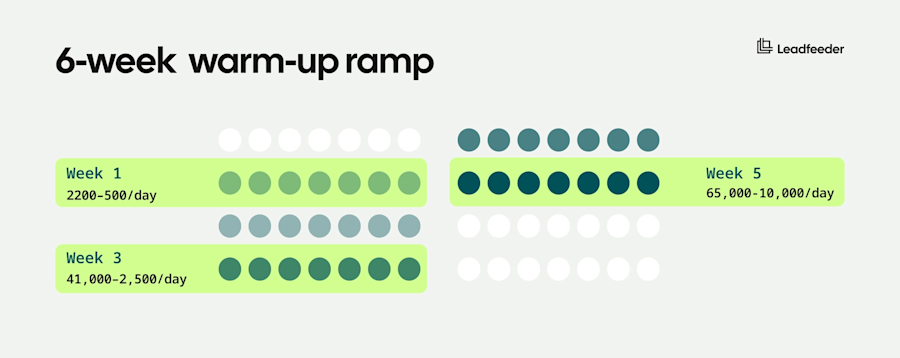
New domains have a 30-point inbox placement penalty vs. established domains. So, plan 45 to 60 days for warm-up:
Week 1 to 2: 200 to 500 emails/day (most engaged contacts only)
Week 3 to 4: 1,000 to 2,500/day
Week 5 to 6: 5,000 to 10,000/day
Scale further based on engagement health
Keep an eye on hard bounces (under 2%), spam complaints (below 0.1%), and inbox placement rate once you begin.
Dealing with security tools and non-human clicks
Security gateways like Proofpoint or Microsoft Defender click every link in an email to scan for viruses, which makes your engagement data look higher than it is.
Treat open rates as proof the mail was received rather than vested interest.
Watch for clicks that happen within milliseconds of delivery; those are almost always bots.
Prioritize replies or form fills, as these require intent from a person.
Filter out IP addresses that show up across dozens of different contacts at once.
Keeping the list healthy
Mail sent to people who never open it makes you look like a spammer to Google and Outlook. Eventually, even your emails to active customers won't get through.
Cut anyone who hasn't clicked a link in the last 6 months.
Send one "Still interested?" message before you pull the plug on a contact.
Delete hard bounces the moment they happen.
Avoid role-based addresses like info@ or admin@ because they're frequently used as spam traps.
Diagnosing and fixing B2B email deliverability issues step by step
Work through these steps if your open rates suddenly crater or you suspect a deliverability problem:
Verify SPF, DKIM, and DMARC alignment using MXToolbox or similar
Remove excessive links, all-caps subject lines, or heavy images that look like old-school spam.
If you’re in the doghouse with Gmail or Outlook, scale back to your most engaged 10% of users to rebuild your reputation.
Look up your domain and IP on MultiRBL to see if you’ve been flagged.
If your spam complaint rate hits 0.3%, stop all non-essential mail until you find the source of the reports.
Segmentation and personalization that moves pipeline
If you want to disqualify the deliverability and disengage your contacts with one of the quickest methods, just send the same email to your entire list. It’s segmentation and personalization that differentiates a pipeline-generating program from one generating noise.
The aim here is not complexity for its own sake, it’s relevant: delivering the right message to the right person, at the right moment in their buying journey.
High-impact segmentation dimensions
Start with 3 to 5 segments before expanding. The highest-revenue segments to prioritize:
Account tier (strategic, mid-market, SMB)
Role and persona (exec, practitioner, IT, finance)
Lifecycle stage (new lead, MQL, active opportunity, customer, churned)
Industry or vertical
Intent level (high-engagement signals, pricing page visits)
Product usage data
Deal stage via CRM sync
Behavioral triggers to use
These are the signals that indicate buying intent, not just general interest:
Pricing page visit
Return visits to the same page multiple times
Integration or feature page visits
Webinar participants (live, not just registered)
In-app milestone (first report created, team member invited)
Demo request without booking
Deal stage change in CRM
Account-level website activity data can show when a target account's team is actively researching your category, and give you a timely, relevant reason to reach out.
Personalize past the first name
Show you’ve done your homework by mentioning industry-specific problems
Fit the context to their company size so your solution feels realistic for their scale
If you know what tools they use, show how you integrate with their tech stack
Point back to a guide or report they downloaded to keep the conversation going
Avoid data they didn't explicitly share. If you tell a prospect you saw them on your pricing page, it can feel invasive and kill their trust.
AI-driven personalization, when done well, boosts revenue by 41% and CTR by 13.44%. The key phrase is "done well."
Get to know them in small steps
You don't need a massive, 10-field form to get the full picture. It’s often more effective to gather details one at a time through your regular emails.
Embed a "Which of these best describes your role?" link to let them segment themselves.
Get a real conversation started by prompting them for their biggest hurdle this quarter
Provide a preference center where they can choose the topics they actually care about.
Sync these answers to your CRM, so your sales reps have actual context for their next outreach.
How to craft high-performing B2B Emails
Even with the right audience, the right timing, and a good sending setup, poor email execution will undercut your results. Let’s look at the UX principles, subject line frameworks, copy structures, and CTA strategies that consistently perform in B2B.
Great B2B email UX principals
Make it about one key goal per email. When you give people three things to click, they generally don’t click at all.
Restate in the first and last sentence. Most people read the first line, skim through the middle, and then look at your CTA. Ensure those two points tell the entire story.
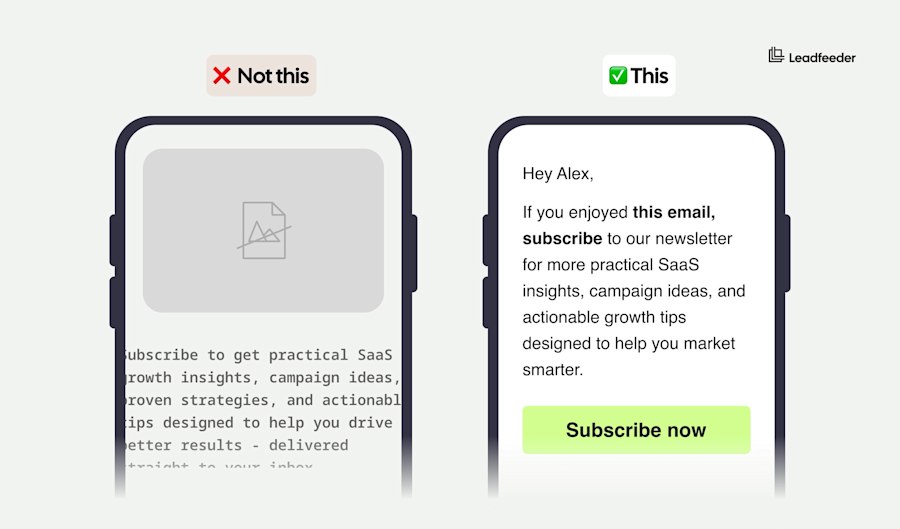
Keep it mobile-friendly. More than 50% of your buyers are reading this between meetings on their phones. If your email contains huge pictures or strange tables that wander off the side of a small screen, straight to the trash it goes.
Don't rely on pictures. Corporate Outlook settings often block images by default. If your message is trapped within a graphic, your prospect sees nothing but a blank box.
Subject line frameworks
Here is a quick breakdown of those subject line frameworks with some examples of how they look in an inbox.
Framework | The strategy | Example |
|---|---|---|
Outcome-first | Lead with a specific win or a hard number. | "How [Company] hit [Metric] without more headcount" |
Risk reduction | Flag a potential mistake or a compliance gap. | "Is your [Process] GDPR-compliant? A quick check" |
Curiosity | Share data or an insight they don't have yet. | "We analyzed 500 [Industry] firms. Here’s the data." |
FOMO / urgency | Use for time-sensitive events (use this sparingly). | "Filling up fast: [Event] this Thursday" |
Direct | Keep it short and human for late-stage deals. | "[First Name], worth 15 minutes?" |
No spammy patterns: overuse of punctuation, all-caps, false “RE:” or “FWD:” prefixes and created urgency on emails in which there will be none.
Copy frameworks for your strategy
Framework | How to use it | Why it works |
|---|---|---|
Problem / Agitate / Solve | Name a specific headache, remind them why it’s a nightmare (the "cost of doing nothing"), and then offer a way out. | It creates a sense of urgency for people who are currently "just dealing with" a broken process. |
Before / After / Bridge | Paint a picture of the "old way," show the "new way" using real metrics, and explain how they got from A to B. | It makes your solution feel like a proven path rather than a risky experiment. |
The objection gandler | Call out the elephant in the room (like price or setup time), and give a direct, honest answer backed by a case study. | It builds massive trust by showing you aren't afraid to address the hard questions. |
Note: Generic claims ("we help companies grow faster") will get ignored. Specific claims with proof ("customers reduce onboarding time by 30% in the first 60 days, see the data") build credibility.
Designing CTAs by funnel stage
Stage | CTA examples |
|---|---|
Early (awareness, nurture) | Read the guide, Watch the video, Get the benchmark report, Download the template |
Mid (evaluation) | Try the calculator, Join the webinar, Compare your options, See how it works |
Late (decision) | Book a demo, Start your trial, Request a security review, Let's talk ROI |
Each CTA should be one "micro-yes" step. Do not ask for a demo on a first nurture email. Build toward it.
B2B email campaign types (with example flows)
Different moments in the buyer and customer journey call for different campaign structures. A lead who just downloaded a guide needs something very different from a customer approaching renewal, and both need something different from a target account in an ABM motion. Below are the core B2B campaign types with practical example flows you can adapt and deploy.
Lead nurture sequences
Top-of-funnel (triggered by content download):
Lead magnet delivery + what to expect next (Day 0)
Related educational content to deepen the topic (Day 3)
Customer story relevant to their pain (Day 7)
Useful tool, template, or benchmark (Day 12)
Soft CTA: webinar invite, qualifying question, or low-friction next step (Day 18)
Mid-funnel (triggered by demo request or high engagement):
6. Confirmation + what makes your approach different (Day 0) 7. Use case most relevant to their role or industry (Day 2) 8. ROI data or customer outcome story (Day 5) 9. Objection-handling email (Day 8) 10. Comparison guide or security overview (Day 12) 11. Direct meeting request (Day 16)
Bottom-of-funnel (triggered by deal stage or trial expiry):
12. Summary of their specific use case with proof (Day 0) 13. "Here's what implementation looks like" (Day 2) 14. Social proof from a similar company (Day 5) 15. Final value summary with clear CTA (Day 8) 16. Last-chance or expiry reminder (Day 12)
Product onboarding and activation (SaaS / PLG)
Build triggers around activation milestones, not just time:
Account created: immediate welcome
First core action completed: reinforcement and next-step prompt
7-day check-in: Are they stuck?
Feature discovery: highlight something they have not used yet
14 to 21-day value reinforcement: show what they have achieved
Trial expiry or upgrade prompt
Note: If the user is active, ease off. If they have gone quiet, trigger re-engagement. Behavioral triggers outperform time-based sends in PLG contexts.
Event and webinar campaigns
A full webinar campaign flow:
17. Initial invite (2 to 3 weeks out): value-focused, who it's for, what they'll take away 18. Second invite to non-openers (1 week out): different angle or format 19. Last-chance reminder (24 to 48 hours before) 20. Day-of reminder with link (1 to 2 hours before) 21. Replay email within 24 hours post-event (with key takeaways) 22. Follow-up nurture based on attendance (attended, registered only, interested but did not register)
ABM Sequences for Strategic Accounts
A 5 to 7 touch sequence, coordinated with SDR and LinkedIn:
23. Marketing: thought leadership piece personalized to account challenge (Day 0) 24. LinkedIn connection or InMail from SDR (Day 2) 25. Marketing: customer story from a similar account (Day 5) 26. SDR follow-up email referencing the marketing content (Day 7) 27. Marketing: ROI calculator or benchmark relevant to their industry (Day 10) 28. SDR call attempt and voicemail (Day 12) 29. Marketing: direct, short check-in, or invitation to a roundtable (Day 16)
Relevance and timing matter more than volume. Each touch should add something new, not repeat the same ask.
Using AI and automation in B2B email, safely
AI has genuinely changed what is possible in email marketing, 64% of marketers already use AI in email workflows. But there is also a real risk in applying it carelessly.
AI is genuinely useful for:
Generating subject lines for fast A/B testing
Drafting copy for standard email types (welcome, onboarding, re-engagement)
Summarizing long-form content
Building personalization with dynamic content blocks
Analyzing reply sentiment for routing
Where people need to stay in the loop
AI tends to drift toward generic corporate speak. You still need a person to check for:
Brand voice
Legal/compliance
Fact-checking
Automations lean B2B teams should set up
Despite representing about 2% of email volume, automated emails drive 37% of all email sales. Automated workflows generate 30x higher returns than one-off campaigns.
Start here:
Welcome and onboarding sequence
Lead magnet delivery with follow-up nurture
Re-engagement and sunset sequence
Demo or meeting follow-up support
Customer activation milestone series
Once they’re running, optimize them before adding more.
Measuring B2B email performance and proving revenue impact
Marketing teams spend too much time obsessing over open rates and not enough time looking at the actual money. It’s easy to get trapped in vanity metrics while the real pipeline impact remains a mystery to leadership. If you want the executive team to take email seriously, you have to show them how it moves the needle on revenue.
Core metrics by funnel stage
Layer | Metrics |
|---|---|
Deliverability | Inbox placement rate, hard/soft bounce rate, spam complaint rate (target below 0.1%) |
Engagement | Click rate, click-to-open rate (CTOR), reply rate, site visits from email, and time on page |
Pipeline | MQL-to-SQL rate from email, meetings booked, opportunities influenced, and influenced revenue |
Connecting email to CRM and opportunities
To connect the email to the CRM and opportunities, the following steps are required:
Apply UTM parameters to every email link. Use a consistent structure, such as utm_source=email and utm_medium=nurture, to ensure the traffic is identifiable.
Establish a shared naming convention. The marketing and sales teams must use the same labels to prevent data silos.
Sync email campaigns to the CRM campaign object. This allows the system to associate contacts and leads with each email effort.
Define the attribution model. Documentation should specify if the team uses first-touch, last-touch, or multi-touch influence to attribute revenue.
Monitor "Pipeline Influenced" metrics An email has influenced the pipeline if a contact engages with it at any point during the sales cycle.
Track "Meetings Booked" as a distinct KPI Separating these identifies which specific sequences generate actual sales conversations rather than just passive clicks.
Simple Dashboards for Founders and CMOs
Six to ten metrics maximum, reported monthly and quarterly:
Deliverability: placement rate, bounce rate, complaint rate
Engagement: click rate trend, CTOR, reply rate
Pipeline: MQLs from email, pipeline influenced (dollar value), meetings from email
Program health: list growth rate, unsubscribe rate, re-engagement rate
B2B A/B testing
Rule | How to handle it | Why |
|---|---|---|
Isolate variables | Test one thing at a time: just the subject line, just the CTA, or just the send time. | If you change the subject and the copy at once, you won't know which one caused the win. |
Check your volume | Aim for at least 1,000 contacts per version to get a clear winner. | On small lists, a few random clicks can skew the data and lead you in the wrong direction. |
Set a time limit | Close the test and pick a winner after 48 to 72 hours. | In B2B, if they haven't opened it by day three, they probably won't. |
The strategy for a B2B email program must align with the company's specific growth stage and sales model. A startup focusing on initial traction requires a different playbook than an enterprise firm managing long-term security reviews.
Strategic Archetypes
Company Type | Primary Focus | Tactics | Essential actions per stage |
|---|---|---|---|
Early-stage startup | List building & learning | Develop 2 to 3 core sequences: a welcome series, lead magnet delivery, and a basic re-engagement flow. Prioritize gathering data on which topics generate replies over maintaining a high send frequency. | Keep the tech stack simple with one ESP and basic CRM sync. The goal is to establish a clean sender reputation and a baseline for engagement metrics. |
Mid-market SaaS | Lifecycle & Sales alignment | Integrate product usage data into the email platform to trigger behavioral messages. Establish a clear "hand-off" model between marketing nurtures and SDR outreach to prevent overlapping communications. | Segment the list by user role and engagement level. The team should report on "Pipeline Influenced" monthly to prove the impact of email on the bottom line. |
Enterprise Vendor | Trust & account coordination | Create content assets around security FAQs and GDPR compliance to shorten the 6-to-18-month sales cycle. Use an Account-Based Marketing (ABM) approach where emails are tightly synced with field sales activity. | Invest in multi-touch attribution. Because enterprise deals rarely close via a single touchpoint, the system must track how various emails contribute to the overall deal progression.
|
B2B Email marketing checklist
Strategy and goals
Email goals defined and tied to pipeline KPIs
ICP documented with email eligibility criteria
Buying committee roles mapped with messaging angles
List and compliance
Consent status documented for all segments
CAN-SPAM, GDPR/PECR, and CASL requirements reviewed for your sending regions
Suppression lists active (unsubscribes, bounces, opt-outs)
Preference center in place
Tech and deliverability
SPF, DKIM, and DMARC are configured and aligned
Custom tracking domain in use
Spam complaint rate monitored (target below 0.1%)
List hygiene and sunset policy defined
Content and design
One primary CTA per email
Mobile-friendly, skimmable layout
Subject lines are A/B tested regularly
Outlook rendering is tested before major sends
Measurement and optimization
UTMs on all email links
CRM campaign sync active
Attribution model documented
Monthly dashboard reviewed with pipeline metrics
Final thoughts
The teams seeing real returns with B2B email marketing in 2026 aren't winning because they found a better subject line formula, but because they stopped treating email as a megaphone. Your email strategy will only work if you know who you're talking to, why it's relevant, and what you want the person to do next.
If you've read this far, choose the one thing in this guide that your email program is missing and go fix it. Not next quarter. This week.
If you want sharper targeting to go with your sharper strategy, Leadfeeder reveals which companies are visiting your site and what they're reading. Use that context to make every email feel timely and relevant. Start there and build from it.
B2B Email Marketing FAQs
How often should I email my B2B list?
Match frequency to intent. Active nurture: 1 to 2 per week. Newsletter subscribers: 2 to 4 per month. If someone hasn't engaged in a while, sending more won't fix it. Your unsubscribe rate will tell you when you've pushed too far.
What does good email performance look like now?
Stop leading with open rate. Apple MPP has made it unreliable. Watch click rate (2 to 4% is healthy for B2B), CTOR (above 5 to 8% means your content is landing), and for sales sequences, reply rate. Pipeline movement is the real measure.
Who owns email: marketing, sales, or RevOps?
All three, which is exactly why the system breaks down. Marketing owns lifecycle programs. Sales owns direct outreach. RevOps holds it together with shared infrastructure, naming conventions, and suppression lists. Without that layer, you get conflicting messages and no clean attribution.

CMO
Jillian Als is Chief Marketing Officer at Leadfeeder and a B2B SaaS marketing executive with nearly two decades of experience leading global go-to-market teams. She specializes in revenue-driven marketing strategy, demand generation, and aligning marketing and sales organizations.
Throughout her career, Jillian has helped SaaS companies scale marketing-sourced revenue and build high-performing marketing teams across international markets. Her leadership experience shapes her perspective on marketing strategy, attribution, and the systems modern revenue teams use to drive sustainable growth.