


This structure is especially important today. According to Gartner, B2B buyers spend only 17% of their buying journey meeting with potential suppliers, meaning much of the decision-making process happens before a sales conversation even begins.
A sales funnel depicts the buying journey that prospective customers go through, from the initial touchpoint when they first interact with your brand to the last touchpoint when they purchase your offerings.
Sales teams must follow a series of steps (usually portrayed as a funnel) to convert prospective customers into paying customers. This means the sales funnel’s primary purpose is to convert a prospect/lead into a paying client.
The secondary purpose of a sales funnel is to increase your company’s long-term return on investment (ROI). This happens when you continuously optimize the sales funnel, which we’ll get into later.
Step 1: Know the Key Stages of a B2B Sales Funnel
B2B sales funnel stages aren’t the same for all companies. Salespeople often add extra stages to their sales funnel depending on their sales cycle length and their organization’s internal sales processes.
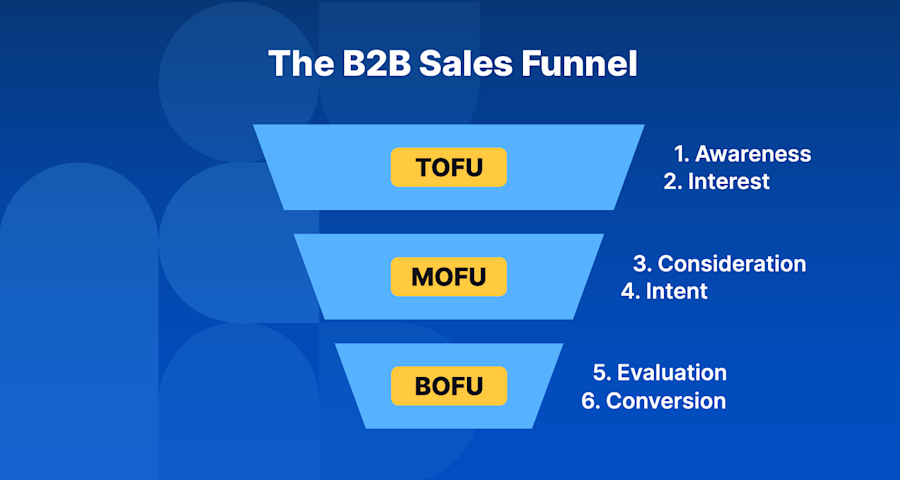
However, all B2B sales funnels fall into three key stages.
Top of the Funnel (TOFU) or Awareness Stage: The initial stage of the sales funnel, where a potential customer discovers your brand or products and services.
Middle of the Funnel (MOFU) or Consideration Stage: The consideration (or interest) stage is the second step, where a potential buyer evaluates your solution and value proposition to determine whether or not you solve their pain points.
Bottom of the Funnel (BOFU) or Conversion Stage: The last step, where a prospect chooses your company’s products or services for their business use.
While these three stages are fundamental to a B2B sales pipeline, they only scratch the surface. Most B2B sales rep teams map their customer journey using the following six phases.
Awareness: Potential buyers become aware of a brand through various channels such as word of mouth, referrals, inbound marketing, or social media.
Interest: Prospective B2C or B2B customers show interest in a brand’s products and services by browsing product pages or filling out email sign-up forms and webinars.
Consideration: Potential buyers weigh if a brand’s solutions can solve their problems. They read product reviews, testimonials, case studies, whitepapers, and other product-focused content.
Intent: Potential buyers express buying intention. They may download a demo, request pricing proposals, or book a sales demonstration.
Evaluation: Potential buyers compare a brand’s solutions with those of other brands. At this stage, all the company's B2B decision-makers are involved.
Conversion: Potential buyers convert to customers and purchase a brand’s product or service.
We should add retention as the seventh stage. But because of its significant contribution to a B2B company’s long-term success, we’ll discuss retention in a separate section later in the article.
It takes a lot to build a B2B sales funnel that elevates a sales strategy and ROI. But leveraging sales intelligence should be a top priority. You can’t create an effective sales funnel without first collecting customer and market data.
To make sure your B2B sales funnel strategy is effective, lay a strong foundation by doing the following.
1. Define your target audience
You’ve probably heard marketers say, “When you market to everyone, you market to no one.” The same is true when it comes to building B2B sales funnels. If you don’t know who your target audience is, you can’t predict their buying behavior. You’ll simply have no concrete data points you can apply to your sales funnel.
But when you define your target audience, you understand their pain points, company size, interests, purchase intent, financial power, and buying behavior.
Here are some ways you can identify your target audience:
Analyze your existing customer base
Research your competitors to know their customer base
Examine your website and social media traffic data
Join social groups that your target audience shows interest in
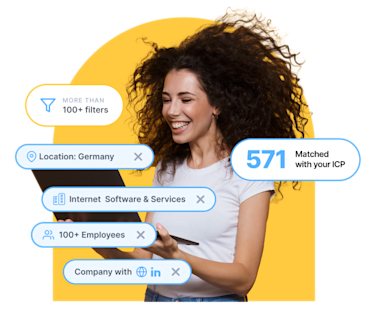
Better yet, use Leadfeeder for B2B sales prospecting to identify and engage your dream customers in Europe. Leadfeeder does all the heavy lifting for you by providing comprehensive company profiles as well as technographic and firmographic data. This way, it’s easy to evaluate and pick out companies that can quickly convert into customers.
Identify and land your dream customers
Find the right prospects, accelerate your sales pipeline, and land your ideal customers even faster.
Start Sales Prospecting2. Create a buyer persona
A buyer persona is a semi-fictional depiction of your ideal customer, based on customer data and research. It helps you narrow down the list of prospective customers you identify through your target audience research and create profiles for the most likely candidates.
When creating your B2B buyer persona, model it after a real human being rather than an entity. Remember that although B2B companies are your customers, individuals go through the buying process and make the purchase decision. That’s why your B2B buyer personas should include the following demographic and psychographic information.
Pain points
Social media channel preferences
Aspirations
Pet peeves in digital sales
Daily routines and hobbies
Keywords and phrases
Rank in a company (consider if they’re decision makers or supporters who influence purchase decisions)
What a buyer persona could look like:
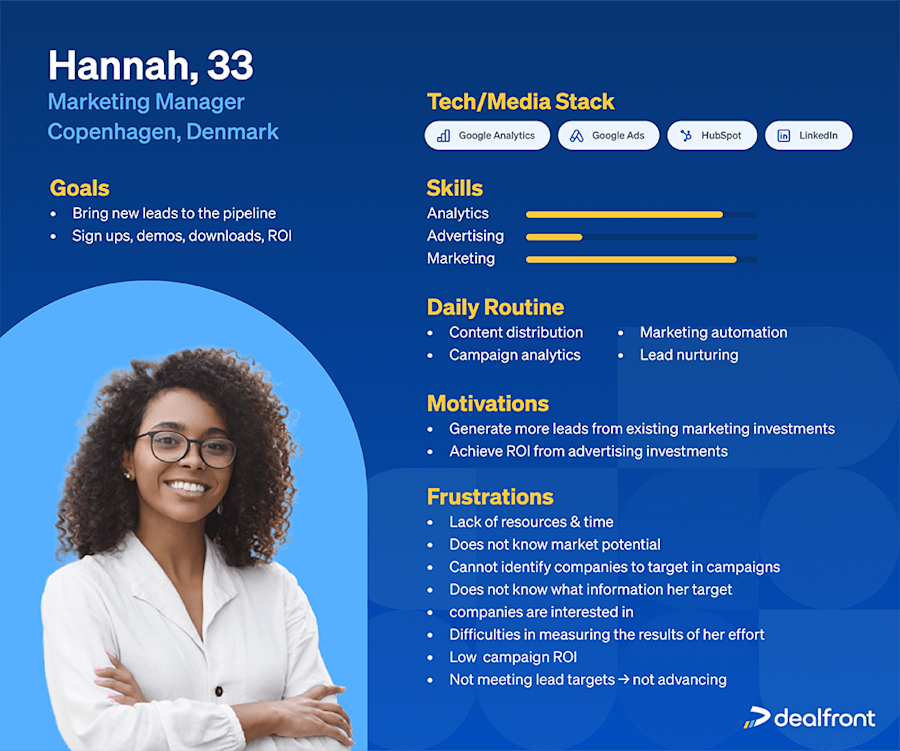
This way, your buyer personas will be detailed enough to help you build a sales funnel model that fully optimizes the customer journey.
3. Conduct market research and competitor analysis
Carrying out detailed market research gives you multiple advantages. First, it helps you establish your prospective customers’ pain points. This empowers you to anticipate customer needs and build a B2B sales funnel that addresses their challenges.
Market research can also show you where your competitors are falling short, so you can capitalize on their failures. For instance, if none of your competitors are creating call-to-action (CTA) videos for their BOFU stage, you can include them in your sales channels and improve your customer experience.
Market research can also help you to do the following:
Get new ideas for product development
Identify new market trends
Gather customer feedback
Establish competitive pricing strategies
These factors will help you build an effective and unique B2B funnel that attracts, engages, converts, and retains customers in the short and long term.
4. Set clear goals and objectives for each stage of the funnel
Now that you have an ideal customer profile and understand your customers’ pain points, needs, and desires, it’s time to move on to the next stage. You can finally allocate goals to each stage of your sales funnel.
You should outline your goals and objectives at the TOFU, MOFU, and BOFU stages. Set clear goals alongside key performance indicators (KPIs) to help you track progress.
For instance, if your customer needs an eco-friendly product, you can create (with your content marketing team) the following content for all three stages.
Reach potential customers with a TOFU content piece that focuses on their needs and pain points. Explain why green living is significant and why companies should pursue that lifestyle.
Create MOFU content explaining why your product is better than other solutions. Show how your product/brand helps companies achieve better outcomes than competitors.
Create BOFU content pieces with a CTA/download option to drive the target audience to action (i.e., convert them into customers). To add another layer of persuasion, showcase the difference your brand’s green initiatives have made to companies’ operations.
5. Align your sales and marketing teams
Your B2B sales and marketing teams must work together when creating sales and marketing funnels because many of their tasks overlap. For many B2B companies, the disconnect occurs when marketing teams transfer sales-funnel workflows to sales teams, or vice versa.
For instance, the marketing team may engage prospects up to the purchase stage and then transfer them to the sales team. If the sales team fails to close the deal, your company will lose the sale.
But when your sales and marketing personnel collaborate to build a sales funnel, they’ll generate leads much more quickly.
Step 2: Be Great at Customer Retention
In the B2B sector, customer retention is king. And if you’re a SaaS B2B company running on a subscription model, customer retention is the lifeblood of your business.
If you’re good at customer retention, you can perpetually sustain or increase your sales revenue. In fact, a 5% increase in customer retention can more than double your revenue. Additionally, you’ll spend five times more time acquiring new customers than retaining your existing customers.
But even with all the significant advantages of customer retention, some organizations only pay lip service to this metric and suffer the consequences. B2B companies that overlook customer retention risk losing clients during recessions or due to higher churn rates.
Top B2B sales teams use the following ‘3 pillars’ to sustain or enhance their customer retention rate.
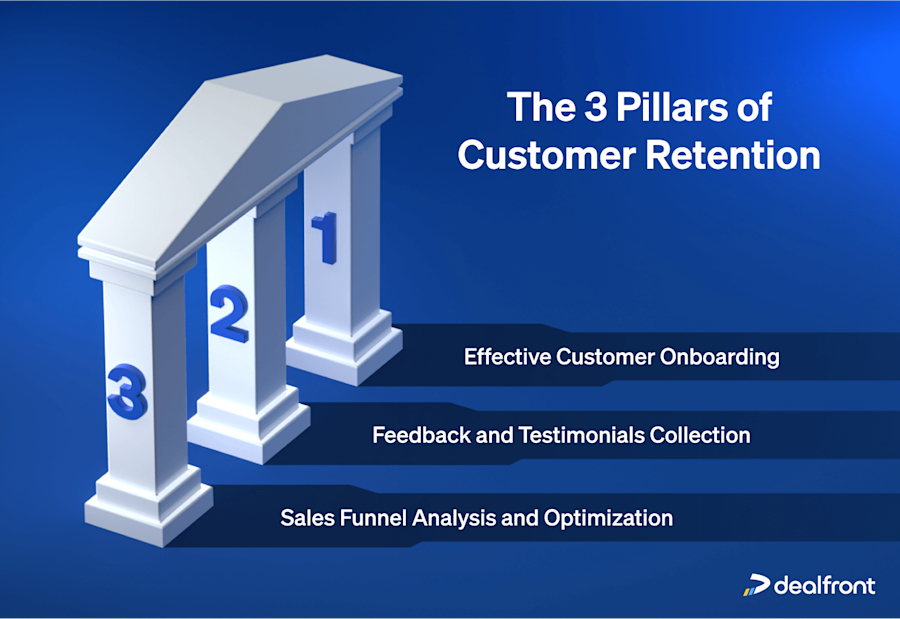
So let’s break that all down…
1. Develop effective customer onboarding
Stats show that an effective onboarding process can improve customer retention by about 50%. This tells you that in the B2B sector, first impressions really matter. It means you should go out of your way to make your TOFU and MOFU experiences engaging and memorable as you teach new customers the value of your products and services.
Here are some tactics you can use to create an effective customer onboarding experience:
Set up new customers with a dedicated client success manager
Invite new customers to your community forums so they can interact with existing customers
Record personal videos to introduce yourself and your product
Be as available as possible (e.g., use chatbots and business instant messaging apps for quick and continuous onboarding communication)
Your goal is to leave a positive, lasting first impression. This will encourage your customer to stay loyal to your brand or product.
2. Recognize cross- and up-selling opportunities
Forbes says that your existing customers are 50% more willing to buy new products and spend 31% more than new customers. This is because it’s easier to cross-sell and up-sell existing customers as they’re already familiar with the quality of your brand and product.
Your sales team should be hawk-eyed and seize any opportunity to increase sales. If you create new products or upgrade existing product features, cross-sell them to your current customers.
Also, use your business acumen and select the right time to up-sell an existing customer who may have started with a lower subscription tier but now qualifies for a higher tier.
3. Collect feedback and testimonials
What better way to retain your customers than to give them what they want? Customers’ opinions and satisfaction levels change as they use your product more. And, given that B2B buyers innovate quickly to capitalize on new tech developments, you must keep up with their evolving needs.
You can do this by collecting customer feedback and testimonials using the following methods:
In-app feedback
Social media feedback
Reviews on review platforms such as G2
Customer surveys
Customer interviews for success stories
Customer advisory boards
After collecting customer feedback, determine the best ways to apply it to your products and services. This yields two benefits.
First, implementing customer feedback improves your products/services for all customers, even those who didn't leave feedback.
Second, it tells customers you care about their opinions. Remember that even customers who didn't leave feedback most likely read other customer reviews and suggestions. When they see you accommodate feedback, they'll also see you’re authentically a customer-centric company.
Step 3: Analyze and Optimize the Sales Funnel
You can build the best B2B sales funnel out there, but if you fail to track results and optimize it accordingly, it won’t serve its purpose. You must measure and track key metrics to gauge your sales funnelis progress and identify which parts to tweak or improve. Here’s how you can achieve this.
1. Track and measure key metrics
B2B sales funnel metrics track different parts of the customer journey to reveal how effective your B2B sales funnel strategy is. Here are some key funnel metrics to track:
Brand awareness
Conversion rate
Sales
Leads
Costs (cost per lead, customer acquisition cost per channel, service line, or product)
Brand loyalty
Brand consideration
Fortunately, you can use many online tracking and automation tools to measure your success with the above metrics, including the following:
Clicky
Woopra
HubSpot
Microsoft Dynamics 365
Plerdy
Although you have to pay a subscription fee to enjoy all the features of most tracking tools, you can also achieve a lot using a free tool like Google Analytics.
1. Identify areas for improvement
After tracking your key funnel metrics, you should compare them to the key performance indicators (KPIs) you set for your goals and objectives. If they don’t measure up, review the problem areas and earmark them for improvement. Sometimes, it can be as simple as adding a fresh step to your sales funnel, or as complex as rethinking the entire sales funnel.
2. Be ready to adapt to market changes
Given the rapid evolution of the B2B market, fueled by emerging technologies, the sales funnel strategies you set up one year ago may be outdated the next. Fortunately, your funnel metrics data will tell you where you’re lagging and what changes you need to make to align with current market trends.
Step 4: Make your B2B Sales Funnel Strategy Efficient
Building a B2B sales funnel for your business is a surefire way to improve customer experience and retention in the long term. But before you start building your sales funnel, make sure you do the following:
Understand your prospective customers
Carry out detailed market research
Set clear goals for what you want your sales funnel to achieve
Get your sales and marketing teams on the same page
After setting up your sales funnel, always track results in real time and make data-backed adjustments where necessary. But if building a B2B sales funnel from scratch feels like a lot on your plate, particularly for the vast European market, you can count on Leadfeeder.
At Leadfeeder, we’re all about helping B2B sellers like you develop winning strategies to conquer the competitive market. Our extensive tools help you identify and understand qualified leads based on deep data insights, so you can quickly model the right sales funnel.
Start your free trial today or contact us to learn more about how Leadfeeder can help you create a successful B2B sales funnel.
Win leads and close deals
Discover how the Dealfront platform helps build successful sales and marketing teams.
Start Free TrialFAQ
1. Where can I find out how to create a B2B sales funnel?
Leadfeeder provides a whole range of tools and informative guides to help sales and marketing professionals turn potential customers into loyal clients. If you want to create an effective B2B sales funnel that will convert potential customers into customers, you’ll find lots of useful support in our help center and via the Sales Intelligence platform.
2. What advantage does a sales funnel offer to B2B companies?
A B2B sales funnel will help you convert more potential customers into customers. That’s partly because it makes it easier for you to visualize the sales process and measure B2B sales funnel conversion rates. And by tracking customer journeys through the funnel, you’ll be able to target potential clients with the right messaging, at the right time.
3. What are the stages of the B2B sales cycle?
You can break down the B2B sales cycle into six main stages: Awareness, Interest, Consideration, Intent, Evaluation, and Conversion. This tracks the customer’s journey from first hearing about your brand to closing the sale. For many B2B businesses, a seventh stage — Retention — would also be relevant, particularly those whose business model relies on subscription income.
4. What are the most important B2B sales funnel metrics?
Some of the most important metrics to monitor include the following:
Stage-to-stage conversions: check the percentage of potential customers who progress from one stage to the next. If there’s an unusually high drop-off at one point, that will indicate the issue and give you the chance to rectify it.
Qualified leads: What percentage of potential customers in the first stage turn into qualified leads? Boosting this is ultimately a positive for your conversion rate.
Sales cycle length: Track how long it takes on average for customers to complete their journey through the funnel. Understanding your sales cycle better can help you identify resource gaps that might harm sales.
5. Is there a difference between B2B sales and marketing funnels?
Although the terms are sometimes used interchangeably, sales funnels and marketing funnels have different goals. The B2B marketing funnel stages help you find people who might like your product and make them aware of your brand, while a sales funnel converts a prospect into a sale. So, while a B2B marketing funnel and sales funnel are not interchangeable, they often work very closely together and can overlap.
6. How are B2B and B2C funnels unique?
Although B2B and B2C funnels both lead to a sale, B2B companies have more stages in their sales funnels. A typical sales funnel for a B2C business ends with individual consumers' desire for a product, whereas B2B companies usually have multiple senior decision-makers who must approve new purchases. This results in the B2B sales funnel having more steps, such as pitching your product internally and seeking buy-in from senior management.

CMO
Jillian Als is Chief Marketing Officer at Leadfeeder and a B2B SaaS marketing executive with nearly two decades of experience leading global go-to-market teams. She specializes in revenue-driven marketing strategy, demand generation, and aligning marketing and sales organizations.
Throughout her career, Jillian has helped SaaS companies scale marketing-sourced revenue and build high-performing marketing teams across international markets. Her leadership experience shapes her perspective on marketing strategy, attribution, and the systems modern revenue teams use to drive sustainable growth.