



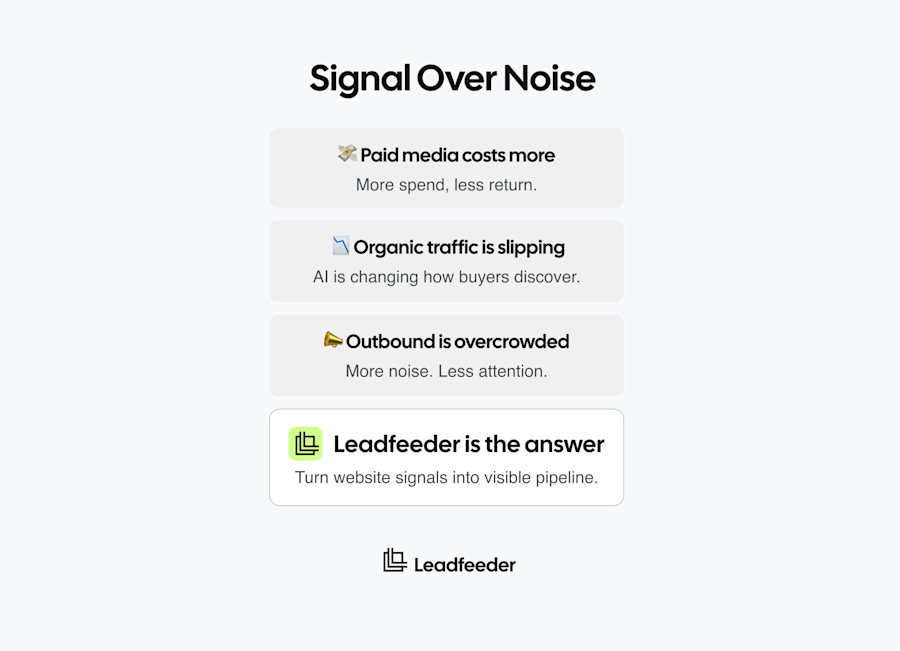
The channels driving B2B growth are under pressure. Paid media costs more and delivers less. Organic traffic is declining as AI reshapes how buyers find information. Outbound is overcrowded. And buyers, increasingly selective about who gets their attention, are doing most of their research independently before ever making contact.
Marketing teams are working harder than ever. The gap between effort and visible outcome keeps widening.Lead generation still matters. And we see a massive opportunity to help our customers do it better.
When we ask our customers where we bring the most value, the answer keeps coming back to the same place: using website signals to drive better lead generation. We've already helped customers do this at a massive scale. But to fully run at that opportunity, we had to take an honest look at ourselves to understand if we were best positioned to do this. In the market we had two brands, two narratives, and two websites -- our own noise was getting in the way of our ability to focus.
That's what led us here. Moving forward as Leadfeeder is a decision to make our strongest capability the whole point. What we do is in the name. It’s built around the signal that matters most: understanding which companies are on your website, where they came from, and what they care about. Together these signals tell a story that enables the next best action across the buyer journey.
The signal that matters most
The most reliable buyer signals in modern B2B go-to-market already exist within every marketer’s control. The website. Not as a traffic metric, but as a window into real demand at every stage.
Every go-to-market motion leads back to the company website. Even as LLMs continue to disrupt traffic patterns, the website is still where campaigns land, where buyers validate, and where the clearest signals in the entire funnel accumulate, from early awareness all the way through to purchase consideration. It's also the most important asset marketers truly own - the experience, the data, and what to do with it.
Yet for many marketers, the website remains a black box. Traditional analytics can indicate if traffic is growing or declining and where the traffic is coming from - but it does not tell the whole story, and definitely not what’s most important. For being a company’s most important asset, lack of clarity on the website represents a massive challenge.
Leadfeeder turns the website into the most reliable source of lead generation. Identifying which companies are visiting, where they came from, and how they're engaging gives marketers the clarity to act across the full funnel. Whether that means building high-fit audiences, attributing website visits back to campaigns, or converting engagement into pipeline, the company visit signal powers every stage.
We're not new to this. For over a decade, we've been building the infrastructure to turn website activity into something marketing and sales teams can act on. More than 40,000 websites. Over 500 million leads generated for customers. A proprietary IP-to-company database cultivated over 10+ years, with 60M+ companies and 400M+ verified contacts, backed by deep integrations across CRMs, marketing automation platforms, and ad networks.
This is the foundation. It's what makes it possible to go beyond identification and actually improve how you go to market.
This is what clarity looks like
Take a mid-sized industrial equipment manufacturer in Germany. They sell into procurement teams across European logistics and manufacturing, run campaigns across paid and events, have a field sales team, and a small but capable marketing team managing a long, relationship-driven sales cycle.
Before Leadfeeder, how that activity showed up on the website was invisible. Traffic came in. Some of it converted. Most of it disappeared.
With Leadfeeder, that changes. They can see which companies from their target verticals are visiting and exactly which campaigns brought them there. When contacts from a tradeshow return to the site the following week, the sales team knows. When a procurement manager at a target account shows clear purchase intent through repeated engagement with product and pricing pages, that account moves up the priority list.
But the value isn't only in catching late-stage signals. When a brand awareness campaign runs, marketing can see whether it's pulling in the right companies, not just generating impressions. That feedback shapes where the budget goes next.
Better targeting drives better traffic. Better traffic creates clearer signals. The whole motion compounds. That's the difference between a point tool and a platform.
Where we go from here
The category is moving fast. AI is reshaping go-to-market from multiple directions, both as a pressure on the old playbook and as a genuine advantage for teams who can act on better information faster. That's where we're focused. Not AI as a feature, but as the thing that reduces the distance between seeing a signal and knowing what to do with it.
We're investing in attribution that connects marketing activity to revenue across the full funnel. Analytics that move beyond traffic to show what actually builds pipeline. And a growing partner ecosystem that extends Leadfeeder's signal into the tools teams already rely on.
B2B marketers are navigating real complexity: more channels, more pressure to prove impact, and buyers who are harder to reach than ever. Yet every go-to-market motion continues to lead to the website. Leadfeeder makes sure what happens there is visible and ready to act on. That's the company we've built, and that's the company we're strengthening.
Signal over noise.

CMO
Jillian Als is Chief Marketing Officer at Leadfeeder and a B2B SaaS marketing executive with nearly two decades of experience leading global go-to-market teams. She specializes in revenue-driven marketing strategy, demand generation, and aligning marketing and sales organizations.
Throughout her career, Jillian has helped SaaS companies scale marketing-sourced revenue and build high-performing marketing teams across international markets. Her leadership experience shapes her perspective on marketing strategy, attribution, and the systems modern revenue teams use to drive sustainable growth.