60-Second Summary
Leadfeeder turns the companies visiting your website into LinkedIn Matched Audiences you can retarget, keeping lists current and intent-driven. Syncing Lists to LinkedIn enables account-based retargeting that improves conversions and can lower cost per lead.
Key takeaways: Syncing Leadfeeder Lists to LinkedIn creates continuously updated, intent-driven Matched Audiences for ABM-style retargeting—driving better conversions and lower CPL (one example saw 33% below target).
Standout strategies & tactics: Build precise Lists with filters in Leadfeeder, connect the LinkedIn integration, sync Lists as Matched Audiences, allow up to 48 hours for matching, layer job/location targeting, and automate alerts or CRM pushes when accounts re-engage.
Real-world lessons & frameworks: Treat retargeting as part of an ABM funnel—measure performance across paid and organic channels, follow up quickly via sales alerts/CRM automation, and remember retargeting alone won’t replace a full pipeline strategy.
Practical implementation notes: Ensure audiences meet LinkedIn minimum size (≈300), monitor build status, choose appropriate campaign objectives (lead gen vs conversions), and use lookalikes to expand reach beyond matched accounts.
*This summary was created with AI assistance, using our original content.
You're probably wondering how to retarget on one of the most widely used B2B advertising channels, LinkedIn. You're not the only one. Leadfeeder LinkedIn retargeting makes it straightforward: you use the companies already visiting your site to build the audiences you retarget with. We get questions on this marketing strategy often, as LinkedIn ad campaigns are a huge contributor to lead generation.
If you're new to the platform, it's worth getting the LinkedIn marketing fundamentals down before you set up your retargeting audiences.
Retargeting campaigns, also known as remarketing, give you a second chance to turn a website visitor into a paying customer through sponsored content. Everybody deserves a second chance. (Except that leftover sushi from last night, please just toss that.) To close the loop on campaign performance, measure your website visitor tracking results across both paid and organic channels.
The best part about retargeting? It works, especially if you use account-based marketing. In one example, a B2B agency used tightly targeted LinkedIn text ads to hit a cost per lead 33 percent below its target. Leadfeeder's website visitor identification makes it easy to create hyper-focused retargeting audiences. So, let's talk about retargeting options.
Note: Leadfeeder is a website tracking tool that tracks the companies that visit your website, even if they don't fill out a form. Try it free for 14 days. Beyond retargeting, you can expand reach by finding lookalike companies that match your best customers.
What are LinkedIn retargeting ads?
LinkedIn retargeting ads are ads that target users who have interacted with your company in some way.
For example, maybe they visited your website, watched a video, or followed your company page. Using a retargeting ad on LinkedIn, you can limit your paid ad audience to target users who have taken a specific, defined action.
Retargeting helps move beyond brand awareness ads and get in front of customers further down the funnel.
You can retarget people (LinkedIn users) who have:
Website retargeting: visited a page on your website
Video views: viewed all or part of a social media video ad
Lead generation form: opened or submitted a landing page lead gen form in a specific time period
Engaged with your company page by viewing your page or clicking your CTA
RSVP'd for a current or past LinkedIn Event
You can also create retargeting audiences by uploading a list of contacts or companies to LinkedIn and targeting those users directly. And if you use Leadfeeder, you can skip the manual upload entirely and sync your target companies straight into LinkedIn (more on that below).
That's almost like having a superpower (or a frozen margarita machine, your choice).
Here's how to use LinkedIn retargeting to target companies that have already visited your site
So how do you target LinkedIn audiences who have already visited your site? The short version is Leadfeeder LinkedIn retargeting: pairing Leadfeeder (that's us!) with LinkedIn website retargeting.
First, you'll need to add our Leadfeeder tracker to your website. It's a small piece of code that helps us track which companies visit your site and which pages they view.
You'll also be able to see how often companies visit, where they are located, and more. After a few hours (in most cases), you'll start to see data rolling in.
Now that's all set up, let's get into the step-by-step section.
1. Build your target List in Leadfeeder
Leadfeeder Lists let you zero in on specific companies. You know who your ICP is, and you want to make sure you reach the right decision-makers.
Use the filters to define exactly who you want to retarget on LinkedIn, then save that segment as a List. Lists are what you'll sync to LinkedIn in the next step.
Let's say you want to target companies in the United States that visited your site in the last month. You can do that. You can also filter on company demographics, acquisition pages, goals, device type, buying intent signals, and much more.
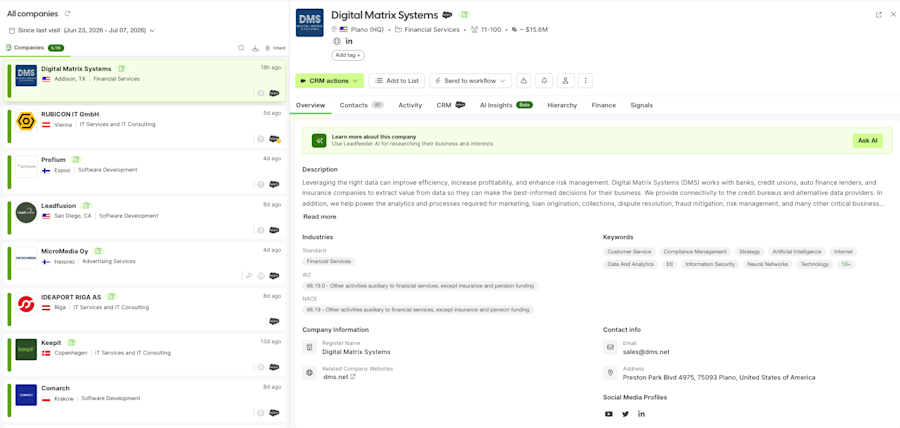
This is a pretty powerful tool, so I won't walk you through all the options, but you can see the full list of custom feed filters.
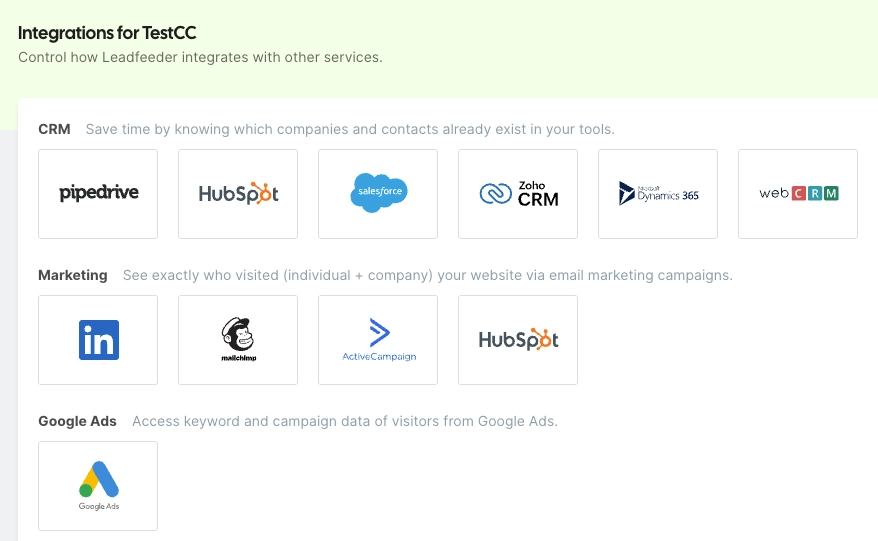
2. Connect Leadfeeder to LinkedIn
This is where things have got a lot easier. You no longer need to export a CSV and upload it to LinkedIn by hand. Leadfeeder now connects directly to LinkedIn and syncs your Lists into LinkedIn Matched Audiences, so your targeting stays aligned with real buying intent instead of a spreadsheet you exported weeks ago.
To set it up, go to Settings → Integrations → LinkedIn (under Marketing) and connect your account. During setup you'll sign in to LinkedIn, approve the permissions, and Leadfeeder will fetch the Ad Accounts you have access to.
A couple of things worth knowing:
You'll need a LinkedIn account with Campaign Manager access, and permission to manage audiences in the relevant LinkedIn Ad Account. Account Manager or Admin permissions are required (this is LinkedIn's minimum).
Leadfeeder only requests permission to read your Ad Account data and to create and update Matched Audiences. It does not modify your campaigns, edit your ads, or change your account settings.
3. Sync your List to LinkedIn as a Matched Audience
Once LinkedIn is connected, you can sync a List in a few clicks, either from the List's own settings or from the LinkedIn integration settings.
Here's the flow:
Select the LinkedIn Ad Account you have access to.
Give the audience a name. This is the name that will be created on the LinkedIn side.
Choose the List you want to sync (or hit Create if you're syncing directly from a List's settings)
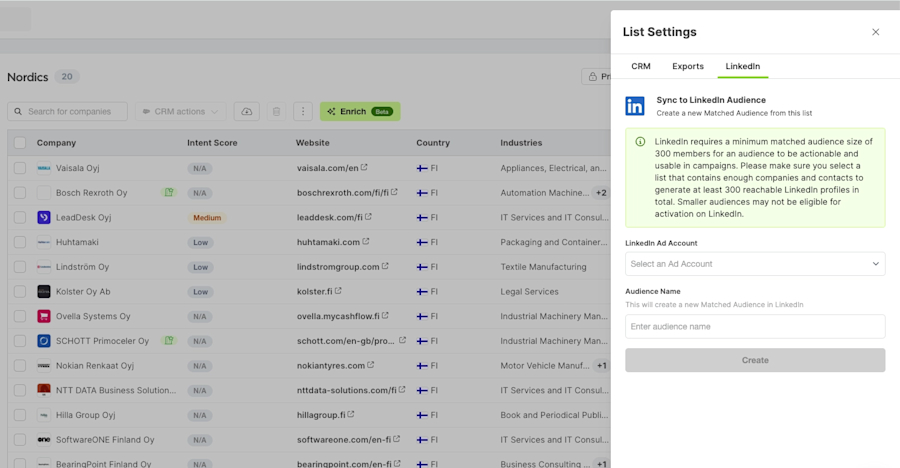
That's it. Leadfeeder creates a new Matched Audience on LinkedIn and starts matching the companies from your List against LinkedIn's database. You can set up as many audiences as you need.
A few things to keep in mind:
Give it time to build. The matching process can take up to 48 hours. While it runs, the audience shows a "Building" status; once it's done, it shows "Ready".
Mind the minimum size. LinkedIn requires a minimum audience size (typically at least 300 matched companies) before you can use it in a campaign. If your List is small, add more companies before you expect to run ads against it.
It stays up to date on its own. As companies are added to or removed from your List, the LinkedIn audience updates automatically. No more re-exporting and re-uploading. This is the big win over the old CSV method: your audience reflects who's actually showing intent right now.
No credits are consumed by the sync.
4. Create a retargeting ad on LinkedIn
Now you'll want to head over to LinkedIn's Campaign Manager. The first step is to choose an objective for your ad, that might be website visits, lead gen, website conversions, or something else.
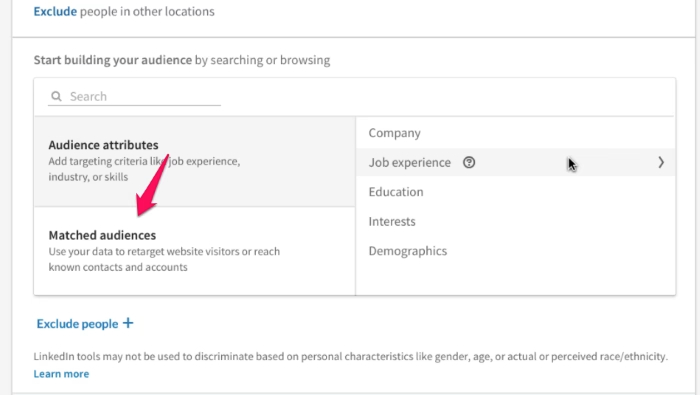
LinkedIn will then prompt you to create your target audience of LinkedIn members. This is where that Leadfeeder data shines. Under Audiences, select the Matched Audience you synced from Leadfeeder in step 3.
Then, create your LinkedIn ad by uploading assets, writing copy, and setting your budget.
When your ad goes live, LinkedIn can show it to members associated with the companies in the Matched Audience you synced from Leadfeeder, subject to LinkedIn's matching, audience-size, and campaign targeting rules.
But remember, the audience can include anyone who works for those companies. So include a few other targeting options as well:
Location: to ensure you're only advertising to your target markets
Job Function / Title: to ensure you're advertising to your buyer personas
5. Bonus step: Alert your sales team when companies engage on LinkedIn, and then visit your website
Remember, I mentioned you can track acquisition channels in Leadfeeder? You can use this feature to monitor when target accounts revisit your website and then alert your sales team.
As a final bit of magic, set your email notifications to send an email to your sales team when a lead from your LinkedIn campaign comes back to your website. Lead generation gold.
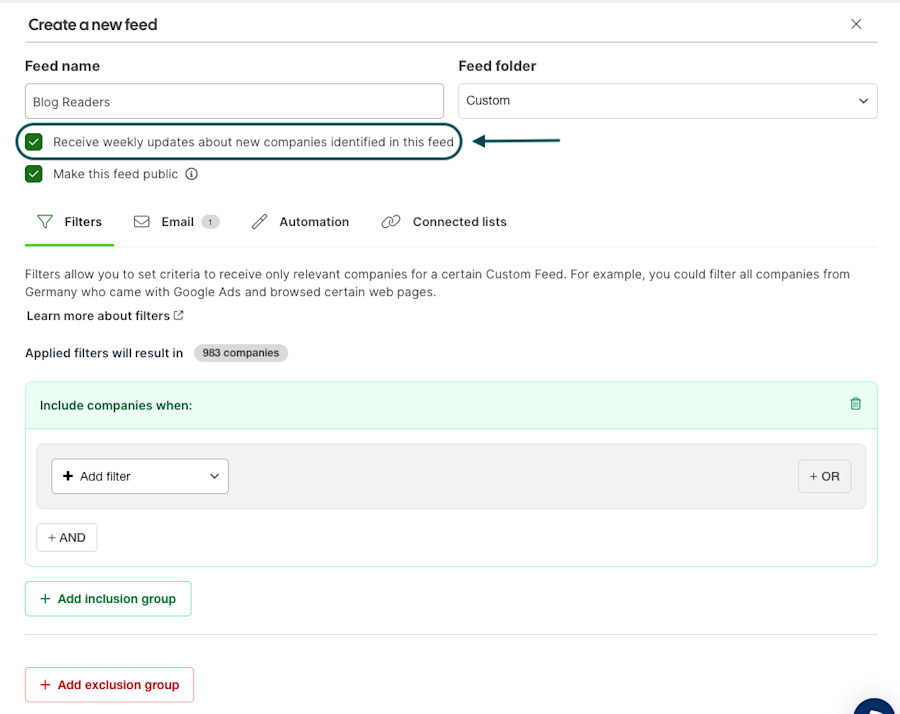
You can also use Leadfeeder automation to send that lead to Salesforce, send a Slack message, or create a new account in your CRM.
LinkedIn and Leadfeeder: a match made in B2B marketing heaven
Many businesses aren't making the most out of their LinkedIn pages. Many don't realise that LinkedIn has a retargeting feature for website audiences, and fewer still keep their audiences current once they've built them.
That's the real advantage of syncing Leadfeeder Lists to LinkedIn: your audiences update automatically based on real company activity and intent signals, so instead of targeting an old spreadsheet, you're continuously targeting the accounts that actually matter right now.
Retargeting allows you to reconnect with interested visitors, convert them into paying customers, upsell them, and even increase brand loyalty.
LinkedIn ads can deliver solid conversion rates and click-through rates, and retargeting can push those results further. But it's not a magic trick on its own. Andrei Zinkevich, co-founder of Full Funnel and a well-known practitioner in ABM, puts it plainly: "If you skip all other stages and you think that there is a tiny hack that will help you to land enterprise deals, then obviously everything would be bad, including account-based marketing."
Used well, LinkedIn audience retargeting and Leadfeeder data make a strong combination for sharper conversions and lower retargeting costs.