That’s where a 30-60-90 day approach makes the difference. It brings clarity to what matters most in the first three months: what to learn, who to meet, which skills to sharpen, and what results to deliver. It aligns individual goals with company priorities and turns onboarding from a checklist into a focused ramp toward performance.
In sales teams, this structure is especially critical for new Account Executives, and for SDRs or BDRs stepping into closing roles for the first time. The shift from learning to owning revenue is significant. Without clear expectations, it’s easy to feel overwhelmed. With defined milestones and support, new hires gain direction, accountability, and confidence.
The first quarter is more than product training and pipeline activity. It’s about understanding the company’s mission, building relationships across teams, learning the competitive landscape, mastering the sales process, and developing a deep understanding of customers and their needs. Progress should be measurable, goals should be realistic and time-bound, and managers should provide the right mix of feedback, tools, and autonomy.
When structured well, the first 90 days don’t just onboard an Account Executive, they launch one. By the end of the quarter, the goal is simple: independent execution, a healthy pipeline, and the foundation for sustained revenue contribution.
Our 30-60-90-Day Plan Template for Account Executives
Our 30-60-90 plan template is a great way to introduce your company culture and workflow to new account executives.
This 30-60-90 plan example covers the following aspects of the ramp-up period:
Company overview: An introduction to your company, its history, mission, vision, values, and corporate culture.
Sales skills: Evaluating current soft and hard skills and setting goals for skills development.
Industry knowledge: Assessing your new hire's understanding of the industry and market trends, your main competitors, and sales and marketing strategies. Establishing goals for closing gaps.
Product or service knowledge: Presenting the specifics of your company’s products or services.
Customer insight: Familiarize your hire with your target market, trends, customers, and their behavior. Developing strategies to tailor account executives’ performance to their needs.
Company sales processes and tools: Immersion in your company's sales processes and tools.
The specifics of your plan will depend on your company and your account executive's role. Still, let’s look at some typical template elements.
Elements of a Development Plan
A 30-60-90 plan is like a mini development plan for your new hire. And just like any development plan, it should have a mission or purpose, attainable goals, and resources.
The primary role of your account manager is to build and maintain relationships with customers, meet or exceed sales figures, and capitalize on new business opportunities.
You can break this role down into incremental learning goals using the S.M.A.R.T. framework. Within this framework, the best goals have five qualities:
Specific goals: Good goals are unambiguous and target a specific area. Account executives might have a specific goal of scheduling client meetings each week to check in on their needs and address any concerns.
Measurable goals: The goal should be quantified to track and evaluate progress. For example, how many weekly client appointments will the executive need?
Achievable goals: A goal should be realistic, meaning it can be accomplished with available resources and within existing constraints. For example, to schedule client meetings in Google Meet and send reminders on LinkedIn.
Relevant goals: A goal should align with your organization's mission and with the employee's job duties and personal objectives. Meeting with customers regularly, for example, helps a business maintain strong relationships. Additionally, regular meetings help account executives deal with objections effectively.
Time-bound goals: Time-bound goals have a specific deadline or timeframe for completion.
Setting smart goals ensures that your new executive is working on something that matters and keeps them accountable for their actions.
Alongside goals, resources are key to the success of your plan. These could include books, courses, workshops, mentoring, coaching, and, most importantly, talent. A sales manager should never forget that people set goals, take action, and make changes for the good of the company.
The following steps will help ensure your new hires fulfill their potential and make a positive impact on your company.
Day 1 to 30 - Learn and Build Foundation
Quick Template
Primary Objective: Product mastery and pipeline initiation
Focus Areas
Company mission and positioning
Product knowledge
ICP and buyer personas
CRM and sales process
Shadowing live sales calls
Begin outbound prospecting
Activity Targets (Example KPIs)
50 - 100 outbound touches per week
5 - 10 discovery calls scheduled
1 - 2 pipeline opportunities created
Complete product certification/training
Manager Checkpoint Questions
Can the AE articulate product value clearly?
Do they understand the ICP?
Are they entering clean data in CRM?
Deliverables by Day 30
Active pipeline started
Comfortable running discovery calls
Clear improvement areas identified
A new employee's first month is crucial to learning the ropes and adjusting to your company culture. In this stage, your account executive will learn their role, responsibilities, and expectations, start building relationships with their colleagues and supervisors, and lay the groundwork for the next 60 days.
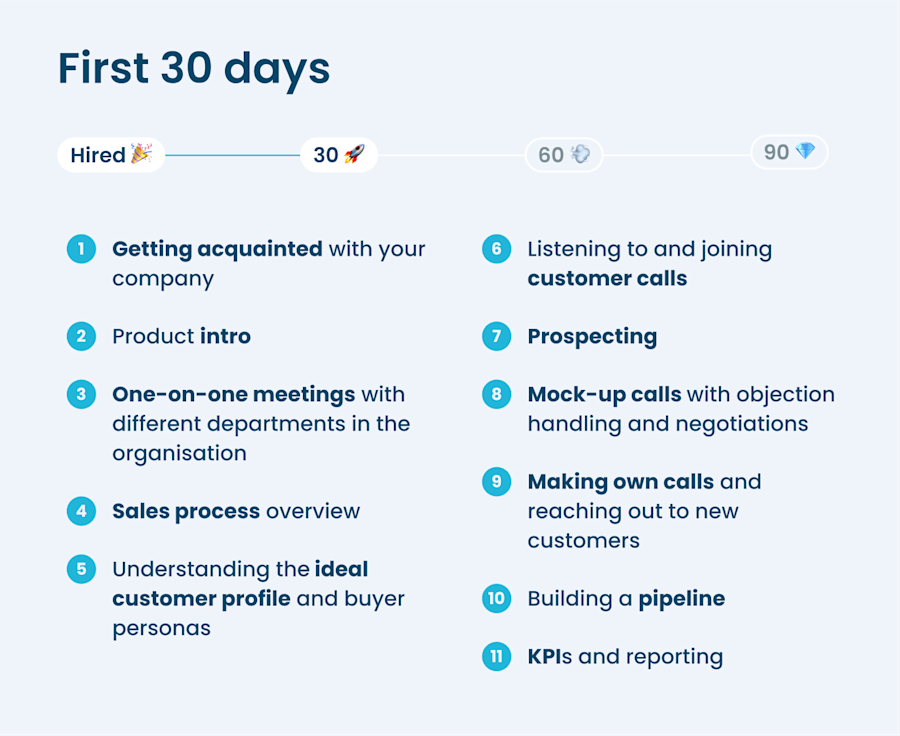
Here are some examples of goals in the first 30 days of a 30-60-90 plan.
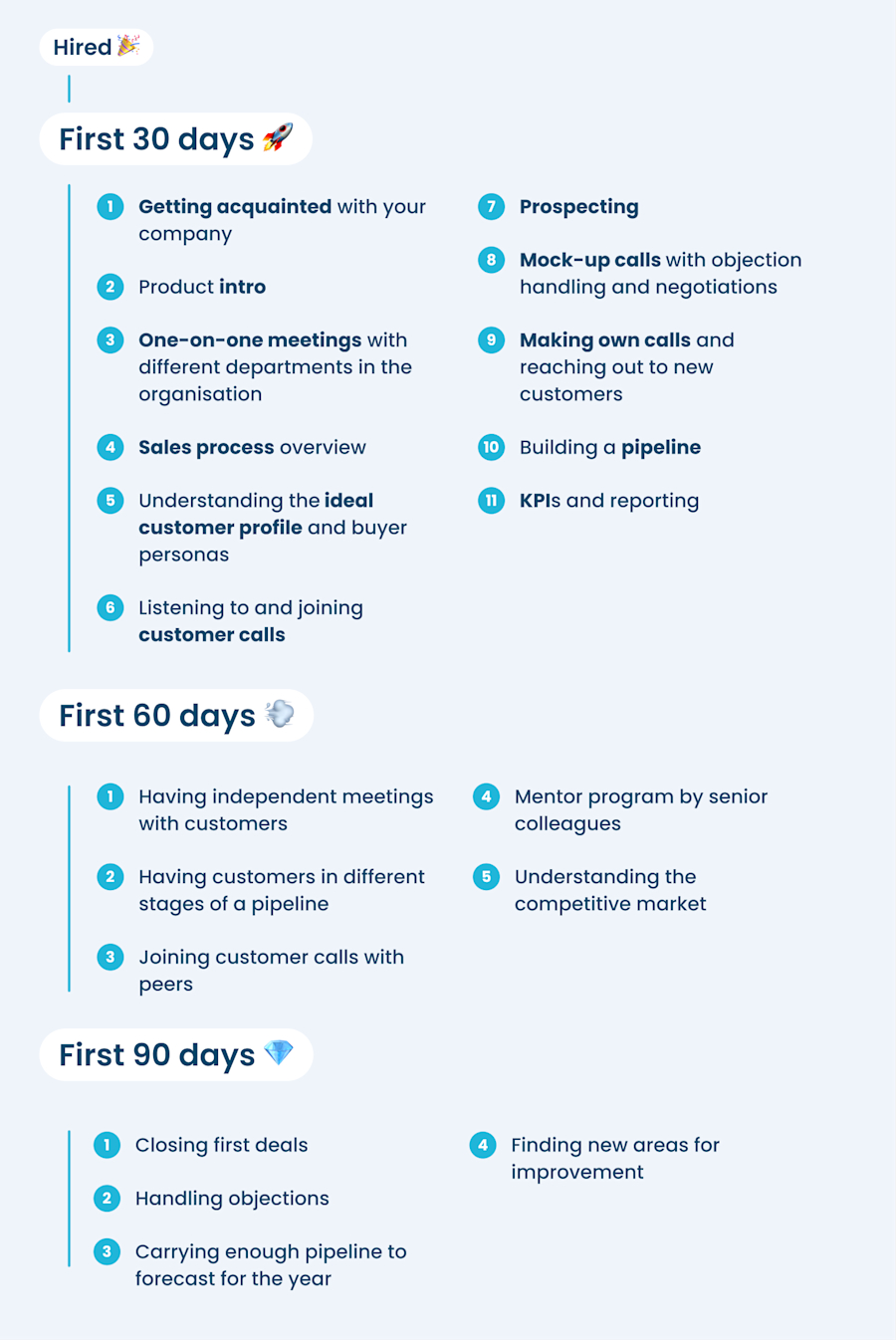
1. Getting acquainted with your company
Making a positive first impression on a new employee begins here. It's simple enough: start with your company’s mission, history, and values that guide everything you do, from the projects you work on to how you treat each other.
2. Product intro
Explain how your company's products solve customer problems, with key features and benefits. When an account executive truly believes in the benefits of your company's offerings, their enthusiasm and passion will spread.
You should also communicate where a product falls short of the competition. That way, in meetings, they’ll be prepared when hit with hard questions.
3. One-on-one meetings with different departments in the organization
Visiting different departments will help a new hire better understand your company's internal operations. Relationships with other team members will be key to supporting future negotiations, and when employees feel valued as part of a bigger whole, they’re more motivated and engaged.
4. Sales process overview
Now is the time to show your account executive the battlefield. Describe how your company engages customers and closes deals and what the AE role is at every step in the process.
Explain the sales process using real-life examples and case studies. This can help clarify the process and make it easier to follow.
5. Understanding the ideal customer profile and buyer personas
Describe the ideal customer profile for your company, including industry, size, location, and budget. Don’t forget to add how this profile fits into your overall sales strategy.
Give an overview of the needs, problems, and buying motivations for each customer persona. Provide examples of how each persona might contact the company and what the sales process would look like in each case.
6. Listening to and joining customer calls
Take it slowly, so your newbie doesn’t get swept away in a tide of challenges too soon. Listening to customer calls is a small rehearsal before the big swim. Experienced colleagues can serve as role models for new account executives, offering tips and best practices for customer interactions.
7. Prospecting
During this phase, your account executive will make their own efforts to find potential clients. Encourage them to think outside the box and develop messages that resonate with your target market.
Share your prospecting successes (and failures) to show how persistence and creativity can lead to successful acquisitions.
Don't forget to equip your hire with comprehensive lead generation tools and CRM integration. These are key to a successful sales enablement process and will make for an easier, more enjoyable journey to new customers, based on data-driven insights.
8. Mock-up calls with objection handling and negotiations
Consider setting up mock-up calls in a controlled environment, such as a training session, with a role player or coach acting as the customer. Done right, realistic mock-ups will prepare your executive to deal with objections and make effective sales presentations in real-world situations.
9. Making own calls and reaching out to new customers
Encourage your account executive to remain authentic and provide them with all the materials and resources they’ll need to meet the customer on their own ground.
One deep breath, and your newbie will be calling their first account client for you.
10. Building a pipeline
With some practice under your belt, you and your new hire can move on to strategic planning. Account executives must handle the entire customer journey, from qualifying to nurturing potential customers.
Each step involves a specific set of actions, including resources. Demos and trials, for instance, are helpful in the nurturing phase. Give your newbie everything they need to survive and thrive as they develop their sales pipeline.
11. KPIs and reporting
The first 30 days were a wild ride. Your account executive has been hitting the phones and hustling to build their pipeline. Schedule a 1:1 meeting to recap this time and move them to the next level.
In your meeting, evaluate the first 30 days of work and set measurable goals. Create reports on account executive performance based on key sales metrics. To get started with KPIs, you can measure lead response time or call volume. If appropriate, you can also look ahead to target conversion rates.
Day 31 to 60- Execute and Own Deals
Quick Template
Primary Objective: Manage pipeline independently
Focus Areas
Running full discovery calls
Handling objections
Multi-threading accounts
Competitive positioning
Forecast hygiene
Activity Targets
10 - 15 active opportunities
3x pipeline coverage vs. quota
20%+ meeting-to-opportunity conversion rate
First proposal sent
Manager Checkpoint Questions
Is the AE qualifying properly?
Are objections handled confidently?
Is deal progression consistent?
Deliverables by Day 60
Multiple deals in mid-stage
First proposals out
Improved close positioning
With 30 days of experience, your account executive should be ready to face real challenges in the brave new sales world. The second month sets the tone for the rest of their time with your company. Below are some steps to help a new employee get off to a good start (and hit the ground running).
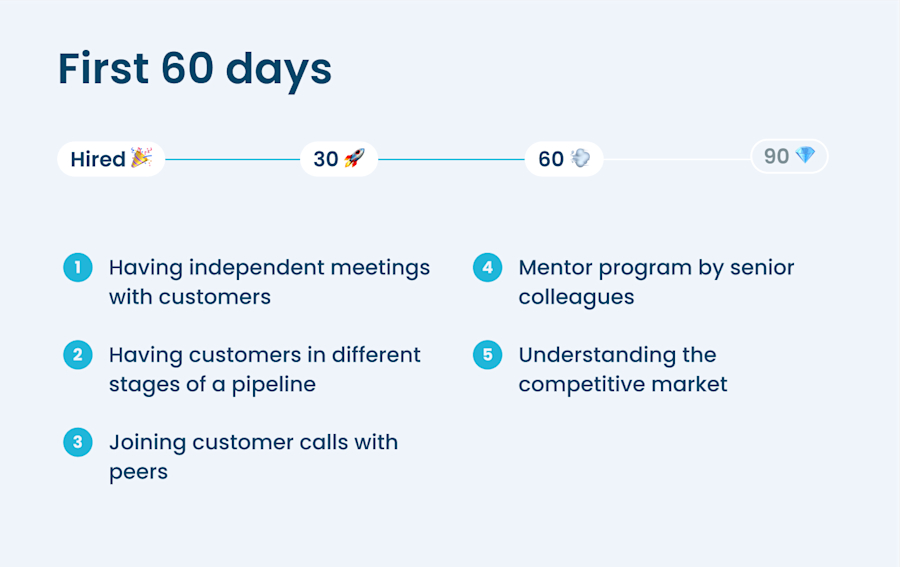
1. Having independent meetings with customers
That’s right: your exec should be on their own this time. Loosen the reins and let new employees learn from their mistakes. This is where they’ll learn to find the sweet spot between pushy and passive.
2. Having customers in different stages of a pipeline
Time management and attention to detail are essential here. Juggling multiple priorities, deadlines, and customer needs can be a challenge, especially when your account executive doesn't want to drop any.
3. Joining customer calls with peers
At this level, your new employee will deal with objections from multiple customers. Make sure they can control sales call agendas so they don’t end up discussing the latest football match instead of communicating product benefits.
4. Mentor program by senior colleagues
Now that your new employee has basic knowledge and skills, it's time to grow them. Start by looking at your new employee’s mistakes. Assign a more experienced account executive to teach them the fine skills of active listening, workload balancing, and creative thinking.
5. Understanding the competitive market
Throughout the training, your new hire should always have your competition in mind. They should also use online resources, industry reports, and publications to gather information on the competitive landscape and market trends, and to examine their competitors' strengths and weaknesses.
We’re almost at the finish line! Let’s see what your account executives should have achieved by the third month.
Day 61 to 90 90 - Close and Forecast
Quick Template
Primary Objective: Revenue contribution
Focus Areas
Closing first deals
Advanced objection handling
Accurate forecasting
Account expansion planning
Activity Targets
First deal closed
3x - 5x pipeline coverage
Forecast accuracy within ±10%
Clear next-quarter plan
Manager Checkpoint Questions
Can the AE forecast confidently?
Is pipeline quality strong?
Are deals moving without heavy supervision?
Deliverables by Day 90
Revenue generated
Predictable pipeline
Independent execution
The last 30 days of a 30-60-90 plan provide a reference point for evaluating your employee's performance and progress. This is where your new hire will take independent sales steps for your company.
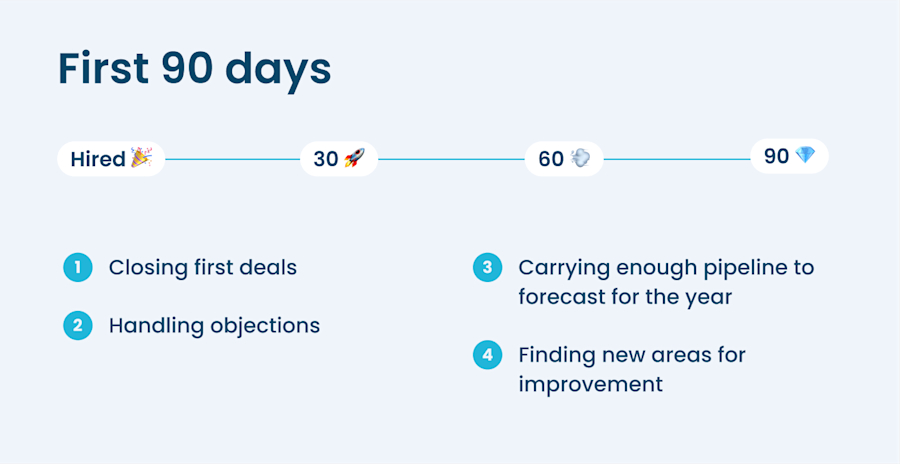
1. Closing first deals
Your account executive already knows your expectations and the specifics of your customer database. Therefore, they must now have all the necessary tools to impress your target audience, you, and even themselves. They’re the experts here, walking into meetings with their heads held high, and all that's left for you is to be proud.
Your pride doesn’t have to be silent. Don’t forget that you can offer incentives to your account executive, such as bonuses for reaching milestones, commission-based payouts, and advancement opportunities.
2. Handling objections
By day 90, your account executive should be able to handle customer objections like a boss. They should already have mastered active listening, understanding customer concerns, finding common ground, and pinpointing and addressing key customer issues.
3. Carrying enough pipeline to forecast for the year
As your account executive successfully progresses through the first quarter, it’s time to consider the future. By this stage, they should already know every detail of their sales pipeline and be able to identify patterns and trends to build what-if scenarios, experiments, and forecasts.
4. Finding new areas for improvement
Your new hire will already have learned a lot by the end of their 30-60-90 plan. But this is just the beginning. When the first quarter ends, what new heights should they aim for?
Take time to give honest feedback on your new employee's performance. This way, you’ll identify any areas for improvement. Then you can focus on increasing their knowledge of the products and the industry, and on showing them how to better prioritize tasks and optimize collaboration with other teams. You can consolidate the outcomes of your onboarding plan with sales enablement tools and a training program for after the 90-day period.
Make the First 90 Days Count
Continuous improvement is a journey, not a destination. Likewise, your new account executive’s development shouldn’t end with their 30-60-90 plan.
The plan is an exciting starting point, as it gives a clear idea of what new employees need to accomplish and how they’ll get there. Why rush into things? Instead, allow your new employees to take small steps toward becoming true professionals with a well-designed 30-60-90 onboarding plan.
FAQ about 30-60-90 Day Plan
1. How detailed should a 30-60-90 day plan be?
Detailed enough to provide clarity, but not so rigid as to limit flexibility. Focus on clear outcomes, measurable milestones, and priority activities. Avoid micromanaging daily tasks. The goal is structured progress, not over-engineering.
2. Who should create the 30-60-90 plan?
It should be developed collaboratively. Sales managers define expectations and performance standards, while the new Account Executive contributes goals and learning needs. Shared ownership increases accountability.
3. Should revenue targets be included in the first 90 days?
Yes, but realistically. Early goals may focus on pipeline creation and activity metrics before full quota expectations apply. By Day 90, the Account Executive should be contributing measurable revenue or maintaining sufficient pipeline coverage.
4. What happens after Day 90?
The ramp phase transitions into ongoing performance management. This includes advanced skill development, refined forecasting, strategic account growth, and expanded responsibility for revenue. The 30-60-90 period establishes the foundation, because long-term growth builds from there.

Team Lead Growth AM/Sales Team @ Leadfeeder
Thijs Schutyser is Sales Manager at Leadfeeder with more than a decade of experience in B2B sales and pipeline generation. He has worked across account executive and leadership roles helping companies turn website visitor data into qualified sales opportunities.
Having delivered hundreds of product demos and worked directly with sales teams across Europe, Thijs brings firsthand experience in modern sales prospecting and buyer engagement. His experience using visitor insights and intent signals to prioritize outreach informs his perspective on building predictable pipeline and improving sales prospecting strategies.