
Facing these objections can be frustrating, especially in B2B sales, where deals are often complex and require multiple touchpoints. Knowing how to handle objections separates successful salespeople from the rest.
A sales objection is any reason a prospect gives for not buying, whether it is a genuine concern about your product or a practical issue like timing. The key is being ready with a response that keeps the conversation moving.
In this article, we outline 30 of the most common objections you will encounter and show exactly how to overcome them so you can keep your pipeline moving and close more deals.
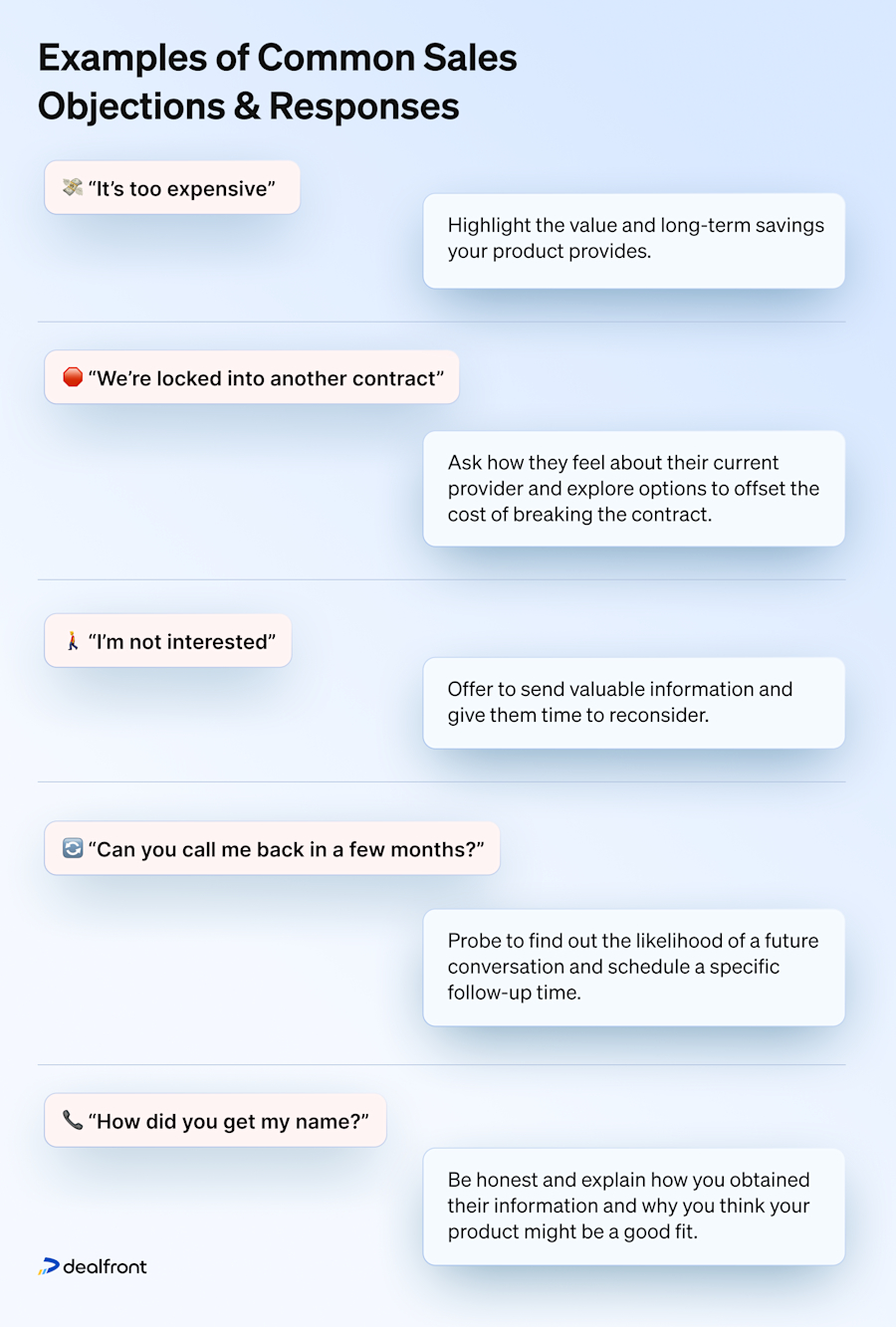
1. “It’s too expensive.”
Remember that more people are likely to say this than genuinely mean it. After all, what good negotiator starts by agreeing to the proposed terms immediately?
So, expect to hear this often, but be aware that it has several possible interpretations.
Yes, it could be that the prospect really is balking at your pricing, but they might simply be staking out a negotiating position.
How to resolve it: Either way, you tackle this response by highlighting the value of your product. Point out how it solves specific problems, or how much time it will save when implemented.
2. “The budget is assigned elsewhere.”
The prospect is letting you know that there is money in the budget, but their company has already decided to allocate its limited resources to a different priority.
How to resolve it: This one is simple in theory, but tricky in practice. You have to find a way to bump your product's purchase up the priority list. Try sharing a few examples of how other companies have used your product to save money or achieve significant efficiency gains. That might just do the trick.
3. “I don't see the ROI here.”
The prospect can’t see the value in what you’re offering, so they’re reluctant to invest in your product.
How to resolve it: If what you’ve said to them so far hasn’t gotten the message across, you’ll have to change tack and find another way of illustrating why your product will be a good investment. Again, if you can point to real-world case studies that show how your product has delivered cost savings and driven productivity gains for other customers, that might break through.
4. “We're locked into another contract.”
The interesting thing about this objection is that the wording could suggest the speaker feels trapped. In other words, they’re not dismissing your approach out of hand.
How to resolve it: First, you need to establish whether they’re happy with their current provider or are looking to get out of the contract.
Ask open-ended questions to probe into how they feel about their current vendor. If it sounds like they could be ready for a change, explore options such as a special discount to offset the cost of ending their existing contract early.
5. “I don't want to get locked into a long contract.”
This objection often comes from those keeping a close eye on cash flow. They may be genuinely interested in your product, but wouldn’t want to sign up if it could jeopardize other aspects of their business.
How to resolve it: Assuming there’s some leeway in your pricing model, you can assuage their concerns by offering more flexible terms. For instance, you might suggest monthly billing instead of asking for an annual payment upfront.
6. “I'm happy with [competitor].”
If your contact sees no reason to change suppliers because they’re satisfied with the current one, this can seem like a roadblock to progress.
But it doesn’t have to be.
How to resolve it: Direct the conversation to what they like about their current vendor. The more they talk about this, the more likely it is that you can spot an opportunity to explain why your solution offers better value or another specific advantage relevant to their needs.
7. “I plan to shop around for quotes.”
If someone has already decided they want to compare quotes, that’s not necessarily a problem. In fact, it’s good news because it shows they’re very much in the market for a product like yours.
How to resolve it: In effect, this prospect is already halfway down the B2B sales funnel. You just need to make sure you guide them into yours. While there are no guarantees, make sure you reinforce the value of your product with social proof wherever you can.
8. “I don't have the time to talk at the moment.”
This objection can be intended to shut down the conversation. So, it’s a challenge to handle, but by no means impossible.
How to resolve it: Simply explain that you’re not looking for an in-depth conversation at this stage. Say that if they can give you three minutes of their time, you’ll sum up in a nutshell how your product can bring value to their business.
9. “It's not my decision.”
The person you’re speaking to might be very interested in what you have to offer, but unfortunately, they don’t have the authority to strike a deal.
How to resolve it: This one is pretty straightforward. Ask who the relevant decision-maker is at their company and whether your contact could set up a call with them. If the first person you speak to doesn’t have the power to make the decision, talk to someone who does.
10. “I can't sell this internally.”
While you’ve made a good case to your prospect, they think they’ll have trouble convincing their boss or other key stakeholders.
How to resolve it: If you can’t set up a direct meeting with a decision maker, ask your contact what kinds of objections they expect when they bring your offering to the table.
Then, suggest you help them build a business case they can use on your behalf. If you have case studies and other relevant documents you can share with them, so much the better.
11. “We're not ready to commit.”
There can be several reasons why someone might not be ready to make a purchase decision. They may be interested in your product, but not in a hurry to buy.
How to resolve it: Resist the temptation to pressure them into a decision. Instead, try to pin down what’s causing the reluctance by exploring their needs a little more deeply. You may be able to alleviate their concerns and encourage them to rethink. If not, make sure it’s still your product that the contact thinks about when they are ready to commit.
12. “You don't offer this feature we need.”
Unfortunately, your prospect is looking for a particular feature your product doesn’t have, so they’d rather go with a different solution.
How to resolve it: It’s possible your product simply isn’t a good fit for their needs, and if so, there’s no way around that. But in some cases, you might be able to suggest a partner product that complements yours and serves the desired purpose, allowing you to sell both together.
13. “We've tried similar products before, and it didn’t work out.”
The “once bitten, twice shy” objection. The prospect has already sought out and implemented similar products but has encountered problems with them.
How to resolve it: Here, you need to persuade them that your product is the answer. They’re already in the market for something similar, so that’s a good start. Ask them why the previous products they used didn’t work out, and show them evidence of how your product will solve those issues.
14. “I'm not interested.”
A very common objection, particularly when you’re doing cold outreach. It doesn’t have to be a deal-killer, though.
How to resolve it: Tell them you understand, then suggest sending over information about how your product will address their specific pain points. This gives them the space to investigate your offering at their leisure, and if they change their mind, they can get in touch.
15. “This looks too complicated to learn.”
You finish your pitch, only to be met with blank looks and a puzzled face. Oh dear.
How to resolve it: Don’t panic. It could be that your prospect is having trouble grasping just a couple of aspects of your product. Ask if there are certain parts of the product that aren’t clear. Put a strong focus on reminding them that your excellent customer service team will always be available to help them navigate any difficulties they’re experiencing.
16. “I've never heard of you.”
Some prospects put more store by an established reputation than others. They may be reluctant to go with an unknown name.
How to resolve it: Explain what your company does and how your product works. Suggest having a conversation to discuss their current challenges so you can explore how your product can help them meet their goals.
17. “Can you email me the details?”
This is a hopeful sign since the prospect appears to be engaging with you. They might not have the time to talk right now, but they’re registering an interest in what you have to say.
How to resolve it: This is a good opportunity to ask deeper qualification questions. Say you’ll be happy to send over the details, and ask whether there are any particular aspects of the product they’d like further clarification on.
18. “This won't work with our current setup.”
You’ve hit a snag, but maybe not a fatal one. The prospect sees value in your product but can’t see a way to integrate it into their current system or workflow.
How to resolve it: If the prospect is solidly committed to maintaining their current setup, this objection can be a deal-breaker. But it’s worth asking a few questions before giving up.
Ask what they like and dislike about their current tools, and see if you can persuade them that your product would be a more efficient replacement. Or, better still, find out if your offering can work with them—perhaps there’s an integration your contact isn’t aware of.
19. “Our team isn’t big enough to need this.”
Particularly with smaller companies, you’ll sometimes find that prospects take more convincing that investing in your product will really be worth what they get in return.
How to resolve it: Acknowledge the concern and ask what the team’s everyday responsibilities entail. Explain that you think your product might help take the load off. If you can offer a demo or free trial, this is a good time to mention it.
20. “I don't see why your product would benefit us.”
This is a straightforward value-based objection. You’ve yet to persuade the prospect that your product will add value to their company.
How to resolve it: Go deeper into your value proposition. If you’re working from a script, don’t just repeat what you’ve already said. Explore what your prospect’s pain points and business goals are, and find a way to tie them to your product.
21. “The challenges you mention aren't a big problem right now.”
No matter how good your preparatory research is, you’ll sometimes get a curveball like this. You’ve been illustrating why your product is good for problem X, but the prospect says they don’t need help with X right now.
How to resolve it: Pivot to what they do need. Ask what their current challenges are, and focus on how your product can address them. Essentially, think of this as a quick lane change rather than a roadblock. After all, if the prospect didn’t see any value in your product, they’d have stopped talking to you already.
22. “We're in the middle of being bought out.”
You’re not likely to come across this objection very often, but when it crops up, there’s not much you can do to seal the deal right now. The disruption a merger causes often means purchasing decisions are suspended until the dust clears.
How to resolve it: You can still maintain a connection with the individual you’re speaking with, though. Thank them for their time and suggest keeping in touch. That way, if they ever need your product, they can call you.
23. “I saw you got a bad review.”
The prospect is aware of your company or product, but is skeptical after reading a negative review from an unsatisfied client.
How to resolve it: This one can actually be an opportunity rather than a problem… providing your company has actually addressed the issue raised in the review. Acknowledge the bad review and explain the fix your company made. If you have any documents or case studies to prove the fix was effective, offer to share them.
24. “Your product sounds great, but I'm too busy to look at it right now.”
This one is slightly different from a straight-out “I’m too busy” or “don’t have time to talk” objection. It shows much more potential engagement, so it’s actually a good sign.
How to resolve it: You can take a leaf out of the “don’t have time to talk” sales rebuttal, where you ask for three minutes to give a quick summary of your product (see objection 8), but that shouldn’t be the main focus here. Instead, thank the prospect for their time and ask if you can schedule a more in-depth conversation at their convenience.
25. “Can you call me back in a few months?”
If a prospect says this, odds are they’re brushing you off and hoping you’ll go away. So, it’s not the easiest objection to handle—but it’s not a dead loss, either.
How to resolve it: Say you’ll be happy to call them back in a few months’ time. Before you go, though, do a little more probing. Ask them whether they think they’ll be able to get the go-ahead from the decision maker in their department later on in the year. You might also try to pin them down to a time or date for you to call back.
26. “How did you get my name?”
You’re not off to a great start here. This objection implies they’re irritated to hear from you, so they’re probably not going to be enthusiastic about listening to your pitch.
How to resolve it: Be honest. Tell them how you sourced their information and explain that you thought your product might be a good fit for their needs. If the worst happens and they start getting aggressive, just keep calm, end the call, and chalk it up to experience.
27. “This looks like a fad to me.”
This objection is one you’ll sometimes face if your product is an innovative solution within a particular niche. Your prospect doesn’t yet understand how important your product will actually be.
How to resolve it: You’ll need to demonstrate why your product is crucial, using real-life examples. If you can pull out case studies of clients who experienced huge benefits by implementing your solution, you’re much more likely to get the prospect on board.
28. “We don't have the capacity to deploy your product.”
This one can be a real problem. That’s because if using your product means the client company has to recruit more people to use it or divert resources from elsewhere to implement it fully, it may turn out to be a burden rather than an asset.
How to resolve it: The best you can do here is acknowledge the issue and try to gauge the extent of the capacity shortage. If you can offer any practical support with implementation that might make it more cost-effective for them to deploy your product, do so. But be ready for the possibility that your product might not be a good fit.
29. “We only work with companies we know.”
If the prospect tells you this, there are two possibilities: Either their company has a strict policy in this area, or it doesn’t.
How to resolve it: You can’t win if the policy isn’t flexible, but spend a little time exploring whether it might be. If you can demonstrate that your product would add substantial value to your prospect’s business, they might be able to get you on the approved vendors list.
30. “Hello, you've reached [prospect]. Please leave a message.”
Your contact seems impossible to reach. They never answer the phone or respond to messages.
How to resolve it: It’s rarely worth trying to make a full pitch on a recorded message, so don’t try. If the prospect seems to be avoiding talking to you, there’s probably a good reason. Consider the possibility that they don’t like taking sales calls because they’re not a decision-maker. Check to see whether someone else at the company might be a better bet to pitch to.
What is sales objection handling?
Sales objection handling is about finding a way to continue the conversation by appropriately alleviating the prospect’s concerns.
Understanding how to handle objections sales agents encounter regularly is one thing. Actually putting the theory into practice is quite another. It’s something that takes time to master, but the crucial point to bear in mind is that there’s no one-size-fits-all response.
While you’ll always need to be careful to be empathetic rather than pushy, the ideal response in each case depends on the details of the objection. A good start is to categorize sales objections into distinct subtypes. That’s because each of these subtypes will usually require a different approach to be countered effectively.
Types of sales objections
Broadly speaking, you can slot the vast majority of objections into one of five categories: Budget, authority, need, timing, and competitor-related. Let’s take a closer look at each of these:
1. Budget-related objections
One of the most common types of objections in sales is budget-related ones. The prospect may claim the money just isn’t available right now for their company to invest in your product. Or they might simply say your price point is too high.
Your job here is to focus on value. Remember that from the prospect’s point of view, they would be taking a business risk in taking on your product. If you can convince them that your offering would help rather than hurt their bottom line, you might pique their interest.
2. Authority-related objections
Given the B2B sales process, authority-related objections are a fact of life. These are the objections that stem from the fact that your prospect is just one cog in a corporate wheel and may not have the final say in purchasing decisions.
Ideally, this shouldn’t happen too often since you should be working from a list of qualified leads. But in practice, this is an objection you may come across on a fairly regular basis. The right tactic here is to start a conversation with whoever does have the authority to make the decision. That means either speaking to them directly or doing so indirectly via your initial contact.
3. Need-based objections
Occasionally, you’ll find a prospect telling you that they don’t see a need for your product. They already have a working system, and your product is surplus to requirements. This might seem like a tricky sales objection on the surface, but you can turn it to your advantage.
Ditch the script and ask a few open-ended questions. The vast majority of businesses have at least a few pain points and face some challenges. The goal here is to unearth what these are to see whether you can find any that your product can help with.
4. Timing-based objections
If you find a prospect is telling you that your product looks great, but they’re not in the market for it right now, you’re dealing with a timing-based objection. These sometimes go hand-in-hand with budget-related objections, so it’s not unusual to have to deal with both at once.
The answer to this one depends on the underlying reason for the objection. In other words, is this a polite brush-off, or is timing the real issue? Either way, the best approach is to ask whether you can reschedule the conversation to a time that suits your prospect. If they say yes, great. If not, it was probably a brush-off, and you’d be better off moving on anyway.
5. Competitor-based objections
A well-informed prospect might raise objections relating to your competitors. Maybe they point out that a competitor’s product has a feature yours doesn’t. Or perhaps they’re already familiar with other companies’ pricing models and feel that yours isn't a good fit for their budget.
While this kind of objection can seem intimidating, it’s actually a good sign. That’s because it demonstrates that the prospect is already genuinely interested in products like yours. So, the key here is to plan ahead and master your brief.
Any effective B2B sales strategy must take the competitive landscape into account. You need to be intimately familiar with what the competition is offering, so that you understand how you compare. With this knowledge, you can highlight the areas where your product is superior.
Tips for overcoming sales objections
Although each different type of sales objection needs a tailored response, there are some underlying principles at work.
That’s because any kind of personal selling inevitably involves negotiating the quirks of human psychology. Effective countering strategies—or “sales rebuttals,” as they’re also known—must work with the prospect’s mindset rather than against it.
With that in mind, here are a few tips for how to handle sales objections sensitively:
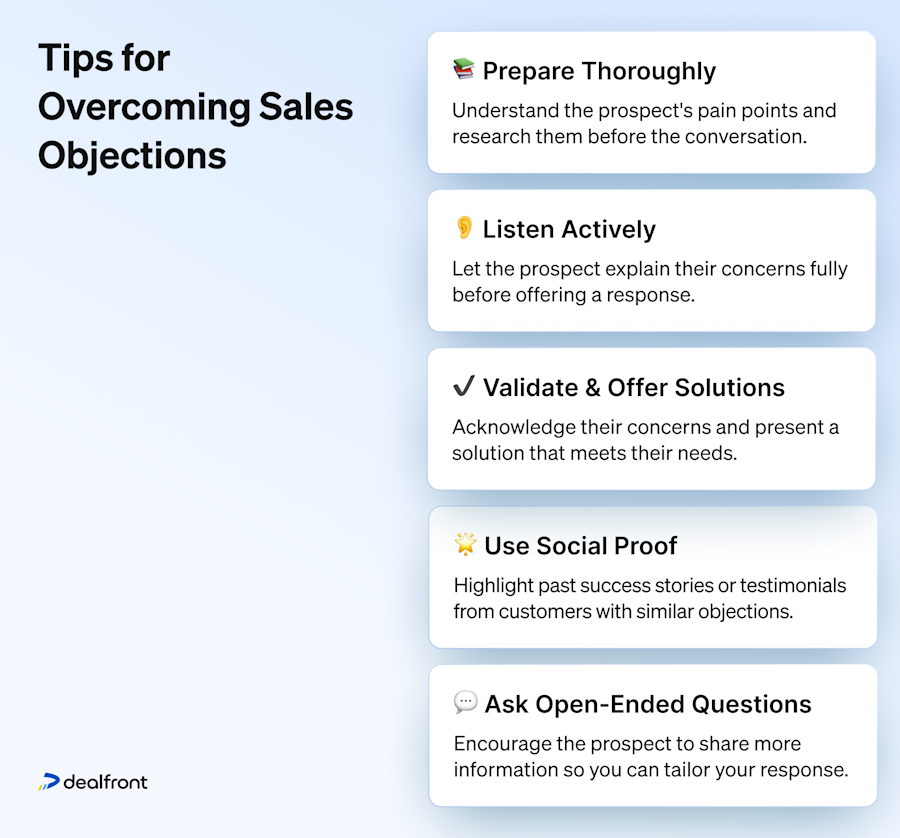
1. Fully prepare before sales conversations
Preparation, preparation, preparation. That’s the first and most important aspect of selling. You can’t simply go in blind and wing it. You need to have an in-depth understanding of your prospect’s pain points and challenges.
The only way to achieve this is to spend time researching your potential customers and their businesses in advance. That’s why sales intelligence tools like those provided by Leadfeeder are so useful, because they can help you gain insights into your leads before you even open the conversation.
When you do this, you’ll have all the information you need at your fingertips to anticipate the kind of objections that might be raised. And that means you’ll be able to overcome them.
2. Truly listen and understand your lead’s concerns
It’s crucial to remember that you can’t address a concern unless you understand it. While it might be tempting to jump in and try to counter an objection quickly, this is a mistake.
The worst possible thing you can do is not give your prospect the space to explain their thoughts in full. You’ll probably come across as defensive or pushy, which is the opposite of what you want.
Instead, practice active listening.
Pay attention to what the prospect is telling you and try to understand where they’re coming from. That way, you’ll be in a much better position to suggest solutions that are relevant and keep your prospect interested.
3. Provide validation and present solutions
Never dismiss objections or tell a lead they’re wrong. Nobody likes being told they’re mistaken or misinformed, so that’s the fastest route to failure. If you truly want to get someone on your side, you need to take a completely different approach.
Validate any concerns your prospect has, so that they know you’re actually listening to what they have to say. Take them on board and offer a solution that acknowledges the nuances of the objection.
Responding constructively like this signals that you’re being sincere in your efforts to provide something useful for your clients that takes their individual circumstances into consideration.
4. Leverage social proof
Don’t forget the power of social proof.
In some cases, you’ll be able to cite examples of how you resolved similar objections from other customers. In fact, this can be an excellent opportunity to turn a concern into a strength.
If you can point to evidence of your having solved this particular issue before, and explain how you did it, you’re doing something very positive. You’re demonstrating to your prospect that you can do the same for them.
Anticipating common sales objections can help you close more deals
Of all the demands working in sales involves, few are as challenging as dealing with the objections that prospects throw into your path. While some are easy to predict, others can be genuinely unexpected and take you by surprise.
While there’s a lot to be said for being able to think on your feet, there’s no substitute for being well prepared. Hopefully, this guide has given you insight into how to handle sales objections you might not have encountered before. The next time they crop up, you’ll know exactly what to do.
Oh, and if they do take advice from a trusted astrologer? Try finding out which one it is and calling them for a chat before your next meeting. You know it makes sense. So, get going, and close that deal!

Team Lead Growth AM/Sales Team @ Leadfeeder
Thijs Schutyser is Sales Manager at Leadfeeder with more than a decade of experience in B2B sales and pipeline generation. He has worked across account executive and leadership roles helping companies turn website visitor data into qualified sales opportunities.
Having delivered hundreds of product demos and worked directly with sales teams across Europe, Thijs brings firsthand experience in modern sales prospecting and buyer engagement. His experience using visitor insights and intent signals to prioritize outreach informs his perspective on building predictable pipeline and improving sales prospecting strategies.