60-Second Summary
CRMs don't lie — unvetted leads do. Poor qualification inflates pipelines, breaks forecasts, and wastes Sales and Marketing effort; this guide shows how to tighten definitions, automate routing, and align teams to focus on real opportunities.
Key takeaway: Unqualified leads bloat the funnel — 61% of companies pass every lead to Sales but only ~27% are qualified, which destroys forecast accuracy and burns rep time.
Standout strategies & tactics: Audit labels, document shared funnel definitions, set SLAs between Marketing and Sales, automate fast routing for high‑intent signals (contact within 5 minutes) and filter bad fits automatically.
Frameworks & qualification: Use BANT/CHAMP for quick screens and MEDDIC for enterprise deals; require fit, engagement and a validated problem to label a prospect, and require cost, timeline and technical fit to create an opportunity.
Real-world operational checklist: Track lead→MQL→SQL and SQL→opportunity rates, require opportunities to include amount, close date, stage, next step and competition, review labels weekly, and use PQLs/Pipeline tiers to prioritize outreach.
*This summary was created with AI assistance, using our original content.
It can feel like your CRM is lying to you, but really, you may be filling your database with unvetted leads that lack a confirmed budget, timeline, or pain point. The knock-on effect causes revenue leaks that wreck your forecasts, fuel infighting between Marketing and Sales, and burn your reps' time on people who aren't even close to buying. 61% of companies send every lead straight to Sales, yet only 27% of those leads are qualified.
The following guide breaks down how to clean up your sales process, stop the pipeline bloat, and finally get your Sales and Marketing teams speaking the same language.
Quick comparison: lead vs prospect vs opportunity at a glance
The table below breaks down each term by definition, funnel stage, buyer signals, owner, goal, and the metric you should track.
Visual funnel: from anonymous visitor to closed-won
The process starts when a visitor lands on your website. At first, they are anonymous. Once they fill out a form or you identify them through research, they become a lead.
From there, the relationship evolves through a few key milestones:
The Prospect: Your team confirms the person is a good fit for what you sell and starts a conversation.
The Opportunity: A real deal is on the table with a clear budget and a path to purchase.
The Customer: The contract is signed.
Keep in mind that people leave the process at every stage. They might not be the right fit, they might choose a competitor, or their budget might get cut.
The hand-off
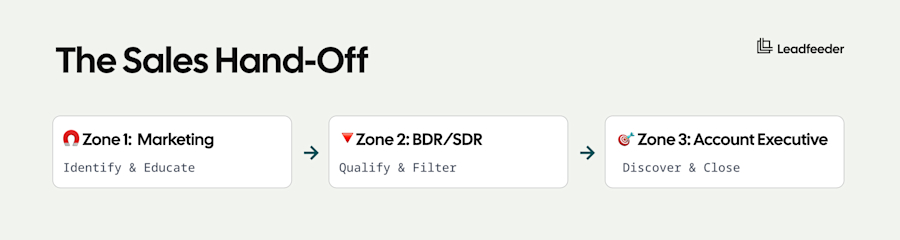
The process usually moves between different experts. First, Marketing identifies people with high interest. They pass those leads to a representative who qualifies them. Once a lead is ready for a serious sales talk, they are handed off to an Account Executive to finalize the deal. Different companies use different names for these stages, but the goal is the same: making sure the right people are getting the right attention.
What is a lead?
Leads are the widest part of the funnel, and most of them won't go any further. Here's how to define and handle them.
Simple definition and stage in the funnel
A lead is a person or account that has shown potential interest, but nobody has qualified them for a sales conversation yet. MQL (Marketing Qualified Lead) and SQL (Sales Qualified Lead) are internal thresholds used to distinguish between leads and prospects. An MQL has taken a qualifier action, like a demo request. An SQL has been vetted by sales. For context, the average MQL-to-SQL conversion rate sits around 13%, but top performers who use behavioral scores hit 40%.
Common examples of leads (B2B and B2C)
Inbound leads come from form fills, ebook downloads, webinar signups, and free trial signups. Outbound leads come from list-built contacts, event badge scans, and cold outreach replies.
B2B account-based example: your website analytics show multiple visitors from one company browsing product pages all week. Nobody has raised a hand, so the account is a lead until someone engages directly.
How Marketing and Sales should treat leads
Marketing needs to educate, segment, nurture, and score leads. When engagement spikes, route to sales fast because leads contacted within 5 minutes are 21x more likely to convert than leads contacted after 30 minutes.
Don't push pricing on a first touch. Don't lead with a demo when someone just downloaded a whitepaper. 79% of marketing leads never convert to sales, and lack of follow-up is usually why.
Manage leads in your CRM
Keep your CRM database organized with labels to track where every potential customer is, it doesn’t have to be super complex, just mark the leads as:
- New (no contact yet)
- In Progress (a salesperson is reaching out)
- Nurturing (sending helpful content over time)
- Disqualified (not a fit).
If fewer than 15% to 20% of your initial leads are turning into real sales conversations, it’s a red flag that your criteria or your hand-off process needs an audit. To stay efficient, use automation to fast-track high-interest leads to your sales team within minutes, while automatically filtering out bad fits or broken email addresses.
What’s a prospect?
A prospect has cleared the first bar. The fit looks right and the person is engaged. Now your team needs to figure out whether there's a real deal here.
Working definition: a qualified, engaged lead
A prospect is a lead that matches your Ideal Customer Profile and has given you two-way engagement. The person has moved past your content and into a real conversation. Prospect means you're still in the explore-and-qualify phase. Opportunity means you're after a specific deal.
Qualification frameworks you can use
BANT (Budget, Authority, Need, Timeline) works as a quick initial screen. CHAMP (Challenges, Authority, Money, Prioritization) puts the buyer's problem first. MEDDIC (Metrics, Economic Buyer, Decision Criteria, Decision Process, Identify Pain, Champion) goes deep for enterprise deals, and companies that adopt it see an average 25% improvement in win rates.
What you need before labeling anyone as a prospect:
Fit: ICP match on industry, company size, geography, or tech stack.
Engagement: responded to outreach, booked time, or triggered clear intent signals.
Problem: acknowledges a challenge your solution can address.
If a contact doesn't clear all three, the contact is still a lead. At least 50% of prospects won't be a good fit for what you sell, which is why these criteria matter.
Spotting a Real Prospect
A prospect is someone who has clearly shown interest. Depending on how you sell, look for the following signals:
Inbound: They book a discovery call, ask for a specific case study, or send a detailed reply to your email.
Outbound: They accept a meeting, open up about their priorities, or pull a teammate into the conversation.
Product-Led/Self-Serve: They hit a usage limit, invite their coworkers to the account, or check your pricing page repeatedly.
Tracking which companies are visiting your website with platforms like Leadfeeder helps your team know where to focus their energy. Just remember: website activity is a hint, not a guarantee. Your reps still need to have a conversation to confirm if there’s a real deal to be made.
How to engage prospects vs. leads
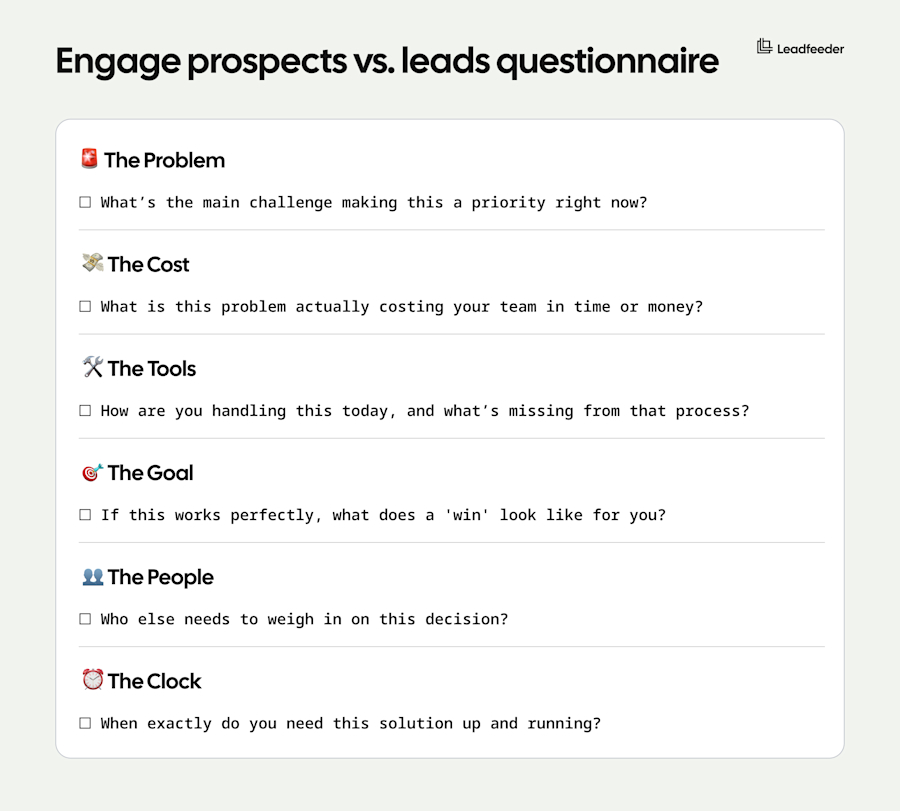
Marketing’s job is to educate leads. Once someone becomes a prospect, the salesperson’s job is to discover the truth. Instead of pitching features, ask questions that get to the heart of their business:
The Problem: "What’s the main challenge making this a priority right now?"
The Cost: "What is this problem actually costing your team in time or money?"
The Tools: "How are you handling this today, and what’s missing from that process?"
The Goal: "If this works perfectly, what does a 'win' look like for you?"
The People: "Who else needs to weigh in on this decision?"
The Clock: "When exactly do you need this solution up and running?"
Tracking prospects in your CRM
You have two main ways to handle prospects: keep them as qualified leads in your system, or convert them into contacts linked to a company account (which is normally the better move for team-based selling).
Either way, make sure you're tracking their fit, how much they're interacting with you, and their role on the buying team. To keep your data clean, set strict rules about who can change someone’s status; otherwise, your reps will inevitably promote people before they’re actually ready.
What’s a sales opportunity?
An opportunity is a deal, not a person. It sounds like a small detail, but confusing a "contact" with a "deal" is the number one reason sales forecasts fail. If you aren't tracking the deal itself, you aren't really forecasting anything.
Clear definition: a qualified prospect with real purchase intent
An opportunity exists when you've got a real deal: a defined need, an expected value, and a credible path to purchase.
Before anyone creates the record, the team should have evidence of intent, a timeline, and identified stakeholders. Top-performing teams convert 59% of SQLs into opportunities; if your numbers fall well below that, the qualification criteria need tightening.
Typical stages of an opportunity
Stop using your CRM’s default settings; they rarely reflect how you sell. Align your CRM stages to your team’s real-world process instead:
Three non-negotiable characteristics of a true opportunity
Before your team marks a deal as an opportunity, they should be able to check these three boxes. If they can’t, it’s still just a prospect:
The customer can tell you exactly what this problem is costing them in time, money, or risk
There’s a follow-up meeting on the books and a clear date in mind for when they need to make a decision
Your team has verified that your product actually solves their specific technical needs and that they’re a good fit for your business
How AEs should work on opportunities
A big mistake you can make is relying on just one person at a company. Deals fall apart the second your only contact gets busy, leaves the company, or gets overruled. So get at least two or three people involved early. You also need a shared game plan with the customer and a clear reason why they’ll get their money's worth. Before you even think about putting a closing date in your calendar, make sure you understand their internal legal and buying process.
Managing Deals in Your CRM
A deal is only as good as the data backing it. At a minimum, every opportunity in your system must include the dollar amount, expected close date, current stage, a clear "next step" with a deadline, and a note on the competition.
Use these four categories backed by hard evidence:
Pipeline: Everything you’re currently working on
Best Case: Deals that are moving forward and looking solid
Commit: Deals where the buyer has taken concrete action (like a signed contract or confirmed next meeting) toward a purchase
Closed: The final result: signed or lost
Lead vs prospect vs opportunity: why the differences matter
Using the wrong labels for your sales process can actively hurt your bottom line and team alignment. Here’s how to mitigate it.
Impact on forecasting accuracy and revenue planning
Labeling a contact as an opportunity before it’s earned is a recipe for broken forecasts, your win rates will drop, and your revenue projections will have no basis. In fact, fewer than 20% of sales leaders say their forecast is predictable, and only 7% manage to hit 90% accuracy. The core issue is pushing deals into later stages without the evidence to back them up.
To see if you have a labeling problem, keep an eye on four things: how many leads move from stage to stage, whether your total pipeline is roughly three times your goal, how your current forecast compares to the last quarter, and how long deals sit idle before they either move forward or fall through.
Impact on Marketing and Sales alignment
68% of B2B organizations haven't written down what their funnel stages mean. Because of this, marketing feels ignored, and sales feels flooded with poor-quality leads - and both are right, because without shared definitions, there’s no shared language.
The fix is a service-level agreement. Marketing delivers leads that meet specific criteria. Sales follow up fast, because teams that respond within one hour convert at 53% versus 17% for teams that wait a full day. Companies where both teams share CRM dashboards convert over 30% of MQLs versus 13% for siloed teams. In fact, aligned organizations see 24% faster revenue growth over three years, as a result.
Impact on SDR and AE productivity
When everyone on the team uses the same criteria, your reps stop burning hours on people who won't buy. Consequently, your meetings improve because the sales team only receives contacts who have already confirmed they have a real problem and are a good fit.
To stay on track, monitor: how quickly reps respond to new leads, how many of those leads actually turn into serious prospects, and how many of those prospects eventually become actual opportunities.
How to standardize these definitions in your company
Most teams know their definitions are broken. The hard part is the fix. Here's a four-step process that works.
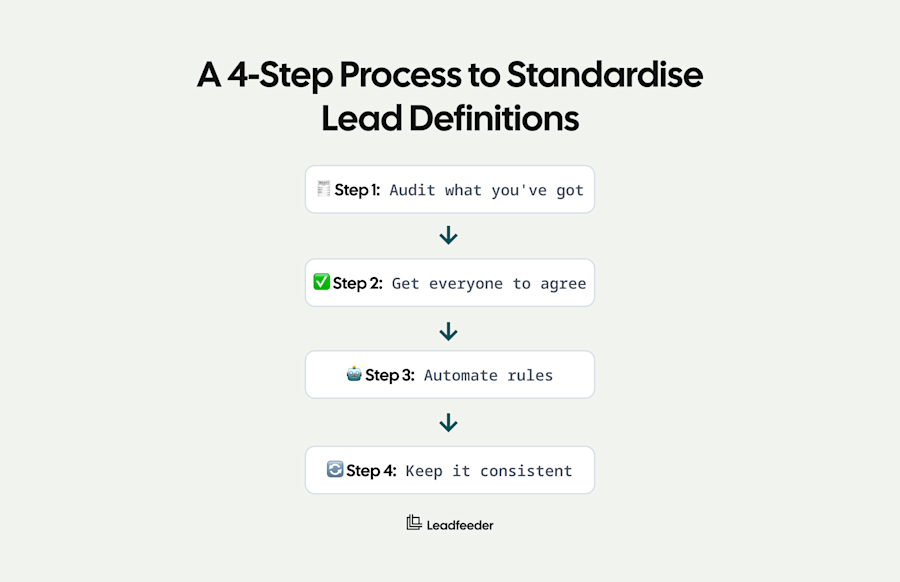
Step 1: Audit what you've got
First, check your database to see where people get stuck. If your active deals haven't been touched in weeks, your labels don't really reflect reality.
Step 2: Get everyone to agree in writing
Then, meet with other teams and define exactly what a good lead looks like using concrete examples (like someone booking a demo).
Step 3: Automate rules
Next, program your system to immediately send high-interest leads to a real person, then let the software automatically filter out any bad fits so your team doesn't waste time.
Step 4: Keep it consistent
Remember not to just set it and forget it, so review these labels in your weekly meetings to make sure they still match how you talk to customers.
How to adapt lead, prospect, opportunity to different sales motions
The basic definitions of a lead or prospect aren't one-size-fits-all. How you label people depends entirely on your business model:
B2B vs B2C nuances
B2B involves multiple stakeholders, longer validation, and account-level signals. However, B2C is faster because individual behavior drives the funnel.
Inbound vs outbound
If someone downloads your pricing guide then they’re high-priority and need a call immediately. If you reached out to them first (outbound), they aren't a prospect until they actually talk back and show interest.
PLG and hybrid models
If you offer a free trial, user activity will tell you everything. A sign-up is just a lead, but once they start inviting teammates or using key features, they’ve proven they’re a serious prospect. PQLs convert at 25-30% when the sales team reaches out, far above the rate for traditional MQLs.
Examples: how different teams define lead, prospect, and opportunity
Abstract definitions are useless without concrete triggers, so here’s what they look like in practice.
Software Sales (SaaS)
Lead: An HR manager downloads a free checklist from your site.
Prospect: They book a demo and confirm their company is big enough to need your help.
Opportunity: They agree on what they need and introduce you to the person who signs the checks.
Agencies & Service Providers
Lead: Someone fills out your "Contact Us" form or a friend refers them.
Prospect: You have a first call where they admit they have a budget for the project.
Opportunity: They ask for a formal proposal and give you a deadline for their decision.
Quick, High-Volume Sales
Lead: A simple request for more information.
Prospect: A quick phone call confirms they actually need the product this month.
Opportunity: You’ve sent over a quote and scheduled a follow-up to close the deal.
FAQs about leads, prospects, and opportunities
Can someone move backward from prospect to lead?
Yes. If a prospect goes silent or turns out to be a poor fit, move the record back or disqualify it. Document the reason.
Should we skip the prospect stage for high-intent inbound leads?
If someone reaches out specifically asking for a quote or has a clear deadline, it’s tempting to jump them straight to the Opportunity stage. You can do this, but don't get sloppy. you still need a quick health check to make sure they can afford your service and are a good fit.
How do free trials and freemium users fit in?
Treat trial signups as leads. When usage data shows the user activated key features and matches your ICP, promote to prospect. An opportunity opens when an upgrade conversation starts.
What's the difference between a lead and a contact in my CRM?
A lead is an unqualified record. A contact is tied to an account and represents a validated person. The conversion typically happens when the record becomes a prospect.
Final thoughts
At the end of the day, it doesn’t matter what you call your sales stages. What matters is that everyone on your team agrees on what those labels actually mean. Start by using a simple comparison table to get everyone on the same page, set up your system to match those rules, and then focus your team's energy on the people who are really showing interest.
Leadfeeder can reveal which companies visit your site and how engagement builds over time, giving your team the signal-based context to route and prioritize with confidence.