The reality is that sales is rarely about effort alone. Buyers ignore pitches that feel generic, pushy, or irrelevant, no matter how many follow-ups you send. The reps who consistently win are the ones who understand how people think, make decisions, and respond emotionally during the buying process.
That’s where sales psychology comes in. By using a few proven psychological principles, you can make your outreach more persuasive, your pitches more memorable, and your sales process far more effective without doubling your workload.
Note: Tired of pitching prospects that aren't a good fit? Sign up for Leadfeeder to generate a list of engaged companies that have visited your website. Get started with a free 14-day trial.
1. Seek rejections, not just sales
This sounds counterintuitive, I know. A sales rep is in the business of selling, right? Why would you want more rejections?
There's a psychological reason to seek more rejections. How many emails do you send a day? How many cold calls do you make? And how often do you hear back?
The psychological effect of not hearing back can take a toll on your mental health and, more importantly, impact your ability to be persistent.
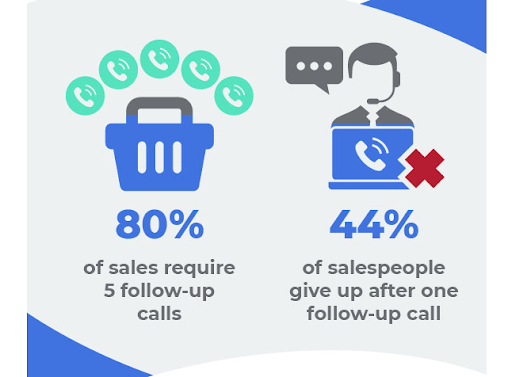
That lack of persistence can cost you sales. Persistence predicts success in sales. In fact, 80 percent of sales require 5 follow-up calls, yet 44 percent of sales reps give up after just one follow-up attempt.
Most salespeople never reach the point of rejection. Being persistent is difficult: it requires resilience, strong organizational skills, and the ability to bounce back.
According to psychologist Ian Price,
"A team from the University of Columbia’s Sauder School of Business found that employees who were ostracised or ignored suffered greater health problems and were more likely to leave their jobs than those who experienced direct harassment, in other words, bullying."
The good news is that handling rejection in sales isn’t nearly as bad as you might think. A polite “Thanks, but no thanks” message is liberating.
Doctors report that being cold-shouldered is harder to accept than outright rejection because it preys on one of our most primal fears--being ignored or irrelevant. Andddd, cringe.
Feeling like you don’t matter is the worst.
Ask openly if your prospect wants you to stop contacting them. Hearing that someone isn't interested is good because it means they haven’t forgotten about you. It also provides clarity: now you know where you stand.
Set a goal for rejections, not just sales. Hell, create a chart and hang it on your office wall. Celebrate when you get actual rejections — seriously, a month without ghosts is one for the books.
The best part? When you spend less time focusing on leads that aren't interested, you have more time to focus on the leads who are interested.
2. Create a feeling of reciprocity
Recently, a colleague wrote a recommendation for me on LinkedIn. It was unexpected, but it felt good.
What did I do? I thanked them—and then I wrote a recommendation for their profile as well.
Why? Because I felt obligated to return the favor. That's the reciprocity principle in action.
Here's how it works, according to the Nielsen Norman Group:
The reciprocity principle is one of the basic laws of social psychology: it states that, in many social situations, we repay what we receive from others. In other words, if John does you a favor, you’re likely to return it to him.
How does the reciprocity principle apply in sales? Offer prospects something of value, and they are more likely to respond to you. Even if they don't end up buying, you'll know where you stand. (And hey, maybe they'll refer you to someone else!)
Here are a few ways to use reciprocity in sales:
Offer physical gifts: Look at prospects' social channels to see what they are into. Snacks from a favorite (but far away) bakery, a book they expressed interest in reading, or a customized bobblehead can create a sense of reciprocity.
Free tool: Create a free tool, spreadsheet, or checklist that helps prospects solve a problem. They'll appreciate the help and be more likely to respond.
Video pitch: Use a customized video to show you've done your research and understand their business needs. They'll be more likely to respond because you've invested time in getting to know them.
Make sure your gifts are small but thoughtful or useful. Offering a gift that's too large creates too much pressure.
3. Leverage social proof
Humans are social, and we want to be accepted and liked. When we see others using and enjoying a tool or service, we want to be part of that group. (Unless the group decides that New York pizza is better than Chicago, in which case the group is obviously shunned.)
In fact, B2B buyers are 92% more likely to purchase after reading a trusted review.
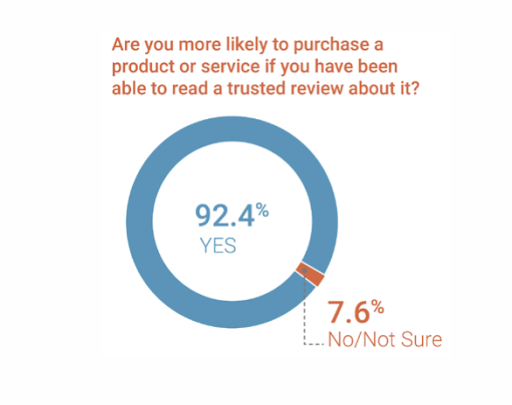
Social proof drives sales, but why does it work?
From a psychological standpoint, social proof in the form of reviews and case studies works because it relies on normative social influence, or humans' innate desire to be accepted by a group. There's another reason social proof works, called the liking principle.
According to leading social scientist Robert Cialdini,
"We found that if an advocate for a candidate makes demands that are based on the candidate’s merits, it doesn’t harm the candidate. But if the candidate argues the very same case, it does. The people on the receiving end just don’t like that person, who comes off as a braggart."
Customer reviews aren't just for online platforms like Amazon— they can help in the sales process, too.
Here are a few ways to make it work for you:
Include customer testimonials on landing pages.
Send customer case studies to prospects to highlight results.
Include social proof in your pitch: "A recent client saw an improvement of X% using our tool…" or "Let me show you how X brand was able to increase revenue by X…"
4. Reduce risk
Humans are inherently risk-averse. It's built into our DNA — when early ancestors faced a risky situation, say an attack by a tiger, those who fled were more likely to survive and pass down their genes, while those who stayed to fight did not.
But you aren't facing tiger attacks at your cubicle desk (I hope). So how does this risk aversion apply to sales?
Before taking a risk — like buying an expensive new software product — prospects naturally look for ways to reduce the risk of a bad outcome. Your job is to find ways to reassure prospects that they aren't taking a risk.
How do you do that? Here are a few ways to reduce risk in the sales process:
Use social proof, as we already discussed.
Ask what might be holding them back, then address those concerns. For example, if they are concerned about price, you might offer a free trial or show them how to calculate the ROI.
Create a script for common objections so you can address them quickly and coherently.
Find the right decision-makers. Losing money isn't the only risk prospects face when suggesting a new tool or service — they also risk social capital. Lower-level HR staff might not feel comfortable pitching to the head of HR. Instead, use LinkedIn or sales prospecting tools to find the person who can actually make the decision.
Create content like this Leadfeeder profit calculator, designed to show a positive ROI
People tend to be risk-averse; as a sales rep, your job is to explain why your solution isn't risky by helping prospects understand the benefits rather than focusing on the risks.
Final Thoughts
Gone are the days when sales teams could just build a better sales process and have people beating a path to their door. Nowadays, sales teams have to go out into the world to discover and create their own sales opportunities.
So, how do you create more opportunities?
Start by focusing on prospects versus leads. Then, use the psychological principles above to overcome rejections, encourage reciprocity, build trust, and reduce risk. Note: Lacking leads? Look no further than Leadfeeder’s 14-day free trial.