

60-Second Summary
Quick guide to launching a B2B sales strategy in the Benelux (Belgium, Netherlands, Luxembourg): know the market nuances, localize your approach, and stay GDPR-compliant. Focus on clear ICPs, tailored value propositions, local talent, and measurable processes to build trust and scale.
Key takeaways: Benelux is compact but economically strong and culturally diverse—localize by country (NL: direct and digital; BE: Dutch/French split; LU: formal, finance-focused), prioritize relationship-building, and ensure compliant outreach under GDPR and local e-privacy rules.
Standout strategies & tactics: Define multiple ICPs by segment, craft country-specific value propositions and localized materials, involve decision-makers early, and combine digital tools (CRM, Leadfeeder, sales enablement) with local events and hires for faster traction.
Real-world lessons & frameworks: Use a repeatable sales process (prospect → qualify → discovery → demo → proposal → close → retention), set clear targets (ARR, ARPA, conversion, sales cycle), invest in onboarding and continuous training, and iterate based on tracked metrics.
*This summary was created with AI assistance, using our original content.
How to Set Up a Winning B2B Sales Strategy for Benelux
Do you intend to bring your offering to market in Benelux? Then don’t go in unprepared because we’ll help you learn how to:
Understand what makes the Benelux market tick
Tailor your strategies to align with the region’s regulations and culture
Outplay your competition with localization and by building real trust
So just what does the Benelux region have to offer?
Quick Overview of the Benelux Market
Before you can start setting up your winning strategy, let’s look at the region a little bit closer.
What does Benelux stand for?
Benelux is a portmanteau, and consists of the following countries:
Be = Belgium
Ne = The Netherlands
Lux = Luxembourg
Together with France, Germany and Italy, the Benelux countries were part of the original six founding countries of the EU.
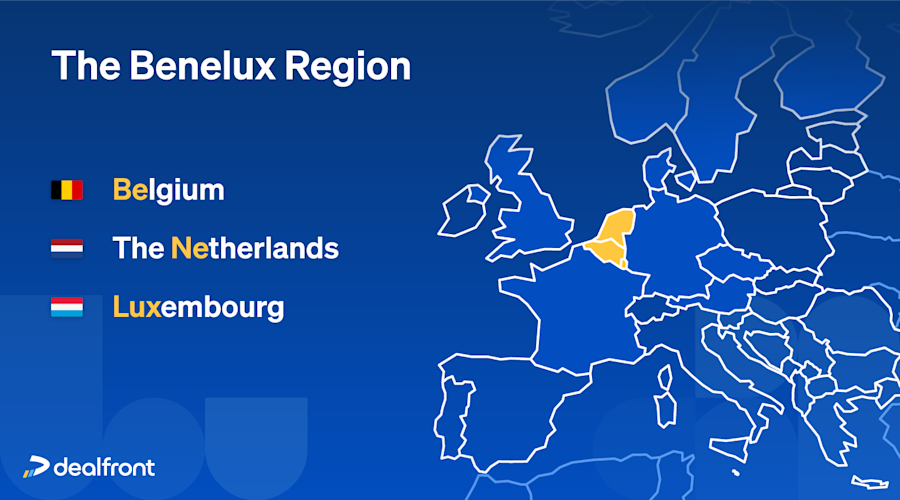
Benelux offers high GDP, strong digital adoption, and diverse industries, but requires country-specific execution.
Economic Overview
Geographically small, but quite substantial in terms of GDP, the Benelux countries are strong candidates for your B2B business ventures.
Belgium is one of the richest countries in Europe–almost on par with Germany–and its main industries are manufacturing pharmaceutical and chemical products.
The Netherlands is much more than just windmills and tulips. This low-lying country is ideally set up for the agrifood and water technology industries. But, it also has thriving energy, IT, and healthcare and life sciences sectors.
One of the three seats (including Brussels and Strasbourg) of the EU, Luxembourg is small but mighty as it houses many European institutions. Known for its thriving banking and financial sectors, Luxembourg also is known to be a tax-friendly country.
You see that the region has a lot to offer in terms of wide-reaching industries so now we can start talking about a sales strategy.
The Basics of a Successful B2B Sales Strategy
Now that you have more insights into what makes the Benelux region tick, you can start honing your B2B sales strategy.
1. Identifying the Ideal Customer Profile
You want to be the go-to vendor for your industry or sector, but who is it you’re trying to do business with? To see success with your B2B marketing and sales efforts, you have to establish your Ideal Customer Profile (ICP).
Please keep in mind that an ICP isn’t the same as a buyer persona which defines a specific person you want to target with your content, for example. The ICP defines the type of company you want to do business with.
Here is some data you can use to define your ICP:
Company size
Industry
Annual revenue
Number of clients
Their target market
Company tech stack
Website visitors per month
Sales channels
Keep in mind that if you offer different tiers for your product or service, you’ll need to have multiple ICP definitions to cover that.
2. Developing a Strong Value Proposition
Your offerings are going to change how your customers do business but how can you convey that to them? In short, what do they gain by being your customers?
You will need to communicate:
How your product or service will help your customers either make more money or save costs.
How your product or service will streamline their business processes to boost efficiency and productivity.
How you can help them grow their business.
Your value proposition should target the right person within an organization. In an ideal situation this would be the decision-maker. People in different roles will need different things. The trick here is to figure out what their unique pains are and then figure out how to solve them.
It’s not just the B2B customer you need to understand, but also your competitors. There are many review sites out there so go see what your target customers are saying about them. What are the “weak areas” that you could exploit? Can you solve what they can’t?
Then, when you understand what your customers need and how your business can fulfill those needs, you’ll be equipped to move forward.
3. Building a Strong Sales Team
You might have the best strategy in place but you still need a superstar team to execute it. Our very own Leadfeeder sales leaders gave us their most desired salesperson traits:
Be a good listener
Be resilient and have grit
Be curious and willing to learn
Be self-motivated
Be ethical
Be persistent, but patient
Be authentic
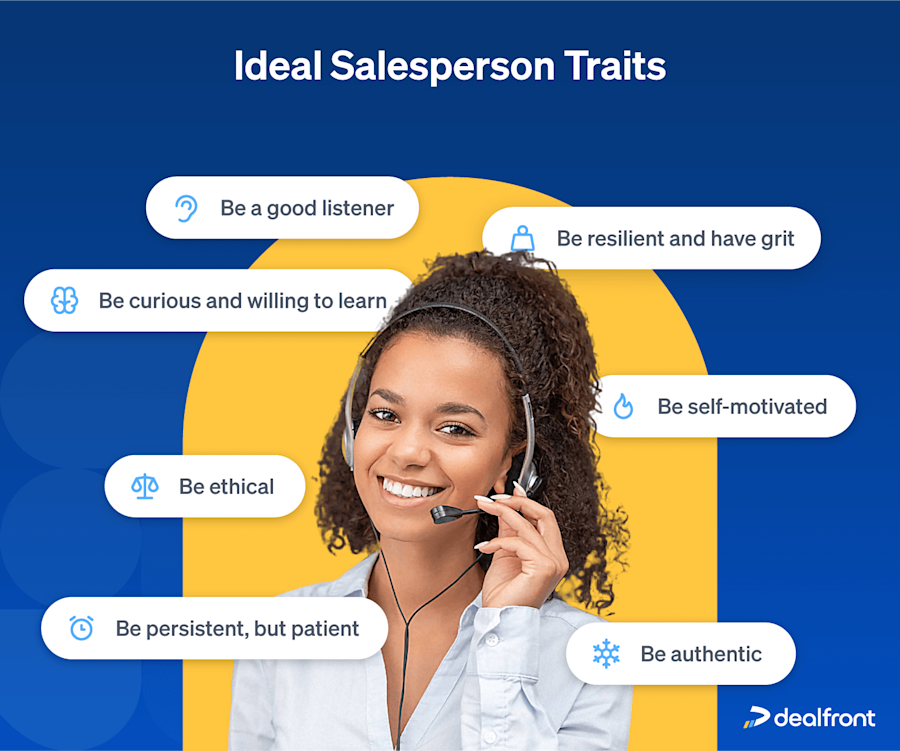
Our experts chose being a good listener as their #1 pick, which isn’t so surprising. While others may think that having a great talker is the key to sales, you know that listening is the key to building rapport from the start. Asking the right questions and really hearing the customer is half the battle already won.
But you can’t just put the team together and hope for the best just because they fulfill certain criteria. You need to have an onboarding process for new hires as well as consistent, ongoing training to make sure your team keeps excelling.
4. Setting Clear Objectives and Goals
Your sales team can’t just pick up a phone and call people. They need to have a clear idea of targets to work towards. Typically, sales team objectives and goals include the following:
Revenue goals per person/team: Define the amount and the timeframe.
Clear responsibilities: What should each team member be accountable for?
Milestones: These are the big events in the overall team timeline. What has to be done and by when.
Overall budget: How much is it and how realistic is the goal-setting within that amount?
Now that you have a framework, don’t keep it a secret. You want to align with other teams within your company. Studies have shown that strong internal alignment (especially with Marketing) can help scale revenue generation and improve overall efficiency.
5. Creating a Sales Process
You can’t just drag a prospect through your funnel just because you want to close deals. Winning a customer is the culmination of a lot of hard work and smart strategies. You and your team have to have a clear vision of what a successful customer journey looks like.
You have a lot of considerations to make in order to set up a process, but ultimately, you’ll have to experiment a little to see what works and what doesn’t. Especially when entering a new market.
Some key things to keep in mind before you start:
Try and involve the decision maker as early in the process as possible.
Research and implement compliant outreach methods for the region you’re targeting.
Personalize your process and outreach to fit your prospects. The more they feel you’ve tried to connect with them, the more likely you are to find success.
The sales process counterintuitively begins with the end goal. Yes, you read that correctly! You need to begin by asking yourself the following questions:
What is your target number of customers?
What is your target revenue?
What is your target revenue per customer?
Now, with those questions answered on your end, you can continue with the rest of the process.
Prospecting for leads: Finding leads in a new market takes time, so focus on where your customers actually are. For example, finance prospects are more concentrated in Luxembourg, while trade shows are effective in Belgium and the Netherlands. Choose channels based on how your target industry operates (online vs. offline).
Lead qualification:Not all leads are worth pursuing. Focus on high-intent prospects. Those actively engaging with your content or website. Tools like Leadfeeder help identify who’s visiting, what they’re viewing, and how they behave, so you can prioritize leads more likely to convert.
Outreach: Effective outreach is both personalized and compliant. Make sure your approach aligns with local data privacy laws, then tailor your message using real insights. Instead of generic emails, use tools like Leadfeeder Connect to trigger outreach based on events like company growth or leadership changes.
Discovery call: This is where real selling begins. Use the conversation to uncover pain points and assess fit. Sometimes, the best outcome is honesty, if you’re not the right solution, say so. It builds trust and keeps the door open for future opportunities.
Product presentation and demo: Focus your demo on the specific challenges uncovered during discovery. It’s tempting to jump straight into the big pitch once a pain point is clear, but that’s exactly where many reps lose the room. As Jack Frimstone, host of The Sales Stoic, puts it: "I've rushed in to help. I've over-pitched. They said they've got a problem. I've got the perfect answer for that." Show exactly how your solution solves their problems, and involve decision-makers early if possible.
Proposal: Expect objections and prepare for them. Often, what’s said isn’t the real issue. Dig deeper to understand the underlying concern, whether it’s pricing, timing, or competition.
Close: Once value is clear and alignment is reached, move confidently to close the deal.
Customer retention: Closing isn't the finish line. Retention drives long-term growth through upselling and stronger relationships. As Alex Goldfein, Wall Street Journal bestselling author and founder of Revenue Growth Consultancy, says: "I've seen people double their sales just by making one additional proactive phone call a day when nothing's wrong. Most of us reach out to customers when something's wrong. I'm saying call them when nothing's wrong." Treat every deal as the start of a longer journey.
6. Leveraging Technology
Having a great strategy also means having the right tools to bolster it. It would be so frustrating to have a strategy that looks good on paper, but is let down by tools that fail to support that in practice. Your tools should support your processes and workflows.
We suggest checking out the following solutions:
A reliable CRM system: SuperOffice / HubSpot / Salesforce
A practical prospecting and lead generation tool: Leadfeeder Companies / Leadfeeder Connect
A tool for data hygiene and maintenance: Leadfeeder Datacare
A sales enablement tool: Calendly / Loom
A sales engagement tool: InsideSales (formerly Xant) / Outreach
A tool to create & sign contracts online: Pandadoc / Docusign
Tailoring Your B2B Sales Strategy for Benelux Market
Until now, we’ve given you a general overview of what your strategy should look like. But, fine-tuning it to fit the Benelux market will push it that one step further so you can beat out your competitors. And ultimately, tailoring your strategy is also a win for your potential customers. Here’s a quick checklist for tailoring your strategy for Benelux:
Here’s how you can effectively do that:
1. Customizing Your Value Proposition
Until now, we’ve given you a general overview of what your strategy should look like. But, fine-tuning it to fit the Benelux market will push it that one step further so you can beat out your competitors. And ultimately, tailoring your strategy is also a win for your potential customers. To dig deeper into your target region, you need to ask yourself:
What does Benelux value more than other regions? For example, data security and GDPR compliance are important in this region. How can you or your offering leverage that?
Do each of the Benelux countries need something different? Just because they share languages in common doesn’t mean they have the same culture. You need to adjust your value proposition for each country.
Does your pricing structure fit your target company? You can’t try to enter a market with enterprise pricing if you have no organizations that match your criteria.
What are the unique pain points that your target customer in Benelux has compared to other markets? Many industries and companies (especially the more traditional ones) don’t do business in English. Can you outplay your competition here?
This brings us to the next point: localization.
2. Localizing Your Marketing Materials
English is considered the standard business language in many parts of the world, but offering your products and services in the language of your customers will help you shine. The Netherlands is known for its multilingual culture, but depending on the industry (especially in the more traditional ones), Dutch is still very widely spoken.
Belgium’s Dutch-speaking region is more open to dealing in English than their French-speaking fellow citizens. So, depending on where you are in Belgium you’ll have to adapt your materials.
Luxembourg is quite an international hub and doing business in English is widely accepted. However, if you want to have an advantage over your competition, you’d be wise to tailor your materials into either French or German.
Don’t forget, getting localization right isn’t just about translations, it’s about providing value to your customers because you kept their culture in mind as well. How do they prefer to consume content in the Benelux region? And in which channels are they most active? Once you’ve considered all of these aspects, you will be one step closer to winning in Benelux.
3. Adapting to Cultural Differences in Benelux
Just because countries share a language or are geographically close doesn’t mean their cultures are the same. Here are some tips to help you navigate the nuances of culture in the Benelux region and win customers:
Business culture in the Netherlands
The Dutch are an open, straightforward people that value directness and “getting to the point”. Prove yourself reliable by keeping appointments and being on time.
Business culture in Belgium
We mentioned before that you have to keep two cultures in mind here. So, depending on which part of Belgium you intend to do business in, you’ll have to adjust to fit the region.
In the Dutch-speaking part of Belgium, you can expect many similarities to the Netherlands where direct, efficient business dealings are expected and practiced. In the French-speaking region, you can expect more emphasis on relationship building and more social events built around business. For example, doing business over lunch with wine is quite common in the French part of Belgium.
Business culture in Luxembourg
Hierarchy and respect for those in a higher position is deeply valued in Luxembourg. Consensus decision making isn’t practiced, but that’s slowly changing. In contrast with the Netherlands, Luxembourg doesn’t rush through decision processes. You’ll have to learn to be patient here.
4. Building Relationships
Giving your customers in Benelux a personalized strategy that fits their needs is great! But why should you be making all this effort? To build higher levels of trust. You should see the process as a way of building long-term business relationships and meeting the customers’ needs. Retaining a valued customer is even more rewarding than gaining a new one. Showing that you can sustain the trust and goodwill of your customers will positively impact your business growth.
And speaking of trust, we’re about to move onto one of the trickier aspects of doing business in Benelux: How to adhere to GDPR and e-privacy regulations when you want to make that initial contact with a prospective customer.
Compliant B2B Sales Outreach in Benelux
If your target market is within the European Union (EU), you are going to have to get up to speed on the General Data Protection Regulations (GDPR) and local e-privacy regulations. While the GDPR is in place to regulate how you collect, process and store a person’s data, e-privacy regulations dictate how you reach out.
Disclaimer
Before we dive in, it’s important to note that we’re not providing you with legal advice. If you require legal advice, please consult a lawyer you can guide and answer any specific questions related to your business case.
Now we can take a look at each of the Benelux countries and their respective e-privacy regulations:
The Netherlands: The Dutch Telecommunications Act
Belgium: The Code of Economic law and Electronic Communications Act
Luxembourg: The Electronic Communications Act
1. Cold calling
In Belgium, you will first be required to check the local “Do Not Call Me (DNCM)” lists and make sure that your prospect hasn’t already opted out of telemarketing. Once you’ve confirmed that they’re not opted out, you can proceed with your outreach via phone.
In the Netherlands and Luxembourg, you will need prior opt-in consent or a prior business relationship in order to reach out over the telephone. And of course, don’t contact a prospect if they are on a “Do Not Call” list.
In all cases you will need to make opting out transparent and easy should they non longer wish to be contacted by your company in the future.
2. Cold emailing
In all three countries, your prospect will need to opt-in to be contacted via email or have a prior business relationship with you. That means, either they must give consent prior to being contacted for advertising purposes or you have collected their email address because they were recently a customer for a similar product of your company.
In Belgium, there is one exception: you are allowed to send marketing emails to a company (even if it is not a customer) without prior consent or business relation, if the email is sent to a business, non-personal email address (such as “info@company.com”) and you are promoting a product or service that fits to the needs of the company targeted.
3. Social selling
Social selling is a legally gray area in all Benelux countries. Since business networks like LinkedIn are set up for business dealings, reaching out via direct message is often not objected to, but be sure your offering matches your prospect’s needs: : If they’re in the medical field, don’t try and sell them a tractor. Also, be sure to review, and comply with the terms and conditions of the social channel you are using for social selling. Some special rules may apply.
4. Trade Shows and Conferences
B2B trade shows and conferences are popular in Benelux, particularly in the Netherlands and Belgium. They are a great way to generate leads in a compliant way as these events are set up for B2B business interactions, including sales.
But don’t forget, even if a prospect agrees to give you their business contact information, you still need to:
Inform them on how you plan to process and store their contact information.
Give them information on how they can opt out.
So now all the foundation of your strategy has been planned and built. Once it’s been launched, how do you know it’s working?
Key Metrics to Track
Unlike a “set it and forget it” oven, keeping a close eye on your strategy plays a crucial role in its success. You need to monitor, measure and analyze it in order to gauge its effectiveness.
If you’re able to compare data, you’ll be able to see any changes on a weekly, monthly or quarterly basis. You can take the results of your analysis to keep doing what’s going right or to further refine what didn’t go so well to improve on it.
Which metrics should you be tracking?
Total revenue: This can be measured monthly, quarterly, or annually.
ARR (annual recurring revenue): This is the recurring revenue projected for a year.
ARPA (average revenue per account): The average revenue generated per account. This can be calculated on a monthly or yearly basis.
Average Sales Cycle: The amount of time from your first touch with a prospect to closing the deal.
Conversion rate: This is used to measure the effectiveness of a sales strategy or your team when it comes to converting leads into new customers
Main Activities: Used to measure your team's input based on discovery calls, demos, and negotiations. Measured on a weekly, monthly or quarterly basis.
Win rate: Your successfully closed deals.
Revenue of new vs. existing customers: A comparison of what your new vs. current accounts are bringing in.
Quota attainment: Displayed as a percentage and shows a salesperson’s total sales.
Best Practices for B2B Sales in Benelux Market
Entering Belgium, the Netherlands and/or Luxemburg will require some careful planning and determination. However, if you know your product or service is exactly what the region needs, it’s absolutely worth it. Now, all that’s left is to put it all together.
Here are the 4 best practices to find B2B sales success in Benelux:
Build strong customer relationships: Focus on long-term trust, not quick wins. In Belgium, prioritize mutual agreement (more formal in French-speaking regions). In the Netherlands, be direct and efficient. In Luxembourg, respect hierarchy and expect slower decisions. Across all markets, be punctual and consistent.
Invest in local talent: Local expertise builds trust faster. Use native language (Dutch/French/German where relevant) and culturally aware touchpoints across the customer journey.
Offer exceptional customer service: Benelux buyers expect fast, knowledgeable support. Resolve issues efficiently and don’t waste time with unnecessary handoffs.
Stay compliant with local regulations: Compliance builds credibility. Stay aligned with GDPR and local laws, and ensure clear internal data governance to protect customer trust.
What can push you even further? Having a platform that can work for and with you to streamline your GTM ambitions.
How Leadfeeder Can Help You to Develop a Winning B2B Sales Strategy for Benelux Market
Leadfeeder is the go-to-market platform made in Europe that combines the tools and stages of the sales and marketing process into one platform. We have five tools that power a flywheel to give you a powerful, full-service, completely GDPR-compliant platform.
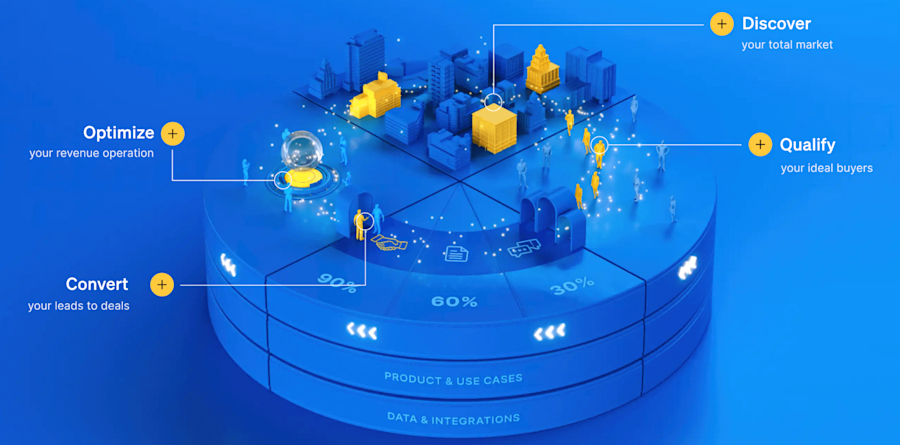
Discover: Unlock your total addressable market (TAM).
Qualify: Refine and prioritize your ideal customer profiles.
Convert: Reach the right buyers with the right message at the perfect time.
Optimize: Multiply your deals won using AI and machine learning algorithms to find B2B lookalikes.
What you’ll end up with is accuracy that’s being constantly refined, real-time and dynamic ICPs, and a higher rate of closed deals!
Your Next Move in the Benelux Market
Now that we’ve unpacked the B2B sales strategy for Benelux, there shouldn’t be anything stopping you from diving into this market. You now understand how the region ticks both culturally and on a business level.
All that’s left is for you to use this knowledge to tailor to your prospective customers so you can always be two steps ahead of your competitors.
The way to win deals in Europe.
Leadfeeder gives sales and marketing teams the data, applications and insights they need to win any European market.
Discover Dealfront