60-Second Summary
For account-based marketing teams that nurture named prospects through a sales funnel, customer feedback is a critical input for retention, personalization, and growth. The main challenge isn’t gathering responses—it’s turning them into visible, actionable insights that the right teams can act on.
Key takeaways: Feedback reduces churn, strengthens ABM personalization, guides product and service roadmaps, improves customer service, and surfaces upsell opportunities—but only if signals are routed to teams that can act.
Standout strategies & tactics: Combine channels (on-site forms, email surveys, analytics, social, reviews) for a full view, favor open-ended and follow-up questions, engage customers on their preferred platform, and prioritize routing insights to sales, marketing, and support.
Collection framework: Use analytics for behavioral signals, surveys for targeted responses, social and reviews for broad sentiment, and site prompts for immediate issues—then triangulate results to filter noise and surface actionable themes.
Real-world lessons & frameworks: Make feedback visible, close the loop by analyzing and acting on trends, iterate product and support based on recurring signals, and use feedback-driven account profiles to sharpen ABM outreach and timing.
*This summary was created with AI assistance, using our original content.
For teams using account-based marketing, where success depends on nurturing specific prospects through the sales funnel, customer feedback is essential. Today’s buyers have more choices than ever, and your competitors are only a quick search away. That is why feedback plays a critical role in long-term success and growth.
The real challenge in any customer feedback strategy is not collecting feedback. It is getting insights that are actually useful, not just noise or empty responses. Here is how to do it right.
Note: Want to know where your potential customers are coming from? Try Leadfeeder's 14-day trial to better understand your customers.
But first, why does customer feedback matter?
Most companies understand that feedback matters in principle. But it is easy to get bogged down by useless feedback from trolls or customers who will never be happy.
You aren't going to change your entire business model because of one review, but listening can still provide valuable insight into your services, products, and sales process.
Here are a few reasons why it (literally) pays to listen to what your customers have to say about your company.
1. Reduce churn rate
We live in a world of options, comparisons, and window shopping.
The online market, in particular, is highly competitive. Customers don't have any issues cutting ties with a company that doesn't treat them well.
According to Statistica, 22% of online retail customers churn annually. And the stats for other industries, like cable, are even worse.
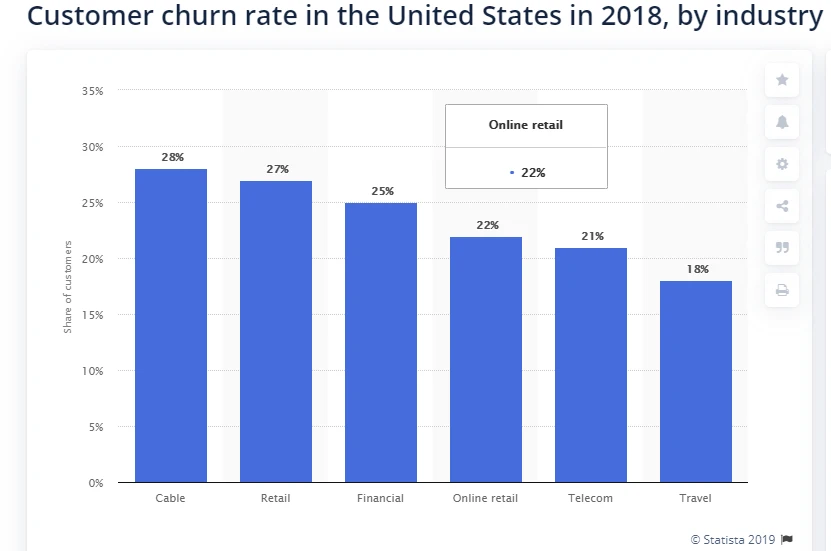
Customer feedback can help you spot issues that might lead to churn before customers leave, allowing you to retain more customers. But the harder problem is often not collecting the signal - it is making sure the right people can actually see it. As sales coach Niraj Kapur puts it: "Marketing can't see that a happy customer hasn't logged in for a month. Sales doesn't know they have complained to support. So both of them don't know what's happening after the sale has happened." - Niraj Kapur
Before adding new feedback channels, it is worth asking whether the signals you already collect are reaching the teams that can act on them. Churn prevention is not just a listening problem; it is a visibility problem.
2. Leverage account-based marketing
Account-based marketing is a targeted approach that relies on building relationships with prospects and then creating a personalized path through the sales funnel. More than 85% of marketers say that ABM offers a higher ROI than any other marketing strategy.
ABM is so effective because it relies on detailed information about each prospective customer, rather than just casting a wide net.
Customer feedback can be critical to developing a personalized plan for each company you are targeting.
3. Guide future growth
Technology is advancing at an alarming rate. A decade ago, most of us could not have predicted how reliant we have become on our mobile devices. Where will we be in another decade?
Only time will tell.
However, listening to your customers and asking what features or services they need can help guide future growth, keeping your company relevant for years or even decades to come.
4. Provide better customer service
Customer service matters more now than ever before. In fact, 82% of customers say they are likely to switch providers after a bad customer service experience.
Listening to feedback can help you better understand where your customers struggle so you can provide the service they need to be successful.
For example, if most customers struggle to get started with your software, you might offer live chat to help them through the process. Or, you could create a video walkthrough for difficult steps.
5. Uncover opportunities to upsell
If you offer more than one product or service, paying attention to feedback can uncover opportunities to upsell customers to a higher plan or a different product altogether.
For example, if a customer is struggling to install a DIY kit, you might offer a paid upgrade to expert installation. Everyone wins!
How do you collect customer feedback?
There are multiple ways to collect customer feedback, and there is no one-size-fits-all approach. Here are five ways to collect feedback, with customer feedback examples and the pros and cons of each, so you can decide which will work best for your company.
1. Instant customer feedback form on your website
A pop-up survey or instant chat can help identify issues with your site or your offering. For example, we use this feedback prompt on the Leadfeeder site to determine whether visitors can find the information they are looking for in our knowledge base.

Pros: Easy to implement; allows you to ask specific questions about your products, services, or your website's usefulness.
Cons: Relies on visitor participation, and not all respondents may be customers. Not the best format for getting detailed insights.
2. Customer feedback survey by email
Looking to launch a new product or want to better understand who your customers are and what they think of your product or service?
Email surveys can be a very useful tool for getting specific feedback. Offering an incentive, such as a chance to win a gift card or a free download, can sweeten the deal.
Pros: Easy to implement and allows for very detailed questions. For example, "What features do you wish we offered?" or "Do you find our product easy to use? If not, what step was most difficult?"
Cons: Relies on customer participation, so people who feel strongly about your brand are more likely to participate, potentially skewing the results. You can also only reach people who are already on your list.
3. Analytics platforms
Platforms such as Google Analytics, Salesforce, and even your email provider offer access to a massive amount of data about what your audience reads, clicks, and takes action on. It can provide detailed insight into how your customers perceive your business and use your products or services.
Pros: Provides access to a far greater range of data and does not rely on customer participation in the same way a survey does.
Cons: Tells you what, but not the why. For example, you can see how long someone stayed on a page, but you can't ask why they left.
4. Social media
More than 3.2 billion people worldwide use social media, making it an ideal place to gather feedback from current, past, and prospective customers. Polls, questions, and even surveys can provide unique insights you won't get elsewhere.
Pros: Access to a large portion of your audience, including global customers, on a platform that many use daily.
Cons: Feedback isn't always standardized, making it harder to analyze the data. Some formats, such as polls, don't provide detailed data. It also relies on customer participation, and you may get feedback from non-customers or trolls.
5. Online reviews
Online reviews give prospective customers the confidence they need to take the plunge, but they can also serve as a source of information for your company.
If you are getting negative reviews about a bug or service limitations, you can work to resolve the issue or extend your offering.
HubSpot uses reviews to better understand how customers use its platform and shares them as social proof.

Pros: One of the easiest types of feedback to get, often including both positive and negative feedback.
Cons: The data isn't standardized in most cases, which can make analysis more time-consuming.
Here's the thing— there are pros and cons for every kind of feedback. I recommend using more than one of the methods listed above to get a more complete picture.
Tips for collecting actually useful customer feedback
Once you begin collecting feedback, you might notice that not all of the answers you get are useful. Here are four tips for collecting feedback that will help your customers.
1. Ask the right questions
Getting feedback isn't just about asking questions and listening to the answers. Asking the right questions can make a huge difference. This is why yes-or-no questions tend not to be the most effective way to give feedback.
If you ask, "Was this useful?" you might find out that half of your customers didn't find a specific resource helpful, but you won't know why. Mix open-ended or short-answer questions with yes-or-no questions to gain better insights.
2. Don't make assumptions
Try not to make assumptions about the feedback you receive. Instead, ask follow-up questions.
If a customer says your software is difficult to use, don't assume they aren't tech-savvy. Instead, ask why. Maybe they're using an outdated browser or failed to connect the software correctly.
3. Engage where they are
If a customer offers feedback on a specific channel, don't try to move them off that channel.
For example, if a customer reaches out on Twitter, don't try to move them to email. That feels dismissive and may prompt them to end the conversation. Instead, engage them on the platform where they are most comfortable interacting.
4. Keep listening
Your goal should be to learn more about your customers every day, then use this information to inform your marketing, sales, and product development. In practice, that kind of clarity often comes from the simplest question: "Go to your customers and say, how do we really help you right now? And that's where all the answers came from." - Alex Olley, Co-Founder of Reachdesk
At Leadfeeder, that means understanding what customers want so we can provide the resources they need to help themselves, and hopefully, make them want to learn more.
Successful companies know that listening to their customers is critical for growth. But that is just the first step. Once you have gathered the feedback, closing the customer feedback loop means analyzing it and using that information as a guide for future success.
Note: Want to know where your potential customers are coming from? Try Leadfeeder's 14-day trial to better understand your customers.