60-Second Summary
Cost per lead (CPL) is the single most important metric for judging marketing efficiency and channel performance. Tracking CPL—including all relevant costs—lets teams spot underperforming campaigns, optimize spend, and make data-driven decisions quickly.
Key takeaways: CPL reveals which channels and campaigns actually drive leads and revenue, highlights when budgets are wasted, and prevents false assumptions based on buzz or vanity metrics.
Standout strategies & tactics: Include full costs (ad spend + ad management + inbound people and tools), split paid vs inbound leads, calculate leads via clicks × conversion rate or direct inputs, and use A/B testing, timing adjustments, and long‑tail keywords to lower CPL.
Real-world lessons & frameworks: Evaluate CPL against customer value and conversion rates (break‑even CPL), compare channel and blended CPLs, and prioritize lead quality over raw volume—higher CPLs can be justified by stronger conversion potential.
Tools & next steps: Use a customizable CPL spreadsheet to model scenarios, add or remove cost rows, and save versions; combine this with Leadfeeder’s trial to identify anonymous site visitors and boost lead quality and conversion timing.
*This summary was created with AI assistance, using our original content.
Without this insight, you won’t know which marketing channels are delivering results, whether social media campaigns are effective, or if your brand awareness efforts are actually driving revenue. Tracking CPL gives you a clear view of your marketing performance and highlights where adjustments are needed.
If you ignore CPL, you risk heading in the wrong direction without realizing it. Campaigns can underperform, budgets can be wasted, and marketing efforts can fall flat. Knowing your CPL ensures you can course-correct quickly, make smarter decisions, and get more value from every dollar you spend.
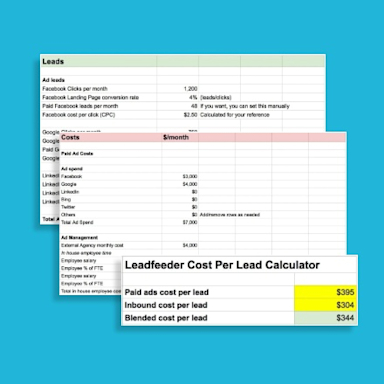
Calculating CPL doesn’t have to be complicated. That’s why we created a free, accurate, and customizable CPL calculator that simplifies the process, making it easy for you to measure your marketing efficiency, compare channels, and improve your results.
Get Your Cost Per Lead Calculator
Easily calculate your paid, inbound, and blended cost per lead.
DownloadNote: Want a full view of companies visiting your website? Sign up for Leadfeeder’s free for 14 day trial to track and monitor the information and behavior of your leads.
What is cost per lead vs cost per acquisition (CPL vs. CPA)?
What does CPL mean? Cost per lead (CPL) is a marketing model in which advertisers pay a set fee for each lead generated.
A lead here is an individual who’s shown interest in your product or service. There are many ways someone could show that interest; they could visit your sales page, reach out via email, download your brochure, or engage with your brand’s social media posts.
Leads vary in value, of course. The strength of the interest and the resources behind it determine how much a lead is really worth. When someone’s really interested and has what they need to invest, they should be a top priority.
But since lead value isn’t always clear at first, it makes sense to treat the acquisition of any lead from a given channel as roughly equivalent.
How and why businesses use CPL campaigns
Businesses use the cost-per-lead model to track exactly how much they’re spending to generate leads. Without that information, they can’t know the efficiency of their marketing activity, so they can’t notice when marketing performance is failing.
Here are the core reasons why they prioritize CPL campaigns:
They drive spending optimization: Getting marketing dialed in is a serious but worthwhile challenge, as marketing costs can easily spiral out of control otherwise. CPL calculations push businesses to think past creative direction and give appropriate attention to their foundational metrics. They also make it easier to tell when a cost-per-lead agency (i.e., a marketing agency that charges you per lead) is offering a good deal.
They show the best-performing channels. By comparing CPL values across their varied marketing channels, businesses can see where they’re getting results and where they're going wrong. They can then improve their lead nurturing tactics by investing further in the channels that are performing reliably.
They challenge marketing assumptions. Marketers can easily assume that big flashy campaigns are working, especially if they’re getting a lot of attention. Similarly, they can assume that campaigns producing high-quality leads are the best.
It’s possible for buzz to have minimal impact, and a broad ad campaign with low-quality leads can offer better ROI by incurring lower operational costs. CPL sticks to the financial reality and works to clear out such assumptions.
Cost per lead formula
Cost of lead generation/Total number of leads per month = Cost per lead
It’s easiest to think of the cost-per-lead formula in layers of detail. Note that “per month” can also be any time period—year, week, or day. Throughout this guide and in the spreadsheet CPL calculator, we use “per month” because most businesses report metrics monthly.
Based on how often your business reports metrics, choose the appropriate time period to calculate your cost per lead. When calculating cost per lead, the detail (second layer of complexity) lies in how you determine costs and leads.
Calculating costs
Most cost-per-lead calculators and formulas focus only on costs from one channel, usually paid advertising. But this doesn’t accurately reflect how most businesses generate leads: through paid sources and organically on their site.
If we call the latter category “Inbound” leads, then we can break down costs per month as:
(Costs per month) = (Advertising Costs) + (Inbound Costs)
Get Your Cost Per Lead Calculator
Easily calculate your paid, inbound, and blended cost per lead.
DownloadAdvertising costs:
When calculating advertising costs, most businesses (and articles) only consider advertising spend and completely ignore an important —and often huge —part of advertising costs—the cost of the people required to manage the ad campaigns! The people who manage your ads aren't free, so why isn't this part of the cost?
If we call these people cost “and management”, then the formula for advertising costs is:
(Advertising Costs) = (Ad Spend) + (Ad Management)
Ad management itself usually has two components: external agency costs and internal employee costs. Of course, this varies from company to company.
Inbound costs:
We’ll consider inbound costs for everything from organic traffic to the main marketing site and content marketing via the company blog and social media. In practice, this can vary a lot from company to company. For example:
Certain companies spend a lot on SEO agencies and consultants.
Certain companies spend a lot of their marketing team’s time on inbound marketing.
Certain companies spend a lot on blogging (content marketing).
But for calculation purposes, these are all people costs, which you can easily think of as internal resources and external resources:
(Inbound Costs) = (External resources) + (Internal resources)
As you’ll see in our discussion later, our Cost Per Lead Calculator lets you easily add or remove external and internal resources, then sums them to calculate your inbound costs.
Cost per lead example
Suppose a business invests $2,000 into a Facebook Ads campaign that generates 100 qualified leads. By dividing the total campaign expenditure by the number of leads ($2,000 ÷ 100), you get a CPL of $20 per lead. This simple calculation shows, on average, how much it costs to acquire a single lead through this specific marketing effort.
At first glance, $20 per lead might seem reasonable, but whether it is average, good, or high depends on several factors. Different industries, business sizes, and marketing channels each have their own benchmarks for CPL. For example, a $20 CPL may be considered excellent in a high-volume B2C context, but B2B cost per lead might sit on the higher side for campaigns targeting niche decision-makers.
That’s why a low CPL isn’t automatically a win. Sam O'Brien, VP of Marketing at Leadfeeder, puts it plainly: "Leads are just easy. They're measurable, and they're attributable to a very specific activity. And you can pour a lot of money into it and immediately see the impact. But the returns on that are diminishing at an exponential rate." A slightly higher CPL may be justified if the leads are highly qualified and more likely to convert into paying customers.
Understanding this balance helps businesses make data-driven decisions, optimize their marketing spend, and focus on channels that deliver the best combination of cost-efficiency and lead quality.
Cost per lead by industry: benchmarks to compare against
Cost per lead varies widely depending on industry, marketing channel, and the expected value of a customer. Understanding benchmarks helps businesses determine what constitutes a good, bad, or average CPL and ensures marketing budgets are allocated efficiently to maximize return on investment.
In the following sections, we’ll break down what a good, bad, and average CPL looks like, as well as the benchmarks you can use to measure your performance.
What is a good cost per lead?
Put simply, a good cost per lead for a given business is a sum that sits comfortably below what that business can expect to make from an average lead.
If a business makes $500 per customer and converts 10% of its leads, then a $50 CPL is its break-even point. Anything below that will be profitable.
What is a bad cost per lead?
A bad cost per lead exceeds the expected revenue of an average lead, leading to net losses that accumulate as more sales are made.
The expected revenue per average lead depends on the average customer spend and the conversion rate.
What is the average cost per lead?
There’s such a thing as an industry-average cost per lead. For instance, B2C ecommerce retailers might want to keep their CPL under $100, while a figure closer to $500 might be a more appropriate cap for a fintech business.
But even if it were practical to gather the sales data of every business in every industry, calculating the true average CPL wouldn’t be useful. It would only apply to a given period and wouldn’t help any business shape its strategy.
If you see value in industry research, look into the average CPL among your competitors. Otherwise, treat your break-even point as your key figure when determining a good cost per lead for your business. You’ll be in a solid position if you can keep your CPL below that.
Cost per lead benchmarks
There’s a different cost-per-lead benchmark for every industry, platform, and marketing channel. Understanding CPL benchmarks helps businesses determine whether they’re paying a competitive rate for leads and whether adjustments are needed to optimize their marketing strategy.
The CPL benchmark is influenced by factors such as industry type, audience demographics, and the complexity of the sales funnel. For example, industries with high competition, such as finance or technology, usually see higher CPLs due to the value of each lead and the complex decision-making processes involved.
On the other hand, industries with lower competition or simpler products, like retail, may experience lower CPLs. Monitoring these benchmarks helps businesses assess their marketing efforts and allocate budgets efficiently to maximize return on investment (ROI).
Calculating leads
Just as with costs, the lead calculation is divided into paid ad leads and inbound leads. This will let us compute both the paid ad CPL and inbound CPL (and, of course, a blended CPL).
To keep the units consistent, make sure your lead values are per month, just like your costs (or whichever time period you’re using, as long as it’s consistent).
Paid ad leads
This is simply separated by a paid ad channel. We've included placeholders for Facebook, Google, and LinkedIn, so feel free to add or remove channels as needed.
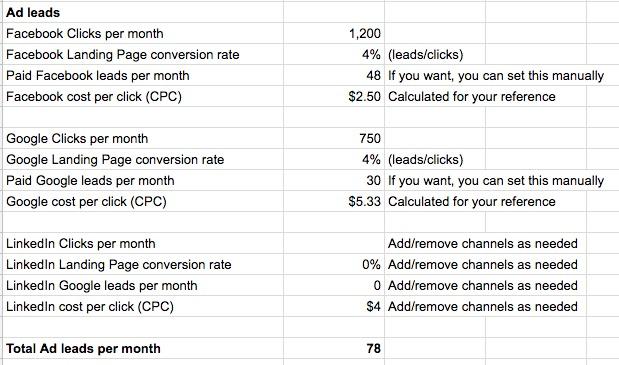
Following our theme of making this calculator customizable (so it’s more useful to you), we designed this section so you can compute your monthly leads by paid ad channel in a few different ways —just choose which method is most useful:
1. Input your average monthly leads directly: This is easiest if you know roughly how many leads you get per month from Facebook, Google, etc., and just want to enter them directly.

If you do this, the clicks per month, costs per click (CPC), and landing page conversion rate cells aren’t used—you can ignore them.
If you prefer to use this method, use the tab titled “Simpler Leads.” It does this already.
2. Input your clicks per month and conversion rate: This gives you a little more granularity.
You can input the clicks per month and the average landing page conversion rate, and the calculator will compute the leads per month (clicks * conversion rate).
It will also calculate the CPC just for your reference.
(Note: Alternatively, you can change the formulas yourself to input a cost per click and have the calculator tell you the clicks per month you’ll get with the monthly ad spend you set in the costs section above.)
Inbound leads
Inbound leads are hard to generalize.
They come from a variety of sources and forms on your site.
Inbound leads include:
Organic traffic to your marketing site
Traffic to blog articles (organic, referral)
Traffic that has come through social channels
Form submissions on your homepage
Form submissions on your “work with us,” “request a demo,” or any other lead generation page
So, we decided it was most useful to keep this section simple:
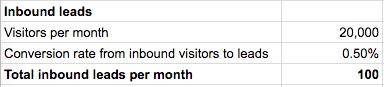
You can compute your inbound leads in two ways:
1. Enter the total inbound leads you get per month: If you aren’t tracking conversion rates on your marketing site or your blog, then this is best.
2. Enter your average monthly traffic and conversion rate: This gives you one added level of granularity.
We’ve found that the second route (the default way the calculator is built) is best for teams looking to see how improving traffic or conversion rates would affect CPL. For example, if you invested in SEO and grew traffic by another 10,000 visitors but kept the conversion rate the same, how would that affect your CPL?
Cost per lead calculator
In this section, we’ll cover how our spreadsheet calculator works. If you haven’t already downloaded our Cost Per Lead Calculator, it’s absolutely free. The spreadsheet is divided into two parts, as per our high-level cost-per-lead formula discussed above.
Calculating costs
First, costs:
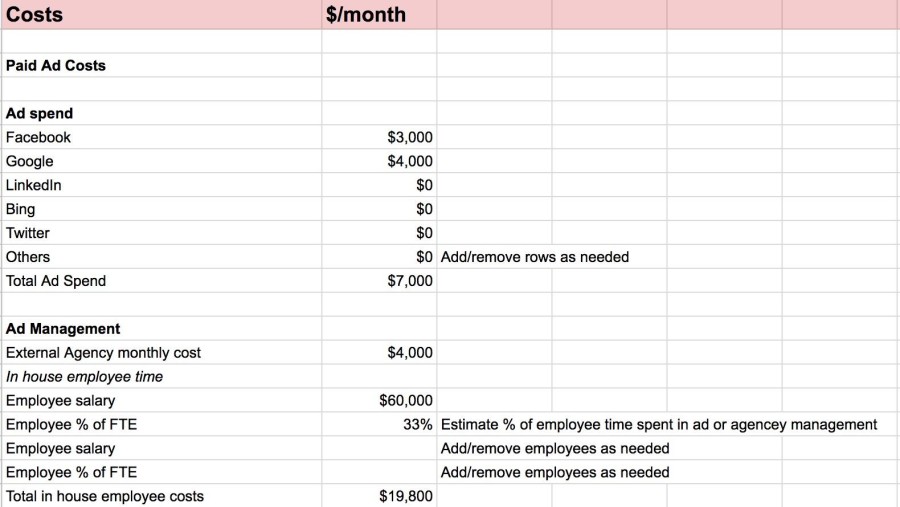
Then, a section on calculating leads:
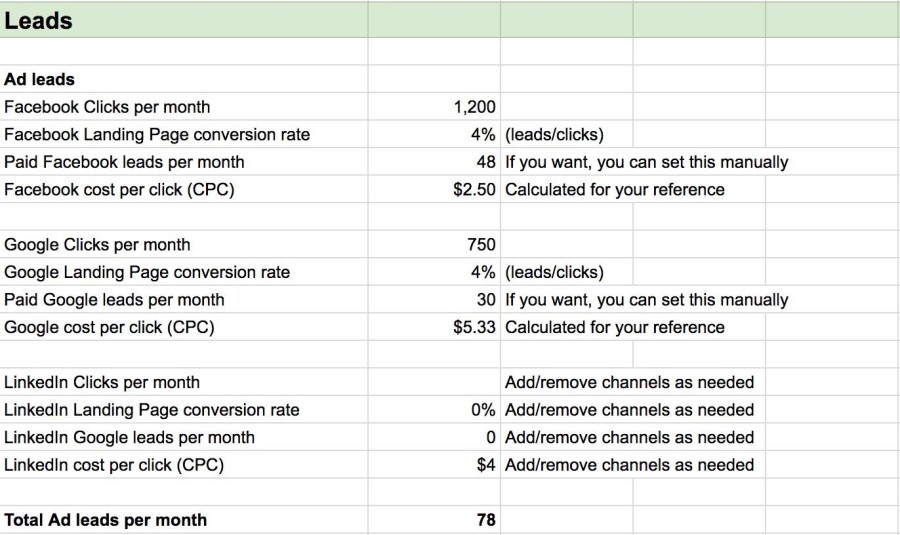
Note that the actual sections are longer and include more information than what’s shown in the screenshots above.
All costs are per month, and column C has helpful notes about certain rows.
Ad Costs:
Ad costs are divided into ad spend and ad management. Adding up ad spend is simple. Just insert your average monthly spend by channel.
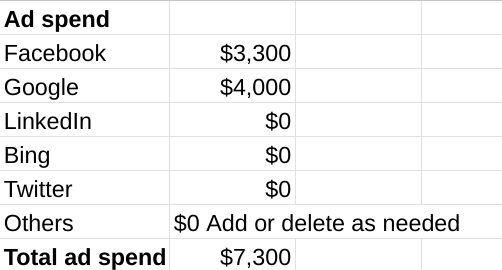
One big advantage of a spreadsheet calculator (vs. a rigid on-page calculator) is that you can easily customize the rows.
So, in this case, you can add and remove rows as needed, depending on where your company spends ad budget.
In the base example, we’ve set a hypothetical $3,000/month spend on Facebook and $4,000/month on Google.
Ad management:
The ad management section gets more interesting. In addition to any monthly spend on a marketing agency that manages your ads, you’ll estimate what portion of internal team members' time is spent managing the agency or the ads themselves.
Estimating this cost will take time—but it's worth it for more accurate data.
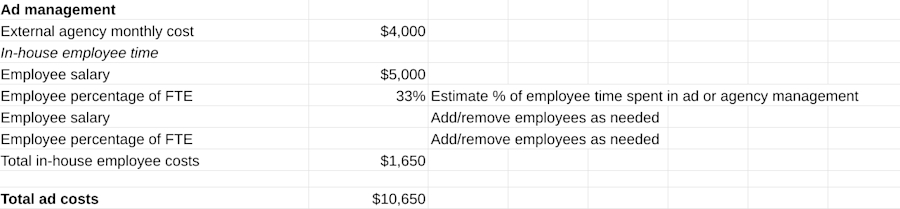
You can copy and paste the Employee salary and Employee % of FTE rows to add more employees. Certain companies want to understand the cost per lead, excluding the internal marketing team's salary costs. That’s okay. If that’s the case, simply set those values to zero or delete those rows.
But in our estimation, the true cost per lead should include that spend because the internal team is required to run the ad process, and without them, no ad-based leads would be generated.
You can also run the calculator with and without internal team member costs and report on the difference.
Inbound costs:
The inbound costs section has rows for spend on software and assets (landing page software, email software, etc.) plus sections for people costs as discussed above:
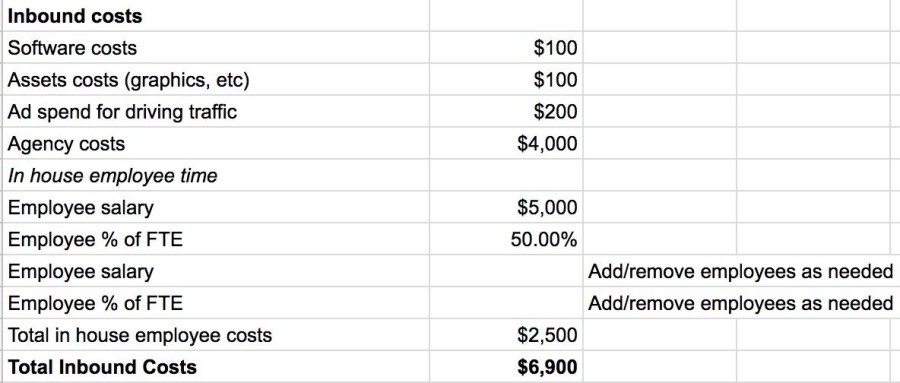
The flexibility of the spreadsheet calculator becomes really useful for computing inbound marketing costs because of what we said above:
“Inbound marketing” encompasses a suite of different activities. This means, from a cost perspective, it includes a variety of different costs you’ll need to add up.
In the inbound costs section of our CPL calculator (screenshot above), there are line items for:
Agency costs: Add as many of these as you like if you have separate agencies for SEO, content marketing, etc.
In-house employee time: Again, just copy and paste these rows to include percentages of salary spent on employees working on inbound marketing
Tech and asset costs: Add as many as you need for landing page software, blogging platforms, marketing automation software, graphics, and other assets, etc.
Total costs:
As you customize the cost per lead costs section, adding and removing sections as it applies to your company, double-check that the formula in the Total Costs row, highlighted in light red, still properly adds up all of your costs—if it doesn’t, adjust the formula until it does.

Results: Computing costs per lead by channel
Once you’ve customized the costs and leads sections, scroll to the top to see your costs per lead.
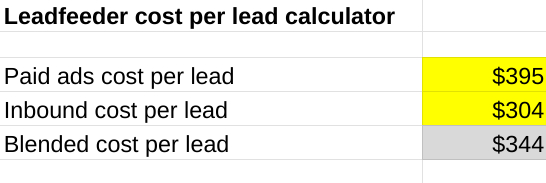
The calculator shows three lead costs: paid, inbound, and blended.
Showing costs per lead by channel is extremely useful for you and your team to see which channel is performing better. Also, having the Cost Per Lead Calculator in spreadsheet form lets you go back and play with values to see how this would affect the relative CPLs between the two channels.
Finally, you can easily save different scenarios by either copying COLUMN B or copying the entire sheet into a new tab with a unique name.
Get Your Cost Per Lead Calculator
Easily calculate your paid, inbound, and blended cost per lead.
DownloadWhat is cost per lead (CPL) vs. cost per acquisition (CPA)?
Cost per lead is different from cost per acquisition (CPA). Cost per lead is the total cost of generating one lead, while cost per acquisition is the total cost of generating one new paying customer or a closed deal.
So, what “costs” does a business usually incur from generating leads? Generally, these include:
Advertising costs
Inbound marketing costs
Other marketing costs
But most CPL calculators and formulas focus only on advertising costs. This underestimates your true CPL. In reality, most businesses require additional costs to generate a quality lead (for example, building and optimizing landing pages to capture the lead).
Limiting CPL analysis to a single channel (advertising) prevents you from fully understanding your business and marketing efforts and can lead to costly mistakes. For example, is your SEO agency providing a good return? You’ll have no idea if you only calculate paid ad CPL.
That's where our free spreadsheet calculator comes in. The spreadsheet format is useful as it lets you:
Easily add different costs to your CPL (advertising, inbound marketing, landing page costs)
Create and save multiple versions and scenarios (So you can predict how changes might impact your business.)
Download our free cost per lead calculator
The cost-per-lead calculator is hosted as a read-only Google Sheet. Once you open it, be sure to add it to your own Google Drive. Then, you can change it, make copies, or export it as an Excel file.
Cost per lead best practices
If you’re going to be using the cost per lead KPI as a metric for improving your operation, you need to start learning how to reduce cost per lead, so let’s get started. Whether your marketing spend is extensive or minimal, the following tips will help you make progress:
1. Refine your landing pages
Each step in the marketing funnel can drive away a viable prospect, and the first visit to a landing page is particularly important.
Your landing pages should be optimized for turning interest into action, so if they’re not performing well, you’re wasting a lot of good marketing work.
Remember that growth for B2B businesses requires making the most of every lead. The better you can make your landing pages, the more likely your average lead will convert.
That means you’ll have more revenue for the same CPL or easier CPL targets to maintain the same revenue level.
2. Experiment with your creative
Experienced marketers will tell you that all their tactics have unpredictable results. Even the most tried-and-tested formats can fall flat.
So if you want to achieve and maintain a lower cost per lead, you need to prevent your creative output from going stale.
Make an effort to try new things. Roll out fresh ad campaigns with distinct approaches using assorted formats and use A/B testing to test variants.
The more you test, the better you’ll understand what works for your target audience, and even minor tweaks can add up to significant performance boosts.
3. Target long-tail keywords
To achieve big results, businesses can prioritize competing for high-traffic, high-cost keywords. This is misguided in two ways.
Firstly, it denies the clear truth that succeeding by targeting such keywords is all but impossible without funding that rivals industry leaders. Secondly, it misses the value of other keywords.
Long-tail keywords—those that extend with specific modifiers—don’t get as many searches or clicks, but they get searches from people with serious intent to act.
And because industry giants don’t need to be subtle, they often overlook targeting those keywords, leaving room for you to take advantage.
4. Tweak your campaign timing
What you say matters, but when you say it can also impact your fortunes. An excellent ad served to your top prospects while they're asleep is a huge waste, yet plenty of businesses don’t put much thought into timing when they run campaigns.
As part of your audience research, try to figure out when your targets are most likely to be receptive to what you’re trying to say. Consider when they sleep, work, go out, and are most attentive. Simply improving your ad timing can noticeably reduce your CPL.
5. Use automation to nurture leads
Once you’ve earned a lead, you need to give it the best possible chance of converting, which means nurturing it. If you show interest but step back and leave everything to the prospect, they’ll likely look elsewhere.
The issue with nurturing leads is that it can be very time-consuming—but that’s where automation comes into play.
Running automated email campaigns that leverage smart personalization can keep leads warm until they’re ready to learn more or take action, all without using up valuable human resources.
Cost per lead synonyms
Depending on the business, the context in which it’s discussed, the ways it’s modified to suit specific goals, and the cost per lead, it can go by other names. Lead acquisition cost and price per lead are synonyms.
Here are terms to watch out for that can nearly match the cost per lead definition:
Cost per action or cost per goal completion: Leads are usually identified by tracking relevant actions, which are often recorded as goals are completed. This means that these metrics are often the same—or approximately the same—as cost per lead.
Cost per qualified lead, cost per marketing qualified lead, or cost per sales qualified lead: Each of these terms refers to the same thing, the cost of a lead that’s been checked to confirm its solid potential to convert.
Discover how to decrease cost per lead with Leadfeeder
What does cost per lead mean for the average business? Economy and stability. As we’ve seen throughout this article, cost per lead is an important metric for any business that aspires to work efficiently, endure market fluctuations, and reach new levels of success. You should be taking it seriously.
But if you’re going to bring down your CPL, you need the right cost per lead software for the job—and Leadfeeder has the features you’re looking for. There are two core ways to lower your CPL. You can bring in more qualified leads and reduce the cost per lead. Ideally, you should do both.
Leadfeeder can help with B2B lead generation by identifying the companies that visit your website but never take action. There’s a good chance they’re interested but need a little push, so you can reach out to them with custom pitches.
It can also help with the latter by improving lead quality by flagging prospects who show additional interest by returning to your website. If you go after those leads immediately after they return, you’ll strike while the iron’s hot and convert at a better rate with no additional marketing and little added effort.
To find out the details of how Leadfeeder can bring down your CPL, why not give it a test run with a 14-day trial? Sign up here for free and start seeing how your website analytics alone can seriously boost the quantity and quality of your leads.
FAQs about cost per lead
How to calculate cost per lead
How is cost per lead calculated? In its simplest form, it’s easy. Take the total sum you spent on a marketing campaign and divide it by the number of leads that campaign generated. A $1000 campaign that generates 40 leads has a CPL of $25.
It’s essential to account for all the leads generated, so pore over all relevant marketing channels and check your tracking is working correctly.
Additionally, ensure you’re calculating your costs properly. What is a cost per lead worth if you’re overlooking costs like sales team members' salaries?
There are cost-per-lead programs that will help you get all the details correct. You can also use Leadfeeder’s free CPL calculator.
How does cost per lead work?
Cost per lead gauges the efficiency of marketing work by calculating how much is spent to secure a potential customer (as indicated by a clear action, such as emailing to request details or requesting a trial).
To make a marketing operation stable in the long run, it’s vital to ensure it’s reliably delivering ROI. So, businesses closely examine CPL to inform their tactics and targeted channels, identifying where they can improve and where they should reinvest.