Together, these strategies help businesses capture high-quality prospects, nurture them with targeted messaging, and convert them into paying customers. In fact, email marketing has an ROI of 312%, outperforming social media, pay-per-click (PPC) ads, and account-based marketing.
An email lead is a prospective customer who has shared their email address, usually in exchange for something valuable like a resource, webinar, demo, or discount. Once captured, that contact becomes part of your owned audience, allowing you to build trust and guide them through the buying journey.
Email lead generation refers to the strategies used to attract, collect, qualify, and nurture those email contacts. This can include gated content, opt-in forms, automation sequences, behavioral tracking, segmentation, and personalized follow-ups.
So, why does email lead generation still matter in 2026?
High-quality leads don’t generate themselves. They must be intentionally captured and nurtured over time, especially true for B2B leads, where 30% of B2B sales cycles take between one and three months. For around 25%, it’s even longer than that. The faster you capture these leads, the faster you can target them with engaging content to drown out noise from your competitors.
Unlike paid ads or social platforms, email is an owned channel. You’re not dependent on algorithms or rising acquisition costs to reach your audience. With the right strategy, email lead generation delivers:
Higher-quality leads at scale
Predictable pipeline growth
Personalized engagement
Measurable performance
Strong long-term ROI
Higher conversion rates compared to cold outreach
In this guide, we’ll explore 10 powerful email lead generation tactics along with a few best practices, email templates, and design tips. Plus, we’ll discuss how you can use lead generation tools like Leadfeeder to leverage email to its full potential.
10 best email lead generation techniques for 2026
Want to get started with email lead generation? Here are 10 tried-and-tested techniques that you can use today.
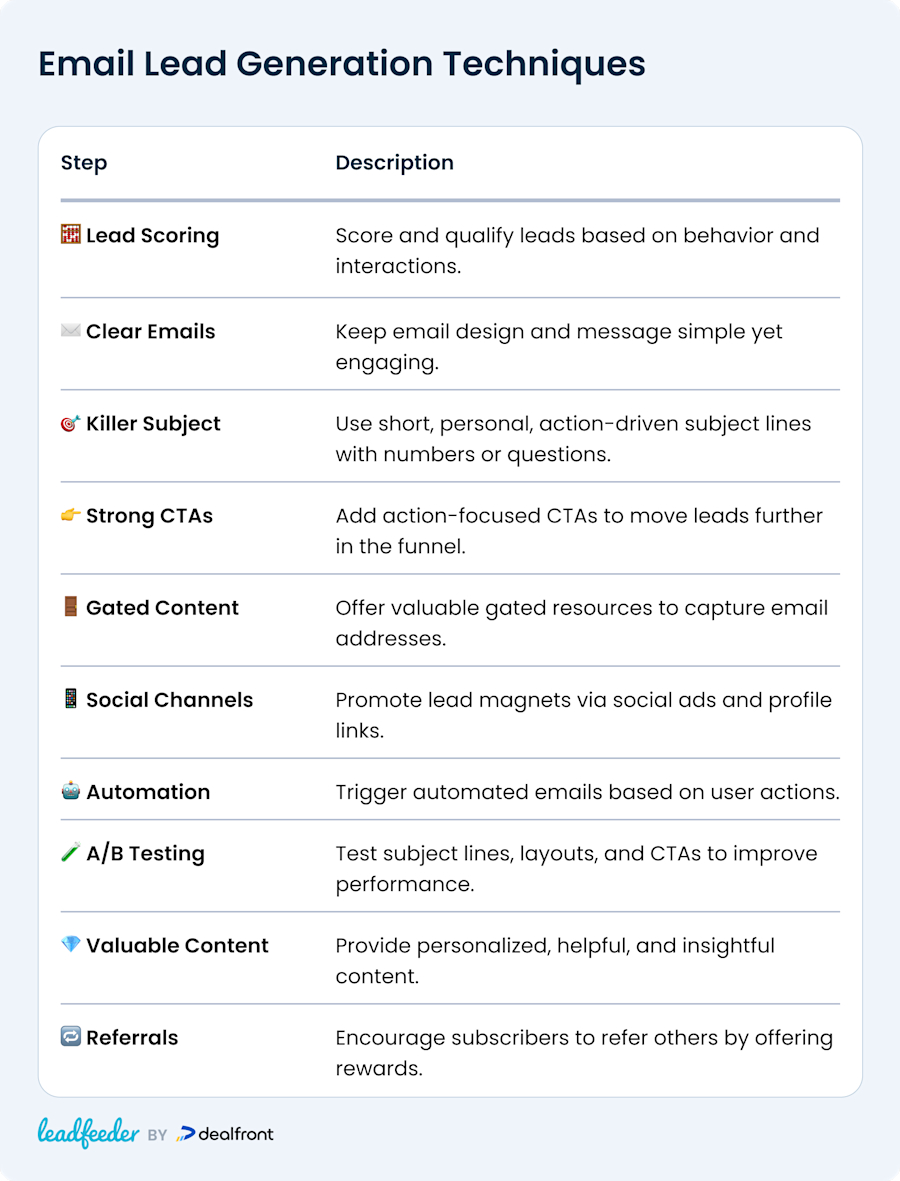
1) Lead Scoring to Prioritize High-Intent Prospects
Lead scoring helps you quickly identify and target email leads that have high conversion potential.
Let’s say that a prospect subscribes to your email list. Using lead generation software, you can score and qualify leads based on specific actions or behaviors, such as opening your email, clicking your CTA, downloading your ebook, or signing up for your webinar.
The higher the score, the more likely the customer is to convert. So, you can target the right prospect at the right time with the right type of message, no more wasting resources and productivity on leads that are unlikely to convert.
2) Clear and Concise Emails That Drive Action
Engaging emails have simple designs and clear, concise messages that hold your reader’s attention and facilitate easy decision-making.
Avoid unnecessary information, technical jargon, or overly elaborate designs, as they can overwhelm readers, cause misunderstandings, and frustrate customers enough to bounce or unsubscribe.
This doesn’t mean your emails have to be boring. Feel free to inject your brand’s personality into your email content, just make sure that your core message shines through.
3) Attention-Grabbing Subject Lines that Increase Open Rates
It doesn’t matter what you write in your emails if you can’t get prospects to open them in the first place.
Your subject lines need to stand out from the sea of marketing emails flooding your prospect’s inbox and entice them to open your message. So, it’s time to get creative (while also keeping best practices in mind).
Here are a few tips to help you create compelling, click-worthy subject lines:
Keep it short: Emails with shorter subject lines have higher click-through rates, so try to keep your subject lines within nine words. You could even try out a one-word subject line. According to data from Klenty, they have an impressive open rate of almost 35%.
Include your prospect’s name: Add a personalized touch by addressing your customer by their first name. Klenty found that this skyrocketed open rates from 10% to 39%. Including other personalized details, such as the prospect’s company or location, can also grab attention.
Use action-oriented verbs: Inspire customers to take action by using words such as “attend,” “discover,” or “update” at the beginning of your subject line. This sparks curiosity and urgency, two key ingredients for click-worthy subject lines.
Add data and numbers: When prospects scan their inboxes, a number or intriguing statistic can catch their eye. For example: “Join 10,000 Customers” or “Grow Your Engagement Rates by 75%”.
Ask a question: Pose a relevant, burning question to pique your audience’s interest. For example, the subject line “What do your customers really think?” prompts leads to open the email to see the answer.
4) Clear and Compelling Call-to-Action That Moves Leads Forward
So, your prospect has read your email, now it’s time for them to move further down the sales funnel. This involves luring them from the email to your content with a strong call to action (CTA).
CTAs should be snappy, compelling, and action-driven. They compel the reader to take the next step, whether that's engaging with your website content or checking out your product demo. Use action words like “read,” “download,” “sign up,” “try,” and “join” to motivate prospects to take immediate action.
5) High-Value Lead Magnets such as Content Upgrades and Gated Resources
Gated resources and content upgrades are lead magnets that can only be accessed by prospects once they’ve signed up for your email list. They can include anything from reports, ebooks, and whitepapers to exclusive webinars and free tools.
If a prospect reads your blog post, you might show them a pop-up lead-capture form promoting your webinar on the same topic. Or if they’re reading a summary of your report, you might promote the full report as a content upgrade.
Offering relevant, valuable, and actionable resources incentivizes prospects to share their email addresses, enabling you to target them with email marketing communications.
6) Social Media Platforms to Expand Reach
Why not turn social media users into email leads by advertising your lead magnets on platforms like LinkedIn, Facebook, or Pinterest?
Gain a presence on social media and add a lead magnet CTA to your profile and social media ads. Create engaging, shareable posts that communicate the benefits of subscribing to your email list. Ensure they have CTAs, too.
Use social media marketing tools to track key metrics, such as likes, shares, and conversions, to see which strategies successfully generate email leads.
7) Email Automation for Scalable Nurturing
Email automation enhances efficiency by enabling you to send bulk emails and drip email campaigns that trigger when prospects complete certain actions.
For example, you might create email campaigns that trigger when a customer:
Joins your email list
Downloads your resource
Signs up for or attends your webinar
Engages with specific product pages
These emails can be scheduled and sent in bulk to deliver consistent, personalized communications to customers without hindering your team’s productivity.
8) A/B Testing for Continuous Optimization
A/B testing involves presenting two versions of your email to two groups of your target audience to see which version performs better.
You can A/B test almost every element of your email, such as the subject line, font, body text, CTAs, and email layout. It tells you which email elements your leads prefer so you can optimize them for increased open rates, click-throughs, and conversions.
Discover which subject lines generate the most opens, which visuals and layouts resonate with audiences, which CTAs drive more conversions, and much more.
9) Valuable, Trust-Building Content That Nurtures Leads
If your sales funnel were a river, your content would be the currents guiding customers along it. So, it’s paramount that every piece of content you share via email delivers real value to your audience.
This is especially true for B2B email lead generation, where prospects rely on your content to learn more about your product and how it can help them solve their pain points and meet their goals.
They also expect you to be a thought leader in your field, which you can demonstrate by providing informational, personalized content like:
Blog posts
Thought-leadership articles
How-to videos and guides
Case studies
Whitepapers
Customer testimonials
Webinars and podcasts
Research reports
Aim to understand your prospects’ unique needs at every stage of the funnel and deliver content that’s relevant, informative, and motivational.
10) Referral Programs that Turn Subscribers Into Advocates
This savvy email lead-generation technique leverages your existing subscribers to generate new email leads.
Incentivize current subscribers to refer your email list to their friends, family, and professional networks by offering a reward for each successful referral.
The reward could be anything you like a discount, a freebie, a charity donation, or a product/service upgrade, for example. The only requirement is that it be worthwhile enough to encourage subscribers to participate.
Email Lead Generation Best Practices
The 10 techniques above help you capture and nurture leads. But techniques alone don’t guarantee results.
The difference between a growing subscriber list and real revenue comes down to how strategically you execute.
These best practices aren’t additional tactics, they’re the principles that ensure your email lead generation efforts actually convert.
1. Start With Buyer Intent, Not Just Traffic
That starts with clearly defining your Ideal Customer Profile (ICP), the type of company or individual most likely to convert and deliver long-term value.
Build your ICP using firmographic and behavioral data, including:
Company size
Industry
Location
Revenue
Sales cycle complexity
Core pain points
Business goals
Budget considerations
Buyer intent isn’t always visible through form fills alone. Some high-intent prospects visit your website, explore product pages, and leave without converting. With tools like Leadfeeder, you can identify companies visiting your site and engage open opportunities you might otherwise never know existed. This allows you to align outreach with real-time interest rather than waiting for an opt-in.
Before building forms or creating lead magnets, clarify:
Who is most likely to buy?
What problem are they actively trying to solve?
What signals indicate buying intent?
When your capture strategy is rooted in buyer intent, your list grows more slowly, but far more profitably.
2. Align Your Offer With Funnel Stage
Not every visitor is ready for a demo. Some are researching. Others are comparing vendors. A few are ready to purchase.
Your lead capture strategy should reflect this.
Top-of-funnel prospects may respond to educational resources. Mid-funnel leads may prefer case studies or comparison guides. Bottom-of-funnel prospects are more likely to convert on free trials or demos.
Matching the right offer to the right stage increases both opt-in rates and downstream conversions.
3. Minimize Friction at Every Step
Email lead generation works best when the path from interest to action is seamless.
This means:
Short, focused forms
Clear landing page messaging
Fast load times
One primary call-to-action
Each additional barrier reduces conversion rates. Simplicity increases them.
4. Prioritize Relevance Over Frequency
Sending more emails doesn’t necessarily generate more revenue. Instead of focusing on volume, focus on relevance. Use behavioral data, like downloads, page visits, and webinar attendance, to guide follow-up communication. Emails that respond to what a prospect has already shown interest in will consistently outperform generic broadcasts. Relevance builds trust, and trust drives conversion.
Timing also influences engagement. Analyzing performance by day and time helps you identify when your audience is most responsive. In fact, 47.9% of B2B marketers report peak email engagement between 9 am and 12 pm. While this can be a useful benchmark, your own data should guide optimization.
5. Treat List Health as a Growth Lever
An engaged list is more valuable than a large one.
Inactive contacts hurt deliverability, reduce open rates, and distort performance data. Regularly monitor engagement and remove or re-engage dormant subscribers.
Strong list hygiene protects your sender reputation and ensures your emails reach inboxes, not spam folders.
6. Design Emails That Support Conversion
The design of your emails should reinforce clarity and momentum. High-converting emails typically:
Open with a clear value proposition
Focus on one primary message
Use concise, scannable formatting
Feature one strong, visible CTA
The goal is not to impress. It’s to guide action. Every email should move the reader one step closer to becoming a customer.
Bonus: 5 Best Email Lead Generation Templates
We’ve compiled five customizable email templates that you can use in your lead generation campaigns. Whether you’re conducting sales outreach or nurturing new leads further down the funnel, these templates can be adjusted to fit any situation.
1. Free ebook download template
Hi [Name],
We saw you checking out our blog post on [topic] and thought you’d be interested in our free ebook! It goes into more detail about practical strategies that you can use to improve [skill/metric].
Download your free copy now.
2. Webinar invitation template
Hi [Name],
We’re delighted to offer you an exclusive invitation to our live webinar on May 17th! You’ll join renowned industry expert [Name] to discuss [topic] and get the answers to all your burning questions.
Register for our webinar now to secure your spot.
3. Limited-time offer template
Hi [Name],
Are you looking to upgrade your [software]? We’re offering 25% off all our products until May 25th—and we don’t want you to miss out on [improving specific business goal] for less! So, explore our range of software plans and select the right one for you before time runs out.
Get 25% off today.
4. Free trial template
Hey [Name],
Are you itching to try out a cutting-edge solution with [standout product feature]? Now you can—for free. Sign up for a 14-day free trial of [your product], where you get access to [specific features] that will transform your business operations.
Sign up for your free trial here.
5. Case study template
Hi [Name],
Are you struggling with [pain point]? So were [relevant company] until they switched to [your solution]. After six months, they increased their [metric] by [%] and catapulted their ROI—all while improving their productivity.
If you want to learn more, here’s a case study that goes into depth about how [previously named company] went above and beyond their goals with the help of [your solution].
Read the case study here.
Use the best tool for email lead generation
Opt-in forms are an irreplaceable email lead generation tactic—but they don’t always produce high-value leads. A B2B lead generation tool like Leadfeeder can give you access to the email addresses of anonymous website visitors (along with company names, job titles, and more).
How does this help you? It enables you to reach interested prospects at the top of the funnel with personalized emails to expedite conversions—all without asking them to fill out a form.
With Leadfeeder’s custom segmentation, you can qualify prospects using 50+ behavioral and firmographic filters, including which product pages they visit and what content they download. Accurately gauge their pain points, needs, and buying intent to tailor email campaigns and reach out with the right message at the right time.
Want to learn more about how Leadfeeder can power your email lead generation campaigns? Reach out to our team or request a demo today.
Email Lead Generation FAQs
How often should I follow up on my emails?
If you send too many emails, you risk spamming your prospects, but if you don’t send enough, your leads might get distracted by your competitors. Although it always depends on customer preferences, you should aim to engage with leads once or twice a week to keep your brand top-of-mind and maintain engagement without overwhelming prospects.
How to generate email marketing leads
Creating content that drives your target audience to your website is the most reliable way to generate email marketing leads. Once they’ve engaged with your website content, prompt them to submit a lead-capture form to obtain their email address.
What metrics should I track in my email campaigns?
Focus on engagement metrics like open rates, click-through rates, and conversions. Other metrics to track include bounce rates, unsubscribe rates, and email list growth rates.
How do I get an email address for lead generation?
You can use opt-in forms to get email addresses. This tactic requires you to offer something valuable in exchange, such as a free resource. You can also obtain the email addresses of prospects who visit your website using website identification tools like Leadfeeder.
How much is an email lead worth?
Email marketing can deliver an ROI of up to $44 per $1 spent, suggesting that email leads are worth their weight.
That said, the true value of your email leads depends on other factors, such as whether they go on to make a purchase, refer your product, or share your content. Analyze metrics such as conversion rates, customer lifetime value, and cost per lead.
Is it legal to buy email lists?
Yes, it’s legal to buy email lists as long as you comply with the rules in your jurisdiction. But proceed with caution. There’s no guarantee that the email addresses you’re buying are valid.
And even if they are, there’s a high chance you’ll get reported as spam when you send emails to unsuspecting addresses. So, it’s recommended that you avoid purchasing email lists at all costs.
[1]Rewrote this section to incorporate all other info in the succeeding sections, to reduce fluff and not repeat the techniques themselves

Director of Content Marketing @ Leadfeeder
Jamie Pagan is Director of Demand at Leadfeeder, where he leads demand generation and pipeline growth initiatives. His work focuses on connecting marketing activity with revenue by combining intent signals, campaign performance data, and audience insights.
With experience building scalable demand engines and launching growth-focused campaigns, Jamie brings a practical perspective on how marketing teams generate and capture demand. His experience working with intent data and marketing analytics informs his approach to identifying high-intent buyers and converting interest into qualified opportunities.