60-Second Summary
Generating leads is easy; generating the right leads that convert, stay, and create revenue is hard. Focus on qualification, intent tracking, and targeted execution rather than chasing volume or generic tactics.
Key takeaways: Most B2B failures come from executing the wrong tactics or targeting the wrong people — not a lack of ideas. Prioritize consistent qualification and intent signals so sales time and acquisition costs aren’t wasted.
Standout strategies & tactics: Gate only high-value content and place it behind contextual clicks; add qualifying fields to webinar registration; use retargeting and A/B testing for ads; apply account-based marketing and social selling; identify anonymous site visitors and track page-level intent to time outreach.
Real-world lessons & frameworks: Qualify earlier to keep SDRs focused, follow users through the funnel with behavioral tracking, warm cold outreach through research and engagement, and prioritize lead quality over sheer volume for sustainable revenue and lower churn.
*This summary was created with AI assistance, using our original content.
Anyone can generate a list of contacts. The hard part is generating leads that actually convert, stay, and create revenue. Poorly qualified leads waste your sales team’s time, inflate acquisition costs, and drive churn. Overburden your SDRs with qualification, and you risk slowing pipeline growth or missing real opportunities.
There’s no shortage of advice on how to generate more leads. The market is flooded with tactics, playbooks, and “proven” strategies. But most B2B companies aren’t struggling because they lack ideas. They’re struggling because they execute the wrong tactics, target the wrong people, or apply good strategies poorly.
The issue isn’t generating leads. It’s consistently generating the right leads. So what is B2B lead generation that actually pays off? This article breaks down the most common B2B lead generation strategies, why they often fail, and how to make them work.
Note: Want better quality leads? Leadfeeder identifies unknown site visitors through their IP address so your business can follow up. Sign up for a free 14-day trial.
The most common B2B lead generation ideas (and why they don't work as well as you want them to)
Even the best-aligned sales and marketing teams can fail at lead generation without a clear B2B lead generation strategy. Whether you're looking to find more leads or find better leads, there's a good chance you've implemented some of the following lead generation tactics.
But are you getting it wrong? Here's what B2B lead generation best practices say you should be doing instead.
1. Gated content
Gated content, such as ebooks, white papers, or reports, can be an effective way to generate leads. We use this strategy ourselves at Leadfeeder with our guides for sales and marketing teams:
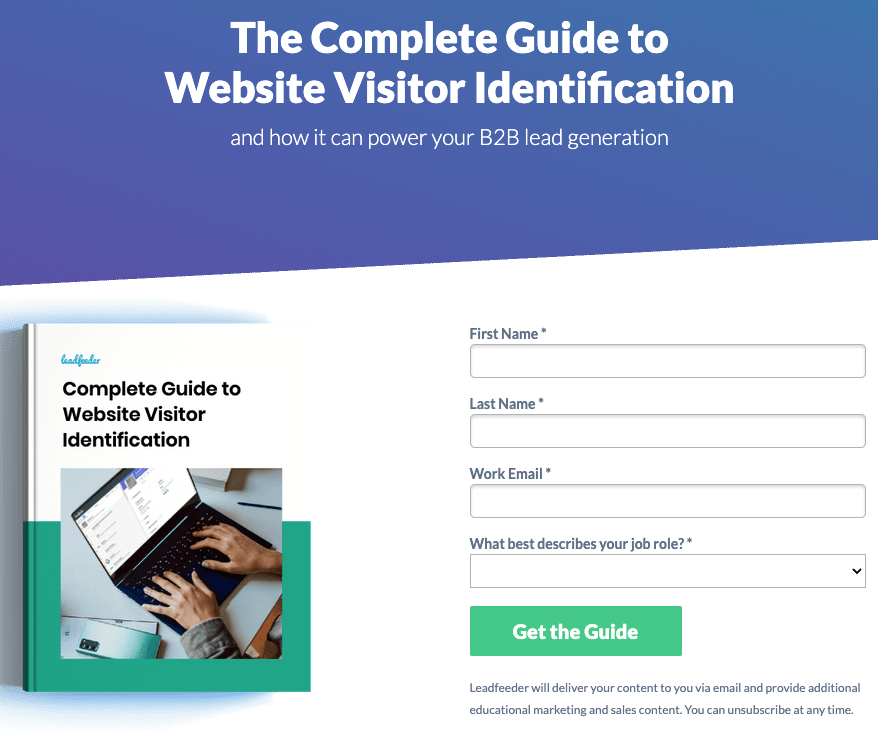
It's been quite effective at helping drive more qualified leads. After all, if site visitors are interested in your content, there's a good chance they are a good fit for your company.
Right? Not always. There are a few reasons gated content doesn't always work. Sometimes the content we create isn't valuable enough to catch the best leads. Other times, the best leads don't fill out your form.
So what can you do to make the most out of gated content? First, make sure the content you gate is valuable to your users. It should address a very specific problem and provide a viable solution. You can't throw a random blog post behind a gate and expect to get high-quality leads.
Second, make sure leads are well-qualified before you offer them gated content. At Leadfeeder, we don't put our gated content on our front page.
Why? Because not everyone who hits our home page is ready to enter our sales funnel. By placing our gated content a few clicks away, users have time to read some of our free content and find out more about what we do.
The final challenge with gated content is that not everyone will fill out the form. Even though they fit your ideal customer profile, some visitors just aren't comfortable sharing their email addresses.
The good news? You can still contact those leads that slip through the cracks with Leadfeeder.
All you have to do is install our custom tracking code, and we'll track visitors who come to your site but don't fill out a form. Then, we match those visitors with a contact database to tell you where they work and who to contact.
Even better, you can track what pages they view and filter by intent. For example, you can create a custom filter to view people who have visited your ebook page, but didn't hit the "download" page — meaning they were interested enough to view the form but failed to fill it out.
2. Webinars
Similar to gated content, webinars offer users virtual classes or training in exchange for an email address.
The problem is that most businesses only ask for an email address, which means you end up with a list of email addresses but no idea if those users fit your ideal customer profile (ICP)
Of course, you could turn that list over to your SDRs to qualify. You might end up with a handful of decent leads after investing time and resources in promoting, launching, and hosting your webinar.
Luckily, there's a better way. Rather than just asking for an email address, use the form to ask other qualifying questions.
For example, Leadfeeder uses educational webinars to gather leads and qualify them by asking for registrants' country, company, and position. Here's a screenshot of a recent webinar for context.
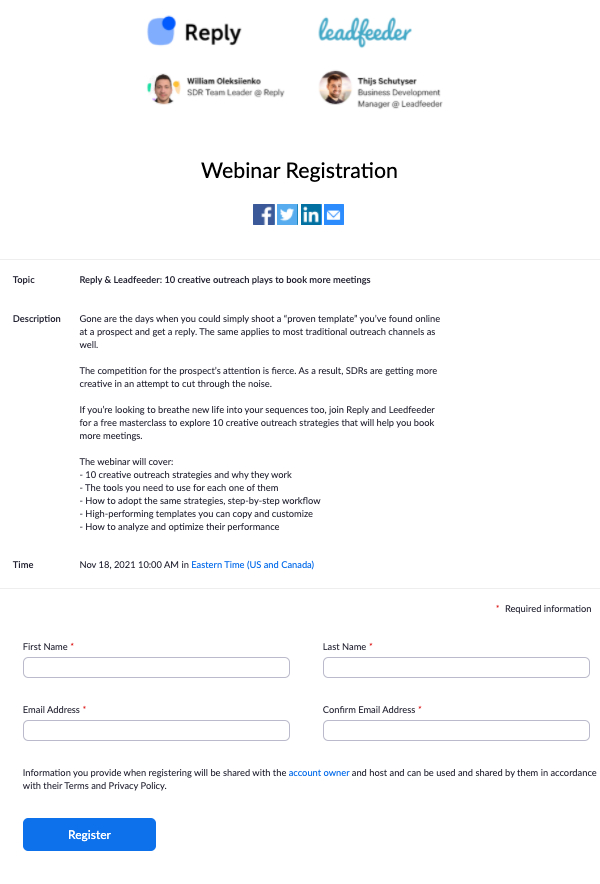
You could also ask for details such as their industry, company size, or other factors you need to determine whether they fit your ICP.
Sure, you might get fewer registrants if you have a long-form, but you'll spend less time sorting the good leads from the bad.
3. Paid ads
Between the fall of organic reach on social media and the end of third-party cookies, sometimes you have to pay to play. Paid ads through networks like Google, Bing, and LinkedIn can be a boon for B2B companies looking to target specific niches.
The problem? Sometimes you pay to target users who seem like the perfect fit but aren't. Plus, users today are far more likely to ignore your ad than to click it.
So, how do you get better leads from paid ads? Start by leveraging retargeting ads to reach users who visit your site or interact with your brand. It's more effective than targeting everyone because you reach users who are already engaging with your brand.
A/B testing CTAs can also improve ad conversion rates by finding the messages that resonate most with users.
But the real key to getting better leads through paid ads is following users through the B2B lead generation funnel.
Most users aren't going to click an ad and immediately make a purchase. They might read a blog post, follow you on social media, maybe come back to your site and check out your pricing page.
With Leadfeeder, you can track users every time they return to your site, then reach out when they show clear intent to buy.
According to Gartner research, B2B buyers spend 45% of their time in the buyer's funnel researching independently and just 17% meeting with potential suppliers.
This means by the time you speak to most leads, they've already performed most of their research. By tracking users' on-site behavior, you can reach out when they are ready to buy, reducing your sales team's time spent on leads that won't convert.
4. Cold outreach
Cold emails and cold calls are a mainstay of sales — but should they be? With an average conversion rate of around 3%, cold calling is one of the least effective sales methods.
So why do we keep doing it? Because when you don't have hot leads, cold leads are better than no leads at all.
Don't worry, I'm not going to tell you to quit cold outreach entirely. What I do recommend is warming up a little bit.
There are several ways to do this — you can use sales email templates to create a series of emails, so you're not reaching out to totally cold leads.
At Leadfeeder, we've also leaned into account-based marketing — where you target specific companies with custom campaigns, rather than targeting a bunch of companies and seeing which ones bite.
The best way to improve cold outreach conversion rates is actually a bit simpler. Social selling methods help you get to know leads. This can be as simple as researching leads on LinkedIn and interacting with a few posts before reaching out.
Instead of writing one bland note and pumping it out to 50 LinkedIn connections, take the time to get to know people who might benefit from your offer.
Who are they, what do they like? What problems do they have? Celebrate their wins and then — when the time is right — show how you can help. If you've done it right, you won't be just another salesperson; you'll be someone they trust.
Leadfeeder makes your B2B lead generation process more effective
Tired of implementing the same old lead generation efforts and not seeing results? Leadfeeder is a lead generation tool that helps B2B companies qualify leads more effectively and target leads at the exact right moment.
How do we do that? By tracking and identifying site visitors, you can see who visits your site and what pages they view. Then, your sales team can reach out to the right person at the right time.
Even better? We offer a free 14-day trial so you can try Leadfeeder before you buy.