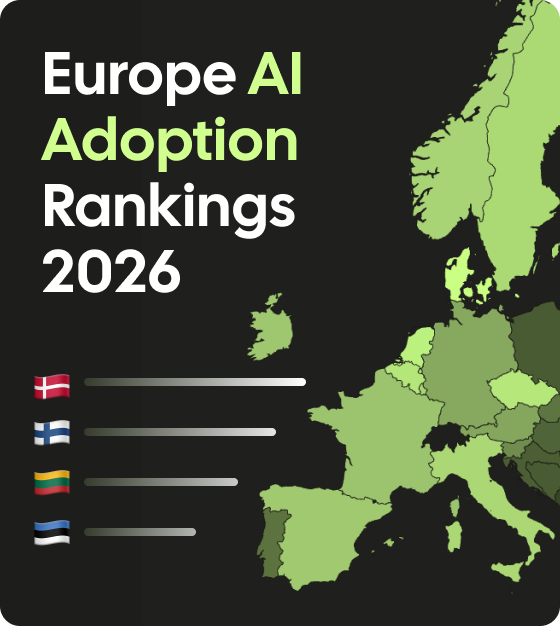
The table below ranks all 32 countries from highest to lowest overall score. Sub-category rankings are included for AI & Data Adoption, Digital Infrastructure, Human Capital, and Growth (1 = best).
Best for: companies looking for a market with deep AI adoption, a strong data analytics culture, and a highly connected enterprise ecosystem.
Top metrics:
Enterprises Using AI Technologies: 42.0% | Rank: 1
Enterprises Performing Data Analytics: 60.0% | Rank: 1
Enterprises Using Business Software (ERP, CRM, BI): 73.1% | Rank: 1
Enterprises with High/Very High Digital Intensity: 66.0% | Rank: 2
Individuals with Above-Basic Digital Skills: 53.0% | Rank: 4
Denmark leads because it performs well across the board. It ranks first in AI adoption, data analytics, and business software usage, three of the most heavily weighted indicators in the study.
Digital intensity is also among the highest in Europe. Danish businesses have fully integrated digital tools into their operations, not just experimented with them. Compared to the European median, Denmark’s AI adoption rate is roughly double.
The one area where Denmark doesn’t lead is growth (rank 16). When you’re already at the top, rapid percentage gains naturally slow down.
Best for: companies that prioritise cloud-first infrastructure, high digital intensity, and a workforce with deep ICT skills.
Top metrics:
Enterprises Adopting Cloud Computing Services: 79.2% | Rank: 1
Enterprises with High/Very High Digital Intensity: 67.8% | Rank: 1
Enterprises Using AI Technologies: 37.8% | Rank: 2
Enterprises Using Business Software (ERP, CRM, BI): 73.0% | Rank: 2
Individuals with Above Basic Digital Skills: 54.9% | Rank: 2
Finland’s strength sits in its infrastructure and its people. It has the highest cloud adoption rate in the study (79.2%) and leads in overall digital intensity, meaning businesses here operate at a high level of digital maturity across the board.
The country also benefits from a strong talent base, with ICT specialists making up a significant share of the workforce. Like Denmark, Finland’s growth ranking is lower (24th), but that’s largely because there’s less room to grow when you’re already near the top.
Best for: those tracking Europe’s fastest-accelerating digital markets. Lithuania leads the continent in growth momentum across cloud, AI, and digital intensity.
Top metrics:
Growth in Cloud Adoption: +51.2% | Rank: 1
Growth in Digital Intensity Index: +89.8% | Rank: 2
Growth in AI Adoption: +238.3% (3.38x) | Rank: 3
Enterprises Performing Data Analytics: 54.1% | Rank: 4
Growth in Data Analytics Usage: +33.5% | Rank: 7
Lithuania is one of the standout stories in this year’s ranking. It places first in overall growth, with rapid gains in cloud adoption, digital intensity, and AI usage.
AI adoption has more than tripled over the period studied. While the current level still sits below the top countries, the pace of change is hard to ignore. Lithuania has positioned itself as a regional tech and fintech hub, and that momentum is clearly feeding into enterprise adoption.
If current trends continue, don’t be surprised to see Lithuania climb even higher in future rankings.
Best for: understanding how a small, digitally-native economy can generate exceptional AI growth momentum even from a mid-tier adoption base.
Top metrics:
Growth in AI Adoption: +251% (3.51x) | Rank: 2
Growth in Data Analytics Usage: +119.0% | Rank: 2
Enterprises Performing Data Analytics: 56.0% | Rank: 2
Employed ICT Specialists (% of workforce): 7.2% | Rank: 4
Growth in Digital Intensity Index: +65.4% | Rank: 7
Estonia’s reputation as a digital-first economy shows up clearly in the data. AI adoption and data analytics usage have both grown rapidly, and importantly, from an already solid base.
That makes Estonia’s progress particularly meaningful. It keeps pushing forward, supported by a strong ICT workforce and a high share of the population working in tech-related roles.
Best for: companies that want a highly skilled, digitally literate workforce and a cloud-connected, software-rich business environment.
Top metrics:
Individuals with Above Basic Digital Skills: 55.6% | Rank: 1
Enterprises Performing Data Analytics: 56.0% | Rank: 3
Enterprises with High/Very High Digital Intensity: 63.3% | Rank: 3
Enterprises Using Business Software (ERP, CRM, BI): 69.6% | Rank: 4
Employed ICT Specialists (% of workforce): 7.0% | Rank: 5
The Netherlands stands out for its workforce. It has the highest share of people with above-basic digital skills in the study, and that translates directly into how businesses operate.
Dutch companies rank highly in data analytics and digital intensity, showing they have both the tools and the talent to use them well. Growth is slower (rank 25), but that’s typical of a mature digital economy that’s already operating at a high level.
Denmark and Finland perform well across the board. High AI adoption, strong cloud infrastructure, and a skilled workforce all reinforce each other. Denmark’s score of 67.86 puts it clearly ahead, with a noticeable gap even to third-place Lithuania (62.05). That suggests a genuine top tier of digital leaders that won’t be easy to catch in the short term.
Lithuania and Estonia outperform much larger Western European economies despite their smaller size. Lithuania posts the fastest overall growth rate in the study, driven by sharp increases in cloud adoption and digital intensity. Estonia shows a similar pattern. Long-term investment in digital infrastructure and government-led initiatives have paid off in both countries.
Romania ranks 21st overall but places third in growth, with AI adoption more than quadrupling over the period studied. Serbia shows a similar trajectory, including the single largest jump in AI adoption across all 32 countries. Neither country is near the top tier yet, but the direction of travel is clear. If that momentum continues, and if gaps in infrastructure and skills are addressed, both could move up the rankings relatively quickly.
Germany and France both land in the middle of the table, lower than you’d expect given their economic scale. Germany’s AI adoption rate trails smaller countries like Lithuania, despite significantly higher spending on digital initiatives. France performs slightly better overall and shows stronger growth, but still lags behind the leaders. In both cases, slower uptake at the enterprise level is holding them back.
Countries like Türkiye, Bulgaria, and Montenegro are still building the basic conditions for widespread AI use. Lower digital skills, weaker infrastructure, and smaller ICT workforces all play a role. Closing the gap with the leaders will likely take sustained investment over a longer period, not quick wins.
Frequently Asked Questions
Which European country is leading in AI adoption?
Denmark is leading in AI adoption across Europe. Around 42% of Danish enterprises use AI technologies, more than five times the rate in Türkiye and roughly double the European median. Denmark also tops the rankings for data analytics adoption (60%) and business software usage (73.1%), which is why it sits clearly ahead of the rest of the continent.
Which European country is growing fastest in AI adoption?
Lithuania is the fastest-growing country in Europe for enterprise AI adoption. Adoption rates have more than tripled, with growth of 238% over the period studied. Combined with the highest cloud adoption growth in Europe at 51.2%, it stands out as this year's biggest momentum story. The current level still sits below the top countries, but the pace of change is hard to ignore.
Why are Nordic countries leading in AI adoption?
Nordic countries lead in AI adoption because of three reinforcing factors. Denmark, Finland, and Sweden all rank in the top 8, and the reasons are consistent across the three. They share strong cloud and digital infrastructure, a workforce with above-average digital and ICT skills, and decades of steady investment in business digitisation. The result is broad, deep enterprise adoption rather than isolated AI pilots.
Why is Germany ranked lower than expected in European AI adoption?
Germany ranks 16th because only 26% of German enterprises use AI technologies, well below the European leaders. Denmark sits at 42%, Finland at 37.8%, and even smaller economies like Lithuania have grown adoption faster. Since enterprise AI usage is the single most heavily weighted metric in the ranking, Germany's middling performance on this measure pulls its overall score down despite stronger results in other areas. Growth momentum is also modest at rank 21, meaning the gap with the leaders is not closing quickly.
Which European countries are catching up fastest in AI adoption?
Romania and Serbia are the European countries catching up fastest in AI adoption. Romania ranks 21st overall but third for growth, with AI adoption more than quadrupling over the period studied. Serbia shows the single largest jump in enterprise AI adoption across all 32 countries. Neither is near the top tier yet, but the direction of travel is clear.
This study analysed 32 European countries: all 27 EU member states plus five additional European nations (Norway, Bosnia and Herzegovina, Montenegro, Serbia, and Türkiye). Countries were selected based on data availability in the Eurostat statistical database.
All data comes from Eurostat, the statistical office of the European Union. Key metrics include enterprise AI usage, data analytics activity, business software adoption, cloud computing uptake, digital intensity, ICT specialist employment, and digital skills. All data is sourced from Eurostat. Each metric in the table below is hyperlinked to its corresponding Eurostat dataset. Reference years are documented in section 6 (Data Period).
The table below lists all 13 metrics included in the study, their sub-category, and the weight applied during scoring.
Growth metrics are calculated from the same Eurostat datasets as their corresponding level metrics, comparing 2023 to 2025 values (2023 to 2024 for ICT specialists).
Each metric was normalised to a 0–100 scale using min–max normalisation, with larger values treated as better for all 13 metrics. Normalised scores were multiplied by their assigned weight and summed to produce composite index scores across two overarching indexes:
AI Adoption Index - combines AI & Data Adoption, Digital Infrastructure, and Human Capital sub-categories.
AI Growth Index - combines all six metrics in the Growth sub-category.
The Overall Score represents the combined weighted sum across all 13 metrics and both indexes, producing a single comparable value between 0 and 100 for each country.
Four metric/country combinations contained missing values: France (Growth in Digital Intensity Index), Montenegro (two ICT specialist metrics), and Türkiye (Growth in Digital Intensity Index). In each case, the missing metric was excluded from that country’s calculation. This may result in a marginal under- or over-estimation of performance on the affected index.
All metrics reflect the most recent data available in Eurostat as at the date of analysis (2026). The majority of figures cover the reference years 2023–2025. Growth in ICT specialists uses the 2023–2024 period; all other growth metrics use the 2023–2025 change.
The clearest takeaway from this ranking is that Europe isn’t moving in a single direction. The gap between leaders like Denmark and countries at the bottom of the table reflects years of investment in infrastructure, education, and policy. Such differences take time to close.
But the growth data tells a more dynamic story. Lithuania and Estonia are combining strong digital foundations with rapid AI and cloud adoption, compressing what took more mature economies a decade into a much shorter timeframe. Romania and Serbia are also worth watching. Their growth rates in AI adoption and analytics stand out, even if they’re still in the middle of the table overall.
For Europe’s largest economies, the challenge is different. Germany and France have the resources and industrial capacity, but enterprise adoption has been slower and less consistent. As AI becomes more embedded in global supply chains and business processes, slower adoption could start to have real economic consequences.
There’s also a structural shift underway. Cloud-based AI tools are lowering the barrier to entry, making it easier for smaller or less digitally mature countries to catch up. EU-level initiatives (funding programmes, regulatory frameworks like the AI Act) are shaping how quickly businesses adopt these technologies. That combination means the gap between leaders and followers could narrow over time. But it won’t happen automatically.
What this ranking shows, more than anything, is that momentum matters. Where a country stands today is important, but how quickly it’s moving may matter even more.
Leadfeeder will continue tracking enterprise AI adoption across Europe. Bookmark this page for updated rankings as Eurostat releases new data, and follow our research programme for deep-dives into individual country profiles, sector-level breakdowns, and policy analysis. For teams putting these insights to work, B2B website visitor identification helps connect country-level signals to the specific companies engaging with your business.
© 2026 Leadfeeder. All rights reserved. Data sourced from Eurostat.
For methodology queries or media enquiries, contact serban.giurgi@leadfeeder.com.