60-Second Summary
Top-of-the-funnel (TOFU) content is about building awareness and trust early in the buyer’s journey rather than selling. When done right, TOFU fills the pipeline with qualified prospects, supports retargeting, and creates reusable assets for sales.
Key takeaways: TOFU content educates and attracts the right audience, leverages less-competitive long-tail keywords, builds brand authority, and feeds qualified leads into the rest of the funnel.
Standout strategies & tactics: Produce educational blogs, guides, templates and thought leadership (including founder stories), use short-form social to drive traffic, and capture interest with lead magnets and retargeting.
Real-world lessons & frameworks: Funnels are flexible—align sales and marketing on stages, track TOFU impact on downstream conversions, and prefer relevance over raw traffic to avoid the "traffic trap."
How to find high-impact TOFU ideas: Research long-tail keywords (SEMrush, Ahrefs), use Google Suggest and People Also Ask, mine Quora and forums, and ask sales/support what prospects ask most—then create helpful, non-salesy content.
*This summary was created with AI assistance, using our original content.
When it comes to B2B marketing, there's an awful lot of talk about funnels, including who owns the different stages of a funnel, what those stages are, and (maybe most important of all) what the heck you're supposed to do in each stage of whatever funnel we're talking about.
Here's the thing — the marketing funnel isn't set in stone. Companies use marketing funnels in different ways — to track website conversions or to see if new content is impacting sales, for example.
Even here at Leadfeeder, our sales and marketing team don't look at funnels the same way.
Which can make it really confusing when we're talking about top-of-the-funnel content. However, top-of-the-funnel content is one of the most powerful tools to grow your business.
That sounds a little over the top — but it's true!
Let's talk about why top-of-the-funnel content is crucial to business growth — and how to create it.
Note: Leadfeeder is a website identification tool that helps B2B businesses identify leads visiting their site. Sign up for a free 14-day trial.
Top of the Funnel Meaning: What Is TOFU Content?
Top-of-the-funnel (TOFU) content is content created to build awareness and attract potential customers at the earliest stage of the buyer’s journey.
Instead of focusing on your product or service, TOFU content addresses broader questions, challenges, and topics your ideal audience cares about.
The goal isn’t to sell, but to educate, build trust, and bring the right people into your funnel.
Common examples include blog posts, guides, thought leadership, and educational resources.
What, Exactly, is a Marketing Funnel?
To understand where TOFU content fits, it helps to look at the bigger picture, the marketing funnel.
To make the most out of top-of-the-funnel content, we first need to define exactly what a marketing funnel is.
A marketing funnel is a visual representation of the steps in the buyer's journey from becoming aware of your product or service to closing the deal.
Depending on who you talk to, a marketing funnel might have anywhere from five to nine steps. At Leadfeeder, we like to use the five-step marketing funnel, which looks like this:
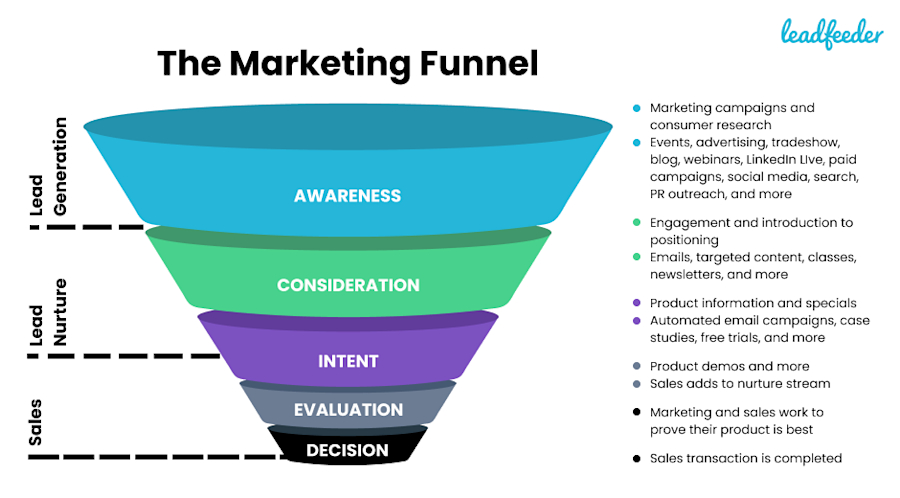
Notice how each step in the funnel is a little smaller than the last? That's because fewer top of the funnel leads move from one step to the next.
Here's what it might look like in real life:
Step 1: Awareness: Let's say 100 leads visit your website. They might not all be in your target audience and they might not need what you offer. But they are pulled in by content that addresses challenges they face.
Step 3: Consideration: Out of those 100 visitors, maybe 25 are in your target audience and know they need a solution. You've whittled your leads down to maybe 10 or so. They match your ideal customer profile and they know they need a solution. Your job is to show your offer is the best fit for them.
Step 4: Intent: They are interested in your offer, woo! Maybe they visited your pricing page after a demo, sent your demo to their boss, or otherwise indicated they are ready to buy.
Step 5: Evaluation: This is where leads make their final decision. In most cases, sales and marketing will work together to ensure this stage goes smoothly.
Step 6: Decision: Closing the deal — you'll also want to lay the groundwork for retention by ensuring the onboarding process is smooth and considering upsells.
Top of the Funnel Vs Bottom of the Funnel Content
What is the top of the funnel, and how does the content there differ from the bottom of the funnel? Top of the funnel content is broader and might target topics that your ideal customers are interested in — even if they don't relate to your specific tool or product.
The goal of top-of-the-funnel content is to educate or inform — not sell. At Leadfeeder, we create a ton of lead magnet marketing and sales content that isn't solely related to our website identification software.
Here's an example:
We wrote this post on start-up pricing strategies.
Leadfeeder doesn't have anything to do with pricing. Our tool helps businesses identify leads that come to their site but don't leave contact information, not build a pricing plan.
So, why are we writing about start-up pricing strategies?
Because we've been a start-up, we know a lot about the topic and — most importantly — people like to hear from the CEO. Posts authored by the CEO build his authority and personal brand.
If they find this content, they’re more likely to want to learn more about what Leadfeeder does and how we have the authority to write on that subject.
Bottom-of-the-funnel content is more related to our tool or the problems we solve. It's for leads who know about Leadfeeder and are considering purchasing a website visitor identification tool — like this piece about using Leadfeeder for Sales teams.
Top vs Bottom of the Funnel Content (Quick Comparison)
Benefits of Top-of-the-Funnel Content
So, top-of-the-funnel content tends to be broader and targets a wider audience. Why should you bother with it, especially since it often attracts businesses outside of your target audience?
Let's look at a few reasons why TOFU content rules:
It's not as competitive: Think about the main keywords your business targets. There's a good chance those are highly competitive terms. With TOFU content, you can find key terms with a smaller search volume and less competition, making it easier to stand out.
Build brand awareness: Businesses can't buy from you if they don't know you exist. By creating top-of-the-funnel content, you get your name out there so leads already recognize you when it's time to make a purchase.
Built trust: Trust can be a deciding factor in the marketing funnel. Using top-of-the-funnel content, you can show your expertise and build trust. When leads need the solution you offer, the trust is already there. (Which also makes your sales team's job easier!)
Create assets your sales team can use: TOFU content can educate users so sales teams spend less time educating and more time selling.
Power retargeting efforts: If your content gets organic traffic, you can track those users and retarget them on other platforms or create targeted sales lists.
Discover what topics your customers are most interested in: Struggling to come up with content ideas for the middle or bottom of the funnel? Take a look at the most popular top of the funnel content and see what topics your top customers like the most. Then, create content targeting more niche keywords.
Examples of Top-of-the-Funnel Content
Top-of-the-funnel content can take many forms, as long as it focuses on education, discovery, and awareness rather than direct selling.
The goal is simple: meet your audience where they are, answer their questions, and help them make sense of their challenges.
Here are some of the most effective types of TOFU content:
1. Blog posts that answer common questions
These are often the backbone of TOFU strategy. Think “how to,” “what is,” or “why” content that addresses real problems your audience is already searching for.
Example: Instead of writing about your product, you write about a related challenge your audience faces—like pricing strategies, cold outreach, or lead generation tactics.
2. Educational guides and long-form content
Guides allow you to go deeper into a topic and position your brand as a trusted resource. These are especially useful for complex B2B topics that require more explanation.
Example: A complete guide to building a B2B sales pipeline or improving conversion rates.
3. Templates, checklists, and downloadable resources
Practical resources provide immediate value and are highly shareable. They also work well as lead magnets if you want to capture contact information.
Example: Cold email templates, campaign checklists, or sales scripts.
4. Thought leadership and expert insights
Content written by founders, executives, or internal experts helps build credibility and authority. It also humanizes your brand. The strongest version of that content isn’t polished advice — it’s lived experience. Patrick Cumming, Head of Marketing at ClientBoost, draws the line clearly:
"What's more valuable is experience content — instead of saying 'how to do this,' it's 'how we did this, and here was the outcome.'" - Patrick Cumming, Head of Marketing, ClientBoost
That’s the difference between a generic thought leadership post and something readers can’t easily get anywhere else. Example: A CEO detailing the specific decisions made while scaling, including what failed, rather than a polished overview of best practices.
5. Social media and short-form content
TOFU content doesn’t always have to be long. Short-form content on platforms like LinkedIn can spark interest and drive traffic back to deeper resources.
Example: A quick insight, stat, or perspective that resonates with your target audience’s daily challenges.
How to Find Top-of-the-Funnel Content Ideas
Now you know what top of the funnel content is and why it matters — let's put all that knowledge to work. Before you chase a keyword, though, make sure it’s not just feeding the traffic trap. Sam Dunning, Founder of Breaking B2B, puts it plainly:
"The biggest mistake is what I call the traffic trap — going after a high-traffic informational keyword, a 'how to' or 'what is,' rather than one with commercial intent. It's less likely to drive sales leads or demos." - Sam Dunning, Founder, Breaking B2B
The best TOFU content doesn’t just attract traffic — it attracts the right people. Here are a few ways to come up with top-of-the-funnel content ideas that will drive traffic, educate your audience, and streamline the sales pipeline.
Research your main keywords and look for related, long-tail terms. These will be topics related to your main keywords but won't be as competitive. We use SEMrush and Ahrefs.
Use Google suggest and people also ask. Like related keywords, they are more likely to be long-tail and less competitive.
Use Quora or related sites to find out what questions your audience asks. Remember, these topics don't have to be closely related to your solution, just topics your customers care about.
Solve common problems your users have, even if they aren't related to your business. At Leadfeeder, we know salespeople often struggle to send cold emails. So, we asked our internal team what templates they use and bundled them together as a blog post.
Ask sales and customer service what questions they get asked the most. See if any questions make sense as TOFU content.
Top of the Funnel Sales and Marketing Content Is Key to Filling Your Pipeline
If you want to close deals, you need qualified leads. The only way to get qualified leads is to fill to the top of your funnel. That's why top-of-the-funnel marketing (and specifically content) is so crucial to long-term business growth.
If the top of your funnel is empty, so is the bottom of your funnel.
Note: Leadfeeder is a sales and marketing tool that helps B2B businesses fill their sales funnel with qualified leads. Sign up for your free trial and uncover hidden leads on your website.