60-Second Summary
Retargeting absolutely works in B2B — the challenge is execution, not the tactic. This piece outlines advanced, practical approaches (ABM retargeting, ungated content, gated-bounce follow-up, and CRM-driven timing) and shows how buyer-intent data improves conversions.
Key takeaways: Retargeting succeeds when tailored to long B2B cycles — use account-level signals, nurture sequences, and timing to turn visits into conversions rather than expecting immediate clicks.
Standout strategies & tactics: Use AdWords competitor targeting combined with Leadfeeder to build ABM LinkedIn retargeting lists; try ungating ebooks with indirect CTAs; capture gated-content bounces and proactively send PDFs to identified contacts.
Real-world lessons & frameworks: Track buyer-intent pages (e.g., pricing, buy now), prioritize leads showing repeat visits, combine retargeting with account-based selling, and follow up when intent is fresh to dramatically boost bottom-of-funnel conversions.
Implementation & measurement: Leverage buyer-intent tools like Leadfeeder, create custom feeds and CRM automations, route leads by team/persona, monitor lag and conversion lift, and combine tooling with timely outreach for best ROI.
*This summary was created with AI assistance, using our original content.
That assumption is understandable but wrong. Retargeting does work in B2B. The issue is usually not the strategy itself but how it is executed.
Simply running a LinkedIn retargeting campaign and expecting results is not enough. B2B buyers have longer decision cycles, more stakeholders, and higher scrutiny. That changes how retargeting needs to be structured.
In this article, I will walk you through advanced retargeting tactics I have learned over the past few years, including the ones our own marketing team uses, to help turn attention into conversions.
Note: Looking for better retargeting data? Leadfeeder is a buyer intent data tool that delivers real-time data about your website visitors. Sign up for a free 14-day trial.
1. Making the most of your AdWords competitor targeting
We all target our competitors' brand names; so why not do it well?
The problem with competitor targeting is that people end up on your website/landing page instead of your competitor's (which they were expecting), creating a disconnect that can lead to lower direct inbound conversions or lots of bounces.
Nonetheless, the buyer intent signal is crystal clear. So, what’s the solution to the kink in the campaign? Nurturing those leads.
With Leadfeeder, you can search for your specific AdWords competitor targeting campaign and use that list of companies to do ABM retargeting on LinkedIn.
The Leadfeeder marketing team experimented with this exact retargeting strategy. After a few weeks, this campaign achieved one of the highest bottom-of-funnel conversion rates we've ever seen.
The lag time could be because website visitors still needed some convincing of our brand. Maybe Leadfeeder needed to build trust, or maybe the potential customers had an active contract with our competitors and weren't quite ready to pull the trigger.
The end result, however, was definitely worth it. Don’t want to leave it to LinkedIn to make the most of these leads? Account-based selling (ABS) is a perfect answer, but in an ideal world, we'd combine both efforts.
2. Ungated content or full ebooks on the website
We all love making content and racking up those new sweet, sweet email sign-ups, don’t we?
The problem is, people are holding on to their email these days as we’re getting pulled into a marketing machine with lots of different messaging.
But, here's what you might not know: B2B content consumption is actually up 50 percent. People want your content. So, how do you make sure your content actually drives leads?
It might sound counterintuitive, but try ungating your content.
I know, I know. But hear me out. 🔊
Leadfeeder has a couple of good examples of ebooks gone ungated: The Lead Generation Guide and Your Complete Guide to Website Visitor Tracking.
By creating an easily accessible URL, people can bookmark your site and get everything right from your website! This builds trust and will do wonders for your SEO if done correctly.
On the page itself, you can include multiple CTAs to still drive those email sign-ups. In fact, we've seen even higher conversion rates for clients who use indirect CTAs like this (almost 10 percent for some!).
If you're using Leadfeeder, you can identify companies visiting the page and take appropriate action to nurture those leads.
For example, you can create a custom feed filter that tracks users who view that page three times and filters your target audience by industry, size, etc.
3. Make the most of gated content bounces
Still not convinced that ungating your valuable content for everyone is the right path, but want to gain more value from driving that traffic to the page?
Here's what you can do:
Head to your Leadfeeder dashboard and create a custom feed to track visitors who bounce from a page.
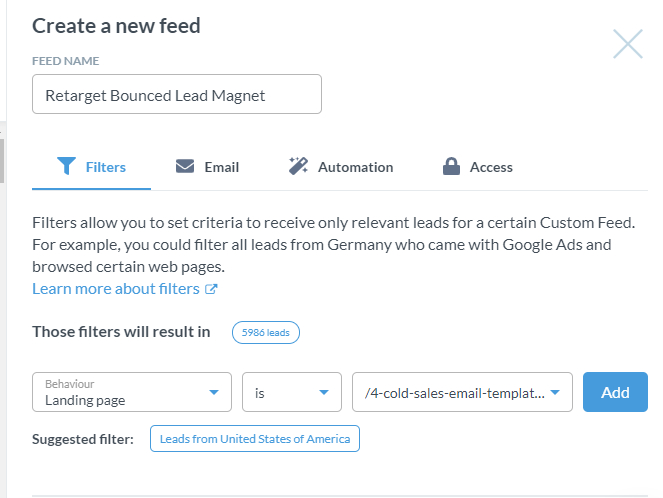
Decide where you want those leads to go — you can get an email notification, Slack message, or even have it uploaded to your CRM.
Use the contact info in Leadfeeder to find the best point of contact.
Then, send the PDF directly to the target persona within those companies through a quick email or social message. You already know they are interested, so it's not an ice-cold email. 🌤
You might be surprised by the great conversations that can flow out of those. Not rocket science, but being at the right place at the right time — with the correct message — is what we all want, isn't it?
4. Keep your focus on the right deals and the right time
I just mentioned timing, didn’t I? Well, here’s another tip on being in the right place at the right time! Leadfeeder has tons of CRM integrations, and those integrations can create powerful automations.
For example, you can set parameters and automatically assign leads to sales. Say you have B2B and B2C sales teams, you can automatically send leads to the right team or even to a specific salesperson.
It's all about working smarter, right?
Another way to use this is to track your current prospects and create meaningful touchpoints at the right time. A good example of this is my own custom feed:
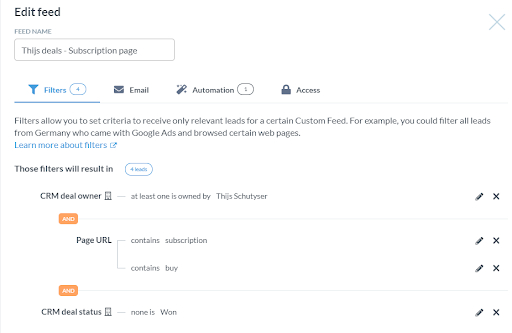
Here, I keep track of the pages my prospects visit that indicate buyer intent. I want to know when people are going to the ‘buy now’ page or want more information about the subscription packages, because that (usually) means they are ready to ‘buy now.’
Or they might need a last nudge or a question answered. Since I’m tracking them, I can follow up when they’re ready to buy.
Sure beats cold calling, right?
You can do the same for your lost deals. Instead of reconnecting with them at random intervals, you can see when they are showing buyer intent again by visiting the payment page and reaching out.
You can also use this data to power your LinkedIn retargeting efforts.
Leadfeeder makes advanced retargeting easier
Effective retargeting needs good data. 📈 Leadfeeder lets you use buyer intent data to drive your remarketing campaigns — so you're not wasting time (and $$) retargeting users who aren't ready to buy.
Note: Leadfeeder is the buyer intent tool you've been dreaming about. We identify companies that visit your website and track their behavior so you can focus on marketing strategies that work. Sign up for your free 14-day trial.