60-Second Summary
Account-based marketing is the default GTM motion for B2B teams selling into complex, high-value accounts, but it only works with the right foundation, execution, and measurement. This summary distills the practical tactics and playbook—from ICP design to multichannel execution and account-level metrics—that teams should apply and iterate on.
Key takeaways: Build your ICP from closed‑won and lost data, tier accounts by fit+intent+value, map full buying committees, and align sales, marketing, and CS with explicit SLAs before running campaigns.
Standout strategies & tactics: Use first‑party website intent (e.g., Leadfeeder) to escalate tiers in real time, run orchestrated multichannel plays, build account‑specific landing pages and ads by buying stage, and deploy direct mail/exec outreach for Tier 1 accounts.
Real‑world lessons & frameworks: Operate across Foundation, Execution, Measurement & Scale: use a content matrix by tier/stage/persona, map committees per account, run 30/60/90 pilots, and iterate from evidence before widening scope.
Measurement & scaling advice: Shift to account‑level KPIs (MQAs, account engagement, pipeline, revenue), review dashboards weekly, avoid scaling too fast or buying tools before process, and prioritize depth over breadth in target lists.
*This summary was created with AI assistance, using our original content.
Account-based marketing (ABM) has become the default GTM motion for B2B teams selling into complex, high-value accounts. And though it’s the go-to way forward, it’s still difficult to execute well without the right strategies in place.
These are the best account-based marketing tactics and account-based marketing best practices we see working across B2B teams in 2026, organized across three phases: Foundation, Execution, and Measurement & Scale. Whether you're running your first pilot or responsible for account-based marketing management inside a larger revenue org, each tactic here is practical and ready to apply.
Foundation
Before you run a single campaign, you need the right building blocks in place. The tactics in this section cover the decisions that everything else depends on: who you're targeting, how you're prioritizing them, and whether your teams are actually set up to work together.
1. Build Your ICP From Data, Not Assumptions
Most ideal customer profiles are built in a conference room using gut instinct and educated guesses. That's a mistake. Your best source of ICP truth is your own closed-won data.
Start by pulling your last 12 to 24 months of won deals and looking for patterns across industry and sub-vertical, company size and headcount range, tech stack and existing integrations, sales cycle length and deal size, and who championed the deal internally.
Then do something most teams skip. Analyze your lost deals and churned accounts. These reveal anti-patterns, companies that looked like a great fit but weren't. Understanding who to disqualify is just as valuable as knowing who to target.
Finally, make your ICP a living document. Set a calendar reminder to revisit it quarterly as your win/loss data grows. Markets shift and your product evolves, and so should your ICP.
How Leadfeeder can help
Seeing which companies are visiting your site gives you real behavioural data to validate or challenge your ICP assumptions. If you see a high concentration of visitors from a particular industry or company size you hadn't prioritized, that's a signal worth investigating.
2. Tier Target Accounts by Fit, Intent, and Revenue Potential
Not every account deserves the same level of effort, so knowing how to prioritize leads can make a major impact on your revenue. The tiering model exists precisely to match your investment with the opportunity.
This three-tier structure is built on firmographic fit, intent signals, deal size potential, and existing relationship strength, and can help you determine how to approach and prioritize different leads:
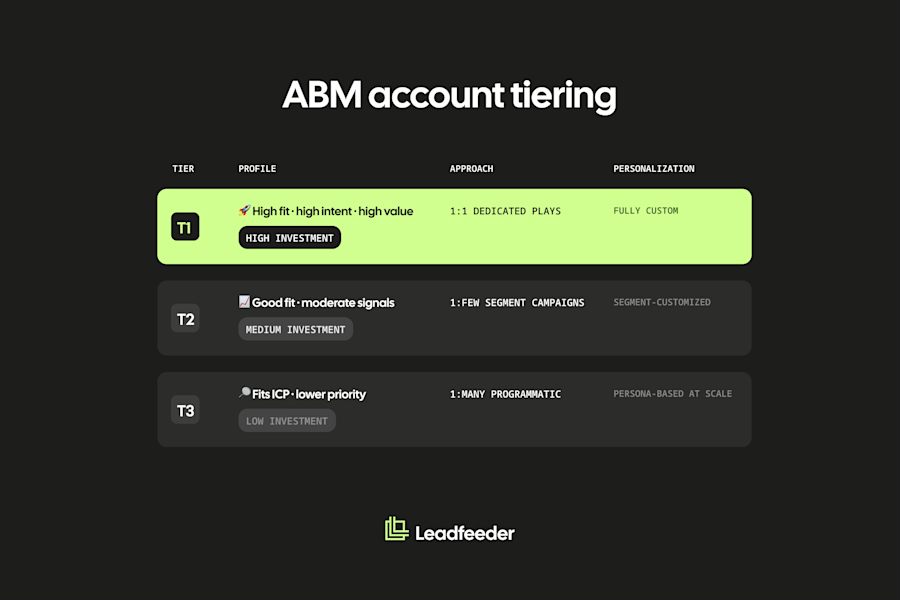
Tiering directly controls your personalization effort and resource allocation:
Tier 1 is your highest-investment motion. A dedicated rep or pod owns each account. Outreach is fully custom, built from real account research. You are running coordinated plays across LinkedIn, email, and direct mail simultaneously. Content is account-specific. Meetings are requested by name, not by template. This is where exec-to-exec introductions and invite-only events make sense.
Tier 2 is segment-level personalization at a manageable scale. Accounts are grouped by industry or use case, and messaging is customized to that segment rather than the individual account. You are running LinkedIn ads to an account list, sending sequenced emails with industry-relevant hooks, and offering case studies from similar companies. Sales reps engage, but without the same depth of preparation as Tier 1.
Tier 3 is programmatic. Persona-based messaging goes out at scale through automated sequences, retargeting ads, and nurture content. There is little to no individual sales rep involvement until an account shows stronger signals. This is where most of your ICP-fit accounts live before they demonstrate intent. The list can be large, but the spend per account is low.
How Leadfeeder can help
Leadfeeder’s website engagement data works as a real-time input to shift accounts between tiers. An account that starts as Tier 3 but suddenly spends time on your pricing page and reads three case studies in a week should be escalated immediately.
3. Use Intent Signals to Prioritize Accounts Showing Buying Behavior
Reaching accounts when they're actively researching beats reaching them on your schedule. Intent signals tell you when the timing is right.
First-party signals to monitor include website visits from target accounts, pricing page views, content downloads and return visits, time on site and pages per session, and demo requests or form interactions from known account domains.
Third-party intent data adds another layer, covering research behavior on review sites like G2 or Capterra and topic-level search activity showing interest in your category.
The real power comes from combining fit (which is static criteria like industry or company size) with intent (which is dynamic). Fit tells you which accounts are worth pursuing on a firmographic basis, but intent tells you which ones to pursue right now. Together, they create a prioritization model that updates in real time rather than sitting stale in a spreadsheet.
How Leadfeeder can help
This is where Leadfeeder earns its place in the stack. Identifying which target accounts are on your site, what pages they're visiting, how frequently they return, and how engagement patterns change over time is the signal layer that makes account prioritization dynamic. Without it, you're just guessing.
4. Map the Full Buying Committee Beyond a Single Decision-Maker
ABM deals stall when teams cover one or two contacts and ignore the rest of the buying group. In complex B2B sales, you're rarely selling to one person. Instead, you're often selling to a committee.
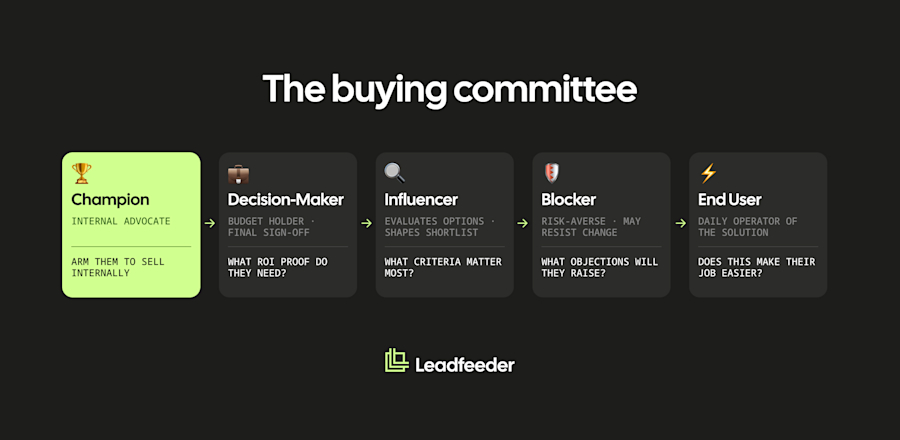
For each stakeholder, work out:
What they care about most
What problem they're trying to solve
What objections they might raise
What proof will actually move them before you write a word of outreach.
Messaging by persona matters. A VP of Marketing cares about pipeline growth and proving ROI. An end user cares about whether the tool fits into their daily workflow without creating more work. The same message to both contacts will land with neither.
Messaging should shift meaningfully depending on who you are addressing. That may look like this, for example:
Champion (Head of Demand Gen): "I know you're under pressure to show pipeline contribution from every channel. We work with demand gen teams who use website intent signals to prove which campaigns are actually driving high-fit accounts to site, not just traffic. Happy to show you how that reporting works."
Decision-Maker (CMO or CRO): "Most of the marketing leaders I speak with are being asked to do more with the same budget. The teams getting ahead of that are starting activation from first-party website data rather than buying more reach. Worth 20 minutes to see if the model fits how your team is set up?"
The champion needs ammunition to sell internally, while the decision-maker needs a business case framed around efficiency and outcome.
Finally, build a committee map for every Tier 1 account and update it as you learn more through sales conversations and engagement data.
5. Align Sales, Marketing, and CS Around Shared Account Goals
The benefits of account-based marketing only materialise when sales and marketing are genuinely working from the same playbook. ABM fails when it's treated as a marketing program that sales is supposed to benefit from as a byproduct.
What alignment actually looks like in practice:
A shared target account list that both teams agreed to and own
Shared definitions of what counts as engagement and qualification
Shared reporting, so both teams see the same data
Clear ownership: marketing owns awareness and engagement, sales owns pipeline and close, CS owns expansion
Set a joint operating rhythm, including:
Weekly syncs on active accounts cover who's engaged, who's gone cold, and what the next play is.
Monthly pipeline reviews should cover ABM-sourced and ABM-influenced opportunities.
Quarterly refreshes of the account list based on win/loss data and market changes.
Then, make SLAs explicit with real numbers.
A reasonable starting point, for example, would be that marketing commits to delivering 15 to 20 Marketing Qualified Accounts per month that meet the agreed engagement threshold. That threshold should be specific, like two or more high-intent page visits from a Tier 1 or Tier 2 account in the past 14 days.
Then, Sales commits to first outreach within 48 hours of an account being flagged, with a full sequence started within five business days. Without written commitments tied to actual figures, accountability slips and each team blames the other when the pipeline falls short.
Execution
With your foundation in place, execution is where ABM either earns its reputation or falls flat. The tactics here cover how to show up across channels in a way that feels coordinated, relevant, and worth the account's attention.
6. Craft Account-Specific Messaging Anchored in Real Business Pain
Generic messaging is invisible and will be forgotten before the lead even closes out of the message, while account-specific messaging opens doors.
The difference between good and bad messaging is research. Before writing a word of outreach, know the account's industry and current market pressures, their strategic priorities, and the specific challenges your solution addresses.
For example:
Generic: "Hi [Name], we help B2B companies improve their lead generation. I'd love to connect."
Researched: "Hi [Name], I noticed [Company] recently expanded into the DACH market. A lot of teams making that move struggle to identify which local companies are actually visiting their site. That's a problem we solve specifically for mid-market B2B teams in that region."
Personalization depth should match tier:
Tier 1 leads get fully custom messaging built from real research.
Tier 2 gets segment-customized templates with relevant industry hooks.
Tier 3 gets persona-based messaging at scale.
7. Orchestrate Multichannel Campaigns, Not Single-Channel Plays
Running LinkedIn Ads to an account list is a tactic. That alone is not an ABM program.
Real ABM works through coordinated touches across ads, email, sales outreach, content, social, and events— and the sequence matters. Warming an account with relevant content and ads before a sales rep makes first contact increases response rates meaningfully.
A typical sequence runs paid and content warm-up first, so the account becomes familiar with your brand and point of view. Sales outreach follows, timed to coincide with or just after engagement signals. Deeper engagement comes last, through case studies, direct mail, or invitations to events or roundtables.
Each channel should reinforce the same account-specific narrative. If your ads are talking about revenue attribution and your sales rep opens with a cold pitch about lead volume, you've wasted the warm-up.
8. Build Personalized Landing Pages for Top-Tier Accounts
For Tier 1 accounts and high-priority Tier 2 accounts, a generic website is a missed opportunity. A landing page that speaks directly to the account's industry and challenges will outperform a standard product page every time.
A good account-specific landing page includes:
An account-relevant headline that references their industry or known pain point
Industry-specific proof points drawn from companies like theirs
A tailored CTA that matches where they are in the buying journey.
Keep production simple. A clean, relevant page beats a flashy generic one every time. Relevance is the differentiator, not production value.
9. Run Account-Targeted Ads Matched to Buying Stage
Account-based advertising works best when the creative matches where the account actually is in their journey, not where you hope they are:
At awareness, run thought leadership and industry perspective content.
At consideration, shift to case studies and comparison content.
At decision, lead with demo offers, ROI calculators, and proof points from similar companies.
Use account lists to target across LinkedIn, programmatic display, and retargeting platforms. Build separate audience segments for accounts at each stage and rotate creative accordingly.
Finally, retarget accounts showing engagement signals with next-stage content. If a target account visited your pricing page, showing them a top-of-funnel brand ad is wasted spend. Teams that get this right are using intent data to drive their ABM targeting, matching creative to observed behavior rather than assumptions.
How Leadfeeder can help
Website visitor data feeds retargeting audiences and helps you match ad creative to where the account actually is in their journey based on behavioral evidence.
10. Personalize Outreach Sequences With Depth, Not Templates
Five well-researched emails beat 20 generic templated messages every time. Volume without relevance is noise, and noise gets ignored.
Before writing the first line, research the account:
Read recent company news and press releases.
Check for relevant job postings, since a wave of sales hires signals growth and a hiring freeze signals constraint.
Look at tech stack changes or new integrations they've added. Note recent leadership hires or org changes.
You can reference something genuinely specific to the account in the opening line. The goal is to make it obvious you did your homework.
Avoid "I noticed you visited our website" as your opener. It's overused and feels like you’re conducting surveillance. If they visited your pricing page twice in a week, open with value relevant to where they are in their evaluation.
You can try something like: “"We work with a lot of [industry] teams who are weighing up [your category] right now. The question we hear most is [common objection or concern]. Happy to share how others have thought through it."
Video outreach works especially well in complex sales where showing beats telling, with technical buyers who want to see under the hood, and in late-stage engagement when you're trying to re-engage a stalled account.
11. Create a Content Matrix by Tier, Buying Stage, and Persona
Content without structure creates gaps. Consequently, you want a content matrix that ensures you have the right asset for every account every stage, and you want one for each persona you're trying to reach.
Here’s what that might look like:
For example, the CFO reading an ROI analysis needs different content than the end user evaluating ease of use.
Use this matrix to audit your existing content library. Identify where you have strong assets and where you have gaps. Prioritize filling gaps at Consideration and Decision stages for Tier 1 accounts first, because that's where deals are won or lost. Make sure you’re updating these assets regularly, and checking them to ensure they’re still relevant after major product, market, or positioning changes.
12. Use Events, Direct Mail, and Executive Outreach for High-Value Accounts
For Tier 1 accounts, you need tactics that cut through digital noise and actually help you connect with your prospects. Some good examples include:
Invite-only roundtables bring together eight to 12 executives around a shared challenge relevant to your ICP. Position your brand as the convener, not the vendor. These build relationships that emails cannot.
Personalized direct mail means sending a book relevant to their industry, a custom report based on their company's public data, or a thoughtful gift tied to something you know about the account. Branded swag gets ignored. Thoughtful relevance gets remembered.
Exec-to-exec introductions signal priority and seriousness in a way that a rep-level email never will. Reserve this for accounts where the deal size justifies the relationship investment.
Don’t forget: Check gifting policies before sending anything. DACH and Nordics markets, for example, have specific norms around corporate gifting and compliance requirements worth understanding.
13. Leverage Social Selling as Part of the Coordinated Play
LinkedIn and social selling work best as one channel in an orchestrated campaign, not as a standalone tactic that lives outside the broader ABM motion.
Have sales reps follow key stakeholders at target accounts on LinkedIn before any outreach begins. Engage genuinely by commenting on their posts and sharing content relevant to their challenges, building visibility before the cold touch. Then, coordinate those social touches with the broader campaign timeline so engagement is warm before email or phone outreach begins.
The goal is to be present and relevant so your name isn't cold when your email lands.
Here is what a coordinated social plus outreach timeline looks like in practice for a Tier 1 account:
Week 1: Rep follows three to five key stakeholders at the account on LinkedIn. No formal outreach yet, but engage with one post if there is a natural opportunity.
Week 2: Paid ads targeting the account go live. Rep comments on a stakeholder post with a relevant, non-promotional observation.
Week 3: Rep sends a connection request with a short contextual note referencing something specific to the account. Still no pitch.
Week 4: First direct email outreach goes out. By this point the rep's name is familiar, the brand has appeared in their feed, and the email does not feel cold.
The sequence takes four weeks and the rep has made five or six impressions before a single sales email is sent. As a result, response rates on that first email are likely to be meaningfully higher than a cold send into an account that has never seen your name.
Measurement & Scale
ABM only compounds if you're measuring the right things and building on what works. This phase is about shifting your reporting to account-level outcomes, proving the motion's impact, and knowing when you've earned the right to scale.
14. Measure What Matters: Account Engagement, Pipeline, and Revenue
ABM measurement works differently from standard demand gen measurement. The unit of measure is the account, not the individual lead. This requires a shift in how you report and what you track.
You need to shift reporting from MQLs to MQAs. A single form fill from a low-fit contact at a target account is not the same as four stakeholders from a Tier 1 account spending time across your pricing page, case studies, and integration docs. The latter is a buying signal, but the former is just noise that can be distracting.
Here’s a quick breakdown of key metrics to track.
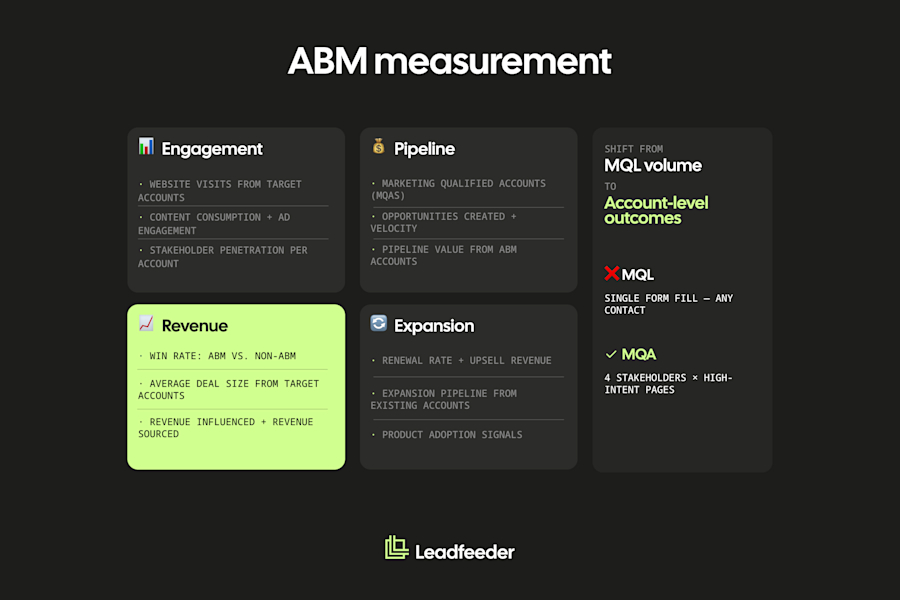
Build a simple dashboard with these four categories and review it weekly at the account level.
How Leadfeeder can help
Account-level website engagement is the leading indicator that an account is warming up, often visible before any form fill occurs. Tracking this gives you the earliest measurable signal in the ABM funnel and a head start on sales prioritization.
15. Start With a Focused Pilot and Scale Based on Results
You don’t want to try to scale before the motion is proven; that can be expensive and time-consuming. Start narrow, learn fast, and expand based on evidence.
A 30-60-90 day structure keeps the pilot manageable while ensuring easy scalability when your team is ready:
Days 1 to 30 are for alignment and account selection. Align key stakeholders from sales and marketing on shared goals and definitions, refine your ICP based on closed-won data, select 15 to 25 pilot accounts, assign tiers, map buying committees, and establish reporting baselines.
Days 31 to 60 are for building. Develop messaging and content by tier and persona, set up targeting across paid and organic channels, establish SLAs between sales and marketing, and configure reporting dashboards.
Days 61 to 90 are for launching and learning. Run campaigns across channels, review engagement data weekly, hold your first pipeline review focused on ABM accounts, and document what's working before making adjustments.
The number of accounts and channels you start with will depend on the size of your business:
Startups should run a lean pilot with 10 to 15 accounts, focus on 1 to 2 channels, and prove the model before investing in tooling.
Mid-market teams should formalize account tiers and reporting, invest in content by tier, and build a repeatable playbook from pilot results.
Enterprise teams should scale governance, orchestration, and regional execution, with account team alignment and reporting infrastructure that can support larger account lists across geographies.
Common ABM Mistakes to Avoid
Win more with ABM by avoiding these common mistakes:
Targeting too many accounts. Spreading effort thin across 200 accounts means no account gets meaningful personalization. Start with fewer accounts and do the work properly. Breadth without depth is just branding.
Running ABM as a marketing-only program. Without genuine sales buy-in on the account list and shared SLAs, marketing builds awareness that sales never follows up on. Alignment is not optional; it's the whole point.
Over-personalizing with shallow research. Inserting a company name into a generic email template is worse than no personalization. Buyers notice when the "research" amounts to a LinkedIn company page skim, and it damages credibility.
Measuring leads instead of account-level outcomes. Reporting on MQL volume from ABM campaigns misses the point entirely. The metric is account engagement, pipeline quality, and revenue from target accounts.
Buying tools before defining your process. No tool will fix a broken ABM strategy. Define your ICP, tier structure, and measurement framework before evaluating software. The tool should support the process, not define it.
Final Thoughts: Start Small, Align Around Accounts, Scale What Works
The b2b account-based marketing tactics in this guide apply whether you're selling enterprise software, manufacturing equipment, or professional services.
Start with a small account list, align your teams around shared goals, and scale what the data tells you is working. Leadfeeder helps marketing and sales teams identify which account-based marketing plays are generating real engagement on their website, so they can prioritize outreach when intent is highest.