

60-Second Summary
Global B2B marketing spend is rising rapidly, making effective, data-driven marketing essential for growth. This summary distills core principles—how B2B differs from B2C, the TOFU–MOFU–BOFU funnel, high-impact channels, tools, KPIs and actionable trends.
Key takeaways: B2B markets have longer cycles and multiple stakeholders; prioritize functional, highly personalized messaging, map content to TOFU/MOFU/BOFU, and measure lead quality, pipeline velocity, CLV/CAC and ROMI.
Standout strategies & tactics: Combine content-led SEO, blogs, podcasts and video for TOFU; use white papers, case studies and webinars for MOFU; and deploy hyper-personalized BOFU offers (trials, consults, bundled pricing) plus paid+organic awareness.
Real-world frameworks & tools: Build ICPs, use prospecting and visitor-identification tools, centralize CRM + automation, enforce data hygiene, and apply real-time analytics to prioritise high-intent accounts and shorten sales cycles.
Trends & lessons to act on: Double down on social video and generational targeting, leverage data and GenAI for personalization, experiment with influencers for niche influence, and continuously track KPIs to iterate quickly.
*This summary was created with AI assistance, using our original content.
And the stakes are rising. Business Research Insights projects that global B2B marketing spend will jump from $20 billion in 2024 to over $37 billion by 2033. Getting your marketing right is no longer optional. It is essential.
To maximize your budget, you must understand the expectations of multiple personalities and job roles. That is why mastering B2B marketing starts with a clear understanding of its core principles, strategies, and processes.
In this article, we will cover everything you need to know about B2B marketing. You will learn what B2B marketing is, how it differs from B2C, the step-by-step processes involved, effective strategies and channels, examples from real businesses, and the key metrics you should track to measure success.
B2B marketing definition
B2B marketing, or business-to-business marketing, refers to the strategies a company uses to raise awareness and generate interest among other firms. It’s the sum total of all the content, promotions, and other marketing tactics you use to reach your target audience and generate leads.
B2B sales cycles are much longer, with Databox reporting a median duration of 2.1 months. As a result, B2B marketing materials often focus on the value your products or services deliver.
You communicate to business leads how your solution helps customers reach their objectives. B2B also involves multiple stakeholders, such as buying groups and procurement specialists.
What are the differences between B2B and B2C marketing?
To fully explain B2B marketing, it helps to consider it alongside its main counterpart: B2C marketing. So what are the differences?
1. Target audience
Where B2B marketing targets companies and organizations, business-to-consumer (B2C) marketing targets individual customers. That makes the principal difference between the two the target audience.
2. Communication tactics
B2B marketing communication focuses on satisfying the information needs of the target customer. That means your B2B communication should be:
Instructive
Data-driven
Problem-oriented
Goal-oriented
Long-term
B2C communication focuses on satisfying the emotional and social needs of the target customer, so your B2C communication should be:
Entertaining
Benefits-driven
Illustrate instant gratification
Show social influence
You could say that the major difference between B2B and B2C communication tactics is that B2C focuses on enhancing brand awareness, while B2B prioritizes customer satisfaction.
3. Personalization
Given that B2B products are expensive, B2B customers demand personalized attention from marketers to ensure they get the best value for their money. That’s why the most effective B2B marketing is super-personalized.
B2C marketing focuses more on mass appeal than personalization. This is because B2C marketers target a broader customer base, making it difficult to personalize each customer's message.
4. Emotional vs. functional appeal
B2C marketing seeks to capitalize on customers’ emotions to persuade them to purchase. B2C marketers leverage emotional marketing strategies to influence purchase decisions.
These strategies include:
Storytelling
Color psychology
Aspirational or inspirational marketing
However, B2B marketers use functional marketing strategies, such as explaining product data and metrics, to influence a customer's buying decision. This resonates with B2B customers, who prioritize a product’s functionality and efficiency over secondary factors like aesthetics that sway emotions.
Experienced B2B marketers who know their B2B buyers well often utilize both functional and emotive marketing strategies.
Despite the differences between B2B and B2C marketing, both serve a common purpose: attracting leads and converting them into returning customers.
Naturally, B2B customers take longer to convert, as a chain of approvals is often required before a purchase decision is made. You must understand the B2B buyer’s journey to determine which types of marketing content to use at different points to optimize the buying journey.
How does B2B marketing work? The B2B marketing funnel
The B2B marketing funnel describes the purchase journey from the first point of contact when prospective customers interact with a brand's website to the last point when they buy a product or service.
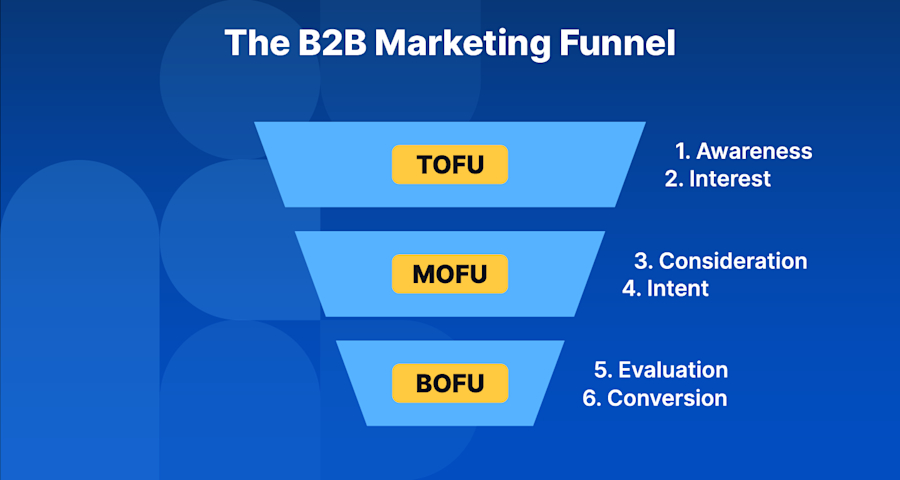
Creating a B2B marketing funnel helps you understand the customers’ pain points at each stage. You can use that to deliver customized solutions through various B2B marketing content.
The typical B2B marketing funnel has these three stages:
Top of the funnel (TOFU)
TOFU, also called the awareness stage, is the first stage of the marketing funnel. Prospective customers recognize the challenges within their businesses and start looking for solutions.
At this stage, prospects are all over the place, shopping for solutions, but aren’t ready to commit to a particular brand or product.
Thus, your main goal in the TOFU stage is to create brand awareness and generate more leads. This helps more prospects discover your company’s offerings online and continue learning more about your solutions.
Remember, prospects have no attachment to your brand or product at this point. You must capture and retain their attention by creating informational content that addresses their existing challenges head-on.
Two of the most effective B2B marketing tips for raising brand awareness in the TOFU stage are:
1. Generating organic awareness
B2B buyers do extensive independent research before settling on a solution, brand, or product. This means they consume tons of content to study and compare various solutions.
All through their research phase, B2B buyers are looking for a brand they can trust. This is where organic awareness comes in.
Organic awareness indicates your website has achieved an organic ranking. Your potential customers know it takes a lot of effort and time to rank organically. So, if your brand has a high organic ranking, it positions your company as an industry leader in the eyes of B2B buyers. This raises their trust levels in your company.
That’s why you should focus on generating organic awareness at the TOFU stage by:
Publishing blog posts
Posting how-to YouTube videos
Creating landing pages
Doing search engine optimization (SEO)
2. Generating paid awareness
Paid awareness comes from paid rankings. It involves paying for keyword-based ads on social media and Google to rank high on search engine result pages (SERPs). While organic awareness and visibility are ideal in the long term, paid awareness delivers expedited visibility.
By using paid awareness, you can reach as many prospects as possible in the shortest time. This helps you enhance brand awareness, which is the primary goal at the TOFU stage.
Paid awareness is even more vital when marketing a new product in a competitive market. As a best practice, you should run your paid awareness campaigns alongside your organic efforts to achieve the best results.
The TOFU stage is critical because it lays the foundation for the buyer’s journey. If you lose prospects at this stage, all your subsequent efforts go down the drain. That’s why you must create top-notch TOFU content that helps you establish topical authority and sell your brand as a thought leader.
Middle of the funnel ( MOFU)
MOFU, also known as the consideration stage, is the second stage in the B2B marketing funnel. Prospects in the MOFU stage have established that you’re a subject matter expert from reading your TOFU content. They then begin to consider your brand's solutions seriously. This is where you introduce your product and show its value proposition. But how?
At this stage of the B2B marketing process, you’re looking to provide value to your prospects. You can do that by creating MOFU content like:
White papers
Case studies
Webinars
Industry reports
Product videos
Quizzes or surveys
Your goal at the MOFU stage is to nurture leads and gradually build purchase intent. Given that B2B buyers are more concerned with improving their business outcomes, your MOFU content should demonstrate how your product enhances their processes.
At the MOFU stage, prospects aren’t ready to buy and are looking for more context. At this point, they’re likely browsing other options but haven’t settled on one. Your MOFU content should show B2B buyers the unique benefits of your product or service and how they help them achieve their company goals.
Bottom of the funnel (BOFU)
BOFU, also called the decision stage, is the last stage where the prospect is ready to make a buying decision or initiate the purchase process. At the BOFU stage, prospects show two critical qualities:
They already recognize your brand as a market leader from reading your TOFU content.
They're aware of your product value from reading your MOFU content.
However, they’ve likely done the same with your competitors and shortlisted a few. So how do you persuade them to favor you?
At this stage, targeted B2B marketing solutions help move prospects to sign on the dotted line. You need BOFU content and interactions that persuade them to make a purchase decision in favor of your brand. Some of the techniques you can use to step up conversion include:
Free strategy consultation calls
Free trial with unlimited access
Interactive call-to-actions (CTAs)
Free quotes and price estimates
Bundled pricing
The BOFU stage calls for hyper-personalization to convert your target prospect. B2B buyers must be convinced your product or solution is tailored to their existing and future pain points.
Typically, B2B buyers prefer a dedicated account manager. So, you may want a sales team member (who would later transition to an account manager) to take over once a B2B buyer initiates contact at the TOFU stage.
8 B2B marketing strategies to reach and convert your audience
Creating B2B marketing content, whether TOFU, MOFU, or BOFU, is an ongoing process, not a set-and-forget strategy. But even if you consistently create top-notch content, without distributing it on the channels your target audience are, you won't get value.
What you need is a comprehensive B2B marketing strategy framework encompassing some or all of the following eight principal elements:
1. Content marketing
Content marketing is the creation and distribution of valuable, relevant, and informative content to a target audience to influence profitable customer action.
Choosing the right content for different marketing campaigns is mission-critical. Here are a few examples of B2B marketing content types proven to be effective:
1.1 Podcasts
Podcasts are audio programs discussing a specific topic, idea, or theme. They’re a great way for B2B audiences to consume your content because they can listen at a time and in a way that's most convenient for them.
There are two ways your B2B brand can benefit from podcasts:
Find a relevant podcast within your target audience and run ads
Broadcast your own show
Either way, you’ll be happy to know that podcasts are great at reaching the people you need to reach. A survey conducted through the end of 2023 found that 83% of senior executives listen to podcasts weekly.
Podcasts are a top traffic and lead-generating channel you should include in your content marketing strategy.
1.2 White papers
White papers play a fundamental role in B2B marketing because they explain a brand’s value proposition in detail and back it up with real-time data and statistics.
You can create three types of white papers for B2B marketing purposes:
Backgrounders: Explain complex and technical product information in a reader-friendly format.
Numbered lists: Highlight the key functions of a product or service using many headings and bullet points.
Problem/solution: Pinpoint specific problems prospects face and provide data-driven solutions.
White papers help attract customers early, particularly if your product or service offers an innovative solution to a challenge that has troubled your niche for a long time.
1.3 Webinars
Webinars are online events that B2B marketers organize for a specific audience. Webinar marketing is one of the more interactive B2B marketing strategies examples, as prospects can ask questions “in person” and get instant answers.
1.4 B2B marketing case studies
Convincing B2B buyers that your product is a game-changer can be a hard sell if you don’t show them a real-life instance in which your product/service has lived up to its billing. This is where case studies come in.
Case studies are comprehensive illustrations of how your product or service helped a particular customer(s) achieve a profitable business outcome. Case studies help you show a product’s value in real-life use cases, other than promising prospects on paper only.
1.5 Infographics
Infographics are visually appealing formats for presenting complex B2B processes, ideas, or products to your target customers.
B2B marketers use infographics to present complex and long-winded ideas instead of long-form blogs. Because infographics are easy to understand, they promote more information retention.
1.6 Testimonials
Testimonials and reviews yield significant influence on a customer’s purchase decision. They’re user-generated, making them more authentic and unbiased, and thus engendering more trust. When sharing testimonials with prospects, try to personalize them as much as possible—ideally by involving a business in a similar niche that shares the same pain points.
1.7 Landing pages
Landing pages are web pages designed to convert visitors into leads. You can customize your landing pages to target customers at each stage of the marketing funnel. The ideal landing page should include a clear CTA, persuasive copy that explains the value proposition, and engaging visuals.
2. Social media marketing (SMM)
Social media platforms like YouTube, LinkedIn, Instagram, Twitter, and Facebook are slowly taking over B2B marketing as more B2B buyers embrace these platforms.
To succeed in SMM, you must know which platforms your target audience is fond of and zero in on those channels. You can establish your customers’ favorite social media channels by:
Developing your ideal customer profile (ICP)
Studying your customer relationship management (CRM) data
Asking customers through surveys and questionnaires
Review the channels your competitors are using
With over 67 million companies listed on LinkedIn, there’s a high chance your B2B prospects are there.
3. SEO (Search Engine Optimization)
SEO is the most effective way of increasing organic traffic across all stages of your B2B sales cycle. Your B2B SEO strategy should encompass these four pillars:
Off-page SEO
On-page SEO
Content SEO
Technical SEO
Because SEO is time and skill-intensive, B2B marketers often outsource SEO or hire an in-house SEO expert.
4. Email marketing
B2B email marketing is more intricate because B2B buyers are usually pressed for time compared to B2C buyers. As such, every email you send to your B2B prospects should:
Be short and precise
Not contain clickbait
Have a personalized subject line
Include social proof
These factors help boost email open rate and click-through rate. To simplify your email marketing processes, consider using reliable email marketing software to automate your workflows.
But automation only works if it stays disciplined. As Michael Hanson, founder of Growth Genie, puts it: "Spamming the whole market might win short term, but we burn the bridges we'll actually need later." Once prospects mark you as spam, you lose the ability to reach them precisely when they're finally ready to buy.
With B2B email marketing, you must study your target audience down to the department level. Study a company’s chain of command in a purchase decision and target each decision maker with customized emails.
5. PPC
Pay-per-click (PPC) advertising involves displaying short, customized ads to search engine users who search for your products or services.
The beauty of PPC is that you only pay when a prospect clicks your ad. PPC ads yield more qualified B2B prospects, reducing the time required to generate high-quality leads and the cost of acquiring new customers.
6. Programmatic display advertising
Programmatic advertising utilizes software to bid and pay for ad space. Programmatic marketing lets you show your ad to a specific audience at a specific time and in a specific context. It allows you to channel your marketing budget to where your B2B customers are.
7. Event marketing
While most B2B marketing activities happen online, offline marketing strategies still work. B2B event marketing capitalizes on offline marketing opportunities, including:
Executive conferences
Trade show marketing
VIP dinners
Lunch and learn events
B2B event marketing enables in-person marketing. In-person marketing is sometimes the secret sauce of closing B2B decision-makers who aren’t readily available online or prefer face-to-face marketing.
8. Video marketing
Explainer videos, product videos, social media videos, and interview videos help your B2B buyers understand your brand’s offerings in depth. Videos are more engaging than text-based content and are more successful at retaining users’ attention.
How B2B marketing tools can help you
Competing in the B2B market requires diligence, analysis, and data-driven processes. You must personalize marketing and sales interactions for each buyer persona and ideal customer profile (ICP).
Effective B2B marketing plans don’t just create an efficient process—they empower your team by giving them the right tools. Let’s examine some marketing platforms and solutions that can streamline lead targeting and conversion:
1. Prospecting and targeting
There are many marketing tools to aid with the B2B targeting process. These tools help you better define your ICPs and buyer personas by collecting and analyzing information.
For instance, solutions like Target help you build a prospect list that matches your ideal customer profile. Use 100+ firmographic, technographic, and persona filters to find the best fit. Discover exceptional customers beyond industry norms!
2. Lead generation and enrichment
Website tools like Google Analytics help you sharpen your SEO and content marketing strategy. However, when a landing page gets lots of views, how do you turn unknown visitors into leads?
Identifying anonymous website visitors is a game-changer for B2B marketers. Platforms like Leadfeeder unmask hidden companies that browse your site.
This means you can identify a visitor even if they never fill out a lead form. Our solution also enriches your CRM with firmographic and behavioral data for enhanced lead scoring.
Your team can prioritize outreach to the most engaged prospects. With Leadfeeder, your sales team always has access to accurate, comprehensive information.
3. CRM and marketing automation
A customer relationship management (CRM) platform is non-negotiable in business-to-business marketing. You need to deliver a cohesive, consistent customer experience from awareness to conversion. CRMs and related tools keep your marketing, sales, and support teams aligned and informed about every lead.
Email marketing tools, meanwhile, can automate follow-ups and initiate drip campaigns for interested leads. GenAI and templates make it easy for you to personalize content for each potential buyer and the company they represent.
Tools like Promote from Leadfeeder automatically open deals using your updated CRM data. Our platform helps you keep your eye on the prize and reinforce your brand top of mind for warm prospects.
4. Real-time analytics and intelligence
Web analytics tools such as Leadfeeder or Hotjar provide live updates on visitor behavior and page performance.
This is crucial for keeping your tactics agile in line with changing market behavior. Real-time website analytics also make A/B testing easy, so you can optimize campaigns on the fly.
B2B intelligence tools like Connect by Leadfeeder stream live updates directly to your inbox. Customize over 30 trigger events to stay on top of target-company changes, such as awards, leadership changes, and new buildings and expansions. Use these insights to strike while the iron is hot!
5. Data hygiene and compliance
Modern B2B marketing relies on your ability to gather data. It also requires clean and accurate data. B2B sales aren’t like taking off-cuts and making Michelin-quality meals. If you put garbage into your marketing and analytics tools, you’ll get garbage out.
On top of that, you need to ensure you’re securely accessing and handling data correctly at all times. Vercara research reports that 75% of US consumers would stop purchasing from a brand after a data breach. You can bet that a similar number of B2B buyers and decision makers would do the same.
Our Datacare B2B marketing service automatically checks, cleanses, and enriches your CRM data. We ensure your team always works with accurate information.
B2B marketing examples: Success stories
B2B marketing sounds easy when you follow the basic steps and use the right tools. Of course, talking theory is nice, but what about in the real world? Here are some examples that demonstrate the value of B2B marketing platforms like Leadfeeder:
1. Tickster: Improved marketing efficiency
The Swedish company Tickster specializes in ticketing and point-of-sale (POS) solutions for events. While expanding beyond Sweden into new markets, the company struggled to understand a new competitive landscape.
Using Leadfeeder solutions like Target, Tickster cuts prospecting time in half. They also improved click-through rates with highly segmented ads.
2. ZenDev: Increased lead quality and shorter sales cycles
ZenDev is an award-winning European IT agency. Despite growing success, the company was struggling to identify high-quality leads and connect with the right people.
After adopting Leadfeeder, the company enhanced visibility on website visitors. By reaching out to firms with intent, ZenDev saw a 30.9% increase in lead quality and a 25-day reduction in average sales cycle length.
3. Coveris: Found ideal companies in less time
Leading the way for manufacturing in Europe, Coveris deals in sustainable packaging products. After expanding to 28 production sites, the company found it difficult to acquire new customers.
Switching to Leadfeeder, the Coveris team had the right information at their disposal for marketing and sales outreach. Using our platform, they identified 99% of their target customers while spending 75% less time on market research.
B2B marketing best practices
So, how can you emulate the companies above and truly nail your B2B marketing? A good place to start is to follow these B2B marketing best practices:
Identify your target buyers through your ideal client profile (ICP), buyer personas, and total addressable market (TAM). This helps you customize your marketing communications to speak to potential customers rather than relying on spray-and-pray marketing.
Have an omnichannel strategy: Identify the social media channels your prospective customers use and build an active profile on each. This way, you can deliver solutions to multiple customers across different channels simultaneously.
Qualify leads: Not every lead you get will convert to a customer. That’s why you should qualify leads so you channel your marketing efforts toward potential customers. A quality lead should:
Have an immediate or upcoming need for your product
Have the capacity to pay for your products and services
Have the authority to make a purchase decision or heavily influence the decision
Be accessible
Nurture and educate your leads and buyers continuously: B2B products have long sales cycles, so aim to build a continuous relationship rather than a one-off encounter. When they become customers, keep them engaged and try to convert them into brand ambassadors who generate word-of-mouth referrals.
Measure results and course-correct: Monitor your B2B marketing campaign and measure it against your KPIs (Key Performance Indicators). Make adjustments where you find performance gaps.
B2B marketing KPIs to track
Marketing managers and sales leaders ultimately want to drive more conversions and bring in more revenue for the business. What about monitoring what's happening on the way to winning those deals?
Here are some KPIs to monitor to keep your finger on the pulse:
1. Lead quality and volume
Generating a high volume of leads is one thing, but how well do they fit your ideal customer profiles (ICP)?
Track both the total number of leads and the percentage that qualified, so you can focus your resources on the prospects most likely to convert. Use a lead scoring system to differentiate between good, bad, and excellent leads.
2. Marketing qualified leads (MQLs)
MQLs have shown sufficient interest or intent to be considered ready for further sales outreach and nurturing. Tracking the number and quality of MQLs helps you gauge the effectiveness of your TOFU marketing activities.
3. Conversion rate
Everyone is working to build momentum toward conversion. Monitor the percentage of leads that move from one stage of your funnel to the next. This helps you identify bottlenecks and optimize your sales process. Compare this against the win rate, which is the percentage of deals the sales team closes.
4. Monthly recurring revenue (MRR)
MRR is critical to SaaS and subscription-based businesses. It tracks the predictable revenue generated each month from new and retained customers. Monitoring MRR helps you measure growth, forecast revenue, and assess the impact of your marketing campaigns.
5. Average deal value
B2B marketing is about catching bigger fish from a smaller pond. Maximum ROI is the name of the game. Average deal value is the revenue generated per closed deal. Tracking this metric helps you understand the quality of your pipeline.
6. Customer acquisition cost (CAC)
CAC measures how much you spend to acquire a new customer and varies across B2B industries. Compare against industry benchmarks to rein in spending and pivot strategies.
7. Customer lifetime value (CLV)
CLV estimates the total revenue you can expect from a customer over the course of your partnership. Loyal customers spend significantly more than one-off acquisitions. Comparing CLV to CAC helps you understand the long-term value of your marketing and B2B sales investments.
8. Website engagement metrics
Website engagement metrics indicate the efficiency of your SEO and content marketing strategies. Website metrics to track include average session duration, dwell time, bounce rate, and pages per session. These KPIs show how effectively your content attracts your target audience and generates interest.
9. Social media engagement metrics
Social media platforms aren’t only for B2C promotion and sales. Monitor likes, shares, comments, and follower growth across your social media channels. Track interactions with target-company accounts and individual buyers.
These metrics help you understand how well your content resonates with your audience. B2B social media listening tools also identify which platforms and content generate the most leads.
10. Account engagement
In B2B, it’s crucial to know not just who’s visiting your site, but which companies are engaging with your brand. Tools like Leadfeeder can identify anonymous website visitors and enrich CRM data, helping you monitor account-level engagement and prioritise outreach. Track individual activity, such as page views and clicks, for target and high-value accounts.
11. Pipeline velocity
Pipeline velocity measures how leads move through your sales pipeline. A faster pipeline means you’re closing deals more efficiently and reducing sales cycle length. It also assesses the quality of the leads generated by your marketing tactics.
12. Return on marketing investment (ROMI)
Everything in business is about the return—B2B marketing is no different. Ultimately, you want to know how much revenue your marketing activities are generating compared to what you’re spending. ROMI helps you justify your budget and optimize resources for future campaigns.
B2B marketing trends for 2026 and beyond
An effective B2B marketing plan is flexible and data-driven. Your team needs room to pivot as customer preferences, needs, and expectations change. Using Leadfeeder and other tools keeps you informed of buying signals and firmographics for your target audience. However, you also need to build your tactics around evolving technologies and patterns.
Let’s see what B2B marketing trends 2026 has to offer:
Social media continues to be important
Social media was once thought of exclusively for B2C brands and personal use. This hasn’t been the case for a long time. All those stakeholders and gatekeepers in a buying group are spending time on social media platforms.
For B2B, LinkedIn still reigns supreme. In a recent CMI survey, 85% of marketers stated that LinkedIn delivers the best value. Use social media listening tools and B2B data providers to identify which channels your target customers are engaging with brands.
Generational marketing is key
Older generations still hold many senior positions at most companies. However, many of the best contacts for getting a foot in the door are younger. What we're seeing is that B2B marketers are moving away from Boomers and Gen X.
Targeting younger people makes sense when you look at the data. Statista reports that Millennials and Gen Z combine to make up 62% of all social media users.
Perhaps that's why the 2025 State of Marketing report from HubSpot found that 73% of B2B companies are targeting millennials. Of course, you’ll need to stay on top of behavioral, demographic, and intent data to know your buyer personas.
Data is the present and future
Every customer interaction generates information full of hidden insights. B2B data is critical for guiding business operations across marketing, sales, and customer success.
As everything people do continues to migrate online and to the cloud, businesses are analyzing data to gain a competitive edge.
Statista reports that 95% of marketing professionals say their data-driven tactics were at least “somewhat successful” if not “very successful”. Businesses that fail to adapt data to inform marketing risk falling by the wayside.
Gen AI still has untapped potential
Gen AI may have proliferated worldwide thanks to memes and gimmicky use cases. That doesn’t mean, however, that its practicality for B2B marketing isn’t increasing as the tech evolves.
Gen AI can help you automate marketing personalization. It can also provide human-like responses for self-service support.
In McKinsey's most recent B2B Pulse Survey, 39% of commercial leaders stated they were scaling Gen AI to “determine the next best opportunity.” It's also reported that 45% of market leaders use Gen AI for research.
Experiment with Gen AI solutions that integrate with your existing tools and find new use cases.
Influencers aren’t just for B2C
More B2B companies are using influencer marketing. A 2025 Forrester survey found that 30% of Gen Z and Millennials reported that 10 or more people outside their organization influenced their purchase decisions.
These individuals come from professional and social networks. The same report expected the number of people consulting outside influencers to exceed 50% in 2025.
Using first-party and third-party data, businesses can partner with influencers to build awareness. An influencer approach also goes hand in hand with the increasing adoption of video marketing. Wyzowl reports that LinkedIn has become the biggest video marketing platform. This is likely because more B2B brands are adopting influencer and social media marketing.
Overcome B2B marketing challenges and make your strategy work with Leadfeeder’s help
If you want your B2B marketing to succeed in a competitive market, you need to lay the groundwork from the start. In this case, the start is your understanding of who your audience really is. You want to position yourself as the business solution that gives your customers a way to beat the competition.
Before you move forward with marketing activities and campaigns, you need to get all the prep work done so your product or service stays top-of-mind. Then you can look forward to sustainable, profitable long-term relationships.
B2B marketing FAQs
How big is the B2B market today?
The B2B market is estimated to be worth tens of trillions of dollars today. There are fewer companies than consumers. However, the average deal and customer lifetime value are much higher than in B2C. Some estimates put the total value of the business-to-business market at five times or more higher than that of the B2C market.
What are B2B marketing strategies?
Business-to-business marketing strategies focus on building long-lasting relationships. They do this by identifying ideal customers and nurturing leads. B2B marketing channels include SEO content, social media, and email. Marketers personalize interactions for multiple buyers over longer sales cycles.
What is an example of B2B marketing?
An example of B2B marketing is a SaaS company promoting its project management platform as a business solution. The company wants to build long-lasting partnerships with high-value companies. They analyze internal and external marketing data to find prospects that fit their ideal customer profiles.
Next, the marketing team creates whitepapers, hosts webinars, and runs LinkedIn ads aimed at decision-makers. The goal is to show how their software benefits each company and meets its specific needs.
How can artificial intelligence work in B2B marketing?
AI has many use cases in B2B marketing. Businesses can use machine learning and predictive modeling for accurate sales forecasting. These technologies help generate deeper insights into your B2B tactics and your ideal customers.
AI analytics can also predict buyer intent when given the right data. Gen AI can personalize marketing campaigns and automate interactions. It can also power intelligent chatbots to answer questions and generate leads.