60-Second Summary
This summarizes key points from a Leadfeeder webinar with Peter and JB on how GDPR affects B2B outbound sales. It covers when legitimate interest allows outreach, the rights data subjects retain, cross-border scope, and practical first-contact disclaimers to stay compliant.
Key takeaways: Recital 47 supports "legitimate interest" for B2B direct marketing (so you can contact LinkedIn-found prospects without consent if they match your ICP and you can justify the interest); data subjects retain rights of access, rectification, erasure and restriction; GDPR covers EU data subjects regardless of company location; fines can reach €10 million or 2% of global turnover.
Standout strategies & tactics: Use a first-contact email disclaimer that names your company, DPO/contact, data categories, purpose, storage period (or criteria), and how to exercise rights; implement a simple reply-code flow or a linked form for requests; integrate processes with your CRM or API to flag "do not contact" and automate deletions.
Real-world lessons & frameworks: Document legitimate-interest assessments, match outreach to an ICP, keep audit trails of disclosures and requests, respond promptly to access/erasure/restriction claims, and operationalize retention/deletion with reminders or CRM tasks to remain defensible.
Practical compliance checklist: Include required disclosure on first contact, record lawful basis and DPO/contact details, implement request-handling flows (reply codes or forms), integrate deletions with CRM, and review cross-border applicability for any EU data subjects.
*This summary was created with AI assistance, using our original content.
It isn't a particularly sexy piece of legislation, to be sure. But it is critical to protect your business if you do outbound sales, whether that means GDPR B2B cold calling or email outreach.
Now, for inbound sales, it is less critical. If you are using lead generation tools like Leadfeeer to see who has been on your site and then look up their email and phone number, then GDPR may apply.
In our recent webinar, GDPR Guidelines for B2B Outbound Sales, Peter, the customer success lead here at Leadfeeder, was joined by JB from Evergrowth.io to discuss how GDPR can impact your B2B sales outreach—and how to ensure your processes stay compliant.
Keep in mind that GDPR fines can reach up to 10 million euros or 2% of a company's global turnover in the previous year. GDPR isn't anything you want to mess around with.
How does GDPR affect B2B sales? Frequently asked questions
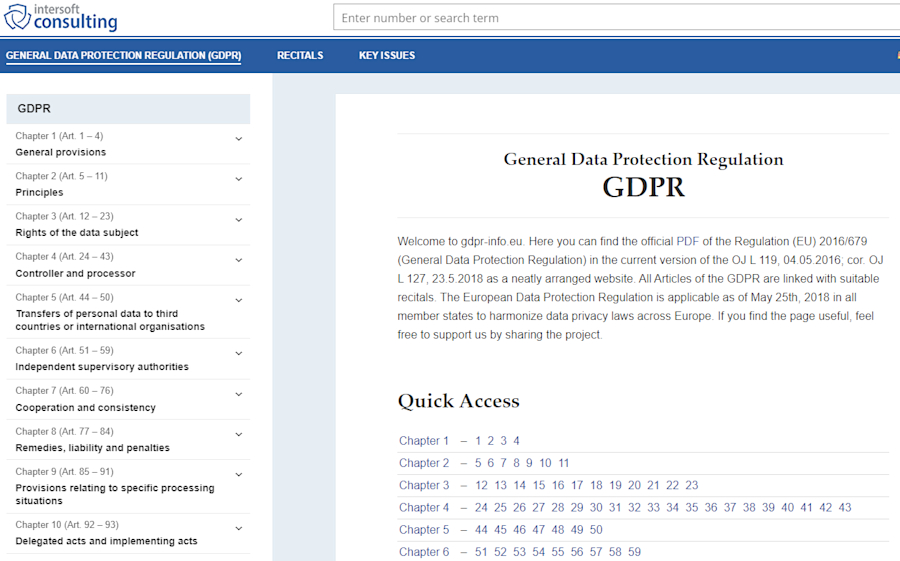
The GDPR is a complex set of laws and rules — comprising 11 chapters and 99 articles. There's a lot to unpack, as you can see in the screenshot of all the laws below.
In the first part of the webinar, Peter and JB answered the most frequently asked questions about GDPR in sales. Here's what you need to know.
1. If I find someone on LinkedIn, can I contact them without consent?
Yes, you can. At the beginning of the text of the GDPR, there is a list of what we call recitals, basically bullet points. Recital 47 clearly states, "The processing of personal data for direct marketing purposes may be regarded as a legitimate interest." What that means, under the GDPR legitimate interest guidance for B2B cold email, is that when you have a legitimate interest you do not need to ask for consent to contact these people.
Now, this doesn't mean you can buy a random list of contacts and send them random emails. You need to make sure you have a legitimate interest, that the people you're contacting actually match your ideal customer profile, and that you have a legitimate reason to contact them because your other customers look exactly like them.
2. Does the data subject have rights if I process their personal data for direct marketing purposes?
Yes, absolutely. Article 15 says the data subject has the right of access. This means they can ask you to extract their data from your CRM and send it to them at any time; they have the right to do that.
They also have the right to rectify the data, meaning that they could say, "I changed my job title, I got promoted; please update it in your CRM." According to GDPR, they have the right to do this, and you have to comply.
They also have the right of erasure, to be forgotten. That's coming from many articles in the GDPR and its recitals. And while some big, big internet companies might not make it very transparent, people have the right to be forgotten, or remove their data.
They also have the right to restrict the processing of their data, which means they can question your legitimate interest. They might say, "Keep my data, but I am going to question your legitimate interest with whatever authority is in my region. Restrict the processing, and we're just going to ask an authority to say who is right here."
3. Do I need to inform the data subject about their rights?
This is a big one. The short answer is yes. You need to inform them of the controller's identity and contact details, i.e., your company's identity and the data protection officer's contact details. You may also need to tell them what you will use their data for and name the legitimate interest.
You'll also need to tell them which categories of personal data you have, such as their full name, email address, job title, and phone number, if you have it.
Then you'll need to tell them how long you will store their data, and if that is not possible, then the criteria used to determine that period. For example, how long will you store their data in your CRM, and at what point would you delete it?
All of this information needs to be shared when contacting them for the first time.
4. Does GDPR apply to B2B companies based outside of the EU?
Yes, because GDPR is about EU data subjects, not about the organization. So if your organization is located in a place where the EU laws apply by virtue of public international law, you do have to comply.
Now, maybe if you're in North Korea, you don't need to follow the GDPR because EU laws don't really apply there. But if you are based somewhere else, such as the United States, Europe, or most other countries, you do need to comply with the GDPR. The laws concern EU citizens' data, so it's not about where the company is located.
B2B GDPR compliance: how to keep your sales process compliant
The easiest way to stay compliant with GDPR B2B email marketing rules is to use an email disclaimer the first time you reach out. It might feel a bit clunky at first, but it protects your company and shows your prospects that you are committed to following the rules.
So, what do you need to include?
Address and full details of your company. This can be included in your email signature line.
Inform them of their rights, including where you found their data, what information categories you have, the purpose of the data, where it will be stored, and how long you will store it for.
Let them know they have the right to lodge a complaint, the right to be forgotten, and the right to obtain a copy of their data.
How to express their rights. For example, you could tell them to reply to the email with the number of rights they want to apply. So if I want you to stop contacting me, I just reply "One". If I want you to erase my data and also get a copy, I reply, "Two and Three."
There are pros and cons to this type of disclaimer. The main pro is that, according to our understanding, it complies with the GDPR and offers a straightforward, painless process for the data subject to make a request.
The format is also straightforward in terms of the internal process. If I get a reply with one, then I just put the status in my CRM as "Do not contact," and that's it, done. The con is that it's not sexy to have this big fat piece of text at the bottom of your email, right? But that's a compromise that has to happen to be compliant.
Another process you could use is to send the disclaimer in an email and tell them to follow a link to another form where they can select the right they want to express.
The cons of this approach are that you might need to integrate with an API, integrate with your CRM, and so forth. If you don't have that, then it adds extra steps to your process because you need to delete information in your CRM. You'll need some kind of reminder or task system to ensure the information is properly deleted so that you keep GDPR compliant data for sales.
Want to learn more about GDPR outbound sales compliance?
Watch the full webinar here, where Peter and JB answer more frequently asked questions, share more ways to make sure you are GDPR compliant in sales, and answer audience questions.