And if you’re asking “what is b2b prospecting in 2026?” specifically, the answer is more demanding than it used to be. If you’re struggling against low reply rates, you aren’t alone. Inboxes are overwhelmed, as AI has flooded every channel with outreach that sounds personal but isn't, and buying decisions now involve multiple stakeholders who all need convincing.
This guide gives you a practical playbook to fix that. Here’s what you’ll learn:
How modern b2b prospecting differs from what worked three years ago
How to build a clean ICP and targeted prospect lists
Step-by-step prospecting workflows for SDRs, AEs, and founders
Multi-channel cadences with ready-to-use templates
How to write emails that get replies
Where AI helps (and where it hurts)
Core metrics and a 30-day plan to get started
What Is B2B Sales Prospecting Today?
The definition of B2B sales prospecting hasn’t changed, but everything around it has. Let’s dive in.
Classic definition vs. modern, buyer-led reality
The classic version of B2B prospecting was simple. You build a list, pick up the phone, send the email, and book the meeting. The rep controlled the information and the pace.
That’s changed.
Buyers now complete at least 60% of their research before speaking to a rep. They compare alternatives, talk to peers, and form strong opinions before you ever reach them.
Timing has become the variable that matters most.
Consider two companies with identical ICPs: one that just hired a new VP of Sales and is rebuilding its tech stack, and one that renewed its contracts last month. That’s the same firmographic fit, but a very different likelihood of buying.
Prospecting vs. lead generation vs. qualification
These are three separate terms, and it’s important to understand the differences:
Lead generation is creating or capturing interest. Owned by marketing.
Prospecting is identifying and initiating conversations with potential buyers who have not yet raised their hand. Owned by SDRs or outbound AEs.
Qualification is confirming fit, need, authority, and timing. Shared between SDRs, AEs, and RevOps.
Keep in mind that each is owned by different teams:
Marketing owns lead generation and inbound routing.
SDRs own outbound prospecting and first qualification.
AEs own discovery and opportunity progression.
RevOps owns data quality, routing, and measurement.
Why prospecting is harder (and more important) in 2026
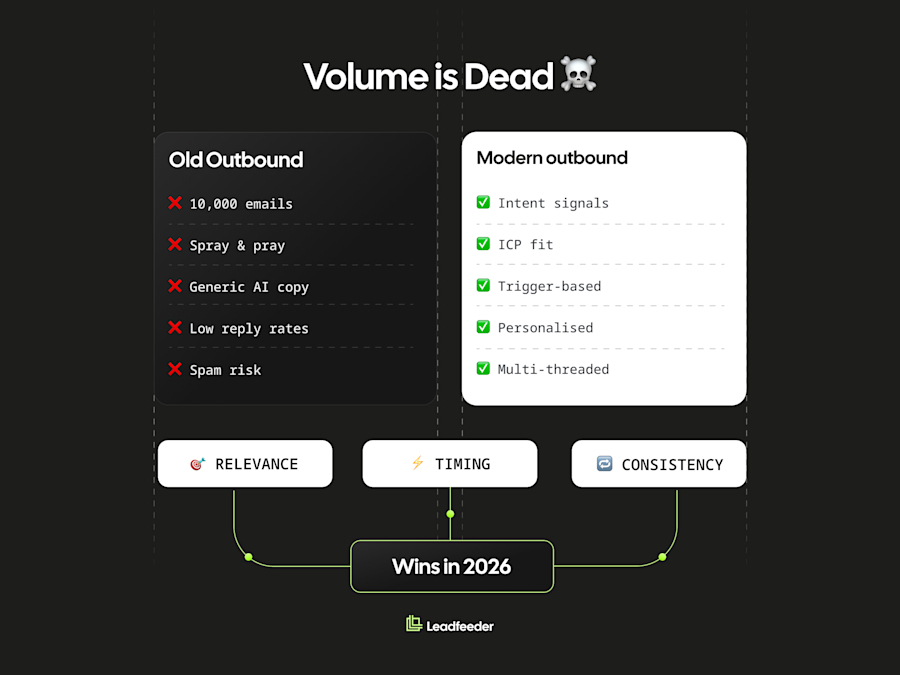
Four things have shifted that make the environment meaningfully harder than it was a few years ago:
Spam filters are tighter. Google and Microsoft have significantly raised the bar for inbox delivery, and poorly targeted sends hurt your domain reputation.
AI has commoditized generic outreach. It is shockingly easy to generate messages that sound personalized but aren't, and buyers have become skilled at detecting them.
Buying committees have grown. A deal that once needed one sign-off now typically involves three to six stakeholders, each with different priorities and objections.
Volume alone does not work. The advantage goes to the rep who shows up with genuine relevance, at the right moment, consistently.
The takeaway? The advantage in 2026 goes to relevance, timing plus consistent execution. This means you don’t need the biggest list or the most automation, you need a solid strategy.
Clarify Your Ideal Customer Profile (ICP) Before You Contact Anyone
Most prospecting problems are actually targeting problems. Before you write a single email or make a single call, you need to know exactly who you are going after and why they are likely to buy.
Use data, not guesswork, to define ICP
Most ICPs describe a hypothetical customer rather than the ones who actually buy and stay.
Fix this by starting with your CRM. Pull your last 12 to 24 months of closed-won deals, and focus on the top 20 percent by speed to close, ACV, retention, and expansion, and look for patterns. Then, you can ask:
What changed at this company right before they bought?
What alternatives did they evaluate, and why did they choose us?
Which role became the internal champion?
What objection nearly killed the deal?
Run the same analysis on lost deals. The anti-pattern is just as valuable as the positive pattern you want to track.
Build an ICP worksheet (with example)
Use this template as a starting point, and fill in one version per segment if you serve more than one market.
Different ICPs for startup vs. enterprise sales teams
There will be different ICPs you’ll focus on depending on your company’s size.
Early-stage teams:
Keep your ICP narrow, focusing on a single segment, persona, and message.
Iterate fast based on what replies.
The founder voice, direct and specific, often outperforms polished sales copy when you have no brand recognition.
Enterprise teams:
Account for multi-threading from the start. You are not selling to a person; you are selling to a buying committee with different priorities across finance, security, operations, and end users.
Build account plans beyond simple contact lists.
Note that you’ll likely have much longer sales cycles, and be prepared with re-engagement campaigns.
Build Targeted Prospect Lists That Actually Convert
The quality of your B2B prospect list is the single biggest lever on your reply rate, so let’s talk about how to build a powerful one.
Core data sources
Good lists come from layering multiple sources rather than relying on any single database:
Your CRM: Existing contacts, past opportunities, dormant accounts
Marketing automation: Form fills, content downloads, event registrations
Website intent signals: Anonymous company-level visits, page behavior, return visits
LinkedIn Sales Navigator: Firmographic filtering and org chart navigation
Company databases and enrichment tools: Verified emails, phone numbers, technographics
Leadfeeder sits at the intent signal layer, identifying which companies are visiting your website and which pages they are engaging with. That way, you can prioritize accounts showing interest before they fill out a form.
Segmentation that powers personalization at scale
Segmentation lets you personalize without individual research for every contact. Use three lenses:
Vertical: SaaS vs. manufacturing vs. professional services. Each has different pain language and proof points that resonate.
Persona: VP Marketing cares about pipeline and ROI, RevOps cares about data quality and workflow efficiency, and your IT Director cares about security and integration complexity.
Trigger: New funding, leadership hire, tech migration, hiring surge, content engagement, or website visit. Triggers tell you why now.
For each segment, define one primary pain, one desired outcome, and one proof point. That is your messaging foundation. For example, a VP Marketing at a SaaS company in growth mode:
Primary pain point: Proving which campaigns drive pipeline, not just traffic.
Desired outcome: Visibility into which accounts are engaging on site so budget follows intent.
Proof point: Teams in this segment have cut wasted ad spend by focusing on accounts already showing website intent rather than broad audience targeting.
Step-by-step list-building workflow
Follow these steps in order. Skipping steps, especially enrichment and tagging, is where list quality breaks down:
Define your segment using ICP rules (vertical, size, geo, trigger).
Pull target accounts from your database or intent tool.
Identify buying committee contacts for each account.
Enrich and validate emails and phone numbers.
Tag each contact in your CRM with segment, trigger, persona, and source.
Route and assign to the right owner based on territory or signal strength.
Launch sequence and track outcomes by segment tag.
Here is what a fully tagged contact record should look like before it enters a sequence:
Keeping your data clean
Bad data wastes touches and harms deliverability, so use this checklist to keep it clean:
Required fields: Company name, domain, persona tag, source, owner, stage, last touch date
Dedupe rule: Match on domain plus email, flag duplicates before importing
Lead routing: By territory, segment, signal strength, or existing account ownership
Suppression: Remove bounces, opt-outs, and current customers before every send
Choose Your Prospecting Strategy Mix (Outbound, Inbound, and “Hybrid”)
The most effective B2B prospecting strategies combine all three core B2B prospecting methods: outbound, inbound, and signal-based. Here is when each applies.
Outbound prospecting: when you need to create demand
Outbound works when entering a new market, launching a new category, or operating with low inbound volume. Follow these rules:
Prioritize a quality list over big list.
Keep messages relevant to a specific trigger or pain.
Use a consistent cadence long enough to generate real data.
Slot 60 to 90 minutes of creation time each morning.
Inbound prospecting: working leads already in motion
Inbound leads are already in motion, and your job is to respond fast and qualify without making it feel like an interrogation. Follow these rules:
Contact high-fit inbound leads within five minutes during business hours, within four hours otherwise.
Reference what they engaged with in your first touch.
Ask open questions: what prompted the look, what they are hoping to solve, and who else tends to be involved.
Don’t run the same sequence as cold outbound; these contacts have already shown buyer intent.
Hybrid “signal-based” prospecting
Signal-based prospecting means running an outbound motion triggered by inbound-like behavior, such as a target account on your pricing page or a funding announcement. Follow these rules:
Score each account on ICP fit (40 points), signal recency (30 points), and signal type (30 points).
Pricing page visits score higher than blog reads; same-week signals score higher than last month's.
Work your highest-scoring accounts first, every day.
Personalize your outreach around the specific signal.
The Modern B2B Prospecting Process: Step-by-Step
Good prospecting is a repeatable process. These five steps give you a framework you can run consistently across every segment and channel.
Step 1: Research accounts and contacts efficiently
Research is to create relevance, not to write a biography. Keep it to three to five minutes, focusing on understanding what the company does, the contact's likely KPIs, one recent trigger, and one proof point you can reference in your opener.
Step 2: Prioritize using intent and trigger events
Not all triggers are created equal. This table can help you match the signal to the right action:
Step 3: Design multi-touch, multi-channel sequences
Use each channel for what it does best: email for detail and context, phone for two-way dialogue and tone, LinkedIn for visibility and soft touches. Vary the angle on each follow-up so you are adding new information, not just bumping the same pitch.
Step 4: Execute in focused prospecting blocks
Prospecting gets deprioritized when it competes with reactive work. Block the time and protect it.
If you are an SDR:
8:00 to 9:30: New outreach creation
9:30 to 11:00: Calls and LinkedIn touches
11:00 to 12:00: Reply management and CRM updates
If you are an AE:
Block two mornings per week for prospecting, 8:00 to 10:00
Treat them like booked client meetings; they don’t get moved
Use the time for account research, first outreach, and follow-up on warm signals
Step 5: Log, review, and refine every week
This is what you need to review weekly:
Top segments by reply and meeting rate
Best-performing subject lines and openers
Deliverability health
Objection patterns
Once you identify trends that need to be changed, you can pivot accordingly.
Proven Multi-Channel Prospecting Cadences (Templates)
Use these as starting templates and adjust based on what your reply data tells you after the first 30 days.
10-touch, 14-day outbound cadence (sample)
Adjust the message angles and CTAs to match your segment, but keep the channel mix and spacing intact until your data tells you otherwise.
Inbound lead follow-up sequence (first 7 days)
The sequence below assumes a high-fit inbound lead during business hours.
Day 1, within 5 minutes: Personal email referencing what they downloaded or submitted. One relevant observation. One low-friction question.
Day 1, within 2 hours: Phone call. Voicemail under 20 seconds if no answer.
Day 2: LinkedIn connection with a short contextual note.
Day 4: Follow-up email with a different angle or a short relevant asset.
Day 7: Final touch. Acknowledge timing may be off and offer a graceful close or clear next step.
Re-engagement sequence for old or “closed-lost” leads
When you’re re-engaging, don’t re-use the same message. Lead with what has changed, such as a new capability, a customer story in their industry, or a trigger event at their company:
Touch 1 (email): "A lot has changed since we last spoke" opener with one specific new angle. Example: "When we spoke in Q3 you were focused on [X]. A few things have shifted that might make this more relevant now. Worth a quick look?"
Touch 2 (value add): A relevant insight or short piece of content with no direct ask.
Touch 3 (permission close): "If the timing still isn't right, I'll stop reaching out. Just let me know either way." This protects your deliverability and often generates a reply from contacts who went quiet.
Writing Prospecting Emails That Get Replies
Email is still the primary channel for most B2B prospecting strategies. The problem is the quality of what gets sent through it, not the channel itself.
Anatomy of a high-performing prospecting email
Every high-performing prospecting email has six elements, in this order:
Subject line: Specific, not clever. Reference the trigger, the persona, or the outcome. "Saw [Company] is hiring three SDRs" beats "Quick question."
Opener: One sentence grounded in a real signal. No "I hope this finds you well."
Problem observation: A credible observation about a challenge common to their role. Not assumptive. Grounded in something verifiable.
Value: What changes for them if the problem gets solved. Outcomes, not features.
Proof: One short proof point. "Teams like yours typically see X" is enough.
CTA: A low-friction yes/no question. "Worth a 10-minute call this week, or not the right moment?"
3 battle-tested frameworks (with examples)
These frameworks can help you send any outreach message you need:
Problem, Insight, Offer (cold outbound): Subject: How [Persona] teams at [Company size] are fixing [problem] "Most [persona] teams I speak with are dealing with [specific problem]. What tends to help is [insight or shift in approach]. We work with teams like [customer type] to [outcome]. Worth a quick look?"
Trigger-based (event or behavior-driven): Subject: Saw [Company] is hiring three SDRs "Noticed [Company] is building out its outbound function. Teams scaling from [X] to [Y] reps usually hit a wall around [specific challenge]. We help with that. Open to a 10-minute fit check?"
Bump and value-add (follow-up): "Wanted to add something useful before I follow up. [Link or stat relevant to their role or industry]. Still think there is a fit here if the timing ever works."
Personalization that scales (beyond {first_name})
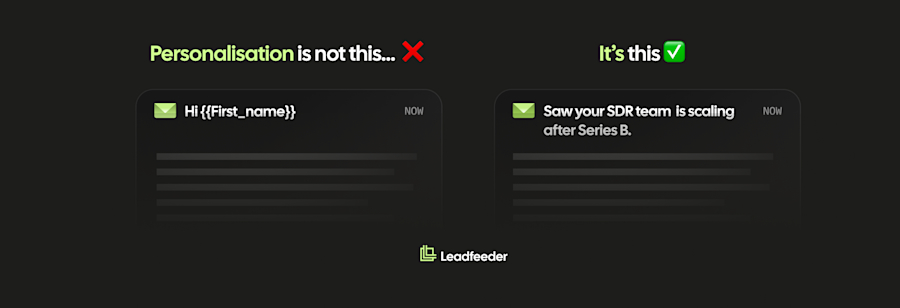
Personalization that actually moves reply rates goes beyond inserting a first name. The tokens that matter are:
Their likely KPI: "Teams focused on pipeline velocity" signals you understand what they are measured on.
A trigger event: "Saw the Series B announcement" shows you did real research.
A tool in their stack: "Given you are running HubSpot" tells them your solution fits their tech stack.
A relevant initiative: "As you are scaling into the US market" connects your outreach to something they already care about.
Personalizing trivial facts does not work. "I see you went to [University]" or "Congrats on your work anniversary" wastes goodwill and signals you are filling a template. If the personalization won’t change how they read the email, cut it.
Common mistakes that tank deliverability and replies
Most of these kill deliverability quietly before you notice anything is wrong.
More than one link: Spam filters treat it as promotional content.
Images or heavy HTML: Plain text outperforms designed templates for cold outreach every time.
Spammy subject line words: "Free," "guarantee," and "limited time" get flagged automatically.
Missing opt-out language: Required in most markets, and buyers notice when it's absent.
Unvalidated or purchased lists: High bounce rates damage your sender reputation fast.
Too many sends from a new domain: Stay under 50 to 100 per day until the domain is warmed up.
Cold Calling in 2026: Scripts and Tactics
Used in the right context and with preparation, cold calling remains one of the fastest ways to qualify a prospect or break through when email is not working. It makes the most sense when:
You have high-ACV deals.
You have a clear trigger.
Email engagement is low.
You need to multi-thread.
Avoid it when you have no clear reason for the call or when the product is self-serve.
30-second opening script formula
Here’s your opening script for a cold call:
"Hi [Name], this is [Your name] from [Company]. The reason I am calling is [specific trigger]. We work with [persona] teams at companies like yours and I noticed [signal]]. Does [problem hypothesis] sound familiar at all?"
And here’s the template you can use if you hit voicemail:
"Hi [Name], [Your name] from [Company]. I’ll keep this short. I am reaching out because [one-line trigger]. I will send an email with more context, but if you want to talk sooner, reach me at [number]. Thanks."
Handling the most common objections
These three objections come up on almost every cold call. Have a response ready before you dial:
"Not interested": "Fair. Most people say the same until they hear what has changed. Can I ask one quick question before you go?"
"Send me an email": "Will do. So I make it worth your time, what is the one thing that would actually make this relevant for you right now?"
"We already have a solution": "Good to know. We often work alongside existing tools. What is the one gap your current setup does not solve?"
Using LinkedIn and Social Selling Without Being Spammy
LinkedIn and social selling works best as a warmth layer in a coordinated campaign. Here’s how to make it work for you.
Optimize your profile to support prospecting
Before you do anything else, make sure your profile is set up to support prospecting:
Headline that states who you help (not your job title)
A buyer-facing summary
One or two proof points
An easy CTA like a Calendly link.
Daily LinkedIn routines
Keep this to 35 minutes total, prioritizing consistency over volume:
10 minutes: Engage with posts from target accounts, and leave a genuine comment, not "Great post!"
10 minutes: Send five to ten connection requests with short relevant notes. Example: "Hi [Name], I work with [persona] teams at [segment]. Saw [trigger]. Thought it was worth connecting."
15 minutes: Follow up with recent connections via DM. Example: "Thanks for connecting. I work with teams dealing with [pain]. Happy to share what is working if it is ever relevant."
Social listening and warm introductions
Watch for hiring posts, product announcements, event attendance, and pain language in comments. Convert to outreach with one observation, one question, and one low-friction next step.
You can use this referral ask template:
"Hey [Name], I am trying to get in front of [persona] teams at [segment]. Do you know anyone who might be open to a conversation? Happy to make it easy to intro us."
Keep in mind that warm intros convert at a significantly higher rate than cold outreach. Build referral relationships with agencies, consultants, and tech partners who serve the same ICP when possible.
Where AI Fits in Your B2B Prospecting Workflow
AI has a genuine role here. The risk is using it to replace the judgment and specificity that make outreach worth reading.
Tasks AI is great at (and where to keep humans in the loop)
Where AI saves real time without compromising quality:
Summarizing a company's website, recent news, and positioning
Generating email opener variants from a trigger event
Creating call prep outlines with likely objections
Rewriting drafts to sound more human and less salesy
What humans must own:
Strategy and positioning
Any specific claims or metrics
Final personalization judgment
Compliance checks
Practical prompt recipes
Here’s some prompts to get you started:
Company and persona summary: "Summarize what [Company] does and what a [persona] there likely cares about. Plain language, no hype, no em dashes or en dashes. Under 100 words."
Email openers from a trigger: "Write three cold email openers for a [persona] at a company that just [trigger]. Under 25 words each. Specific, not generic. No em dashes or en dashes."
Humanize a draft: "Rewrite this email to sound like a real person, not a sales template. Remove hype and vague claims. No em dashes or en dashes. Under 100 words: [paste draft]."
Call prep outline: "Create a call prep outline for a [persona] at a [vertical] company. Include company context, likely priorities, three discovery questions, and the two most common objections with responses."
CTA variants: "Write five low-friction CTAs for a cold prospecting email. Each should be a yes/no question or a two-option ask. Under 15 words each. Conversational tone. No em dashes or en dashes."
Objection handling practice: "I sell [product] to [persona]. Give me the five most common objections I will hear on a cold call and a one to two sentence response to each. Plain language, not scripted."
Guardrails to avoid generic, AI-sounding outreach
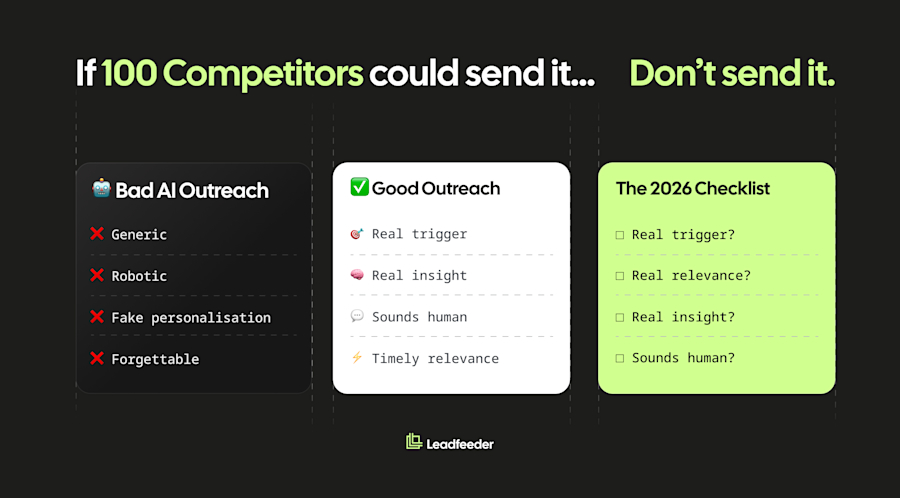
AI makes it easy to produce outreach at scale. It also makes it easy to produce outreach that sounds exactly like everyone else's. These guardrails keep the quality up.
Never invent personalization you cannot verify. Fake personalization is worse than no personalization.
Ground every email in a real signal. If there is no verifiable trigger, the email has no reason to exist.
Run the 100-competitor check. If 100 competitors could send the same email, rewrite it.
Read it out loud. If it sounds like a robot wrote it, it needs a human pass before it goes out.
Keep it short. AI tends toward length; prospecting emails should be under 100 words.
Prospecting Playbooks by Scenario
Here’s some prospecting playbooks that can help your team depending on your unique situation:
SDRs in outbound-heavy teams:
Target 30 to 60 touches per day, five to 15 dials, and two to five meaningful conversations.
AE handoff must include the trigger that prompted outreach, signals observed, contacts engaged, and objections raised.
AEs self-sourcing pipeline:
Block two mornings per week for outbound prospecting. These do not move.
Work 10 to 20 accounts at a time, multi-thread across at least two contacts per account, and track engagement at the account level.
Founders and early-stage reps:
Narrow to 30 accounts per week, write the emails yourself, and build a learning loop.
Send 30 emails, review what replies, adjust one variable, and repeat.
After 90 days you will have a repeatable message.
Metrics, Dashboards, and Optimization
These are the numbers worth tracking, and how to diagnose problems when the data tells you something is off.
Core KPIs to track
Track these KPIs from activity through to revenue. Break each one down by segment and signal type, not just overall. Here are some benchmark examples:
Touches per day: 30 to 60 (SDR outbound)
Email open rate: 30-50% cold
Reply rate: 2-8% open rate
Positive reply rate: 1-3%
Meeting set rate: 1-5% of sequences started
Meeting held rate: 70-85%
Opportunity conversion rate: 30-50% of meetings held
Build a simple prospecting dashboard
Your dashboard should surface this data each week:
Top segments by meeting rate this month
Reply rate by sequence and channel
Positive reply rate trend over 30 and 90 days
Pipeline created by source (inbound, outbound, signal-triggered)
Win rate by source
How to run A/B tests on messages and sequences
Test one thing at a time, or you won’t know what moved the needle. Here’s how it works:
Test one variable at a time, such as subject line, opening line, CTA, or send day.
Set a sample size threshold before you start, with at least 100 contacts per variant.
Define your success metric per test, focusing on specific KPIs.
Diagnosing issues: is it list, message, channel, or timing?
If you’re running into problems, here’s a quick troubleshooting guide:
Compliance, Deliverability, and Reputation Management
Outreach that ignores compliance and deliverability basics can hurt your domain, burn your brand, and make every future send harder. Here is what to have in place.
Staying onside of GDPR/CCPA and Do-Not-Call basics
You need to stay compliant with essential regulations. The practical fundamentals are consistent across most frameworks:
Understand the lawful basis you are relying on for outreach in each region.
In the US, legitimate interest is broadly accepted for B2B cold outreach.
In GDPR-governed markets, the bar is higher, especially in DACH and Nordics.
Honor opt-out requests immediately and log them.
Maintain a suppression list and apply it before every send.
Do not contact anyone on a Do-Not-Call registry for phone outreach.
Note: This is not legal advice. Consult your legal team for specifics that apply to your markets and business model.
Domain warm-up, sending limits, and list hygiene
Deliverability is earned gradually and lost quickly. Here’s how to get started:
Warm new domains gradually over four to six weeks, starting at 20 to 30 emails per day.
Avoid sudden spikes in send volume.
Validate all email addresses before they enter a sequence.
Remove hard bounces immediately.
Monitor spam complaint rates: above 0.1 percent is a warning sign, above 0.3 percent will get your domain flagged.
Use a dedicated sending domain for cold outreach, not your primary company domain.
Respectful opt-out practices that protect your brand
Include a plain, human opt-out line in every prospecting email. Use something like: "If this isn't relevant, just reply with 'unsubscribe' and I'll remove you straight away." Then, honor it within 24 hours.
Remember: Reputation compounds in both directions. A rep known for relevant, well-timed outreach that respects boundaries gets more replies over time. One who ignores opt-outs or blasts unvalidated lists burns their domain and their personal brand simultaneously.
Putting It All Together: A 30-Day Prospecting Plan
Use this as your launch checklist. Each week has a clear focus and concrete deliverables so you are not starting from scratch or guessing at priorities.
Final Thoughts
When it comes to B2B prospecting, consistency and relevance beat volume. A smaller list of well-researched, well-timed b2b sales prospects will likely outperform a mass blast in reply rates, pipeline quality, and how buyers perceive your brand.
Start simple. Pick an ICP segment, a single trigger, and one cadence. If you need b2b prospecting ideas to get going, the trigger table in Step 2 and the cadence templates above give you enough to launch this week. Once you choose your singular starting point, run it for 30 days. Then review the data and improve one variable. And then repeat.
If you want to add a signal layer to your prospecting, Leadfeeder identifies which companies are visiting your website and which pages they are engaging with. That way, you can prioritize outreach to accounts already showing buying intent before they fill out a form.
Ready to identify high-intent leads? Try Leadfeeder free for 14 days.