

According to McKinsey, businesses using AI in their sales process see up to a 50% increase in leads and appointments. That’s not a small bump, it’s a complete re-shaping of how revenue teams perform.
In today’s digital-first B2B landscape, AI tools function like an extra set of highly skilled team members, ones who never sleep, never forget to update the CRM, and can instantly analyze millions of data points. Instead of guessing who to target or spending hours manually qualifying leads, AI sales tools recognize buying signals, surface high-intent prospects, and recommend the next best action.
Modern AI platforms support revenue teams by:
Scoring and qualifying leads using real-time intent data, website activity, and engagement signals
Personalizing communication at scale, crafting tailored emails and outreach that feel human, not automated
Improving sales forecasting and pipeline visibility by analyzing historical and live deal data
Automating repetitive tasks like follow-ups, CRM updates, and data entry so reps can focus on closing
Before AI, sales teams operated largely on instinct and limited visibility. In 2026, AI acts as the radar system, bringing clarity, precision, and speed to every stage of the revenue process.
In this guide, we break down the 10 AI sales tools that truly matter in 2026, the ones that help B2B teams build stronger pipelines, close deals faster, and scale revenue efficiently.
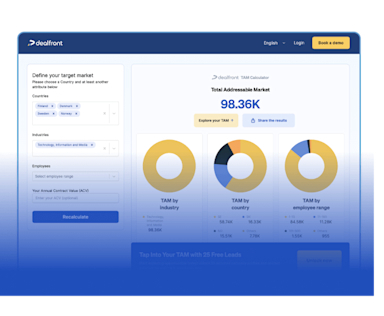
Calculate your Total Addressable Market (TAM) for free
Discover the true size of your Total Addressable Market (TAM) in seconds using the most accurate B2B database in Europe.
Get immediate results now1. Leadfeeder
Best for: Identifying anonymous website visitors and turning inbound traffic into pipeline
Leadfeeder is the Pipeline Generation platform for B2B revenue teams looking to uncover hidden opportunities by identifying website visitors, analyzing buyer intent signals, and enriching account data. By showing you which companies are actively researching your solutions, even before they fill out a form, Leadfeeder ensures your team focuses on the prospects most likely to convert.
Key features:
Website visitor identification
Buyer intent data and account insights
Contact enrichment and verification
GDPR-compliant data handling
What sets Leadfeeder apart is its ability to bridge the gap between marketing and sales. Marketers can see which campaigns are driving real interest, while sales teams can prioritize warm accounts in their outreach.
Pricing: Subscription-based with tiers to fit different team sizes.
2. Salesforce Einstein
Best for: Salesforce-native teams that want built-in AI without adding new tools
Salesforce Einstein is the AI engine built directly into Salesforce’s CRM. Think of it as a smart assistant that sits inside your system, helping you spot which leads matter most and where deals might slip through the cracks.
Key features:
Predictive lead scoring
Opportunity insights (which deals are most likely to close)
Automated activity capture
Sales forecasting
Because Einstein is native to Salesforce, many teams choose it for seamless integration and scalability.
Pricing: Typically bundled into Salesforce licenses, making it an accessible first step into AI for teams already using the CRM.
3. Gong
Best for: Revenue teams focused on call intelligence, coaching, and deal risk visibility
Gong is a popular revenue intelligence platform, and with good reason. It uses AI to listen to sales calls, analyze conversations, and highlight risks or opportunities in the pipeline.
Key features:
Natural language processing of calls and meetings
Deal risk scoring
Performance benchmarking across teams
Automated call transcription
Revenue teams use Gong not just to coach sales reps but also to refine marketing messages. By surfacing the words prospects actually use in conversations, Gong provides insights that can shape campaigns and content strategies.
Pricing: Customized and usually geared toward enterprise teams.
4. Outreach
Best for: Scaling outbound sales with optimized multi-channel engagement
Outreach is a sales engagement platform designed to help revenue teams build and scale personalized outreach sequences across email, phone, and social.
Key features:
Sequence optimization based on engagement data
Conversation intelligence
Recommended next steps for reps
Engagement analytics for better reporting
Outreach is popular because it helps teams increase both productivity and message quality. Removing the guesswork about when to follow up and how to position outreach, it gives teams more time to focus on the human side of selling.
Pricing: Subscription-based with tiered options.
5. Apollo
Best for: All-in-one prospecting, enrichment, and outbound execution
Apollo is a powerful sales intelligence and prospecting tool that helps revenue teams discover new accounts and contacts with precision. Its AI engine does the heavy lifting by analyzing data in real time, ranking prospects, and even suggesting the best way to reach out.
Key features:
Real-time lead scoring
Contact enrichment and verification
Personalized outreach recommendations
Intent data analysis
What makes Apollo appealing is that it combines prospecting, lead enrichment, and engagement into a single platform - no more jumping between multiple tools.
Pricing: Follows a freemium model, which makes it easy for smaller teams to get started before scaling up.
6. HubSpot Sales Hub
Best for: Inbound-focused teams that want tight marketing–sales alignment
HubSpot Sales Hub is part of the broader HubSpot ecosystem, which means it naturally bridges the gap between marketing and sales. It’s particularly well-suited for inbound revenue teams that rely on digital engagement.
Key features:
Predictive lead scoring
AI-driven email personalization
Intelligent workflow automation
Revenue activity tracking
The biggest strength here is alignment: marketing can generate demand, and sales can act on it with AI-powered insights, all within the same platform.
Pricing: Offers a generous free tier, with affordable paid upgrades as teams grow.
7. Clari
Best for: Revenue leaders who need forecasting accuracy and pipeline predictability
Clari, now merged with Salesloft, is a revenue operations platform used for pipeline visibility and sales forecasting. It gives leaders and reps clear visibility into pipeline health and uses AI to forecast revenue with greater accuracy.
Key features:
Deal risk and opportunity scoring
Pipeline health analysis
Forecast accuracy modeling
Quota attainment tracking
Clari is especially valuable for enterprise teams that need predictability in complex B2B cycles. Surfacing early warnings, such as stalled deals or unrealistic forecasts, helps revenue leaders make proactive adjustments.
Pricing: Enterprise-based and tailored to larger organizations.
8. Cognism
Best for: High-quality, compliant contact data in regulated markets
Cognism is a B2B sales and marketing intelligence tool known for the quality of its contact data and strong compliance standards. AI is used not just to enrich contacts but also to flag intent signals indicating which accounts are most likely to buy.
Key features:
Automated lead generation
Buyer intent data analysis
AI-based contact scoring
GDPR-compliant data enrichment
Many revenue teams turn to solutions like Cognism when data quality and compliance are top priorities, especially for campaigns in regulated industries.
Pricing: Subscription-based with usage tiers.
9. ChatGPT
Best for: Content creation, messaging refinement, and sales enablement support
ChatGPT has quickly become a go-to AI assistant for revenue teams. It’s not a prospecting tool; it's a Large Language Model (LLM) that teams are using to help with the communications side of their strategies. Whether you’re drafting a cold email, brainstorming subject lines, writing a LinkedIn message, or preparing a proposal, ChatGPT can accelerate the content creation process.
Key features:
Personalized email and message drafting
LinkedIn and social outreach copy
Proposal writing and formatting
Campaign content ideation
For marketing, ChatGPT can generate blog outlines, ad copy variations, or customer personas. For sales, it’s like having a fast-writing partner who’s always on hand.
Pricing: Follows a freemium model, with a low-cost Plus subscription for more advanced capabilities.
10. InsightSquared
Best for: Data-driven teams seeking deeper revenue analytics and performance insights
InsightSquared is an analytics and forecasting tool designed to give revenue teams sharper visibility into performance. While dashboards have been around for years, InsightSquared uses AI to add predictive context, helping teams understand why something is happening rather than just what is.
Key features:
Predictive analytics for pipeline and revenue
Deal risk scoring
Rep and team performance insights
Customizable reporting dashboards
Revenue teams use it to spot weak points in their funnel and improve forecast accuracy.
Pricing: Enterprise-based, reflecting its depth of analytics capabilities.
Choosing the Right AI Sales Tool
Each of these AI-powered tools addresses a different piece of the revenue puzzle, from identifying prospects to engaging them, to tracking deals, to forecasting growth. The right choice depends on your team’s size, goals, and where you most need support.
With so many options available, the key is to start with your workflow — not the feature list. Where are the bottlenecks? Prospecting? Lead qualification? Forecast accuracy? Admin overload? The best AI tool is the one that removes friction from your existing process and helps your team perform at a higher level without adding complexity.
When evaluating AI tools, focus on:
Process gaps: Map your revenue journey from lead generation to closed-won. Invest where inefficiencies are most costly.
Integration compatibility: AI delivers the most value when it connects seamlessly with your CRM, marketing automation platform, and communication tools.
Team size and maturity: Lean teams may benefit from all-in-one platforms, while enterprises often need specialized tools for forecasting, intelligence, or RevOps.
Data quality: AI depends on clean data. If your CRM is inconsistent, prioritize tools with enrichment or hygiene features.
And, of course, measure ROI. Start with two practical benchmarks:
Time saved: How many manual hours can automation eliminate each week?
Conversion lift: Even a small increase in qualified leads or close rates can significantly impact revenue over time.
For example, if an AI tool can save each team member 2 hours a week and increase conversion rates by even 5%, the cumulative impact on pipeline and revenue quickly outweighs the subscription cost.
Upgrade Your Sales Strategy with AI-Powered Intelligence
AI won’t replace sales and marketing teams, it will amplify them. Just as calculators didn’t make accountants obsolete, AI won’t make revenue professionals unnecessary. Instead, it will handle the repetitive and analytical work, freeing humans to focus on creativity, strategy, and building genuine relationships.
Companies are already using AI-powered sales tools to identify prospects likely to buy and improve how sales teams operate. For more information about AI-powered sales intelligence, book a demo.
Frequently asked questions about AI sales tools
How do sales teams get started with AI revenue tools?
Training a team on new AI revenue tools often starts by introducing one tool at a time. Hands-on training sessions help users learn how the tool works in real situations.
What happens when AI sales and marketing tools make mistakes?
AI can automate many revenue activities, but relying too much on AI may reduce direct human interactions. If the data used by AI tools is inaccurate or incomplete, the tool's suggestions and results can also be unreliable.
Do AI sales tools comply with data privacy regulations?
Most specifically-built AI prospecting tools will include features to comply with laws like GDPR and CCPA. However, they don’t all… It's important to check each tool's privacy settings and data management practices before using them.
Which AI sales tool works best for smaller revenue teams?
For smaller sales and marketing teams, tools like HubSpot and Apollo are popular because they offer free tiers and easy-to-use features that deliver value without big upfront costs. Leadfeeder is another strong option, especially for teams that want to identify website visitors and capture intent data, helping lean revenue teams focus on the prospects most likely to convert.
Can these AI tools connect to existing CRM systems?
Yes, most modern AI sales and marketing tools integrate directly with widely used CRM systems like Salesforce, HubSpot, and Pipedrive. Platforms such as Leadfeeder are built with connectivity in mind, ensuring that insights from website visitors and intent data flow seamlessly into your CRM, so revenue teams can act on them without extra manual work.

Team Lead Growth AM/Sales Team @ Leadfeeder
Thijs Schutyser is Sales Manager at Leadfeeder with more than a decade of experience in B2B sales and pipeline generation. He has worked across account executive and leadership roles helping companies turn website visitor data into qualified sales opportunities.
Having delivered hundreds of product demos and worked directly with sales teams across Europe, Thijs brings firsthand experience in modern sales prospecting and buyer engagement. His experience using visitor insights and intent signals to prioritize outreach informs his perspective on building predictable pipeline and improving sales prospecting strategies.