60-Second Summary
Inbound and outbound are two distinct marketing approaches: inbound attracts customers with valuable digital content, while outbound pushes messages via ads, cold outreach, and traditional media. Choosing the right approach—or a strategic mix—based on goals, audience, and budget prevents wasted time and spend.
Key takeaways: Inbound is generally more cost-effective, measurable, and builds long-term qualified pipeline via content; outbound delivers fast brand visibility and reach but is costlier and harder to attribute. Most businesses benefit from a tailored combination.
Standout strategies & tactics: Use SEO, blogs, educational videos, lead magnets, chatbots and demos for inbound; employ targeted display, cold outreach, direct mail or broadcast for outbound. Enhance both with intent data, ICPs and AI-driven personalization to boost relevance and ROI.
Real-world lessons & frameworks: Consistent content investment compounds organic returns; analytics and ongoing maintenance are essential; attribution can miss channel influence—use split tests and multi-touch models to reveal true impact.
How to choose: Align choice to audience, goals and budget—B2C and awareness plays often favor inbound; B2B expansion or market entry may need outbound. Pilot small, measure, iterate, and combine channels for the best outcomes.
*This summary was created with AI assistance, using our original content.
With the right message delivered through the best channels, businesses of all sizes can achieve lasting, repeatable success.
To do this effectively, businesses need to choose the right approach from the start: inbound or outbound marketing.
Inbound marketing focuses on attracting customers through valuable content, while outbound marketing pushes messages directly to potential audiences through ads, cold outreach, and traditional media.
Understanding the difference between the two is essential before investing time and budget into campaigns that may not deliver results.
In this guide, we will break down inbound vs outbound marketing, including their benefits, challenges, examples, and how to choose the right approach for your business.
Want to know how to turn lookers into bookers at the touch of a button? Request a demo today and discover how we can help.
What is inbound marketing vs outbound marketing?
Let’s define inbound and outbound marketing to help you get a clear understanding of the two approaches and how they differ in practice.
Outbound marketing
When we talk about outbound marketing, we refer to a more traditional approach that pushes specific messaging to potential leads who may not yet be actively seeking your product or service. It focuses on reaching a broad audience through direct promotion, including ads, cold outreach, and traditional media.
Generally speaking, this method is more expensive and delivers a lower marketing ROI than inbound marketing.
Inbound marketing
Inbound marketing is a marketing approach that focuses on attracting potential customers by providing valuable, relevant, and engaging content. Instead of pushing messages out, it draws people in through channels like blogs, SEO, social media, and educational content.
When considering whether inbound or outbound marketing will work best for your business, keep in mind that inbound strategies often offer a more cost-effective way to build meaningful customer relationships.
What is the difference between inbound and outbound marketing?
We’ve answered, “What is inbound and outbound marketing?”, but now let’s look at some of the many differences between the two.
To make things simpler to understand and remember, check out the table below:
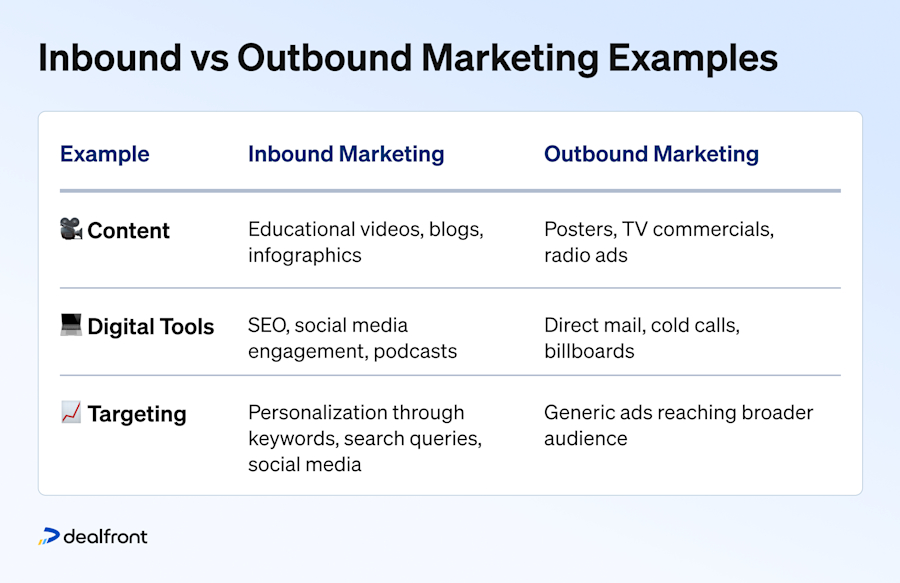
Inbound vs outbound marketing examples
To understand these differences better, take a look at some practical, real-life examples of inbound and outbound marketing that you might have even come across in the past:
Inbound marketing examples
As inbound marketing relies heavily on digital content, some of the most common examples include blog posts, social media content, videos, podcasts, infographics, and other visual content shared online.
A typical example of (successful) inbound marketing could be a short, catchy, and educational video. Let’s imagine you’re a SaaS company selling invoicing software to small businesses and solopreneurs.
Your ideal customer is currently searching for a better, speedier, and more cost-effective way to manage their invoices. They find your quick guide, “Invoicing made easier,” by searching for keywords on Google.
The video—a playful animation that keeps things short and sweet while also delivering plenty of useful information and great value—entices the customer to check out your website.
Here, they’re presented with a range of tools, pricing tiers, and payment options, along with a friendly chatbot ready to answer any questions.
Plus, your stellar—and fully verified—customer testimonials are very prominently displayed on your homepage, further strengthening your brand image and encouraging your leads to stick around.
At this point, your lead might be truly interested in trying out your product, but they might not want to commit to a full membership yet. Luckily, in exchange for their email address, you offer a free, no-commitment 14-day demo, which they happily download.
The demo works great, everything goes smoothly, and your lead is now convinced that they’ve found the invoicing software solution they were looking for—yours!
Outbound marketing examples
Most outbound marketing, as we mentioned, is non-digital, including direct mail, posters and billboards in public places, cold calls and emails, and TV and radio commercials.
A typical instance of outbound marketing is seeing a poster for a newly launched product or service—anything from a streaming service to a high-protein snack—while you wait at the bus stop.
Hundreds of people wait at that same bus stop every day, but only one or two might be genuinely interested in purchasing the product or service advertised on the poster.
Even if a person finds a product or service interesting or useful, they are likely to soon forget about it as they get on with their day. Nothing about the ad was personalized or compelling enough to encourage them to learn more.
However, in the digital realm, you can use intent data and ideal customer profiles (ICPs) to target display ads and reach the audience most interested in your product.
Benefits of inbound and outbound marketing
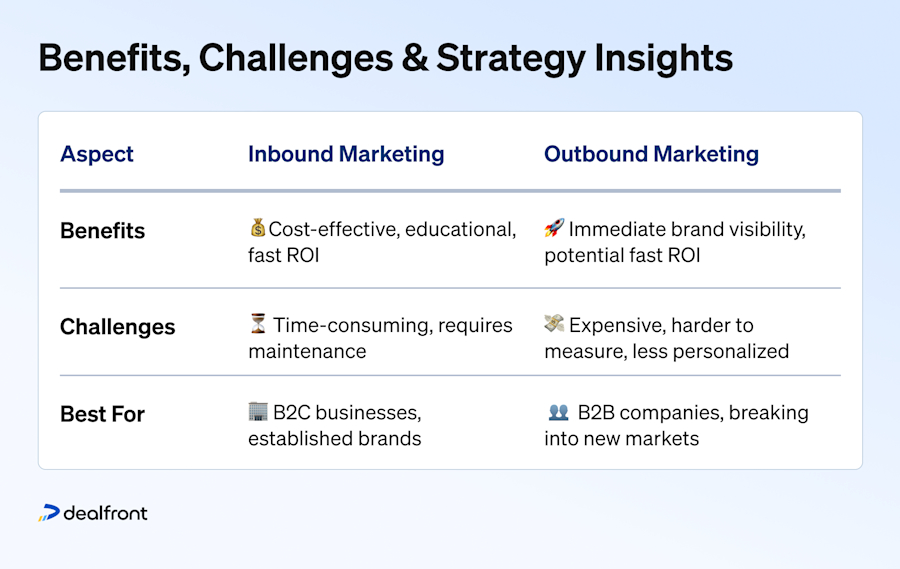
Now that we’ve clarified the main difference between outbound and inbound marketing, as well as looked at some inbound marketing vs. outbound marketing examples, it’s time to consider the benefits of each of these approaches.
Whether you're planning inbound and outbound marketing campaigns separately or combining them for a more integrated approach, each has its unique advantages.
Inbound marketing benefits
As you might expect, there are many benefits to implementing an inbound marketing strategy for your business.
They include:
Better cost-effectiveness: There’s no way around it—physical marketing and advertising are more expensive than digital content, which is why inbound marketing is a lot more affordable, especially for bootstrapped businesses or nimble start-ups.
Higher value for your audience: Because it’s not pushy, salesy, or invasive in any way, inbound marketing offers more informative, educational, and interesting content to your audience, who, in turn, receive higher value from it.
Easier to quantify: By using digital marketing software equipped with analytics functionalities, you’ll be able to work out how your inbound marketing efforts are performing over time and whether or not you should be implementing any changes to improve its chances of success.
Faster ROI: With inbound marketing, you're speaking directly to your target audience—people who you know are already interested in your product or service. And when that interest compounds over time, the payoff can show up in places you wouldn’t expect. Patrick Cumming, Head of Marketing at KlientBoost, put it plainly: "We actually get more influenced pipeline from organic search at KlientBoost than we do from direct traffic — which I would say is very unusual." For companies that invest consistently in content, that’s the real advantage of inbound: it keeps building qualified revenue long after the first click.
Outbound marketing benefits
While outbound marketing is less popular with forward-thinking, digital-savvy marketers, it’s undeniable that it still has a few advantages—especially if you use it in conjunction with inbound marketing.
Brand awareness and visibility: Whenever you put your brand’s name, products, or services in front of people—whether that’s at a train station, on a radio channel, or via snail mail—they instantly become aware of who you are and what you sell. Sure, that doesn’t mean they’ll buy from you, but having higher visibility is a good start.
Potentially fast ROI: While most of the time the ROI from outbound marketing is quite unpredictable, it’s also true that you might be lucky and achieve almost immediate ROI if your message happens to be seen by the right person at the right time.
Potentially more trustworthy: Old-school channels, such as radio, TV, and printed media, have a much longer history with consumers and, therefore, can be seen as more credible and reliable. This might mean customers are more inclined to check out your offering, as they see your brand as trustworthy.
Challenges of inbound marketing vs outbound marketing
Now, for the challenges of inbound and outbound marketing. What are the main hurdles of each? Let’s find out.
Inbound marketing challenges
These are the main disadvantages of implementing a marketing strategy that exclusively relies on inbound marketing:
It can be more time-consuming: Putting together a solid, well-performing inbound marketing strategy is far more complex than it seems, especially when it comes to timing. In fact, before posting a piece of content, you’ll need to do lots of research into your market, customers, and competitors and test a range of content strategies to figure out which one yields the best results.
It requires ongoing checks and maintenance: The digital world moves at a lightning-fast pace, so your content must always be fresh, accurate, and relevant. For this reason, you’ll regularly need to keep a close eye on what you post and, whenever needed, be ready to adjust or make more substantial changes.
It needs to be implemented across different channels: If you want your inbound marketing plan to succeed, it’s not enough to bank everything on writing a couple of blogs a month or a few social media posts here and there.
You need a much better-structured strategy that uses an array of channels—blogs, socials, videos, visuals, website, etc.—to create cross-channel campaigns.
Outbound marketing challenges
In terms of outbound marketing, these are some of the main drawbacks that you may find if your entire marketing strategy only focuses on this approach:
It’s too generic: Because it doesn’t zoom in on a specific audience or segment, outbound marketing tends to be a lot more generic and less personalized than inbound marketing. This means it can be seen as irrelevant, intrusive, and annoying.
It’s much harder to measure: Other than using manual tools and observation, it’s practically impossible to determine whether your sales are coming from the poster you put up on the highway, the direct mail messages you've posted to thousands of people, or something else. Sam Dunning, host of the Breaking B2B podcast, ran a split test that showed how easily spend can influence channels that never get the credit: "We split the US in half — Facebook ads on the East Coast, nothing on the West Coast — to see the impact on branded search, direct traffic, and all these other channels that Facebook was influencing, even though Facebook itself wasn't getting any of the credit." The uncomfortable takeaway is that attribution often misses the real story, especially when a channel’s influence shows up somewhere other than the dashboard.
It’s more expensive: Buying billboard spaces, printing thousands of flyers, or putting together an entire crew for a TV commercial are all things that will cost you a lot of money—and might not even generate the expected results.
Inbound vs. outbound marketing strategy: which method is right for your business?
With all the info we’ve given you so far, you’re probably thinking, “Surely, opting for inbound marketing should be any business’s best bet.” However, as with most things in marketing, the answer is more complicated and multifaceted.
When planning your marketing approach, having a clear understanding of the inbound/outbound meaning will make it easier to match the right strategy with your specific goals and resources.
B2C companies tend to be better off with inbound marketing, especially when customers are already familiar with your brand and what it offers. Creating compelling blog posts, engaging social media content, and educational videos can turn leads into customers.
When you weigh inbound vs outbound marketing for B2B, some outbound marketing could work well. This is particularly true for companies that want to reach new business streams or enter new markets.
Because these companies deal with other businesses and often need to climb an internal hierarchical ladder to close a deal, traditional commercials, printed media, and even cold calling might have the desired effect.
However, the field is rapidly evolving thanks to the integration of new technologies, such as AI, into B2B marketing, which can help businesses personalize outreach, improve targeting, and drive better results from both inbound and outbound efforts.
Ultimately, it depends on the type of company you are, your budget, and the goals you want to achieve. Usually, a combination of inbound and outbound marketing works best for many companies.
Elevate your inbound and outbound marketing today
Understanding whether to use inbound vs outbound marketing for your company is easier said than done. As we’ve seen in this article, each approach has its benefits and challenges, and there are cases where one might make more sense than the other.
Ready to level up your marketing strategy? Request a Leadfeeder demo to fill your pipeline with quality leads, boost conversions, and drive revenue.
Inbound vs outbound marketing FAQs
What is the meaning of outbound marketing?
When we talk about outbound marketing, we refer to traditional methods of doing marketing, in which companies “push” a message out to a broad audience who might or might not be interested in what they sell.
Some of the main tactics include TV and radio commercials, printed media (such as posters and billboards), direct mail, cold calling and emailing, and trade shows.
Is outbound marketing dying?
No! Despite being a very traditional technique, outbound marketing is still alive and kicking. It’s definitely evolving, though, which is something you must be aware of if you’re interested in incorporating it into your overall marketing strategy.
For example, while outbound marketing still tends to be fairly generic and high-level, you might want to try to inject some personalization elements into it. Something like placing your physical billboard in an area that’s usually frequented by people who might be interested in your product or services, for example, could be a clever way to make the right heads turn.
What is the meaning of inbound marketing?
Inbound marketing is another marketing strategy that, unlike outbound marketing, “pulls” potential customers to your company instead of pushing out messages and advertising to make them aware of you.
It does so by crafting targeted, personalized, educational, engaging, and valuable (mostly digital) content that people are attracted to, to the point of feeling compelled to check out what your brand is all about and—if you’ve played your cards well—even buy from you.
Is SEO inbound or outbound marketing?
SEO is inbound marketing. As a digital tactic, SEO, or search engine optimization, is one of the pillars of solid inbound marketing. Because it involves optimizing your digital content by using things such as keywords and key phrases, it can help your website rank higher in SERPs (search engine result pages).
In turn, this enables more users to find out about your brand right when they’re actively searching for information about what you sell.
Outbound vs inbound marketing: What are the key differences?
There are several differences between outbound marketing vs inbound marketing. The main ones, though, involve their approach and the way they engage the audience.
Inbound marketing, for example, leverages a “pull” approach, as it draws people in through carefully crafted digital content. Its audience is mainly composed of people who have already demonstrated a level of interest in what the company sells.
On the other hand, outbound marketing is more proactive and uses a “push” approach, in that it sends out messages to a much wider audience via more traditional, non-digital channels. The audience it reaches might have never heard of the company or be interested in what it offers.
What’s more effective? Inbound or outbound marketing?
We live in an increasingly digital world, so it might seem like inbound marketing is a no-brainer when it comes to which of these two tactics is more effective.
Nevertheless, outbound marketing does have some great benefits when used appropriately. Therefore, leveraging both approaches—and balancing them depending on your business type, size, budget, audience, and goals—is often the best strategy.
What are the benefits of combining inbound and outbound strategies?
There are many advantages to combining inbound and outbound strategies, including:
Widening your reach
Expanding your chances of conversion
Targeting your audience with better, more valuable messages
Strengthening your brand’s presence, visibility, credibility, and awareness, for a more solid and consistent image that improves reputation
How does Leadfeeder support inbound marketing?
Leadfeeder offers many solutions to support your inbound marketing efforts. With precise targeting, website visitor data, and firmographic and behavioral insights into your audience, you’ll be in the best position to gain a much more detailed and accurate understanding of your customers. This can inform your marketing and sales strategies to help you maximize success.
How does Leadfeeder enhance outbound marketing efforts?
Prefer to focus on outbound marketing? We can help with that, too! With real-time data on top prospects, we help you transform generic outbound messages into targeted outreach so your sales team can focus on warmer, higher-converting leads.