60-Second Summary
Two complementary approaches capture email addresses: traditional capture (forms, popups, chat, social sign-in) and an intent-based workflow that identifies the companies behind anonymous visits. Traditional methods catch the 2–3% willing to convert; intent-based identification scales by surfacing visiting companies, enriching contacts, and activating timely outreach.
Key takeaways: Traditional capture remains useful but limited (captures ~2–3%); intent-based identification turns anonymous visits into actionable signals (Leadfeeder reports identifying up to ~45% of companies) and relies on first-party data that competitors can’t commoditise.
Standout strategies & tactics: Combine table-stake capture methods (gate only top research, use exit popups, chat, social sign-in) with IP-based company identification, filter visitors by ICP and engagement, enrich contacts, and reach out with context rather than generic cold email.
Real-world lessons & frameworks: Use a fit + intent framework (ICP filtering + page-level engagement), automate CRM workflows (e.g., pricing page x2 → create lead, notify rep, start nurture), and prioritise timing to contact buyers while intent is fresh.
Compliance & practical tools: Ensure GDPR compliance (company-level ID under legitimate interest, individual data with consent), and use tools like Leadfeeder/Leadfeeder Contacts plus Hunter.io, Apollo.io or GrowMeOrganic, integrated with Salesforce/HubSpot for activation.
*This summary was created with AI assistance, using our original content.
This article covers two approaches. First, the traditional capture methods that still earn their place for a slice of your traffic. Then, the intent-based workflow that lets you get the email address of a website visitor without relying on forms, by identifying the companies behind the visits and reaching the right contacts inside them.
How do websites get email addresses today?
There are two broad categories. The first is traditional capture, where you ask the visitor to hand over their details. The second is intent-based identification, where you figure out who's visiting without requiring a form. Most B2B teams only use the first. Here's why that's a problem, and how to capture email addresses from website visitors using both.
Traditional email capture software and methods (and why they have a ceiling)
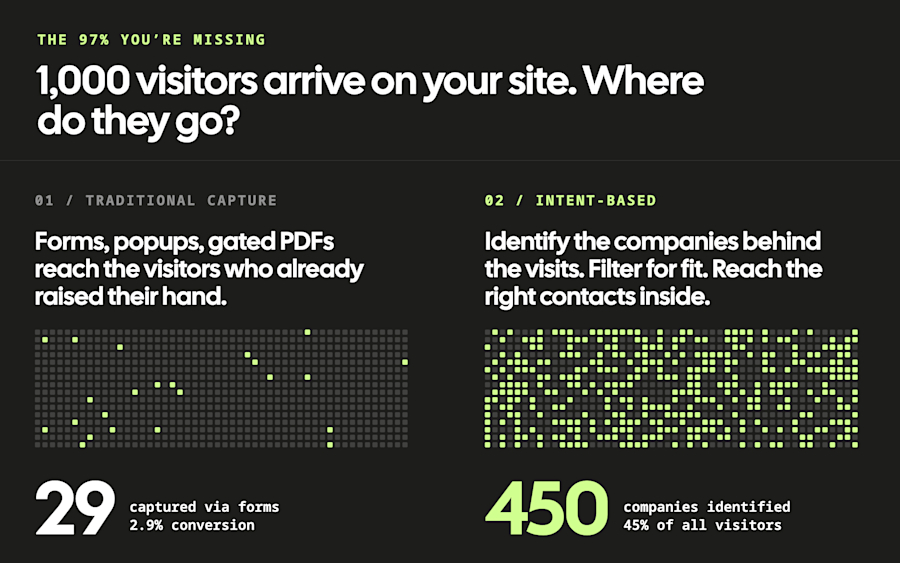
Traditional capture methods still earn their place. They capture the 2-3% of visitors who are willing to raise their hand. But it's important to understand their limits before relying on them as your primary strategy.
1. Forms and lead magnets
The simplest approach: offer something valuable, a guide, a template, a calculator, in exchange for an email address. Still effective when the content genuinely earns the gate.
The problem is that most gated content doesn't clear that bar. Gated content registrations dropped 8.6% year-over-year in 2025 (NetLine, 2026 State of B2B Content Consumption Report). And when people do fill out a form, they wait an average of 47.7 hours before even opening the content they downloaded. That's not a buying signal, it's a filing-for-later signal.
Email capture best practices here are simple: gate your best original research and interactive tools, and ungate everything else.
2. Exit-intent popups
A popup triggered when someone's cursor moves toward the browser's close button. Conversion rates typically land between 2-4%. Better than nothing, but the maths is brutal: a 3% popup conversion on a page that already only captures 2.9% of visitors means you're adding fractions to fractions.
3. Live chat and chatbots
Proactive chat can capture visitor details in exchange for help. Works well on high-intent pages like pricing or comparison pages where someone has a specific question. Less effective on informational content where visitors are still in research mode.
4. Social sign-in
Instead of typing an email, visitors use their LinkedIn or Google account to log in. Reduces friction and tends to convert better on mobile. More common in B2C, but B2B use cases exist for free trials, documentation access, and community platforms.
These methods are table stakes. Use them. But if they're all you have, you're only capturing the visitors who were already willing to convert, and ignoring the vast majority who are showing real interest through their behaviour. If you want to capture emails on your website at scale, you need to go beyond asking and start identifying.
Why the best email capture tools aren't enough in 2026
Before jumping into the alternative, it's worth understanding why the gap between "visitors" and "known leads" is widening.
Buyers don't want to talk to you yet. 67% of B2B buyers say they prefer a completely rep-free purchasing experience (Gartner, March 2026). They're researching on your website right now, reading your pricing page, comparing your features, scanning your case studies. And then they leave.
You're getting fewer visits to work with. 73% of B2B websites experienced significant traffic loss between 2024 and 2025, largely driven by AI search, zero-click results, and ChatGPT citations replacing traditional clicks. When fewer people visit your site, every visit carries more weight. You can't afford to let 97% of them disappear.
Cold outreach is getting noisier. AI-generated emails flood inboxes. Buyers pattern-match them instantly. Response rates on generic sequences are collapsing. What cuts through is relevance and timing, reaching someone when they're already in a buying cycle.
Third-party intent data isn't the answer either. 87% of organisations say the third-party intent data they buy produces unreliable signals (DemandScience, 2026). Your competitors are buying the same data from the same providers. First-party website visitor data, who visits your site, which pages, how often, is unique to you. It's the one signal that can't be commoditised.
This is the context that makes the next approach worth understanding.
The intent-based approach: identify, enrich, activate
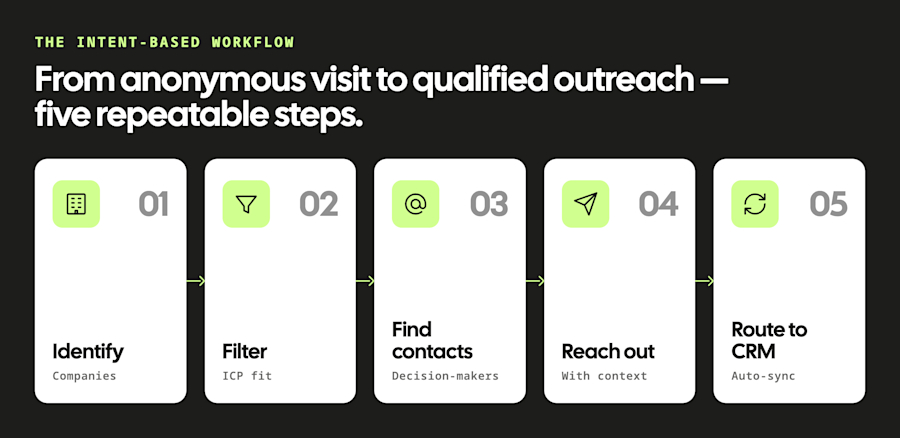
Instead of waiting for visitors to identify themselves, you identify the companies visiting your site and reach out with context. This is the workflow we run at Leadfeeder, and it's the one I'd recommend for any B2B team with meaningful website traffic.
Step 1: Identify the companies on your site
The foundation is IP-based company identification. Instead of hoping someone hands you an email from a website form, tools in this category show you which companies are visiting, what pages they're viewing, how often they return, and how engaged they are.
You don't get individual emails at this stage. You get company-level intelligence: "Acme Corp visited your pricing page three times this week, spent 4 minutes on the enterprise case study, and came back from a Google search for [your competitor's name]."
That's an intent signal, and it's more valuable than a name on a gated content download because it tells you what that company is actually interested in.
Leadfeeder identifies up to 45% of companies visiting your website, even when they never fill out a form. The data sits on top of a proprietary IP-to-company database covering 60M+ companies globally.
Step 2: Filter by ICP fit
Not every visitor is worth pursuing. A 50-person agency browsing your blog is different from a 500-person SaaS company reviewing your integrations page.
Filter your identified visitors by company size, industry, location, and technology stack. Layer in engagement data: how many pages did they view, which pages, how many visits in the last 30 days? The goal is to surface companies that match your ideal customer profile and are showing active buying behaviour. Fit plus intent, not one or the other.
Step 3: Find the right contacts
Once you know which companies to target, you need the right people inside those companies. This is where email-finding and enrichment tools come in.
Leadfeeder Contacts surfaces verified contact details for key decision-makers directly within the platform, pulling from a database of 400M+ verified contacts. For many teams, this is enough to go straight from identification to outreach without leaving the tool.
For additional coverage or verification, complementary tools include Hunter.io (email finding by company domain, 50 free credits/month), Apollo.io (contact database with outreach sequencing, generous free tier), and GrowMeOrganic (LinkedIn-based prospecting, 15M company database, $39/month with unlimited credits).
The key insight: these tools are excellent at finding contact details, but they work best when you already know who to look for. Without the company identification layer, you're pulling contacts from a database and cold-emailing. With it, you're reaching out to someone whose company was just on your pricing page. The difference in response rates is significant.
Step 4: Reach out with intent context
You're not sending a generic cold email. You're contacting a decision-maker at a company that visited your site multiple times this week, spent time on your pricing page, and matches your ICP.
That context changes the conversation. You don't need to mention that you saw them on your website (that can feel intrusive). But the intent data informs your timing, your messaging, and your prioritisation. You're reaching out because there's a reason to, not because their name appeared on a list.
Step 5: Route to CRM and activate workflows
The last step is making this repeatable. Connect your identification tool to your CRM so identified companies and contacts flow in automatically. Leadfeeder integrates with 50+ tools, including Salesforce, HubSpot, Pipedrive, and Microsoft Dynamics.
Set up automated workflows: when a company matching your ICP visits your pricing page twice in a week, create a lead in your CRM, notify the assigned rep, and add them to a targeted nurture sequence. No manual exporting, no CSV uploads, no spreadsheet wrangling.
Staying compliant
IP-based company identification operates in a well-defined compliance framework. Identifying a company (not an individual) from an IP address falls under legitimate interest (Article 6(1)(f)) under most interpretations of GDPR. Individual-level identification requires appropriate consent mechanisms, and clear privacy policies and cookie consent banners remain essential.
Leadfeeder is EU-based and built with GDPR compliance at its core. Before implementing any visitor identification tool, review the visitor tracking in a post-GDPR world guide to ensure your setup is compliant.
The bottom line
Forms capture the 2-3% of visitors willing to raise their hand. That's worth doing, but it's not a growth strategy.
The intent-based approach identifies the companies already showing buying signals on your website, finds the right contacts, and activates outreach with timing and context that generic cold email can't match. It's the most reliable way to identify anonymous website visitors and get email addresses from people who would otherwise stay unknown.
If you want to see which companies are visiting your site right now, explore how Leadfeeder's web visitor identification works. You can try it free for 14 days.