Without segmentation, B2B marketing becomes guesswork, sending the same campaigns to companies with completely different needs and decision-making processes.
In this guide, you’ll learn:
What B2B segmentation is
How it differs from B2C segmentation
The six most effective segmentation methods
A step-by-step process to segment your market effectively
Best practices for building actionable B2B segments
By the end, you’ll understand how segmentation helps B2B teams improve targeting, generate higher-quality leads, and build stronger customer relationships.
B2B Segmentation Explained
Segmentation in B2B is the practice of dividing your business’s customers into groups based on real, meaningful factors such as:
Industry
Company size
Revenue
Technology stack
Business needs
Buying behavior
These segments help marketing and sales teams deliver more relevant messaging and prioritize the accounts most likely to convert.
Instead of treating the market as a single audience, segmentation allows companies to tailor strategies to different types of businesses.
This approach improves targeting, increases engagement, and helps teams allocate resources more effectively.
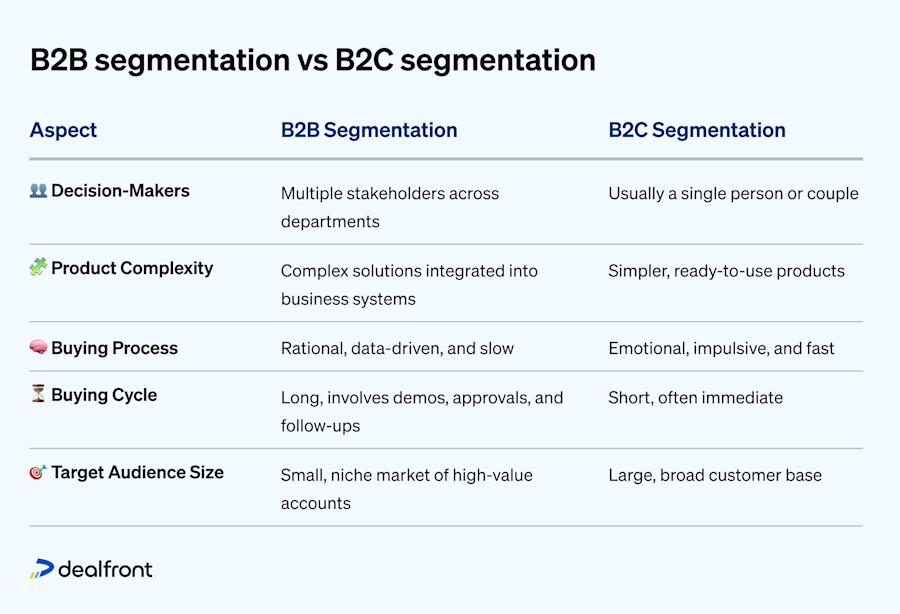
B2B segmentation vs B2C segmentation
Let’s talk about the difference between B2B and B2C segmentation.
While both approaches aim to better understand audiences, the way segmentation works in B2B differs fundamentally from that in B2C.
B2B has multiple decision-makers
In B2C, your customer is usually just one person or maybe a couple making a quick decision together. That’s not the case in B2B. You’ll be dealing with multiple departments. From procurement to operations to finance, everyone wants a say.
Some companies will have ten or more decision-makers involved in buying decisions. That changes everything. You can’t just create one message and hope it lands. You’ve got to speak to everyone at the table.
B2B products and services are more complex
B2C products tend to be simpler. They’re easy to buy and easy to use. But in B2B, you’re selling software, systems, and solutions that need to fit into a company’s existing structure. And that structure is usually messy. You’ve got legacy tools and internal policies to think about. Security protocols are another consideration. It’s all there. So, segmentation has to consider not just who the customer is, but also how complex their setup might be and what kind of solution they are looking for.
B2B decision-makers go through a more rational process
A family might spend five minutes choosing a holiday destination.
“Should we go to Bali this year or Mexico?”
“Bali’s cheaper. Mexico has better tacos. Let’s flip a coin.”
Done. That’s the buying process.
However, in B2B, purchases are tied to performance. Budgets are on the line. Careers, even. So, the process is slower, more deliberate, and driven by data instead of emotion. Your segmentation needs to reflect that reality.
The buying cycle is different
In B2C, the buying journey is basically a sprint. You see it, you want it, you tap your phone, and it’s on its way. Instant gratification.
The B2B buying cycle, on the other hand, is a marathon. A slow, strategic, budget-approved marathon. We're talking weeks, sometimes months, of back-and-forth liaising. Demos. Proposals. Internal meetings. More demos. Revisions. There will be endless follow-up meetings to discuss the previous meetings.
You need to know exactly where your leads are in the B2B sales funnel, what they care about at each stage, and how to move them forward without rushing or losing them.
B2B target audiences are smaller
In B2C, you might have thousands (or millions) of potential customers. You’re casting a wide net. But in B2B, it’s the opposite. You might only need a few dozen key clients to succeed. That makes segmentation even more critical. You’ve got to know which companies matter most and how to serve them better than anyone else.
B2B Marketing Segmentation vs B2B Customer Segmentation
B2B segmentation can apply to both prospective markets and existing customers, but the purpose of each approach differs slightly.
Type | What It Focuses On | Example |
B2B Marketing Segmentation | Divides the broader market into groups based on factors such as industry, company size, location, or revenue. This helps marketing teams tailor campaigns to different types of businesses. | Creating different messaging for start-ups versus large enterprises. |
B2B Customer Segmentation | Segments existing customers based on their needs, behavior, usage patterns, or lifecycle stage. This helps companies personalize offers and improve retention. | Offering advanced features to experienced users and onboarding support for new customers. |
In short, B2B marketing segmentation focuses on identifying and targeting potential businesses, while B2B customer segmentation focuses on better serving and retaining existing customers.
Benefits of B2B segmentation
Look, it’s simple. If you’re not using some type of B2B market segmentation, you’re missing the mark. 80% of companies that use a B2B segmentation model report a sales boost. That’s not a fluke. It’s the power of knowing exactly who you’re talking to and speaking their language. But, just in case you need a little extra push, here are some specific benefits of B2B segmentation:
Helps you develop customer insights: Rule number one of every B2B segmentation strategy is to know your customers. By honing in on niche segments, you can sharpen your strategy and tailor it to your market’s exact needs. Whether it’s marketing, sales, or even R&D, segmentation helps you stay on target.
Improves marketing results: When your marketing is more focused, you hit the right people with the right message at the right time. Fast-growing companies generate 40% more revenue from personalization than their slower-growing counterparts. Speaking directly to your audience works wonders.
Win higher-quality leads: Now, this is where things get real. Better segmentation means better marketing, which means higher-quality leads. With lead scoring, you’ll track how well your efforts are working. You’ll also know exactly which prospects are worth your time, how fast deals are closing, and which segments are bringing in the most business.
Improve customer retention: You’ve got your targeting down. Now, it’s time to keep those customers around for as long as possible. When you invest your time and effort in segmentation and start sending the right message to the right businesses, you’ll see better customer satisfaction.
Brand loyalty and referrals: The cherry on top is that segmentation helps you focus on customers who are most likely to advocate for your brand. Satisfied customers are your best salespeople. They’ll leave glowing reviews and send referrals your way.
6 Most Effective B2B Segmentation Methods
There are numerous B2B segmentation examples that you can choose from to slice and dice your market, but some methods are tried-and-true for a reason. The goal is to sort your customers in a way that actually helps your sales and marketing teams succeed. You’re going to want to create a seamless, personalized experience that’ll get those conversion rates soaring.
Segmentation Method | What It Focuses On | Example Use Case |
Firmographic | Company characteristics such as industry, size, revenue, and location | Target mid-sized SaaS companies in Europe |
Technographic | Technologies and software a company uses | Offer CRM integrations to companies already using Salesforce |
Needs-Based | The specific challenges or goals a company wants to solve | Target businesses looking to simplify file sharing |
Behavioral | Actions prospects take, such as website visits or content downloads | Retarget companies that downloaded a whitepaper |
Sophistication | Level of industry knowledge or technical maturity | Provide detailed product specs to expert buyers |
Journey Stage | Where prospects are in the buying process | Send case studies to leads evaluating vendors |
Here are our top six B2B segmentation examples:
1. Firmographics
Firmographic segmentation focuses on the company, not the individual. It’s about understanding key details like:
Company size
Industry
Locations
Revenue
Growth trends
This type of data overlaps with demographics, but it goes deeper into the organization itself, helping you understand the company’s structure.
To find this information, start by checking the company’s website and social media profiles (especially LinkedIn). These are perfect sources for first-hand insights.
You can also use surveys during your prospecting phase to dig deeper into specifics like revenue and market share.
If you’re feeling overwhelmed by the details, try starting with our Playbook on how to Identify ICP Companies That Show Intent.
2. Technographic
Technographic segmentation is about understanding the technology companies use. By looking at this data, you can find out what tools, software, and platforms your target audience is using. This lets you create more focused and personalized campaigns that speak directly to their needs.
In simple terms, this type of B2B market segmentation helps ensure you’re sending the right message to the right people, increasing the chances they’ll engage and convert.
Finding this kind of information can be a little tricky. Sending surveys might help, but they often don’t get the best responses. Another way is to check a company’s website to see which technology partners they list. Or, you could partner with a third party who has access to reliable, data-compliant tech information.
3. Needs
What is each group looking for in a product or service? Does a particular B2B segment need something a little more cost-effective? Do they require the most powerful features or a product that lasts longer than the competition? This type of segmentation divides customers according to their specific needs.
Among all B2B segmentation methods, needs-based segmentation is often the most accurate for targeting. It’s highly flexible and scalable because marketers can create as many segments as needed.
This approach usually stems from the factors that first drive leads to your business. For example, if you’re a cloud service provider and a visitor comes to your site through a blog about file sharing, you might deduce that they’re looking for a solution that simplifies file sharing.
From there, you could target them with more content that addresses their specific needs, helping guide them further down the sales funnel.
The challenge, however, is that defining customer needs isn’t always easy. It’s also hard for marketing teams to effectively communicate these needs to sales reps, who will be working directly with each customer segment further down the funnel.
4. Behavior
Imagine you're looking at a potential business client. What do you notice? Maybe they engage with your LinkedIn posts, visit your product pages, or download a whitepaper, but don’t take the next step. Their actions are telling you something.
Behavioral segmentation is about dividing customers by how they act and what they do, from their research of your product to their purchasing habits and website activity.
Now, how can you apply this? You can send personalized emails based on past interactions, maybe a special offer to businesses that have shown interest but haven’t made a purchase in a while.
You can also create highly targeted ad campaigns based on their behavior on your website. For instance, if a business has abandoned a shopping cart or spent time on a specific product page, you can show them ads for that product to bring them back.
When you’re crafting content, think about their typical research process. If they’re comparing solutions, share a comparison guide that positions your product against competitors.
5. Sophistication
The next of our B2B segmentation examples divides businesses by their level of knowledge, expertise, and familiarity with the industry, products, and services they deal with.
The truth is that B2B customers are not all at the same level of experience. You’ve got everything from novices to industry experts. Knowing where each prospect falls in that spectrum can help you tailor your marketing.
Let’s explain this a little more with an example. Highly sophisticated businesses may seek advanced features and highly specialized solutions. They don’t need much hand-holding. They want the details now.
On the other hand, less sophisticated customers might need more support. Maybe they’re new to a product or solution and need clearer explanations, demos, and guidance.
The key here is not assuming anything. For instance, just because a business is a start-up doesn’t mean they don’t know about CRM systems or advanced solutions.
By listening to your prospects and making them feel heard and valued, you will get a better idea of their needs. And that allows you to tailor your approach, meeting them exactly where they are.
6. Journey stage
Finally, we have the journey stage. This means segmenting your customers by where they are in their buying journey.
As marketers, you’re likely aware that not all prospects are in the same place when it comes to making a purchase. Some might be just starting to research, some are checking out options, and others are ready to buy right now. Knowing which stage they’re in can help you to send the right message at the right time.
For those at the beginning of their journey, consider offering helpful, educational content (like blog posts or eBooks), as they’re ideal for explaining the problems they’re facing and showing how your product can help.
If they’re already considering options, you can go deeper with product demos, case studies, or customer testimonials that show exactly how your solution works.
The trick is to align your approach with where your prospects are.
How to Segment for B2B Markets and Customers
Here’s exactly how you’re going to go about B2B segmentation:
1. Define your total addressable market (TAM) and target market
First, figure out the market you want to go after. This gives you a solid starting point. When you calculate your TAM, you get a sense of how big your potential market is. You can do this really easily by using a TAM calculator, but if you’re not sure where to start, use our Identify Your Total Addressable Market Playbook.
2. Identify B2B segmentation criteria
Next, choose the criteria that make the most sense for your business. Think about things like industry, company size, or revenue. Make sure your segments are measurable, large enough to matter, accessible, different enough to target separately, and actionable.
3. Conduct market research
Now, it’s time to gather some real insights. Use surveys, customer data, interviews, or industry reports to better understand your marketunderstand your market. This research will help you see what your customers need, where you stand compared to the competition, and how well you’re doing.
4. Segment your market or customers
Once you’ve got all that data, break the market into distinct groups. This is where personalized outreach really shines. The more you know about each segment, the better you can speak to their needs.
5. Develop profiles for each segment
Create an ideal customer profile to guide your marketing. Knowing exactly who you’re talking to will make your content more relevant and help both sales and marketing teams focus their efforts.
6. Tailor your marketing strategies
Now that you know who you’re targeting, create strategies that speak directly to each segment.
B2B Segmentation Best Practices
1. For B2B market segmentation
What is B2B market segmentation dependent on? Keep these best practices in mind to ensure B2B market segmentation success:
Be flexible: You might start with one approach, like needs-based segmentation, but realize it’s not quite working. Maybe the companies you're looking at all have the same basic needs. You may also notice that your products work better for businesses of different sizes or industries. Don't be afraid to adjust and explore new segments.
Engage stakeholders: B2B market segmentation affects many teams in your company. It’s important that everyone, from marketing to sales, understands and uses the buyer personas you create. Keep stakeholders involved throughout the process so they feel like they are a part of it.
Use existing data: Before gathering new data, check what you already have. You might already know which products your customers buy most often, how much they spend, and how often they engage with your marketing. Social media listening can provide valuable insights into the current challenges your customers face.
Combine qualitative and quantitative research: The best B2B market segmentation examples integrate both approaches. Qualitative research helps you understand the "why" and "how" behind customer behavior, while quantitative research gives you hard data with numbers.
Together, they form a complete picture of your ideal customer and help you create better-targeted segments.
2. For B2B Audience Segmentation
To optimize your B2B customer segmentation and provide the best experience, keep these best practices in mind:
Interview prospects and existing customers: It’s important to listen to both current and potential customers, especially those in new segments. Talking directly to them gives you deeper insights into their needs, preferences, and pain points.
Stay goal-oriented: Segmentation lets you align your goals with your customers’ goals. Remember, customer goals can shift over time, so stay in the loop about their changing needs. This ensures they continue to see value in what your business provides.
Get granular: The more specific you can get, the better you can tailor your messaging. For example, you might target customers with international branches, those who’ve made repeat purchases, or businesses that don’t yet sell online. The more focused you are, the more impactful your approach will be.
Challenges of B2B Segmentation
Although B2B customer segmentation is better understood today, it still poses several challenges. Here are a few key difficulties:
In B2B, many decision-makers are involved, such as technical experts, board members, and managers. This makes the decision process harder to navigate.
B2B products are often more complex than B2C ones. To properly segment, you need to look at the product and market from every angle.
B2B audiences are usually smaller, so you need detailed and accurate data to improve your targeting.
B2B marketing requires personal relationships, but it can be tough to connect with decision-makers who are harder to engage on a personal level.
How Leadfeeder Can Help You with B2B Segmentation
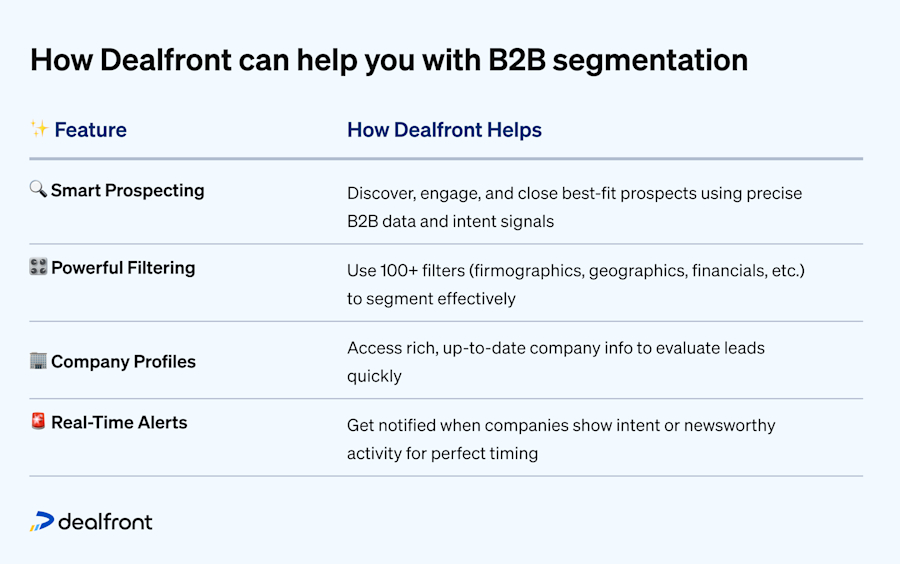
With our platform, you can easily discover, engage, and close the best-fit prospects using precise B2B company and contact data. Focus on accounts showing real buying intent, and expand your target list with advanced machine learning.
Powerful filtering options: Leadfeeder provides compliant data and over 100 filters to help you zero in on your ideal customers. From B2B segmentation variables such as firmographics and geographics to financials, employee details, and more, we’ve got you covered.
Comprehensive company profiles: Quickly evaluate potential customers with accurate, up-to-date company profiles. Let your sales team focus on what matters most—selling.
Stay focused on high-potential prospects: Get notified when a company shows buying signals, wins an award, or makes news. Reach out at the perfect moment, armed with insights to spark meaningful conversations.
Start Your B2B Segmentation Journey Today
That’s it from us. We’ve officially taught you everything you need to know to really nail B2B segmentation.
There’s no time like the present. Get a free demo session with one of our experts today.
B2B segmentation FAQs
What is the purpose of B2B market segmentation?
B2B market segmentation helps you break down your big, broad target market into smaller groups with shared traits. It’s all about making your marketing and sales efforts more focused and effective.
Instead of sending a generic message to everyone, you can tailor it to specific needs, increasing your chances of converting leads into loyal customers.
How can you segment B2B customers?
There are many ways to segment B2B customers. You can segment customers by:
Firmographics: Looking at company size, industry, location, and revenue.
Behavior: Looking at previous purchases and website interactions.
Needs: Looking at specific business challenges.
Technographics: Looking at the tech tools businesses use.
Mix and match these segments to get a better understanding of who you're targeting and make your outreach super relevant.
How do you segment a B2B market?
First, figure out what criteria matter most to your business. Then collect all the info you can through market research, customer feedback, or any existing data you have. Once you’ve got enough insights, divide your market into groups based on those criteria. Then tailor your messaging to each group.

SEM (Paid Search) Manager @ Leadfeeder
Oscar Johnson is Performance Marketing Team Lead at Leadfeeder, where he leads paid acquisition and growth initiatives across global markets. With a background in performance marketing and search engine marketing, he specializes in scaling customer acquisition through data-driven campaign optimization.
Oscar has managed multi-market advertising programs and large paid media budgets while continuously improving targeting, attribution, and funnel performance. His experience managing B2B acquisition campaigns informs his perspective on audience targeting, paid marketing strategy, and optimizing the path from click to conversion.