60-Second Summary
Treating every lead the same wastes time and lets high-value prospects slip away. Lead scoring ranks leads (commonly 1–100) by likelihood to buy so you can prioritize outreach, improve personalization, and protect revenue.
Key takeaways: Lead scoring prioritizes leads most likely to convert using models (demographic, firmographic, behavioral, engagement, negative) and drives better resource allocation, follow-up, personalization, and customer lifetime value.
Standout strategies & tactics: Combine explicit (demographic/firmographic) and implicit (behavior/engagement) models, assign weighted attributes tied to your ICP, set realistic S Q L thresholds via historical simulations, and integrate automation with tools like Leadfeeder and Datacare plus your CRM.
Real-world lessons & frameworks: Involve sales, marketing, and customers when defining attributes; use negative scoring and re‑engagement rules to clean the funnel; prefer multiple complementary models to capture both fit and intent.
Implementation best practices: Run simulations on past data to set thresholds, automate scoring and routing, iterate continuously as customer patterns change, and monitor delivery rates to balance lead quality and volume.
*This summary was created with AI assistance, using our original content.
When you treat every lead the same, you end up spending time on prospects that may never convert while high-quality ones slip through the cracks. That’s not just inefficient. It directly impacts your revenue.
You need a way to structure and prioritize your pipeline so you can focus on the leads most likely to deliver results. That’s where lead scoring comes in. Here’s how lead scoring works, the benefits it brings, and how you can make it work for your business.
What is lead scoring?
Lead scoring is a way of prioritizing leads. That’s it. OK, there’s more to it, which we’ll get into, but the main premise is precisely that clear and straightforward. What’s the priority based on? The lead’s likelihood of buying from you. This is usually represented by a score of 1 to 100.
There are several types of lead scoring, called lead scoring models.
What is a lead scoring model?
A lead scoring model is the system or framework businesses use to score leads. These models can take several forms, from simple point-based scoring to predictive lead scoring, and we’ll review the main ones later.
One important thing to know about lead scoring models is that they concentrate on quite different aspects of the customer. Another is that you can combine multiple models if that best suits your business needs.
Why is lead scoring important?
There are many reasons to prioritize leads. Let’s run through the main ones:
1. It optimizes resources
Because you and your sales team don’t have unlimited resources, you need help deciding where to deploy them. It makes sense to give your immediate attention to the most promising leads. You can then go to work on them, get the conversion, and move to the next on your list.
This might mean that you turn to the lead that’s been waiting in the queue, with the next highest potential. Or, it could mean that you turn to a lead that’s only just come in, and that’s leapfrogged to the front of the line because it’s been scored highest.
The point of lead scoring is to maximize your effectiveness by removing from your work pile those business leads that are less likely to deliver. You can downgrade those ones until time or staffing allows.
2. Gives foundation for follow-up
When the conversion is achieved, you don’t usually want it to end there. There are follow-up communications to be sent concerning service arrangements, product support, and, in time, upscaling options.
Good lead-scoring data will help your follow-up team decide where to deploy their efforts most effectively. In other words, a high-scoring lead is not just good news for initial conversions. It can also mean fruitful territory for further interaction, giving better customer lifetime value.
3. Better personalization
Customers tend to love personalization. It’s great to feel special and that your individual needs are being catered to. A lead score model will help with this because, more than anything else, personalization is based on the information you have about a prospect.
Without data concerning that customer, a personalized experience is impossible. A huge range of data, from customer name and job title to buying history, can make all the difference to your personalization efforts, and lead scoring also involves collecting and analyzing these data varieties.
Lead scoring model examples
So, now let’s turn to the different kinds of lead scoring model templates you can deploy.
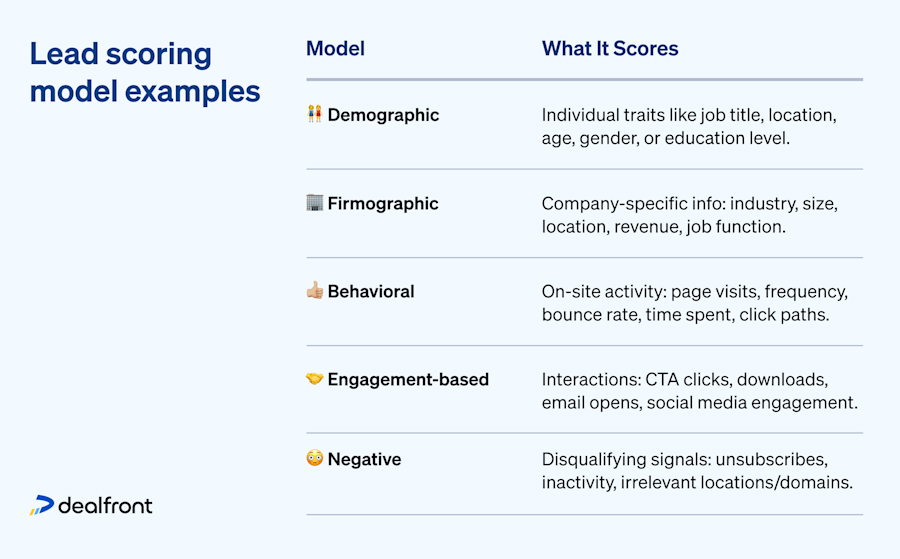
1. Demographic-based model
This is a lead scoring model that uses information about an individual customer, such as job title, age, education level, gender, and location. The premise here is that such characteristics are highly significant in shaping how an individual will approach certain developments.
They may inform their interests, priorities, and attitudes to risk and commitment. These kinds of conclusions can be highly influential in an individual’s decision to buy.
2. Firmographic-based model
This lead score model focuses on information about the company the customer works for. So, the job title is in there, as well as the kind of industry we’re talking about, plus the location, size, and revenue of that company.
Here, the b2b lead scoring model looks at what a company engaged in a particular business is likely to be interested in.
Moreover, this model takes into account the outgoings that the company is likely to be able to cover. If the business is likely to be keen but unfortunately too small to invest in what you’re offering, this should inform the lead score.
Where can you find this kind of information? You could try Leadfeeder’s Datacare. It gives you the means to maintain accurate, clean data across a multiplicity of businesses.
3. Behavioral-based model
The two lead scoring models above were examples of explicit models. They tell us a lot about the lead. The lead score model we’re looking at now is an example of an implicit model. Here, we’re looking at what the lead does.
This kind of model falls onto the latter side of the interest or intent-based lead scoring debate. It assesses how customers interact with your site. How often do they visit? What do they do when they’re there? Do they go to the pricing page, or do they bounce straight off from the landing page?
All these factors can tell you a huge amount about the lead’s intent and enable you to decide whether this lead means business or is merely passing through.
4. Engagement-based model
This is another implicit lead-scoring model that looks at behavior, but of a specific kind. Your site will offer several ways for customers to engage, and it’s this aspect that’s key here. (If your site doesn’t offer this, maybe you should go and take a look at it—you may be missing out on a key deliverable.)
This engagement might involve the customer clicking on one of your CTAs. This would be a clear indication of commitment to what you’re offering. Or, it might include them downloading some product information from your site or emailing the contact address. Or, perhaps they get involved with your social media posts.
Whichever engagement path they choose, this model scores their moves so that you know immediately who seems most interested in you.
Check out our Playbook on how to engage with open opportunities that are visiting your website to ensure you’re making the most of the prospects that are engaging with you.
5. Negative lead scoring model
All the lead scoring models we’ve discussed so far have shared a positive scoring approach. By this, we mean that if something looks likely to increase a prospect’s appeal, they’ll get a point added to their score. In this last model, however, we’re looking at the other side of the coin.
Particular traits or behaviors indicate a lower likelihood of conversion. These can include really obvious ones, like unsubscribing or engagement dropping to zero for a prolonged period. Customers exhibiting these behaviors will be negatively scored.
In addition to these top-line behaviors, other factors may lead to a negative score. A generic rather than business-specific email address, for example. Or an IP address that indicates that the customer is geographically situated outside your business’s target area.
What you do as a result may vary, depending on your policy and resources. You may wish to offer a re-engagement incentive, for instance. Or you may decide that you’ll have to eliminate these leads from your activity, as they’re just not very enticing. Hey, you can’t win them all. And at least this way, you end up with more time to devote to the promising ones.
How to build the best lead scoring model for your business
You may be thinking to yourself that all you need to know right now is how to create a lead-scoring model that’ll work for your business. Here’s how:
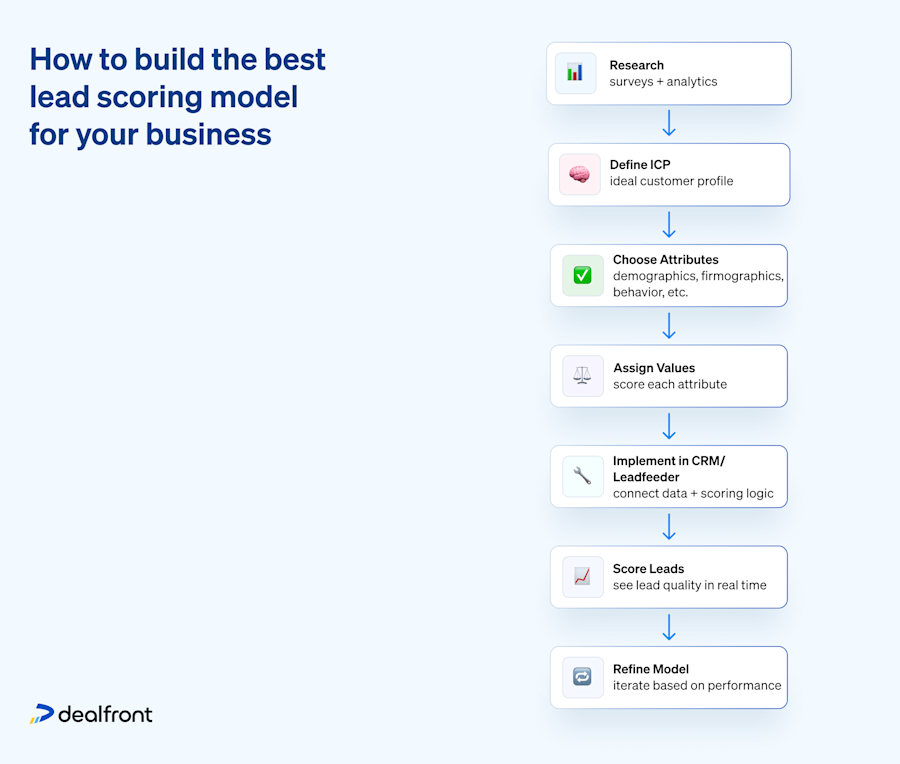
1. Do your research
The first step towards great B2B lead-scoring models is to understand your customers. And you don’t do this in a vacuum. You’re going to need some expert opinion here, so bring in your sales and marketing teams and listen to their observations.
Don’t forget to consult those with the most expertise of all: Your customers. By engaging with them on what makes them tick, you’ll find out a lot more than by just observing them. So, conduct surveys to identify the background factors behind your customers. You may find that certain constants emerge.
And here’s a bonus: Surveys can also be effective promotional tools. You can include all kinds of product mentions as you dig into your subjects’ backgrounds. You can then combine this research with robust analytics of customer behavior and intent data.
Once you know your target customer, you’ll be better able to determine what characteristics you’re looking for in a lead. This leads us to the next point.
2. Choose the attributes to score & assign values
So, you’ve got your ideal customer profile. Now it’s time to transfer the key characteristics to your lead scoring model. Age and gender are two lead scoring criteria examples that could be major considerations. For example, a new donut line tied to Disney’s latest cartoon isn't necessarily going to win over many customers in the senior bracket.
In another example, your data might make it pretty clear that, for one reason or another, your B2B service seems to be a stronger winner with women than with men. In that case, you may decide that female leads should score higher than male ones.
This is just using data from the demographic model, of course. Let’s look at the firmographic approach. Sometimes, the business an individual works for can be more significant for conversion likelihood than any personal factors.
For instance, your sales intelligence may tell you that there’s going to be a bit of a boom in domestic goods, the kinds of products that sell particularly well remotely. You sell contact center solutions that can scale a business operation to meet the highest demands. However, this gear comes at a cost.
Firmographic information will tell you whether your lead is in the right area of activity and, crucially, what their company can likely afford. If things look good, they get a good lead score. Such data will soon focus your efforts on the most productive leads.
3. Decide if one score is enough
You can use more than one lead scoring model template at the same time if you like. Sometimes, this tandem approach yields more information about what you’re looking for in a lead.
Remember that we’re none of us entirely reducible to a set of demographic factors. There’s so much more to us than just our age and gender. Similarly, concentrating solely on what a person does online will only tell you a certain amount about that person. It’ll tell you what they click on, but not always why.
If you can add firmographic data indicating that the individual clicked the CTA because their business appears to be expanding, that could make a big difference. All of a sudden, you’re beginning to understand motivation, a key part of putting yourself in the shoes of that customer.
So, it might be that combining two scores gives you the rounded picture you need for your lead management.
Lead scoring best practices
Let’s finish by looking at some best practice tips that will help you ensure that your lead scoring model’s implementation goes as smoothly as possible:
1. Define a threshold when a lead becomes sales-qualified
The thing about empirical scores is that they gain value only when a threshold is applied. By this, we mean you have to decide at what point a lead score indicates that this lead should be prioritized and sent down the funnel to the next stage.
Set the score too low, and you may be swamped with leads of varying quality. This tends to defeat the object of lead scoring in the first place.
Set the score too high, and you only ever get the creme de la creme of leads. Sounds great, but the trouble is that you may go for months before you actually get one that measures up, even if you go all out to boost lead generation. So, be realistic. You want a manageable rate of high-quality leads coming through.
A good idea is to run a simulation with past data. This can show you the kind of delivery rate you can expect once you start for real. You can then decide if it’s too low, too high, or just right. Goldilocks, eat your heart out.
If you’re going to end up with numerous leads coming through that you’ll struggle to accommodate, then you may use this information to justify investment in your sales team to give you better capacity. After all, it would be a shame to wave goodbye to those possibilities.
2. Use the right tools to streamline lead scoring
Do you thinking this all sounds great, but is too much for you to handle right now? Happily, there are some great tools out there that can help you get your lead scoring model off the ground and deliver great quality leads in no time.
Use Leadfeeder, for instance, to manage your lead scoring, and you’ll get loads of the work done with no effort from you. Companies that you’ve targeted as especially of interest to you (because of their area of activity, position in the industry, or alignment with your ICP) can be automatically tracked and scored for you, with insights served at a frequency you can decide.
Other data, such as behavioral insights into how long customers spend on your site, is all available for use and can be combined with a multitude of other factors to keep your lead operation healthy and productive.
Leadfeeder also integrates seamlessly with your existing tech stack, including Salesforce, Zoho, HubSpot, and other CRM platforms.
3. Continually iterate and improve
Lead scoring is never 100% complete. It’s an ever-evolving tool that changes as the world changes.
For instance, some who decide to buy from you may be outside your existing ideal customer profile. This might be an aberration, or it might represent a trend that you need to factor into your target customer construct.
You then need to decide on the emphasis you should put on these new characteristics when it comes to lead scoring.
What will eventuate is a series of reiterations of lead scores, so that your lead score model stays current and relevant as needed.
Leadfeeder can help support any lead scoring system
So, we’ve learned that you have a good selection of lead scoring models and can combine them to provide a good fit for your business needs. The great news is that Leadfeeder has the tools to support you no matter which lead-scoring model (or models) you choose.
Using solutions such as Leadfeeder to manage your lead scoring and Datacare to assist with the quality of data you’ll need, you’ll be ready to start enjoying the benefits of lead scoring in short order.
All too often, when you find out about a game-changing technique, it comes with a lot of work to be done. It’s not often that you get to learn about one at the same time as discovering a totally trouble-free way of implementing it. You’re welcome.