60-Second Summary
E‑commerce conversions usually fail because of friction in the buying journey—not a lack of traffic. Identifying where visitors drop off and fixing messaging, support, trust, and functionality can turn visits into sales.
Key takeaways: Most lost sales are caused by specific friction points—confusing checkout, weak messaging, poor support, mismatched ads, brand trust gaps, or basic site bugs—and small fixes can yield big gains.
Standout strategies & tactics: Proactively identify and reach out to high‑intent visitors (e.g., via tools like Leadfeeder), ensure message match from ad to landing page, and layer chatbots, virtual assistants, and in‑house support for rapid help.
Real-world lessons & frameworks: Audit every touchpoint (ads, landing pages, support, checkout, mobile performance) and apply a tiered support model—chatbot triage, virtual assistants for moderate issues, in‑house for complex cases.
Quick fixes to implement: Match ads to landing pages, speed up and simplify checkout, add live/helpful support, showcase brand values, and fix basic site bugs across devices to immediately boost conversions.
*This summary was created with AI assistance, using our original content.
That is what makes e-commerce so frustrating. You can invest in ads, optimize your website, build a strong social presence, and create offers people genuinely want, only to watch potential customers leave without buying. After all that effort, missed conversions feel like wasted opportunities.
The truth is, leads rarely disappear for no reason. Something in the buying journey is pushing them away. It could be a confusing checkout process, weak messaging, slow customer support, lack of trust, or a shopping experience that creates friction at the wrong moment. Small issues often create big losses.
If you clicked this article, chances are you have an e-commerce store and know exactly how frustrating that can be. You want more than traffic. You want results. So what is stopping your leads from becoming customers, and what can you do to fix it? Let’s get into the most likely reasons.
Note: Try Leadfeeder's 14-day trial to increase ecommerce leads from the visitors you already have.
1. You’re being insufficiently proactive about ecommerce sales leads
When the e-commerce industry first began to achieve mainstream success and tempt retailers away from the traditional brick-and-mortar model, those making the leap had to accept one thing in particular before they could be successful: sitting back and waiting for shoppers to arrive is not an option for e-commerce sellers.
Get a conventional store in a convenient location, and you can pick up sales without too much effort. Online, all locations are comparably convenient.
To have your store found at all, let alone chosen, you must put serious effort into marketing your business. SEO, PPC campaigning, influencer promotion… There are many possible methods for doing this.
Sellers often err, however, in thinking that proactivity ends at lead acquisition. From there, they determine, everything can (and should) be left to the shopper.
This is ill-advised.
If a relevant consumer lands on your store, takes a look around, and leaves without taking any action, should you really just chalk that lead down as a loss? This is where knowing how to generate leads for ecommerce website visitors who leave without buying matters.
Using Leadfeeder, you can identify the companies visiting your site, compare that list with the set of companies ordering from you, and pick out the notable prospects that evidently had enough interest to visit your site but weren’t convinced.
By reaching out to them, you might be able to persuade them to reconsider: at a minimum, you should be able to get some useful feedback to help you improve your store.
2. Your customer support isn’t good enough
Mobile ecommerce allows us to indulge our retail whims: if you wake up at 2 am and decide that you really need a new cowboy hat, you can reach for your smartphone and order one before the rational part of your mind can shake off the cobwebs.
But what if you find an ambiguous product description and you’re not sure what you’re dealing with?
If there’s a support ticket system, you can log a ticket, but you probably won’t care to for a purchase you considered on a whim.
You either get support immediately or you leave. It’s often that simple, and some sellers often fail to take that into account.
Big retailers don’t, of course.
Customer service expectations have risen dramatically over the years, pushed along by a combination of in-house support, virtual assistants (sourced from across the world to cover all hours of the day), and chatbots.
Go to any big retail site, and you’ll find some kind of live chat system to answer your pressing queries.
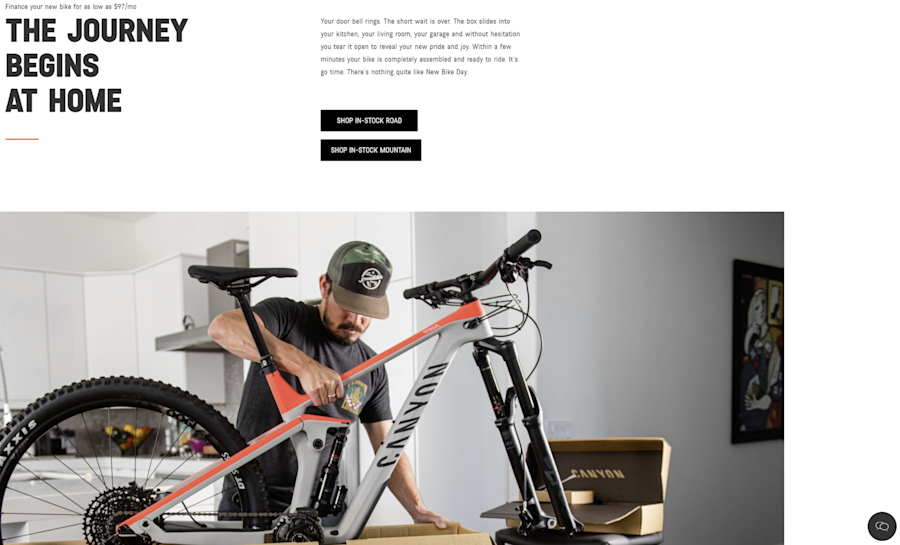
Check out the Canyon site, for instance, and you’ll see that tell-tale icon at the bottom right (see above).
Offering any one of those elements might not be enough. You can cover a lot of ground supplying automated replies with a chatbot (and it’s relatively easy to build a chatbot with a chatbot platform), but they’ll never be as natural as replies from real people.
Virtual assistants are convenient, but hard to train and manage. In-house assistants can handle high-level issues, but their schedules are limited.
Think of it as a matter of scaling.
Queries can be assessed by chatbots, then handled by them if they’re basic or passed to support assistants if they’re not.
Moderate issues can be handled by virtual assistants, and complex issues by in-house support assistants. Optimize your customer support and your leads will prove much more effective.
3. It’s failing to match the incoming messages
Message match is exceptionally important in lead generation, yet it’s an area that consistently sees basic mistakes.
Imagine that you saw a Google Ad saying “Big Sale on Red Leather Coats!” and thought “Ah, excellent, I’ve been meaning to buy a new red leather coat but haven’t been willing to pay full price” — it would seem that you’d found an opportunity highly relevant to your interests.
Now imagine that you clicked on that ad and arrived at a page displaying only fabric shirts, none of them in red, with no indication of any sale or discount pricing.
Those shirts might be spectacular and fully deserving of attention, but you’d most likely leave immediately because you clicked for a specific reason.
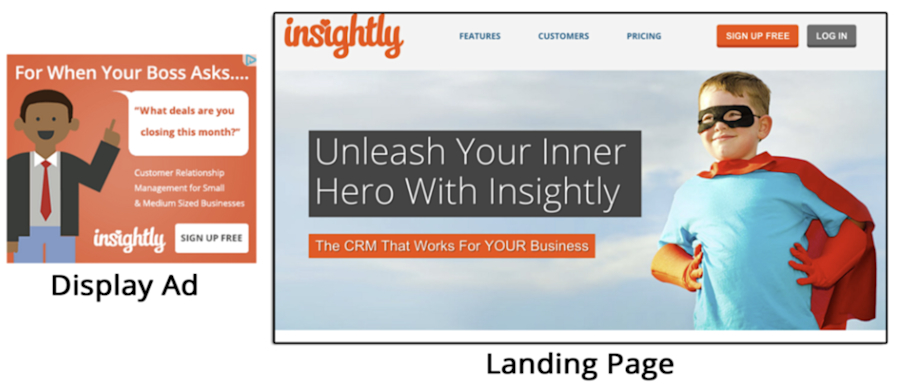
The above example (cribbed shamelessly from Wordstream) shows that Insightly gets their message match disastrously wrong. The ad uses standard business visuals, and the landing page uses… superhero visuals. Not exactly a natural fit.
The promises or suggestions that are bringing prospects to your site must be addressed immediately upon arrival.
Review all your lead sources: everything from PPC ads and influencer mentions to SERP listings and customer referrals.
If your store is being misrepresented at any point, that needs to change. Better to have no leads than false leads, because people tricked into reaching your site will sap your marketing budget and be less likely to return.
4. Your brand doesn’t seem to deserve support
Every online seller needs some unique selling points.
In many cases, it’s enough to have the lowest price for a particular product, or fulfillment options that comparable sellers don’t provide, but there’s a major problem with trying to get ahead through those standout elements: consumers are increasingly determined to buy from brands they find laudable.
They care more than ever about sustainability, ethical operations, and the fair treatment of workers.
They’re willing to spend more and accommodate more inconvenience to get the products they want if they know they’re supporting good companies in the process.
If you’re consistently bringing in people interested in what you’re offering, seeing them go elsewhere, and finding it hard to understand why your offer isn’t compelling, there’s a solid chance that this is a contributing factor.
Use social media to showcase your brand’s personality and let people know what motivated you to start the business.
Provided you’re indeed worthy of support, learning about the people behind your operation will leave potential buyers far more likely to choose you above your competitors.
5. The site has basic functionality issues
Lastly, you’re obviously going to struggle to convert leads if your site has basic functionality issues.
Missing pages, confusing category titles, product filters that don’t work: even an issue that seems relatively trivial can frustrate a visitor enough to drive them away.
How can they expect a seller with such a weak website to provide good products and impressive service?
Your bias can blind you to the reality of the site you developed, so take the time to review it from a shopper's perspective.
Test everything to ensure it does what you expect. Access it from various mobile devices and under different conditions (e.g., high-speed Wi-Fi and low-speed mobile data) to confirm consistent operation.
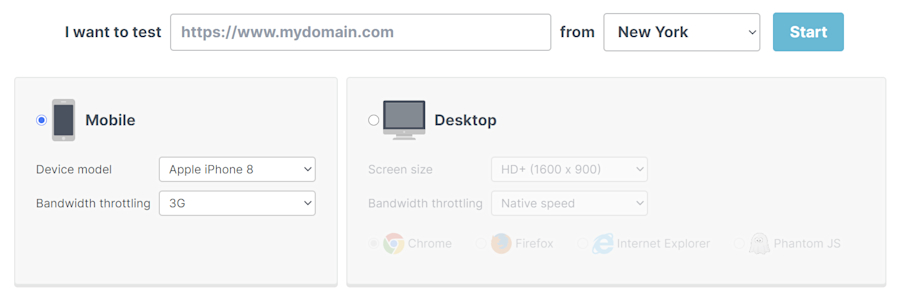
Very usefully, Uptrends offers a tool (pictured above) that lets you test a site with mobile data throttling. I suggest giving it a try.
If you find various foundational problems, then you must address them as a matter of great urgency, because they’ll be undermining the perception of your brand at the same time as they’re losing you sales. Get your store polished to a mirror shine, then look for other areas to improve.
Turn More Ecommerce Store Leads Into Sales
Don’t waste your e-commerce skills setting up qualified leads that ultimately fail to drive conversions. Knowing how to get leads for ecommerce website traffic starts here: hone your store to the extent that it’s an efficient sales machine, making it as easy and desirable as possible for an interested visitor to place an order.
Every touchpoint matters, from the first click to the final checkout confirmation. The brands that consistently convert are not always the ones with the biggest budgets or the widest reach. More often, they are the ones who remove friction, build trust, and create a seamless buying experience from start to finish.
Note: Try Leadfeeder's 14-day trial to maximize your ecommerce lead generation.