That creates a challenge for traditional sales. Why would buyers trust a pitch from someone they do not know when they can access endless information and hear directly from customers, peers, and industry experts? Most will not. Buyers are skeptical of empty promises, polished sales talk, and reps who disappear once the deal is closed.
What buyers do trust is expertise. They trust companies that understand their challenges, offer practical advice, and focus on solving real problems instead of simply making a sale. When you prove that you understand their situation and genuinely want to help, trust begins to form.
In today’s B2B market, trust is not optional. It is what gets you considered in the first place. Buyers need to trust you before they even consider doing business with you.
Educating Prospects to Remove Friction Points

When B2B buyers go on the hunt for answers, they want them fast – but they also want to be in charge of their own education when it comes to solutions. As such, they want to get to know a company before making any concrete deals. That’s why you need to stop selling and start teaching.
Since today’s buyer journeys are so complex and individualized, you must make calculated moves with your target buyers in mind. Get your most important selling resources ready to rock and readily available so you can share them with people at a moment’s notice.
You’ll find that many of your prospects want the same information. They want to know about who you are as a company, how your products and services can help them accomplish their goals, and what makes you different from your competitors.
Show the benefits of your products and services – not just the features. Remember, you’re solving a problem for your audience.
Make sure this information is all prominently displayed on your website, so prospects can learn about you before they’re in touch with you. Make sure your “About” page provides all the key details about your company, such as how long you’ve been in business, what makes you a credible source in the industry, and who your senior executives are.
One of the most effective onsite content tactics that helps in this context is to include a frequently asked questions (FAQs) page. This way, answers are clearly available to the most common questions, and you’ll also find that you need to repeat yourself to all of your prospects less.
Make your contact information easy to find, in case the prospect has questions they can’t answer for themselves after browsing your website and reading your FAQ page.
The Trust Pyramid, Email Capture, and Social Selling
User experience thought leader Jakob Nielsen’s firm, Nielsen Norman Group, recently published an interesting essay that applies Maslow’s “hierarchy of needs” psychology theory to online lead capture. At the center of this discussion is the “pyramid of trust,” whereby sales prospects progress through a series of commitment levels as they build relationships with brands.
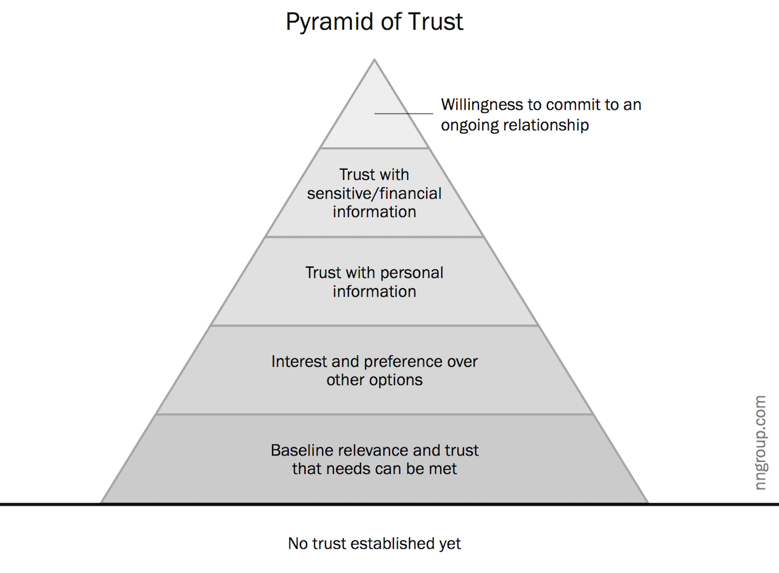
The relationship starts with zero trust and moves on to baseline relevance, once your prospects see that you might be able to help them.
At the next level, you’ve built trust to the point where your prospect is interested in what you have to say and begins to favor your brand over other available options. You’ve proven yourself to be more trustworthy than the competition in some shape or form – be it because you have a better price, better customer service, or better features.
At the next level, your prospect begins to trust you with personal information, such as an email address. Many people are cautious about sharing this sensitive information, so this is a major step in the journey.
Email provides a way for you to communicate with your prospects off your website – to help them learn more about you, and what you have to offer. Email gives you permission to connect with them, but once you’ve got it, you need to deliver useful information regularly. If you disappear or don’t deliver what the prospect expects, you’ve lost them.
If your nurturing emails are effective, then they’ll trust you with sensitive and financial information. This means that you’ve established trust to the point where you have a customer. If you succeed at delivering value to customers, then they’ll trust you enough to forge long-term business relationships, which are expressions of the highest level of trust.
Nurturing Outside the Inbox
It all runs smoothly as long as you continue to build trust. Problems often arise when sales and marketing teams pitch too early in the process. Of course, you don’t want to pressure someone to do business with you before you’ve gotten to know one another, but the same principle is true when it comes to email capture. Asking too early is a turnoff.
To obtain access to someone’s inbox, you have to make promises. On your lead capture forms, you should always tell your prospects exactly what you’re going to do with their email addresses.
Some of your prospects will give you their email addresses to get access to a free report or eBook you have to offer, but even this is actually quite a weighty exchange, so it won’t convert all that many strangers. Although there’s no money in this transaction, there is still a lot of value involved.
Leadfeeder helps enrich the data we find with our Leadfeeder Tracker code. Leadfeeder shows you which companies are visiting your website, and even see if you have any LinkedIn connections in common. You can filter your leads by industry, country, or the pages they visit to see where they are in your sales funnel.
Then, you can use Twitter, LinkedIn, and other channels to reach out to people from these companies to provide the wisdom they’re looking for. This way, you can establish trust without having to ask for an email address.
Trust Is Everything
Customers want to know you’ll take care of them – not just by providing a quality product or service, but also by respecting their privacy. They want to know their email addresses and sensitive financial details won’t be abused. They want to know they’re safe with you.
If there’s any reason they doubt their safety or priority to your business, they’ll simply avoid doing business with you altogether. By building relationships over time and demonstrating that you’ve got their best interests at heart, you’ll close more deals that delight more customers.