60-Second Summary
Outsourcing B2B lead generation can deliver quick volume and tested playbooks, but agencies frequently prioritize scale over qualification, producing low-value leads. Building lead generation in-house—or adopting a hybrid approach with lead-gen software like Leadfeeder—gives more control, better-quality prospects, CRM integration, and stronger sales alignment.
Key takeaways: Agencies bring speed and cross-industry experience but often sacrifice lead quality and timing control; in-house teams deliver higher qualification, better alignment with sales, and stronger CRM/SEO integration—though they require more investment and staffing.
Standout strategies & tactics: Prioritize lead qualification over raw volume, require CRM integration and SLAs from partners, use SEO and on-site analytics to surface intent, and combine internal expertise with lead-gen tools to scale without losing quality.
Real-world lessons & frameworks: Expect only ~5–10% of captured B2B leads to be conversion-ready; measure conversion-ready rates, iterate on ICPs using sales feedback, and maintain rapid follow-up windows to maximize conversion.
When to choose hybrid tools: Use agencies for quick tests or market entry (with strict quality requirements); invest in in-house teams plus lead-gen software for long-term pipeline health; hybrid setups capture the efficiency of outsourcing while preserving control and CRM workflow.
*This summary was created with AI assistance, using our original content.
However, choosing to outsource B2B lead generation is not always the answer. Many agencies promise results but deliver low-quality leads, which wastes your time, money, and momentum.
In fact, agencies often prioritize scale, which can increase lead volume but reduce qualification quality. In B2B markets, only about 5 to 10% of leads are typically ready to convert at the moment of capture. By the time you realize it, you may have already invested heavily in marketing and sales strategies that do not work.
The good news is that you do not have to rely on external agencies. Building your lead generation in-house gives you more control, better-quality prospects, and stronger alignment with your sales goals.
This guide breaks down the key differences between agency-based and in-house lead generation so you can choose the approach that delivers real results.
Lead generation agency
A lead generation agency provides an outsourced solution to a common problem among today’s top salespeople: the need for insight into potential customers or clients. The agency plays an instrumental role in identifying leads that need additional nurturing.
Some lead-gen agencies go beyond merely gathering lead details, continuing their work with potential customers after they become full-blown clients. Agencies may even provide initial email marketing or appointment-setting services. The intention is to streamline the onboarding process.
With this approach, the agency acts as an early liaison between the prospective client and the business.
Pros of using a lead generation agency
Producing top-notch leads takes considerable time and effort, and some businesses may lack the resources to generate effective leads. SMBs, in particular, often struggle to acquire proper personnel to find or make the most of quality leads.
In such situations, a lead-generation agency may be desirable. This resource enables businesses to offload some or all of the lead generation process, freeing them to focus on other pursuits.
Another advantage is speed. Agencies already have systems, tools, and processes in place, which allow them to start generating leads much faster than building a team from scratch. This can be especially useful for businesses that need immediate results or want to test new markets without committing long-term resources.
Agencies also bring experience from working with multiple clients across industries. This exposure can help them identify proven strategies, avoid common mistakes, and implement campaigns more efficiently. For companies without prior lead-generation expertise, this outside perspective can serve as a helpful starting point.
Cons of using a lead gen agency
When your schedule and staff are stretched thin, it can be incredibly tempting to seek short-term solutions to remove some of the burdens. However, these temporary opportunities can often turn into long-term headaches.
At the outset, these services appear to fulfill an important function —quickly securing a high volume of leads for businesses struggling to identify prospective clients. Over time, however, disappointed lead-gen clients notice a discrepancy between quality and quantity.
The leads so swiftly acquired by these agencies reveal themselves as not relevant to the businesses you aim to serve. Lead gen agencies often focus on quick fixes, which prevents them from developing an in-depth understanding of buyer personas or ideal customer profiles.
The result? A long list of leads that provide a minimal return on investment. Without a targeted approach, lead-gen agencies end up sending you leads that aren't qualified for your target audience or your general B2B marketing approach.
Beyond this core problem, additional downsides of working with a lead gen agency might include:
No control over timing: The timing of your leads matters, including their journey through the sales funnel. Unfortunately, timing can be difficult to control when you rely on lead gen agencies. These services may rush the sales funnel rather than maintain the slow-and-steady process that genuine nurturing requires.
No CRM integration: Where do qualified leads go once they have been identified and vetted? Ideally, your streamlined workflow will include integration with your customer relationship management (CRM) solution. This should optimize the transition from lead to prospect to client. Unfortunately, lead gen agencies often neglect to provide easy CRM integration.
In-house lead generation
Businesses that keep lead generation in-house employ B2B marketing professionals who are highly trained in — and passionate about — lead generation and nurturing. Enterprises with large marketing departments may be able to use lead generation specialists, while others may need to involve generalists, such as marketing assistants.
Pros of keeping lead generation in-house
If you want to make the most of every lead, in-house lead gen is the way to go. This curated approach delivers the specific types of leads your business requires, as it relies on professionals who are intimately familiar with your brand and your target client.
Instead of wasting time on irrelevant leads that don't pan out, an in-house team lets you focus on prospects most likely to convert, delivering the greatest ROI. Other advantages worth considering include:
Real-time access: With lead nurturing, time is of the essence. The sooner you follow up with qualified leads, the more likely you are to achieve higher conversion rates. In-house solutions offer a significant advantage in terms of timing, as they provide direct access to leads.
Search engine optimization: SEO can complement and enhance lead-generation efforts by bringing extra traffic to your website. With the right lead-gen solution, this traffic can be analyzed to identify which visitors are the most qualified leads. Lead gen reps typically don't provide high-quality SEO services. Therefore, SEO, like lead gen, will ultimately be more targeted and effective if it remains in-house.
Alignment with marketing campaigns: Brand consistency is key to developing trust among both leads and current clients. But this quality can be difficult to maintain when you rely on outside agencies that don’t specialize in your niche. When lead generation is completed in-house, leads are more likely to be selected based on the realities of your current marketing campaigns.
Fine-tune the process with the data: When you manage lead gen in-house with a tool like Leadfeeder, you’ll stay on top of it. The LF sales leaders constantly review their funnels and sales cycles, always adjusting to the market, new offerings, customer requests, and more.
Cons of keeping lead generation in-house
In most situations, an in-house lead gen strategy will produce higher-quality leads that are more likely to respond to your nurturing efforts. Still, there are caveats. There's a reason so many businesses choose to outsource lead generation services: the struggle to handle complex inbound and outbound marketing processes independently.
As already touched on, lead gen is a labor-intensive process that requires highly trained, deeply passionate employees. Depending on the scope of your marketing department, you may find it difficult to retain enough talented professionals.
If you're unable to scale up, you may quickly find that a few overworked marketing employees are forced to handle a wide range of concerns. This could leave hardworking staff members unable to focus exclusively on lead generation or anything else.
On the other hand, such limitations don't necessarily mean you need to avoid in-house solutions altogether. Consider developing a streamlined workflow if you prefer not to use traditional lead gen agencies. Otherwise, while your leads may be of sufficient quality, you simply won't have the time or attention to improve their quality.
Lead generation in-house vs outsource: the key differences
Choosing between a lead generation agency and an in-house team depends on your goals, budget, and resources. Each approach has clear advantages and trade-offs in terms of cost, control, speed, and lead quality. The table below highlights the key pros and cons of both options for a quick comparison.
Should I outsource lead generation? Choosing the right process for your company
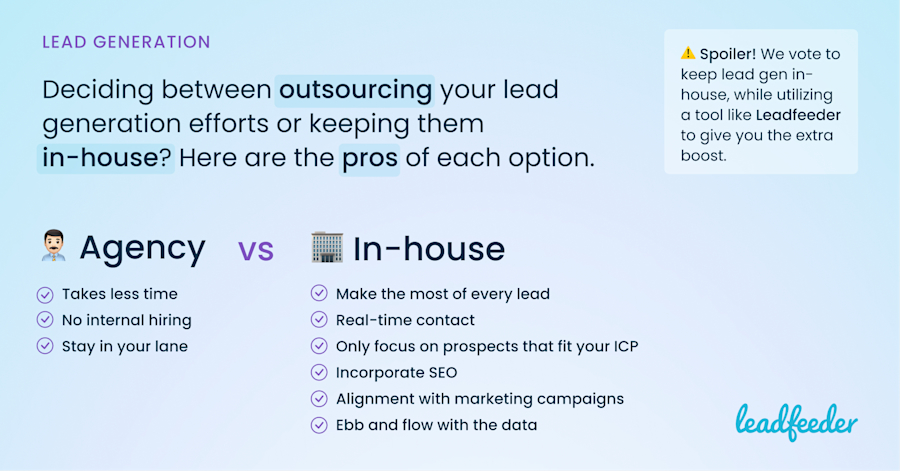
While outsourced agencies and in-house lead gen are the two main approaches to lead generation, these are by no means the only options available for scoring high-quality leads. In all likelihood, you'll benefit most from a middle-ground option that considers both systems' advantages and concerns.
The ideal solution for your next lead generation campaign is an in-house marketing team that benefits from lead generation software. This captures the efficiency of lead generation services while giving your marketing team much-needed control.
The right solution will help you make the most of existing leads you've previously struggled to identify. Advanced software can use current website traffic to generate qualified leads. These are then scored and segmented to help you prioritize.
Once the best leads are identified, they'll automatically be added to your CRM and integrated into your current sales structure. This frees your marketing team to focus on nurturing leads and building strong relationships.
How to set up lead generation processes in your company
It’s one thing to know you’re ready to up your lead generation strategy, but it’s quite another to get the ball rolling. Our experts at Leadfeeder know the undertaking this can be.
A few simple adjustments in your company could make a world of difference for your sales team. We can help with various resources to point you in the direction you want to go. Of course, we first recommend starting with a free 14-day Leadfeeder trial.
If you’re going with in-house management, Leadfeeder is the perfect accessory for your sales team. I love this article titled, “How Leadfeeder Uses Leadfeeder” — this shows how you can utilize the software as an internal team.
Start with understanding how lead generation works and how to build your best approach to getting valuable leads.
Next, find helpful information on key metrics, demand generation, social media marketing, PPC strategies, and more.
Blend the benefits of in-house and outsourced lead generation
Whether you're new to building a lead generation process, weighing how to outsource lead generation, or looking to change up an established strategy, Leadfeeder is the right choice for your biz. We offer the best of both worlds: the targeted approach of an in-house team and the streamlined solutions of an outsourced lead-gen agency.
We aim to help your outbound and inbound marketing systems work as efficiently as possible. In turn, you reach your goals by not having to rely on a “typical” lead gen agency.
Leadfeeder empowers your sales team to find and make the most of exceptional leads. Get in touch today to learn more about our lead generation solutions. We’d love to get you started with a free trial.