60-Second Summary
Today's B2B buyers research independently and often form shortlists before engaging vendors, leaving many buying signals invisible to traditional lead generation. Buyer intent data uncovers that hidden activity so marketing and sales can prioritise the right accounts at the right time.
Key takeaways: Buyers form shortlists early (Forrester/TrustRadius); intent signals (website, search, CRM, third‑party) close the visibility gap so teams can target accounts showing real purchase behaviour.
Standout strategies & tactics: Combine first‑party signals with second/third‑party data, score accounts by fit + intent, prioritise recent high‑intent actions (pricing, product pages, demos), and use ABM, personalised ads and timely sales outreach.
Real‑world lessons & frameworks: Prioritise high‑fit, high‑intent accounts, incorporate signal decay into scoring, measure impact with MQL→SQL, pipeline velocity, win rate and cohort analysis, and ensure vendor transparency and privacy compliance.
Quick start framework: Start with first‑party signals, define your ICP, build a simple fit+intent scoring model, activate one sales workflow (notify on threshold), then measure results and iterate.
*This summary was created with AI assistance, using our original content.
Today’s buyers prefer to research independently. They read articles, compare vendors, watch webinars, ask their network for recommendations and build shortlists before they enter your sales funnel. By the time many companies realise a prospect is in the market, the key decisions may have already been made.
According to Forrester, 92% of B2B buyers enter the purchasing process with a shortlist already formed, while 41% begin with a single preferred vendor. TrustRadius found that 78% of buyers chose products they had already heard of before starting their research, and 71% went with their top initial choice.
This creates a visibility problem for marketing teams. Traditional lead generation only captures a small portion of buying activity. Form fills, demo requests and event registrations remain valuable, but they mostly appear later in the buyer’s journey.
Buyer intent helps close that gap. It refers to the signals that indicate a company or individual may be actively researching a solution. Those signals can come from many sources, including:
Website visits and content engagement
Search behaviour and topic research
CRM, marketing automation and sales activity
Third-party intent providers and partner networks
When used effectively, buyer intent data helps teams focus on accounts that show genuine buying interest rather than relying on gut instinct.
In this guide, you'll learn what buyer intent is, the different types of intent signals, where intent data comes from, how to identify and score buying activity, and how marketing and sales teams can use those insights in practice. We'll also cover privacy considerations, ROI measurement, and a practical framework for getting started.
What is buyer intent?
The buyer intent definition is simple: the behaviours that suggest a person or company is actively researching, evaluating or preparing to buy a product or service.
These behaviours create clues about where a buyer is in their decision-making process. A single action rarely tells the full story. Someone might read one article out of curiosity and never return. Someone else might visit your website several times, compare solutions and engage with multiple pieces of content over a short period. The second pattern provides a much stronger indication of buying intent.
This distinction is important because buyer intent is a concept. So what is buyer intent data? It is the information collected from those behaviours. For example, buyer intent might be reflected through actions such as:
Reading content about a business problem
Comparing different solution providers
Returning to the same website multiple times
Visiting pricing or product pages
The behaviours themselves represent buyer intent. The information gathered from those behaviours becomes buyer intent data.
The buyer intent funnel
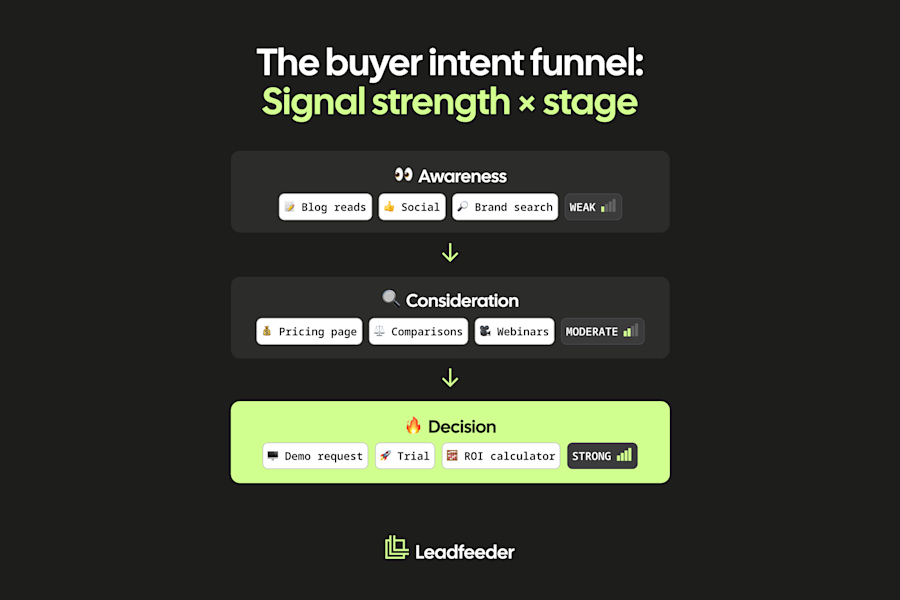
Buyer intent develops over time. Most buyers move through several stages before making a purchasing decision:
Awareness - The buyer recognises a challenge or opportunity. They search for informative content and begin researching the topic.
Consideration - The buyer begins exploring possible solutions. They compare approaches, evaluate options and research vendors.
Decision – They narrow the field by reviewing specific providers, visiting pricing pages, requesting demonstrations and assessing commercial fit.
Intent signals generally become stronger as buyers move through the funnel. A visitor reading an educational article may be exploring a problem. A visitor reviewing pricing information is usually much closer to making a purchasing decision.
Buyer intent vs customer interest
Not every interaction means someone is preparing to buy. People visit websites for all kinds of reasons. They might read a blog post after seeing it on LinkedIn, download a research guide, or visit a site once and never return.
Buyer intent looks different. Someone researching a purchase is more likely to come back multiple times, compare solutions, visit product or pricing pages, and spend time evaluating specific options.
The difference comes down to context. A single visit may indicate curiosity. A pattern of research and evaluation is much more likely to signal genuine buying activity.
Why buyer intent matters in B2B
The way people buy B2B products and services has changed. Buyers now complete much of their research by themselves. They compare solutions, read reviews, consume content and gather recommendations long before contacting a vendor. According to Gartner, 67% of B2B buyers prefer a rep-free buying experience.
As a result, vendors frequently enter the conversation far too late. By the time a prospect fills out a form or books a demo, they may have already narrowed down their options. At that point, the shortlist may already be set.
At the same time, reaching potential buyers is becoming harder. Paid media costs continue to rise. Organic visibility faces growing pressure from changing search algorithms and AI-generated search experiences. Marketing teams must work harder to prove their activity contributes to pipeline and revenue.
Why traditional lead generation misses this activity
Most buying activity leaves no obvious trail. Prospects don’t publicly announce that they've started evaluating solutions. Instead, they search for and consume content across vendors’ websites, industry publications and review platforms. Much of that activity happens before any form submission or sales conversation.
This creates a gap between what buyers are doing and what revenue teams can see, which leads to missed deals. According to Forrester, 86% of B2B purchases stall during the buying process, while 81% of buyers are dissatisfied with their chosen provider. The opportunities are out there, but when you don’t have that essential visibility into buyer behaviour, it’s much harder to identify genuine opportunities and influence buyers at the right moment.
The business value of buyer intent
Buyer intent helps teams focus on signals that indicate active research and evaluation.
For marketers, that can mean:
Targeting audiences more precisely
Reducing spend on low-interest accounts
Improving campaign efficiency
For sales teams, buyer intent can help:
Prioritise the right accounts
Deliver more relevant outreach
Engage while interest is still fresh
Perhaps most importantly, buyer intent gives marketing and sales a shared view of opportunity. Instead of measuring success by lead volume alone, both teams can focus on accounts showing meaningful signs of buying intent.
Types of buyer intent
Not all buyer intent signals carry the same weight. Some suggest a company is close to making a decision. Others indicate early research that a purchase could be weeks or months away. Understanding the difference helps your teams prioritise their time and respond in the right way.
Active buyer intent
Active buyer intent refers to behaviours that suggest a company is actively evaluating solutions. These signals typically appear during the later stages of the buyer intent funnel, when buyers have moved beyond general research and started assessing specific options.
Examples include:
Searching for specific vendors or solutions
Visiting pricing pages
Downloading comparison guides
Booking a demo
Someone taking these actions is usually trying to answer practical questions about fit, cost, features or implementation. While active intent does not guarantee a purchase, it signals that they’re close to a decision.
Passive buyer intent
Passive buyer intent is less direct. Rather than evaluating specific solutions, buyers are collecting information and building knowledge around a topic or challenge. They may not have a defined project yet, but their activity suggests growing interest.
Common examples include:
Reading industry reports
Attending webinars
Following industry conversations
Engaging with thought leadership content
These signals are clearly weaker than active intent, but they still provide useful context. A company that consistently engages with your content on a specific topic may be moving towards a purchasing decision in the future. Even better, your name is on their mind.
Awareness-based intent
Awareness-based intent appears when a company begins to recognise a problem or opportunity. At this stage, buyers are usually focused on understanding the challenge rather than evaluating vendors. They are trying to learn, define requirements and explore possible approaches.
Buyers rarely wake up one morning and decide to purchase enterprise software. Most decisions develop gradually through weeks or months of research. Typical signals include:
Researching business challenges
Reading educational content
Exploring solution categories
Looking for best-practice guidance
This activity frequently takes place long before a formal buying process begins. In some cases, awareness-stage research happens months before the prospect has a budget or a shortlist of vendors.
Taken together, these three types of buyer intent reflect different stages of the buyer intent funnel. Awareness-based intent tends to appear earliest, while passive intent displays itself during the buyer’s research and evaluation stages. Active intent usually signals that the buying decision is getting closer.
Sources of buyer intent data
Knowing that a company is showing buyer intent is useful. Knowing where that information comes from is just as important.
So what is intent data? It is the information collected from the actions buyers take while researching a product, service or business challenge. Those actions can be captured from several different sources, each with its own strengths and limitations. Most intent data types fall into three categories: first-party, second-party and third-party.
First-party intent data
First-party intent data comes directly from your own digital properties. It reflects how buyers interact with your business and content.
Examples include:
Website visits
Page views
Content downloads
Form submissions
Product usage activity
This is considered the most reliable source of buyer intent data because the engagement happens with your brand. It’s the difference between seeing how buyers interact with your website, content or product, rather than relying on information collected elsewhere. For example, a prospect who repeatedly visits your product page and downloads a buying guide is providing a stronger signal than someone who reads about the topic on another website.
Second-party intent data
Second-party intent data is shared by another organisation through a partnership or platform relationship. This information typically comes from:
Publishers
Review platforms
Industry events
Media partnerships
For example, a review site may provide insight into companies researching a particular software category. An event organiser may share attendee engagement data with sponsors. The value comes from gaining visibility beyond your own audience while still accessing information from a known source.
Third-party intent data
Third-party intent data is collected across a broader network of websites and digital properties. Data providers aggregate large volumes of research activity and identify patterns that suggest growing interest in specific topics, industries or solution categories.
Rather than showing direct engagement with your business, third-party intent data focuses on broader market behaviour. It can reveal when companies begin researching subjects related to your solution, even before they visit your website. This makes it useful for identifying potential demand and spotting accounts that may be entering the early stages of a buying journey.
Comparing buyer intent data sources
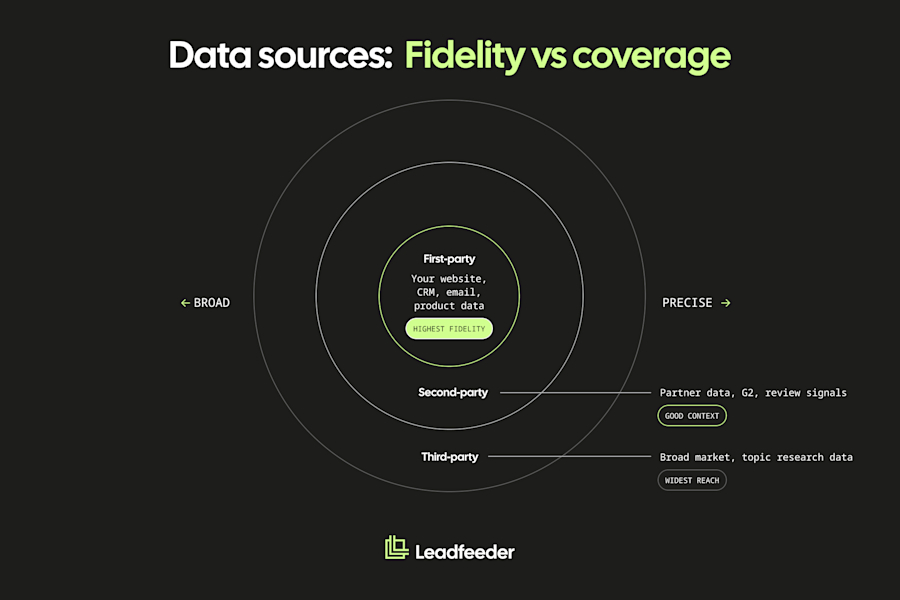
First-party, second-party and third-party intent data all serve different purposes. Understanding the strengths and limitations of each helps you decide which signals deserve the most attention.
How to identify buyer intent signals
Understanding buyer intent is one thing. Identifying it in practice is where the real challenge begins. Buyers leave clues throughout the research process, but those clues rarely appear in a single place. The most effective approach combines multiple data sources to build a more complete picture of buying activity.
Website visitor identification
Your website is typically the most valuable source of buyer intent signals. Today’s tools can identify the companies visiting your website, analyse anonymous traffic and track how visitors move through your various pages and resources. This helps marketers understand which organisations are actively engaging with their brand, even before a form is submitted.
Patterns matter more than individual visits. A company that returns repeatedly and explores multiple areas of your website is often more significant than one that arrives once and disappears.
Search query analysis
Search behaviour can reveal where a buyer is in their journey. Early-stage buyers tend to focus on challenges and questions. As research progresses, searches become more solution-oriented. Eventually, many buyers begin comparing specific vendors, products or categories. For example, there is a clear difference between someone searching for ‘improve sales forecasting’ and someone searching for ‘sales forecasting software comparison’.
Content engagement tracking
The content prospects consume can provide valuable context. Look beyond simple page views and consider:
Which content attracts attention
How often visitors return
How much time they spend engaging
Whether they explore related topics
Someone who engages deeply with multiple resources shows a stronger interest compared to someone who reads a single article and leaves.
CRM and marketing automation signals
Many buying signals already exist inside your technology stack. These may include:
Email engagement
Form submissions
Webinar registrations
Demo requests
Viewed individually, these actions can seem routine. Combined with other signals, they can help reveal which accounts are moving closer to a decision.
Social signals
Social activity can also provide useful insight. LinkedIn engagement, participation in professional communities, and discussions around industry topics can all indicate growing interest in a particular challenge or solution area. While these signals are rarely enough on their own, they can strengthen the broader picture.
Technographic and firmographic triggers
Changes inside a business often signal changing priorities. Such as:
Hiring for new roles
Recent funding announcements
Technology investments
Expansion into new markets
These events do not automatically indicate purchase intent, but they can suggest that a company's requirements are changing.
Why is intent identification getting harder?
Buyer behaviour evolves alongside technology. According to Forrester, 95% of B2B buyers expect to use generative AI to support purchasing decisions within the next 12 months.
As buyers increasingly use AI tools to research vendors and compare options, more buying activity happens outside channels that marketers can easily observe. This makes first-party data increasingly valuable because it reflects direct engagement with your business rather than activity happening elsewhere.
How to score and prioritise buyer intent
Identifying buyer intent signals is only half the challenge. Most marketing and sales teams collect more data than they can realistically act on. Intent scoring helps solve that problem. It ranks accounts by their likelihood of becoming genuine opportunities, allowing teams to focus their attention where it is most likely to have an impact.
Effective scoring combines two factors: fit and intent.
Fit scoring
Fit scoring measures how closely an account matches your Ideal Customer Profile (ICP). An account may show strong buying activity, but that doesn't automatically make it a priority. If the company falls outside your target market, the likelihood of a successful sale may still be low.
Fit scoring typically considers factors such as:
Industry
Company size
Geography
Tech stack
For example, a software company targeting mid-market manufacturers may score a 50-person manufacturer more highly than a 5,000-person financial services firm, even if both display similar buying behaviour.
Intent scoring
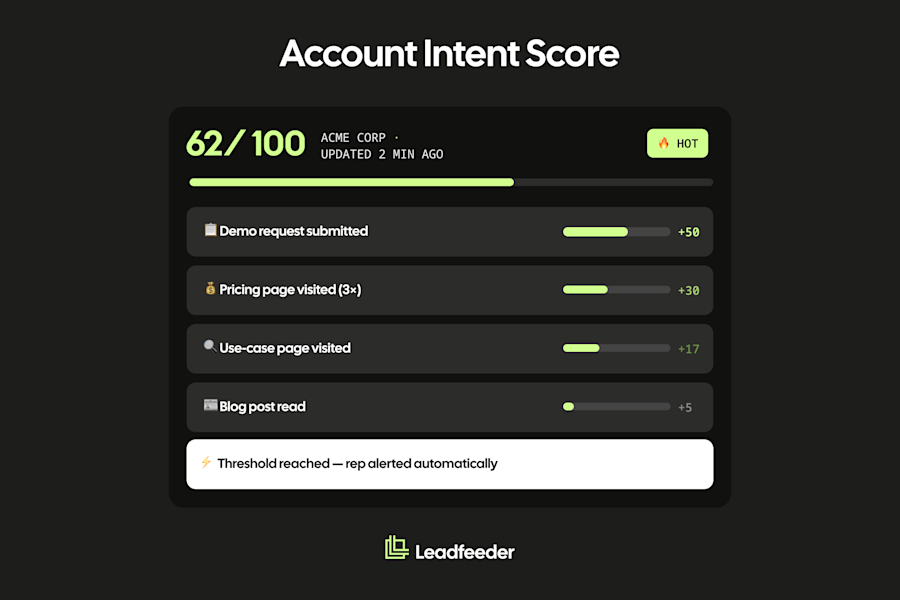
Intent scoring focuses on behaviour. Different actions indicate different levels of interest, so most scoring models assign more weight to activities that suggest stronger purchase intent.
Here’s what that might look like in practice:
Reading a blog article signals early research
Downloading a guide indicates deeper engagement
Visiting a product page suggests active evaluation
Visiting a pricing page may indicate a buyer is assessing potential suppliers
Frequency also matters. Someone who returns repeatedly over several weeks generally demonstrates stronger intent than someone who visits once and never comes back.
Combining fit and intent
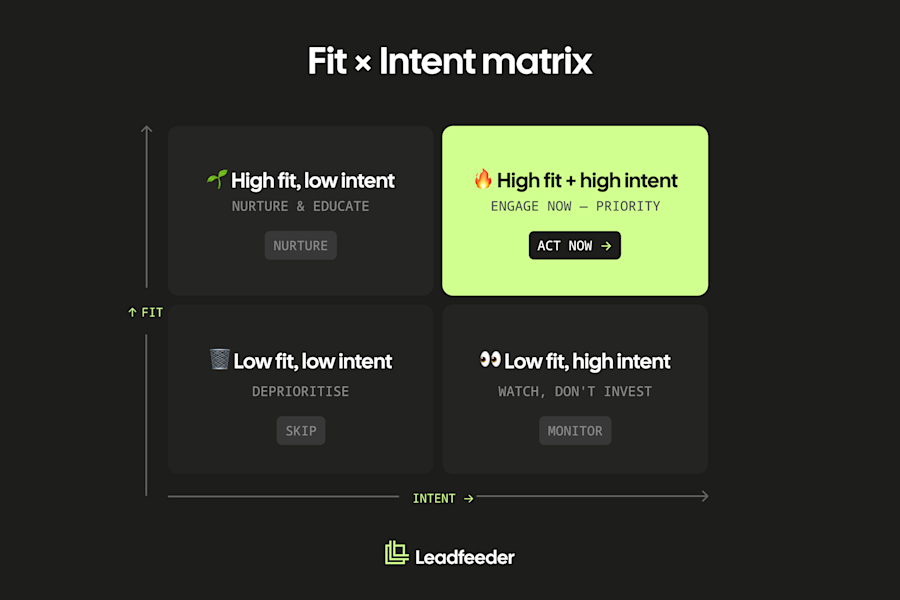
The strongest opportunities usually score highly in both areas.
Consider these examples:
High intent, low fit – A company shows strong research activity but sits outside your target market
High fit, low intent – An ICP match shows little evidence of active research
High fit, high intent – A target account matches your ICP and is actively evaluating solutions
The most effective teams prioritise high-fit, high-intent accounts because their scores reflect both buying activity and commercial relevance.
Signal decay
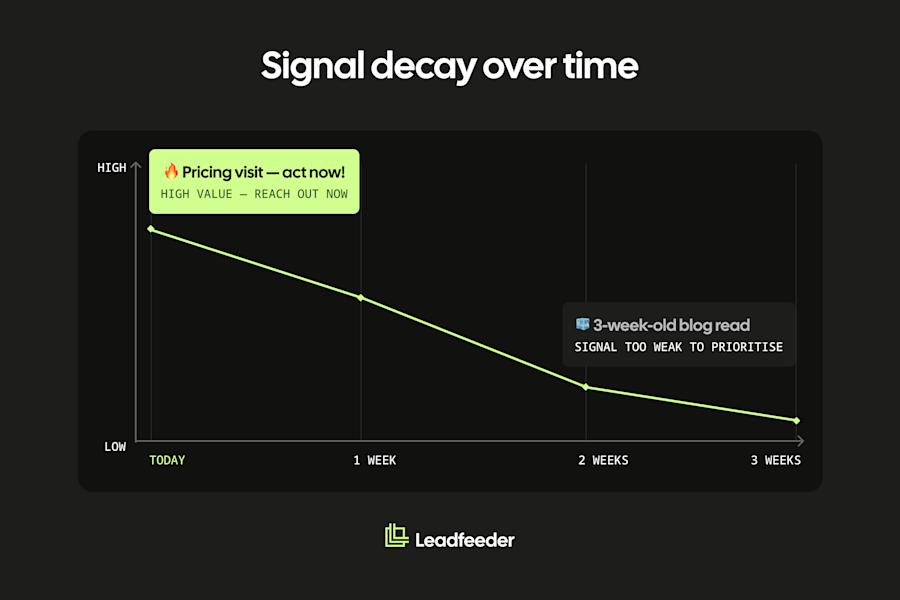
Intent does not remain constant. A pricing page visit from yesterday often carries more weight than one from three weeks ago. The same applies to content engagement, product research and other buying signals. This is known as signal decay.
As time passes, intent signals become less useful indicators of current buying activity. Effective scoring models account for this by giving more weight to recent behaviour and gradually reducing the importance of older interactions.
Example scoring framework
The exact model will vary between organisations, but a simple framework might look like this:
The purpose of a framework like this is to provide a consistent way to identify the accounts that deserve attention first. As you learn more about what drives pipeline and revenue in your organisation, you can refine the model to make it even more effective.
How to use buyer intent data in marketing
The goal of buyer intent marketing is simple: focus your time and budget on accounts that are actively showing interest, rather than treating every prospect the same. Intent data can support almost every stage of the marketing process, from audience targeting through to campaign measurement.
Targeted advertising
Instead of targeting broad audiences, teams can focus on accounts that have already shown signs of research or evaluation. This often improves relevance and reduces wasted spend.
For example, a cybersecurity company could build an advertising audience from organisations researching endpoint protection solutions. Those accounts could then receive tailored ads promoting relevant content, webinars or product information.
Content personalisation
Different buyers need different information depending on where they are in their journey. One buyer exploring a problem may need educational content, while another evaluating suppliers may need product comparisons, implementation information or pricing guidance.
An example could be a manufacturing software provider promoting industry trend reports to awareness-stage visitors while showing case studies and buyer guides to companies with stronger purchase intent.
ABM account selection
Intent data can improve account-based marketing by helping teams identify which target accounts deserve immediate attention. Rather than relying entirely on firmographic criteria, marketers can prioritise organisations that are actively researching relevant topics.
A B2B technology company might maintain a target account list of 500 organisations. Intent signals can help identify which 50 accounts should receive focused campaign activity this quarter.
Lead nurturing
As engagement increases, marketers can trigger different workflows, content recommendations or campaign sequences that reflect the buyer's level of interest.
For example, a prospect who downloads an introductory guide might enter an educational nurture track, while someone engaging with product-focused content could receive more detailed evaluation materials.
Campaign attribution
Intent data can also provide additional context when measuring marketing performance. Rather than looking only at clicks, leads or form submissions, teams can track how buying activity develops before opportunities are created.
A marketing team might discover that accounts exposed to a webinar campaign subsequently showed increased research activity, higher engagement levels and stronger pipeline conversion rates. This creates a clearer link between marketing activity and commercial outcomes, helping teams understand which campaigns are genuinely influencing buying behaviour.
How to use buyer intent data in sales
information. It’s when the goal shifts from quantity to quality, with marketing helping sales to focus on the accounts most likely to become customers.
Account prioritisation
One of the most common uses of sales intent data is account prioritisation. Rather than asking sales teams to contact every lead or target account, intent data helps marketers identify organisations that show meaningful signs of research and evaluation.
For example, if two companies match your Ideal Customer Profile but only one is actively exploring relevant solutions, that account may deserve immediate attention.
Personalised outreach
Intent data can also help sales teams make outreach more relevant. Instead of relying on generic messaging, marketers can provide context around the topics, challenges or solutions that attract an account's attention.
An example could be a company engaging with content about supply chain visibility, which may respond better to a conversation about operational efficiency than a broad product pitch.
Timing and responsiveness
Timing often influences whether outreach succeeds. Intent signals are strongest when they reflect recent activity. Waiting too long can reduce their value and increase the risk that priorities have changed.
An account researching solutions this week is usually a stronger prospect than one that displayed similar activity a month ago.
Upsell and cross-sell opportunities
Changes in research behaviour may indicate interest in additional products, services or capabilities. Examples might include:
A customer exploring content related to advanced features
Increased engagement from new departments within the account
Research activity around adjacent product categories
These signals can help account teams identify expansion opportunities earlier.
Marketing and sales alignment
Perhaps the greatest value comes from creating a shared view of account activity. Marketing can see which accounts are engaging across channels. Sales can use that information to prioritise conversations and plan follow-up activity.
This creates a more consistent handover process. Instead of debating lead quality, both teams can work from the same evidence and focus on the accounts showing the strongest signs of buying intent.
Buyer intent data and privacy compliance
Privacy and compliance should be part of any buyer intent strategy. It is particularly important for organisations operating in Europe, where regulations such as the General Data Protection Regulation (GDPR) place clear obligations on how personal data is collected, processed and used.
While buyer intent data can provide valuable insight into buying activity, organisations should carefully evaluate how that data is obtained and whether its use aligns with their compliance requirements.
Understanding privacy obligations
Not all intent data carries the same level of risk. In some cases, buyer intent signals relate to companies rather than individuals. In others, they may involve information that could be linked to a specific person. Depending on the context, this may fall within the scope of privacy regulations such as GDPR or CCPA.
Organisations should also consider concepts such as legitimate interest, transparency and data subject rights when evaluating how intent data is collected and used.
Personal data and intent signals
The distinction between company-level and individual-level information is important. For example, identifying that a company researched a particular topic may present different considerations from collecting information about a named individual and their online behaviour.
Because the boundaries are not always clear, organisations should assess intent data carefully and ensure they understand what information is being processed.
Evaluating intent data providers
When assessing a buyer intent data provider, consider questions such as:
Where does the data originate?
How is the data collected?
What consent or notice mechanisms are in place?
Is compliance documentation available?
Are data processing agreements provided?
Transparency is essential. Providers should be able to explain their data sources and the processes they use to collect and manage information.
First-party vs third-party risk considerations
From a compliance standpoint, first-party data is often easier to evaluate because it comes directly from interactions with your own website, content or product.
Third-party data may require additional scrutiny, particularly when the source of the information is less visible. Understanding the provenance of the data, how it was collected and what permissions apply can help organisations make more informed decisions about its use.
Measuring the ROI of buyer intent data
Buyer intent data should be measured like any other marketing investment. Without a baseline, it becomes difficult to determine whether intent-driven activity is actually improving performance. Before implementing a buyer intent strategy, record your existing metrics so you have a meaningful point of comparison.
Key metrics to track
Several metrics can help you evaluate the impact of buyer intent data:
MQL-to-SQL conversion rate – How effectively marketing-qualified leads progress into sales-qualified opportunities. Improvements may indicate better lead quality and prioritisation.
Pipeline velocity – The speed at which opportunities move through the sales process. Faster progression can suggest that teams are engaging buyers at the right time.
Cost per qualified lead – How much it costs to generate a sales-ready opportunity. Lower costs may indicate more efficient targeting and reduced wasted spend.
Win rate - The percentage of opportunities that convert into customers. Comparing win rates can help reveal whether intent-driven opportunities perform differently from other leads.
Time to close – The time it takes to convert an opportunity into revenue. Shorter sales cycles may suggest that buyers are entering conversations with stronger intent.
No single metric tells the full story. Reviewing several measures together provides a more balanced picture of performance.
Comparing intent and non-intent accounts
Cohort analysis is one of the most effective ways to evaluate the ROI of your buyer intent data. Compare accounts identified through intent signals against similar accounts that were not prioritised using intent data. Look for differences in conversion rates, sales cycle length, and win rates.
Make sure you take your measurements over the long term. Buying intent often influences outcomes across months rather than weeks, making ongoing analysis more valuable than individual campaign results.
Getting started with buyer intent data
If you're new to working with buyer intent data, start small. You don't need a complex scoring model or multiple data providers on day one. Focus on building a simple process and refining it over time. Here’s a process you can follow.
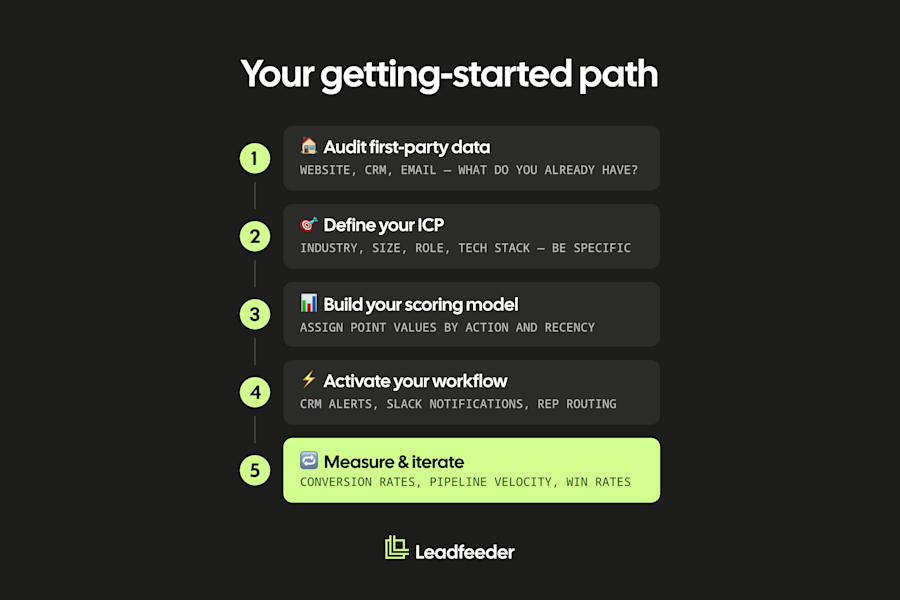
Step 1 – Start with first-party data
Begin with the signals you already have access to. Identify which companies are engaging with your website and content. Tools such as Leadfeeder can help teams understand which organisations are visiting their website and what they're interested in. They’ll also help you find the right contacts when it’s time to reach out.
Step 2 – Define your ICP
Intent signals are far more useful when viewed through the lens of your Ideal Customer Profile. Clarify which industries, company sizes, locations, and characteristics define a good-fit account.
Step 3 – Build a simple scoring model
Start with a handful of high-value signals. Repeated visits, product page engagement, and pricing page views are often good places to begin. You can refine the model as you gather more data.
Step 4 – Activate one workflow
Choose a single use case and prove the value. For example, notify sales when a target account reaches a defined intent threshold or visits a high-intent page.
Step 5 – Measure and iterate
Track the metrics discussed in the previous section and compare performance over time. Use the results to adjust your scoring model, workflows, and targeting approach as your programme matures.
Conclusion
Buyer intent helps marketers understand what traditional lead generation often misses: which companies are actively researching solutions before they identify themselves.
By understanding buying intent, identifying meaningful signals, prioritising the right accounts, activating targeted workflows, and measuring results over time, marketing and sales teams can focus their efforts where they are most likely to have an impact. This data is already in your business. Now it’s time to harness it.
If your team is ready to see which companies are showing intent on your website and prioritise the accounts most likely to buy, Leadfeeder offers a 14-day free trial with no credit card required.