60-Second Summary
Most B2B leads enter the funnel with partial or stale data, and anonymous website visitors are often missed. Lead enrichment fills, validates, and refreshes contact and account data (firmographics, technographics, intent, and behaviour) so teams can qualify, route, and personalise outreach faster.
Key takeaways: Enrichment reduces manual research and routing friction, increases conversion and speed-to-lead, and prevents wasted outreach by keeping CRM records current and by identifying anonymous company visitors before form fills.
Standout strategies & tactics: Use real-time enrichment for high-intent actions (demo requests, pricing pages) and batch enrichment for CRM hygiene; combine first-, third‑party and intent data; enforce ICP-driven field selection and automated routing rules.
Real-world lessons & frameworks: Operationalise a repeatable 6-step flow—capture signal, match, append, score/segment, trigger action, and keep data fresh; audit quality regularly, avoid enriching unused fields, layer providers, and ensure GDPR/compliance.
Measure & ROI: Track lead-to-opportunity conversion, speed-to-lead, MQL-to-SQL, meeting booking rate, and pipeline from enriched website visitors—treat enrichment as a revenue workflow, not just a data task.
*This summary was created with AI assistance, using our original content.
Most leads enter your funnel with partial information. You might have their name and work email, maybe a job title. Meanwhile, anonymous website traffic goes unnoticed entirely, and CRM records that were accurate six months ago are outdated. That’s why companies need lead enrichment, which is the process of adding, validating, or refreshing data on a lead or account to make it more actionable.
Tools like Leadfeeder help teams identify visiting companies and enrich records before outreach begins, capturing that anonymous website traffic.
This guide covers what B2B lead enrichment means and how to build an enrichment strategy that drives pipeline, including:
How lead enrichment works
Types of data used in lead enrichment
Lead enrichment use cases to drive pipeline
How to measure lead enrichment efforts
Lead enrichment mistakes to avoid
What is lead enrichment?
Lead enrichment (sometimes called “lead data enrichment”) means taking what you know about a lead or account and making it more complete or accurate. It may include:
Filling missing fields: Adding data that was never captured
Correcting outdated data: Updating job titles, company names, or contact details that have changed
Adding buying context: Layering in signals like website behaviour, intent data, and account hierarchy that make the record actionable
Say a prospect fills out a form with nothing but their work email. After enrichment, that same record includes their role seniority, recent website activity, and an ICP fit score.
Why lead enrichment matters in B2B
When lead data is incomplete or stale, every downstream process suffers. Enrichment can directly offer these outcomes:
Faster qualification: Complete records mean less manual research and faster assessment
Better lead routing: Enriched fields like industry, company size, and geography enable accurate routing to the right rep or team
More relevant personalisation: Reps can reference real context instead of guessing
Higher conversion rates: Leads that are well-understood convert better at every stage
Less wasted SDR time: Reps spend less time researching and more time selling
Shorter speed to lead: Enriched inbound leads can be routed and contacted faster
According to Salesforce, sales reps spend 70% of their time on non-selling tasks. A significant portion of that is manual research, data entry, and chasing incomplete records. Enrichment reduces this overhead directly.
It’s also worth keeping in mind that poorly managed contact and account data can result in misdirected marketing and sales efforts and lost revenue opportunities across every stage of the B2B revenue waterfall. Data quality can quickly become a pipeline problem, especially when sales teams are drowning in too many tasks.
Say a prospect submits a demo request at 10:14 AM. With enrichment running in real time, you learn their company size, industry, tech stack, and ICP fit score within seconds. The lead is automatically routed to the AE who owns that territory. By 10:20 AM, the rep is sending a personalised follow-up.
Without enrichment, that same request sits in a shared queue. After manual enrichment and assignment, 24-48 hours have passed and the prospect already booked a demo with a competitor.
What data is used in lead enrichment?
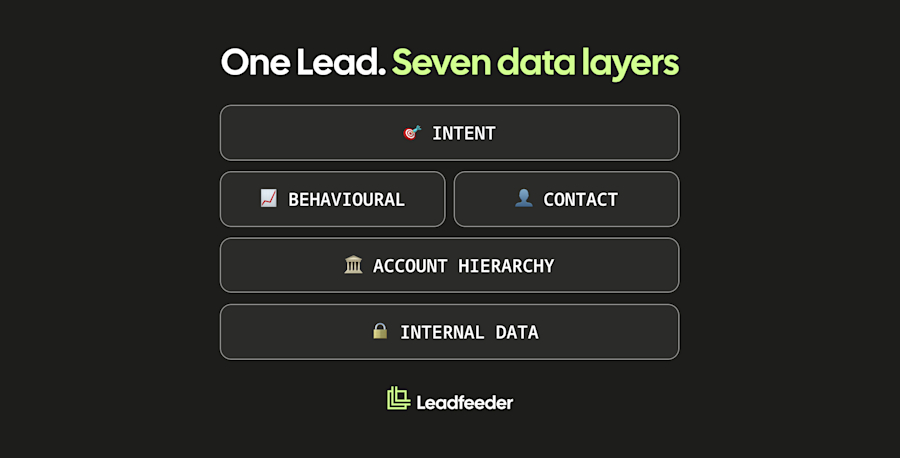
Not all data types matter equally for every GTM team. Research from Forrester and Zoovu found that 66 percent of B2B companies have poor data quality, and 83 percent say it blocks personalisation. The data types below are the building blocks for closing that gap.
Contact Data
Contact data is critical, and includes:
Name, job title, and seniority level
Email address
Phone number
LinkedIn profile URL
Firmographic Data
Firmographics are what connect a lead to your ICP, and may include:
Industry and sub-vertical
Company size and revenue
Growth stage
Geographic data
Technographic Data
Technographics cover the tools a company uses, and may include:
CRM, CMS, and marketing automation platform
Analytics and attribution tools
Sales engagement and outreach tools
Behavioural Data
Behavioural data tells you what a lead is interested in right now and includes:
Page views
Time on site
Form fills
Return visits
Session frequency
Ad clicks and social content interactions
Intent Data
Intent data captures research activity happening outside your website, and may include:
Topic-level search activity
Review site visits
Industry publication research patterns
Account Hierarchy Data
This matters most for enterprise selling, where a single "account" may span multiple entities, and may include:
Parent company and subsidiaries
Business units and regional offices
Ownership structure and acquisition history
Custom and internal data
Custom and internal data may include:
Product usage and feature adoption
CRM stage and deal history
Support tickets and customer health signals
Past engagement and meeting history
Lead enrichment vs. related concepts
These terms get used interchangeably, but they mean different things. Here’s how they differ.
Lead enrichment vs. data enrichment
Data enrichment applies to any dataset, including customer records, product data, financial data. Sales lead enrichment is one specific use case, making sales and marketing records more actionable.
Lead enrichment vs. lead scoring
Enrichment adds context to a record. Lead scoring uses that context to prioritise it. Without good enrichment, scoring models rely on incomplete inputs.
Lead enrichment vs. website visitor identification
Visitor identification uncovers companies before they submit a form, extending enrichment upstream in the funnel. Leadfeeder helps identify anonymous website visitors at the company level so teams can enrich accounts and act before a traditional lead conversion happens.
How lead enrichment works
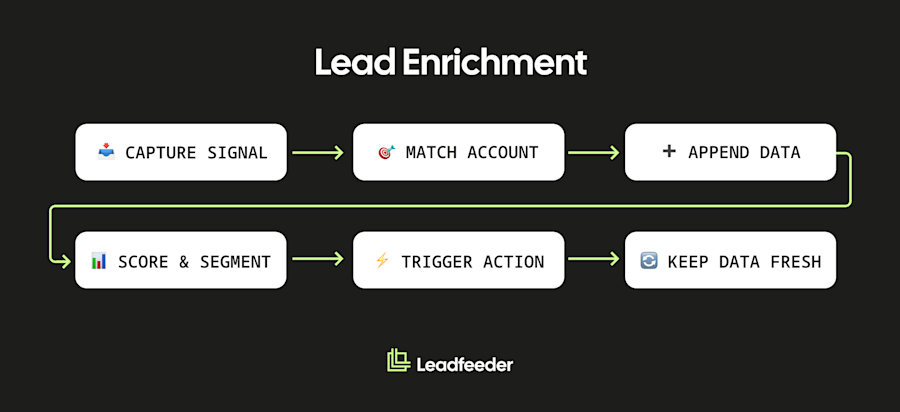
A good enrichment workflow is operational and repeatable. These six steps cover the full cycle from signal capture through to continuous data maintenance.
Step 1: Capture the initial signal
The trigger can be a form submission, demo request, content download, or an anonymous website visit. The important thing is that a signal exists and gets captured in a system that can act on it.
Step 2: Match the lead or company
Match the incoming signal to an existing CRM record or create a new one. Use domain matching and duplicate prevention to avoid creating parallel records for the same account.
Step 3: Append relevant data
Add the fields needed for qualification, routing, segmentation, and personalisation. Relevance matters more than volume. Adding 40 fields that nobody uses creates noise, not value.
Step 4: Score and segment
Use the enriched data to assess ICP fit, buying intent, and routing criteria. Assign the lead to a segment, territory, or priority tier based on the enriched profile.
Step 5: Trigger action
The enriched, scored lead should trigger the right next step automatically: a sales alert, a CRM update, an ad audience sync, or a personalised outreach sequence.
Step 6: Keep data fresh
This is where most enrichment strategies fall short. One-off enrichment solves the problem at the point of capture but does nothing about records that decay over time. Continuous enrichment means checking existing records against fresh data sources on an ongoing basis and updating them when better information becomes available.
Leadfeeder handles this by checking daily against its database, surfacing records where it has fresher data than what is in the CRM, and updating them via the customer's own field mapping rules. Teams can trigger this on a single record, in bulk, or automatically via lists.
What This Looks Like In Action
Let’s say an anonymous company visits your product’s pricing page. Leadfeeder identifies the company. The account is enriched with firmographic and intent data. A high-fit match triggers an alert to sales, and the CRM record stays current automatically as new data becomes available.
Want to enrich high-intent website visitors before they convert? Leadfeeder can identify companies visiting your site and surface account context for faster follow-up.
Lead enrichment use cases that drive pipeline
These are the use cases where enrichment has the most direct impact on revenue.
Enrich inbound demo requests in real time
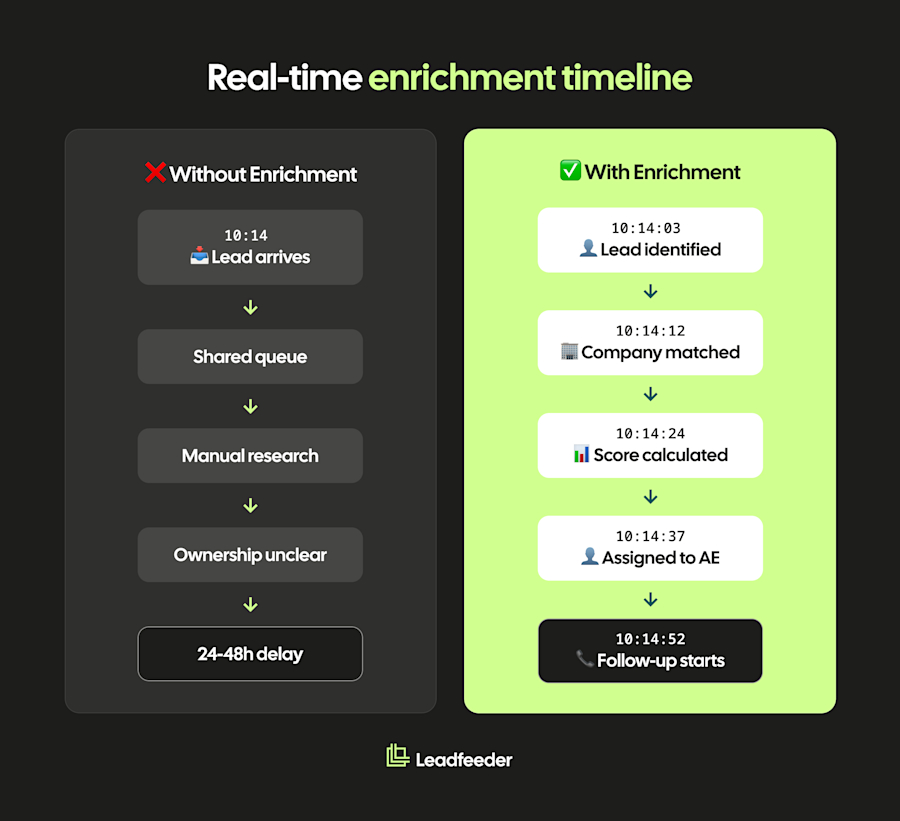
The demo request example above shows this in action. Real-time enrichment turns a form submission into a fully qualified, correctly routed lead in under a minute.
Identify and enrich website visitors before they convert
Leadfeeder identifies visiting companies so teams can prioritise accounts showing interest on high-intent pages and engage warm accounts earlier in the buying journey, before a form fill ever happens.
Improve outbound account selection
Combining enriched account data with intent signals helps outbound teams focus on companies that both fit the ICP and are actively in-market. This is more effective than working from a static list based on firmographics alone.
Use lead enrichment for CRM data hygiene
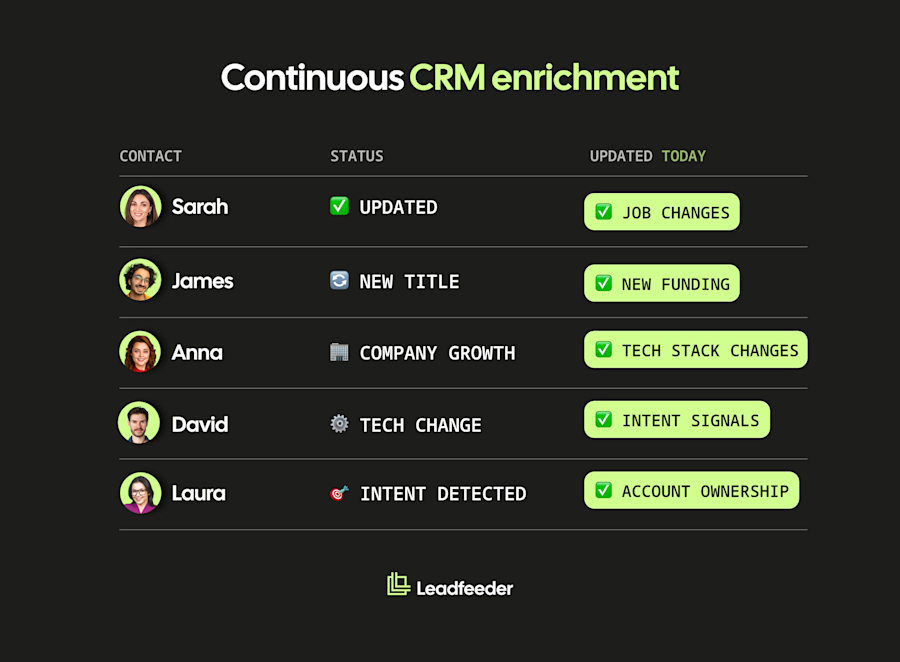
CRM data enrichment matters because records go stale fast. Job titles change and companies get acquired, so manual hygiene doesn’t scale.
Teams using Leadfeeder configure field-level update rules and run automated lead enrichment on the lists that matter most like ICP accounts, territory lists, and campaign-target segments.
Support ABM campaigns
Enrichment builds richer target account profiles that improve ad targeting, personalisation, and stakeholder mapping. The more complete the account picture, the more effective the account-based marketing motion.
Improve reactivation and nurture programmes
Old records lose value over time. Re-enriching and re-scoring dormant leads can surface accounts that are now a better fit than when they first entered the CRM, whether due to company growth, leadership changes, or renewed buying activity.
Who benefits from lead enrichment, and how
Enrichment serves both sides of the funnel. The value depends on the role.
For sales teams:
Better account prioritisation: Enriched ICP and intent data tells reps which accounts to work first
Higher connect rates: Fresher contact data means fewer bounced emails and wrong numbers
Faster follow-up on warm accounts: Enrichment and routing happen automatically, so reps act on signals while they are fresh
For marketing teams:
Sharper segmentation: Enriched firmographic and behavioural data enables more precise audience slicing
More accurate MQL criteria: Scoring models work better when the underlying data is complete
Stronger attribution: Tying enrichment data to campaign source clarifies which channels drive high-fit accounts
Better intent activation: First-party website behaviour becomes actionable when it’s enriched with account context
McKinsey found that faster-growing companies derive 40% more of their revenue from personalisation, which can lift revenue by 5-15% and marketing ROI by 10-30%. That level of personalisation depends on having complete, accurate data on the accounts you are trying to reach, which is exactly what enrichment provides.
The most common lead enrichment mistakes
These are the patterns that undermine enrichment programmes most often:
Enriching every field without a use case. Only enrich fields that feed a qualification, routing, or personalisation workflow.
Relying on one provider only. No single source covers every data type accurately; layer lead enrichment services based on their strengths.
Ignoring anonymous traffic. If you’re only enriching known leads, you’re missing the majority of your website visitors.
Not aligning enrichment with ICP. Enrichment should be configured around your ICP criteria, not applied generically to every record.
Letting stale data remain in the CRM. Set up continuous enrichment or schedule regular refresh cycles for your highest-value segments.
Failing to connect enrichment with routing and scoring. Enriched data that sits in a field but never triggers an action is wasted investment.
Not considering GDPR and compliance requirements. Understand the legal basis for the data you are appending, especially in European markets.
Best practices for a scalable lead enrichment strategy
Once you move past a basic enrichment setup, these best practices can help you scale.
Start with your ICP and qualification criteria
Every enrichment decision should trace back to your ICP. If a data field doesn’t help you determine fit, intent, or routing, you probably don’t need it.
Define required fields by funnel stage
Different stages need different data:
At the inbound form stage, you need company domain and role.
At MQL, you need firmographics and ICP fit.
At SDR handoff, you need contact details, intent signals, and account context.
At expansion, you need product usage and account hierarchy.
Use real-time enrichment for high-intent actions
Demo requests, pricing page visits, and inbound calls should trigger enrichment immediately. These are time-sensitive signals where speed to lead directly impacts conversion.
Use batch enrichment for database hygiene
Run batch enrichment on a regular schedule to refresh your highest-value segments, including:
ICP accounts
Active pipeline
Renewal targets
ABM lists
Combine first-party, third-party, and intent data
No single data type gives you the full picture. First-party behavioural data, third-party firmographic data, and intent data from research signals are strongest when combined.
Enrich at both contact and account level
Contact enrichment tells you about the person, and account enrichment tells you about the company. Both are needed for proper qualification, routing, and personalisation.
Build routing workflows around enriched data
Enrichment without automation is just better data sitting in a CRM. Connect enriched fields to routing rules, lead scoring models, and alert workflows so the data triggers action.
Audit data quality regularly
Review field completeness, data accuracy, and enrichment coverage across your key segments quarterly to assess data quality.
How to measure lead enrichment ROI
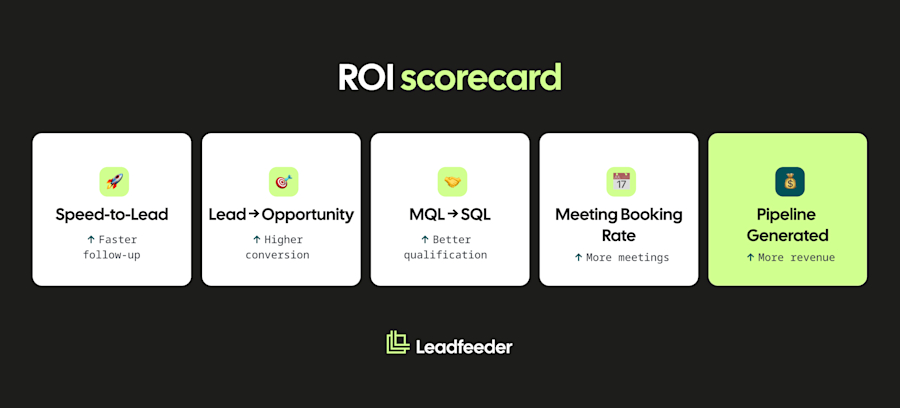
Enrichment should be measured as a revenue workflow, not a database task. Track these five KPIs:
Lead-to-opportunity conversion rate: Are enriched leads converting at a higher rate than non-enriched leads?
Speed to lead: How much faster are enriched leads being contacted and qualified?
MQL-to-SQL rate: Is enrichment improving the quality of leads that marketing passes to sales?
Meeting booking rate: Are reps booking more meetings from enriched records?
Pipeline from enriched website visitors: How much pipeline originates from accounts identified and enriched via website intent data?
How to choose lead enrichment tools
Not all enrichment tools solve the same problem. Evaluate based on what matters for your workflow:
Data coverage and accuracy: How complete and fresh is the underlying database?
Website visitor identification: Can the tool identify anonymous companies visiting your site, or does it only enrich known contacts?
CRM and MAP integrations: Does it offer a lead enrichment API and connect natively to your CRM and marketing automation platform?
Intent signal depth: Does it surface buying signals beyond basic firmographics?
Compliance and governance: How does it handle GDPR, data provenance, and consent management?
Automation and workflow flexibility: Can you set up rules for continuous enrichment?
Pricing model and scalability: Does the pricing work at your volume and scale well?
Multiple tools enrich known contacts well, but fewer help identify and enrich anonymous website visitors at the account level or maintain CRM records automatically. Tools like Leadfeeder can help you there.
Frequently asked questions about lead enrichment
What is the difference between lead enrichment and lead scoring?
Lead enrichment adds data to a record. Lead scoring uses that data to rank and prioritise it. Enrichment comes first, and directly influences the accuracy of scoring models.
Is lead enrichment GDPR compliant?
Lead enrichment can be GDPR compliant, depending on the data sources used.
Should enrichment happen in real-time or in batches?
Enrichment should happen both in real-time and in batches:
Use real-time enrichment for high-intent actions like demo requests and pricing page visits.
Use batch enrichment for regular CRM hygiene and database refresh cycles.
Can I enrich anonymous website traffic?
Yes, you can enrich anonymous website traffic at the company level. Tools like Leadfeeder identify which companies are visiting your website and surface account-level data.
What data fields matter most for B2B?
At minimum, you want these fields populated on every lead record:
Company name
Industry
Job title
Email
At least one buying signal (intent or behavioural)
Beyond that, the fields that matter most depend on your ICP and routing logic. If your sales team routes by geography, you need HQ location. If they qualify by tech stack, you need technographic data.
How often should I refresh enriched data?
For your highest-value records, continuous or weekly refresh is ideal. For broader database hygiene, a monthly or quarterly cadence works.
Final thoughts: Enrichment is a revenue workflow
The teams that get the most from lead enrichment combine first-party website behaviour, account context, and ongoing CRM maintenance into a single enrichment layer.
If your enrichment strategy starts and ends with filling in missing fields at the point of capture, you’re leaving pipeline on the table. The real value comes from keeping that data fresh, connecting it to routing and scoring workflows, and using it to act on buying signals while they are still warm.
If you want to identify website visitors, enrich account data, and keep your CRM records continuously fresh without manual effort, try Leadfeeder free for 14 days.