60-Second Summary
Personalization strengthens customer relationships and delivers higher ROI when applied across the customer lifecycle. In a webinar with Hadrien, Director of Product Marketing Operations at Dolead, practical tactics—Leadfeeder integrations, ad personalization, ABM, measurement and GDPR—were shared to convert intent data into qualified leads.
Key takeaways: Personalization across the funnel increases ROI and gives sales a clearer view of buyer intent, enabling timely, relevant outreach; email plus personalization remains a top-performing channel.
Standout strategies & tactics: Use Leadfeeder to identify company visitors and build audiences, sync via Google Analytics into Google Ads for remarketing, and favor LinkedIn Matched Audiences for hyper-niche ABM; combine ad personalization with email for follow-up.
Real-world lessons & frameworks: Follow a simple ABM checklist—identify visiting accounts, qualify vs ICP, alert sales on revisits, analyze engagement (visits, time on page, visitors), then target with tailored campaigns; adoption is straightforward but check industry labeling and GDPR compliance.
Measurement & tools: Prioritize cost per acquisition over CTR to judge creative impact; use a mix of analytics, ABM, buyer-intent and email tools (Leadfeeder included) and leverage trials to validate fit.
*This summary was created with AI assistance, using our original content.
The results speak for themselves. Nearly all marketers say personalization strengthens customer relationships, and brands that apply it throughout the customer lifecycle report significantly higher returns on investment.
More importantly, personalization gives sales teams a clearer view of buyer intent, helping them engage prospects at the right moment with the right message.
To better understand how to generate qualified leads with personalization, I recently sat down with Hadrien, Director of Product Marketing Operations at Dolead, to discuss the strategies, insights, and practical approaches businesses can use to turn personalization into a competitive advantage.
In the webinar, Hadrien covered:
Different types of lead generation
How to make the most out of Facebook ads
Getting personal with Google Ads
What metrics to track (and why)
How to stay compliant with GDPR
Measuring success and ROI
Here's the video if you want to watch it!
After the webinar, we had a fantastic Q&A session. Below, we'll cover the answers provided by both Hadrian and me and link to a ton of fantastic resources.
Note: Leadfeeder identifies companies that visit your website so you can build more effective personalized campaigns. Sign up for free and see who's visiting your site.
How can I target the list of companies I see in Leadfeeder that visited our website on Facebook and Google?
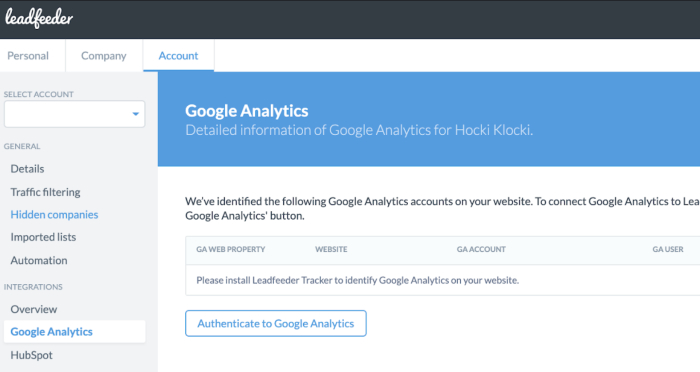
This is possible using Leadfeeder's Google Analytics integration. Leadfeeder identifies the companies visiting your site and creates audiences directly from its own data, letting you segment by industry, company size, or behavior. These audiences can then be synced through Google Analytics and imported into Google Ads for use in your remarketing campaigns.
To add this, head to your Leadfeeder dashboard, select your name, then choose "Settings" or "Personal Settings" from the drop-down menu under your name.
Then click "Google Account" and "Authenticate Google Analytics."
What is the best tool to track qualified leads marketing metrics?
You want us to pick one tool? It's not going to happen. We love data, and we love tools that give us more data.
Pick your poison:
When it comes to B2B qualified leads, how effective is email marketing?
Email marketing remains one of the most powerful marketing strategies. Whether you're qualifying leads, delivering demos, or launching a new feature, email lets you reach your prospects at any time — and there are no algorithms to deal with or ads to pay for.
Add personalization to that mix, and you've got a powerhouse that can drive leads and conversions.
What ABM approach should I use when advertising for small niches with a target KPI of just two to three leads per month?
Using Facebook, Google Ads, etc., can be much more difficult when you're using personalized targeting. I strongly recommend using LinkedIn.
Here's the checklist the Leadfeeder team uses to get ABM retargeting right:
Identify the accounts visiting your website (that's where Leadfeeder comes in).
Qualify accounts to match your ICP (and buyer intent)
Alert your sales team when accounts revisit.
Analyze which companies are engaging by focusing on site visits, time on page, and the number of visitors. (All that info is in Leadfeeder!)
Target your account list and buyer personas.
Create a LinkedIn Campaign.
Upload your list to LinkedIn Matched Audiences.
Launch your ads using the list.
We also offer a full guide to ABM here.
Are there any other tools you suggest for driving qualified sales leads?
You’re lookin’ at it; Leadfeeder. Kidding. There are legitimately hundreds of tools for finding and driving qualified business leads. It's a little overwhelming.
Here's a list of the ones we love the most:
What challenges did Dolead overcome with the integration of Leadfeeder? Was it easy to use? Are there any downsides?
Leadfeeder is simple and effective, and it doesn't overcomplicate tracking companies visiting our website. It has a ton of out-of-the-box connections, like Slack and Hubspot, which make things a million times easier.
Honestly, adoption was a breeze right out of the box. The workflows never fail, the notifications are fantastic, and the email reports are incredibly easy to follow. My only complaint is that the industry fields are not always accurate. I wish they would use the LinkedIn industry label.
Dolead chose Leadfeeder because we wanted to track the companies that we are currently having conversations with, who are visiting our website.
We also wanted to expand to other zones and run different ABM campaigns. As a result, we needed a tool that would provide regular alerts when these companies visit our site.
Leadfeeder was exactly what we were looking for!
What is the best metric to measure an ad or creative's performance?
As we discussed in the webinar, CTR is not always the most accurate metric to track personalized campaigns. Instead, look for the creative with the lowest Cost per Acquisition (CPA).
It's about the creatives that drive the conversions you want from your ads. There isn't much benefit to a creative that drives a lot of people to click your ad (meaning a good CTR), only for none of those customers to convert.
The lowest cost per acquisition provides a better holistic view of your entire campaign.
Ready to drive more qualified leads? Leadfeeder can help.
If you are working out how to get qualified leads from the traffic you already have, Leadfeeder is a sales and marketing tool designed to help your team find and identify companies that visit your website. Leverage company names, buyer intent data, and onsite actions to develop hyper-personalized campaigns that drive real results.