



A strong GTM strategy aligns your product, messaging, audience, and channels before launch. Without that alignment, opportunities are missed, positioning falls flat, and campaigns underperform.
Building an effective go-to-market plan requires research into your target customers, competitors, and market conditions. Every decision, from pricing to promotion, should be grounded in that research.
Below, we walk you through 13 practical steps to create a B2B go-to-market strategy that sets your launch up for success.
Step 1: Identify the core problem you solve
Defining the problem your product solves for customers is perhaps the most important step in creating a go-to-market plan. It helps you establish whether there is an alignment between market demand and the solution your product offers.
All great products fill gaps in the market—issues that current market players haven’t addressed well enough. For instance, Uber made getting around easier, and Airbnb enabled globetrotters to travel to new places without worrying about finding reliable accommodation.
By conducting product-market fit research, you can get a sense of the viability of your solution to the problem you’re targeting. Your research should answer three essential questions:
What problem does my product solve?
Are there enough people looking for a solution to this problem?
How is my product better at addressing those unmet needs than my competitors?
Dedicate enough time to conducting market research. Start by surveying your target customers. Ask questions about their frustration with the current solutions or the lack thereof. Confirm whether your solution version would be sufficient for your target customers.
Visit social sites like LinkedIn and Reddit, where your target customer hangs out. What are their sentiments on the problems you’re looking to solve? You can use this data to adjust your product.
Check out software review sites like G2, GetApp, and Capterra, too. Since your target customers are likely to leave their complaints here, you can use the information from these sites to define the problem you’re addressing.

You may also want to create a minimum viable product (MVP) to prove there’s enough demand for your product. An MVP is an initial version of your product that has just enough features to attract customers and help you validate your ideas. It’ll help you identify gaps in your ideas and make necessary iterations without the cost and risk of creating a fully functional solution.
For instance, the founders of Airbnb started renting their apartments to tech conference attendees to test demand for the service. They first ensured people would be willing to pay to sleep at a stranger’s home before proceeding to the next step: developing their product.
Step 2: Pinpoint your ideal audience
When creating a go-to-market strategy, remember there isn’t a one-size-fits-all product that will delight all potential customers.
Target a smaller group of people rather than casting a wide net. By casting a wide net, you dilute your messaging and product’s unique selling points, limiting the success of your launch.
That’s why it’s important to define your target audience through ideal customer profiles and buyer personas.
What is your ideal customer profile (ICP)?
An ICP is a description of the perfect customer that you’ve made your product for. In the case of a go-to-market strategy for B2B SaaS companies, it refers to the hypothetical company that would benefit the most from your product or solution, and is most likely to buy it.
Defining your ICP will help the sales team assess whether a lead is worth pursuing, as those that match your predefined profile are more likely to convert into paying customers.
You can define your ICP based on multiple aspects, including:
Industry: Identify your target customer's industry.
Geography: What is the location of your ICP? This information can help you craft marketing campaigns targeted towards their specific region for maximum impact.
Revenue: Defining your target customer by revenue will help you choose a pricing strategy that makes your product more appealing.
Company size: Defining the average company size of your ICP will help you tailor your solution and messaging to their immediate needs.
Pain points: What are the main barriers to success for your ICP?
A comprehensive ICP will also inform other parts of your GTM strategy, from the marketing channels you choose to how you craft your messaging.
Define Your ICP and Find Perfect-Fit Companies to Target
Pinpoint your perfect-fit customers so you can focus on prospects most likely to convert, and drive better results.
Learn moreWhat are your buyer personas?
Buyer personas are semi-fictional representations of your target audience based on their habits, goals, challenges, and motivators. Unlike ICPs, which represent ideal businesses you want to sell to, buyer personas refer to people with specific attributes who work within your ICP.
For example, the ICP for a company like Leadfeeder is a B2B company that focuses its sales on European markets. We then divide the customer base into different buyer personas, such as marketing and sales employees.
A marketing employee would want to validate their campaign effort by identifying the companies visiting the company website through different channels. A sales employee would be interested in a prospecting solution to generate a list of potential companies to sell to and obtain contact details for decision-makers to reach out to.
Both personas fit Leadfeeder’s ICP but have different motivators and behaviors that call for segmented product messaging.
Here’s an example of a buyer persona:
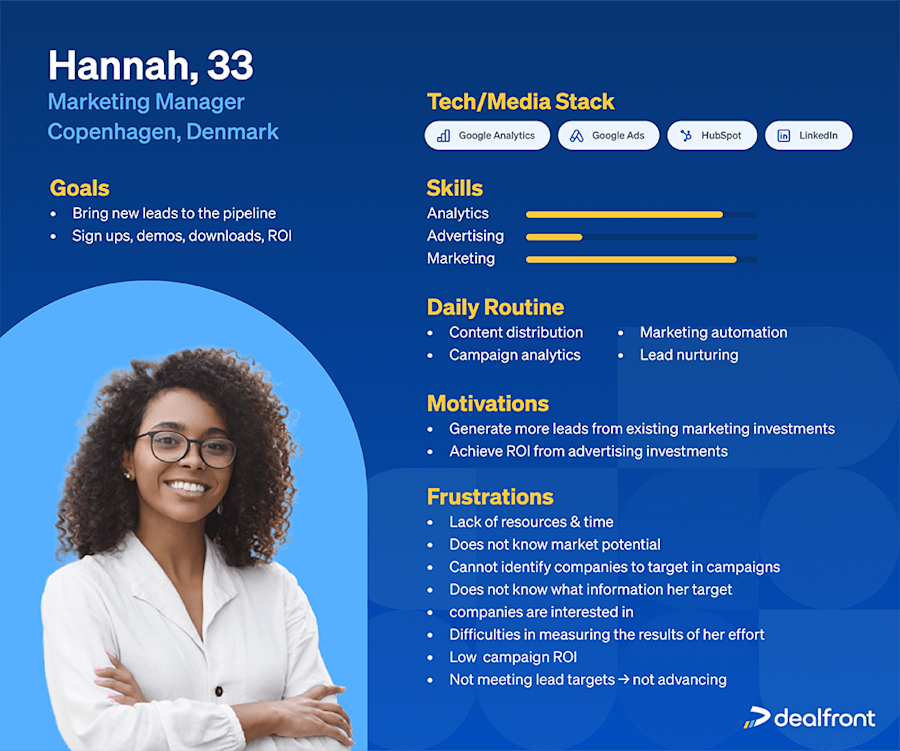
Creating buyer personas starts with conducting deep customer research. You can find information about your ideal customer online from their social media conversations or from their interactions with your sales and customer success teams.
Deploying conversational intelligence tools like ZoomIQ and Gong across different customer touchpoints will make it easy to collect this data. Google Analytics and customer surveys are other excellent sources for insights into your ideal customers.
You can also use tools like Leadfeeder to see which companies are visiting your website. When creating buyer personas, ask questions that can help you differentiate one buyer group from the next, such as:
Which online spaces do my buyer personas visit?
What are the daily work challenges and stressors of my buyer personas?
What motivates my buyer personas to purchase my product?
What objections to purchasing my product/services do my buyer personas have?
How do my buyer personas describe the problem that I’m solving?
Will my product be a must-have or an optional addition to their typical workday?
Step 3: Conduct industry research
The quality of your industry research will be a major factor in the success of your product launch. You want to understand the market inside and out, know how to outcompete the competition with your offering, and embed that into your go-to-market approach.
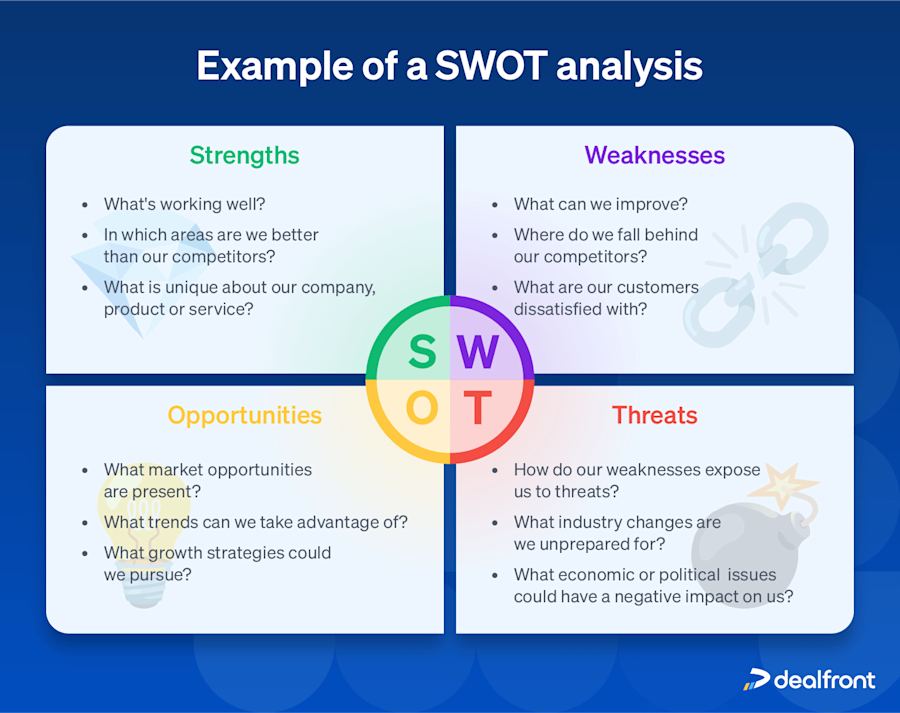
Start by assessing the competition. Who are the key players, and what are their unique selling points? Then, create a SWOT (strengths, weaknesses, opportunities, and threats) analysis of the competition. This will help you poke holes in the competition’s business concepts. You can use these gaps to your advantage and create a strong product and great messaging.
Focus on the number of competitors and their market share, too. Is the market saturated or underserved? While you’ll need to work hard to differentiate your business in a saturated market, you’ll need to establish yourself as a category leader in underserved markets.
For instance, if you were trying to establish a social media platform, you would need to be quite differentiated from the established media giants. One possible option is to market your business as a web3 social media platform, as it would address user concerns with existing social media giants, such as privacy.
Zero in on the competitor’s pricing strategies and positioning, and customers’ perception of them. Are customers happy with the competition’s pricing strategy? Are there holes in the competition’s positioning and messaging that you can exploit?
After assessing the competition, evaluate demand for your product by looking for signs that customers want it. Are people discussing the problem you solve, and to what extent are they doing it?
Quantifying the demand for your product/solution ensures that you’re on the right track. It will also help you avoid investing resources into products that potential customers aren’t ready to buy.
Investigate market trends to get a clear picture of demand. For instance, while the pandemic negatively impacted the hospitality industry, the e-commerce industry benefited greatly as many people shifted to online shopping to avoid contact. Understanding market trends will help you make decisions that will improve the success of your product/feature launch.
Step 4: Refine your unique value proposition
Why should your target customers choose your business over the competition? In what ways have you differentiated yourself?
A unique value proposition can help you answer your customers' questions and is a cornerstone of robust go-to-market plans. This statement briefly explains what your product is, the problem it solves, and the ultimate value it offers customers.
To formulate your unique value proposition statement, list the top ways your product adds value to customers. Next, conduct a SWOT analysis of your competition to gauge how your product differs from theirs. You can then create a simple statement that best portrays both aspects—the value your product provides and what makes it different.
For instance, Uber’s immediate benefits to customers are allowing users to book transport quickly, ensuring user security throughout their journey, and providing comfort while moving from one place to the next. This makes its unique value proposition, “we re-imagine the way the world moves,” a perfect fit. If the company ever introduces a new product, such as a freight solution, it will align with its unique value statement.
Step 5: Define your pricing strategy
Your pricing will make or break your GTM strategy, as price affects how customers perceive your product and your sales cycle.
Expensive products require longer sales cycles, as your sales team must work harder to convince customers to buy. You might also need to offer potential customers free trials or demos of such products to show them the value they can get before they commit to a purchase.
Since less expensive products are a smaller commitment, they tend to have shorter sales cycles. Potential customers usually need less convincing with lower pricing, but you’ll make less money per purchase.
A SaaS go-to-market strategy, meanwhile, must account for the subscription-based pricing model of that niche. Such a strategy must build in a focus on customer retention, which is arguably more crucial than initial acquisition.
A few pricing strategies you can consider implementing to avoid the issues above and gauge the perfect pricing for your business model include:
Competition-based pricing: Under this pricing strategy, you’ll use your competitor’s prices as a baseline and pick a price point based on it. If you don’t veer too far off the baseline, you can choose a lower or higher price point. This pricing strategy is ideal for saturated markets where price is a key driver of customer decisions.
Freemium pricing: Under this strategy, you’ll use a subscription model with multiple tiers, with the base tier free. You’ll let customers test your product for free and decide whether to upgrade to premium features. Such a strategy can be effective if your product is complex, since it helps customers learn how to use it and understand its value before they invest in it.
Dynamic pricing: Under this pricing model, you’ll adjust your prices based on ebbs and flows in demand. Businesses in the hospitality and transport industries, like hotels and airlines, frequently use this strategy. If you’re in an industry that experiences seasonal changes in demand, dynamic pricing can help you acquire huge profits in the high season and keep your business afloat in the low season.
Step 6: Align messaging across teams and channels
Your messaging is the magnet that draws customers toward your product. It addresses their pain points and frustrations and counters sales objections.
Therefore, you should ensure your messaging is always on point and consistent across all platforms to avoid confusing your customers and causing a mixed customer experience.
Consistent messaging equals consistent brand experience. With all your messages and conversations aligning perfectly—not only for product launches but brand interactions in general—you are more likely to inspire trust in your customers and build brand authority.
To do so, customize brand messaging for different buyer personas, define visual and textual elements for all your content, and create guidelines. All your employees should be united around your messaging. Only that way can your organization deliver on consistency.
Step 7: Outline the buyer’s journey
The buyer’s journey is the set of stages customers go through as they discover, assess, and purchase a new product or service. Mapping out the customer journey will help you identify your customers’ decision drivers and common sales objections, further informing your content marketing strategy.
These are the three stages buyer’s journeys mainly involve, and the content you can create for each to inspire customer action:
Top of the funnel: At this stage, customers recognize they have a specific problem but don’t know how to solve it—or don’t know your brand can solve it. Serve these customers with content and social campaigns that spread brand awareness. For instance, GoPro’s social media campaigns, like #HomePro, are great examples of how they have helped market the brand to new audiences.
Middle of the funnel: At this stage, customers know about your brand but compare you to the competition. Serve these customers with content that showcases your brand as the best option. For instance, content that shows your product in action or compares your brand with competitors will help customers lean more toward your business.
Bottom of the funnel: At this stage, customers already believe your product can solve their problem but need a little push to make the final purchase. Serve these customers with content that solidifies their belief in your brand. Case studies and customer reviews will help turn leads into paying customers.
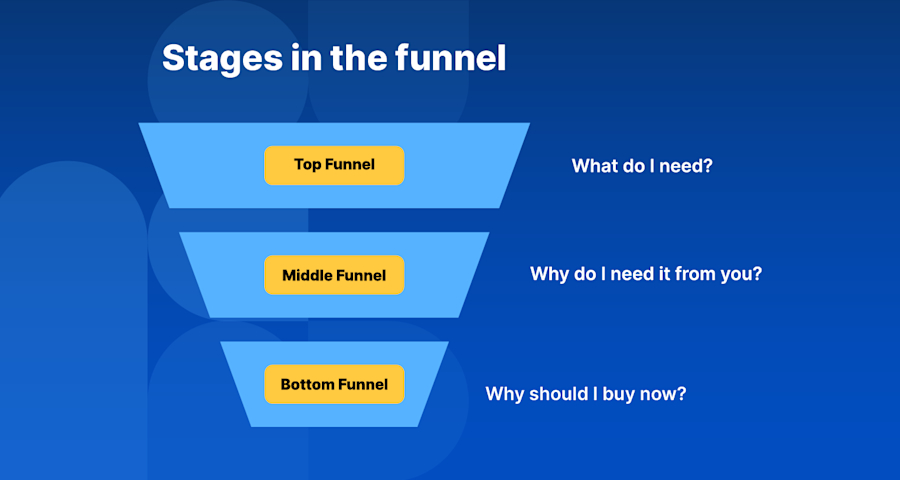
Serving customers with the right content allows you to guide them through the different stages of their journey and motivate action.
You can also use tools like Leadfeeder to gain insights into the behaviors of companies that visit your website and determine their stage in the purchase journey. The tool enables sales to understand the optimal time to prospect.
Step 8: Build a sales strategy
Creating a strong sales plan ensures you’re approaching potential customers correctly. It will also ensure your sales team understands your business strategies and recognizes potential GTM obstacles they must prepare for.
The first step in creating a sales plan is determining whether you want to use product-led growth (PLG) or sales-led growth (SLG). While PLG works for differentiated, simple products that attract customers on their own, SLG works for products in saturated markets or for complex products that require salespeople to nudge buyers into making a purchase.
Think of Slack (PLG) vs. Oracle (SLG). Since Slack is an easy-to-use self-service app, target users don’t need a sales team to guide them in adopting the product. In comparison, Oracle’s suite of products, such as ERP and CX solutions, is quite complex. Leads often need sales teams to walk them through the products and their features before they can make a purchase.
Align sales and marketing
Regardless of the chosen sales plan type, ensure your sales and marketing teams align so they work as a unit. Siloed teams often result in wasted resources, misaligned messaging that confuses customers, and lost sales opportunities.
The marketing team might create content that does little to improve the sales team's success—and vice versa. It is also possible for the two teams to promise customers different things. Having a joint effort in which marketing targets the companies or markets the sales team focuses on helps boost conversion rates.
When teams align, the marketing team can create content that turns readers into high-quality leads for the sales team. In turn, the sales team can share customer feedback with the marketing team to improve messaging for the product launch.
Nurturing such a symbiotic relationship will also give your product the best chance at thriving post-launch.
Define your sales cycle
Sales cycles represent repeatable processes your sales team follows to close a lead. The standard sales cycle involves six steps:
Finding high-quality leads
Connecting with leads
Qualifying leads
Presenting to leads
Countering sales objections
Turning leads into buyers
Defining your sales cycle steps ensures that you’re in control of your sales process. A well-defined cycle will help you create structure around it to drive repeatable results.
To define your sales cycle, map out the steps your sales team will need to take to close a lead, from reaching out to a prospect to sharing demos to finalizing the sale.
Step 9: Choose the right marketing channels
Your first step in selecting a marketing channel for your new product should be identifying where your target customers spend their time.
In this digital age, potential customers are often active on multiple marketing channels. You may need to be present on all or most of them to engage with your prospects.
But while this may be viable for large corporations with large marketing teams, small businesses may want to focus their marketing efforts on a single channel to avoid burnout and increase the chances of success.
They can also monitor how successful their marketing is across different channels and allocate more marketing dollars to the most successful ones, reducing the cost of large-scale marketing.
For instance, if your ideal customers prefer getting email recommendations and promotions from you, use this channel to inform leads about your product launch. You can also cut back on low-performing marketing channels, but only after you've tried all viable marketing tactics without success.
Slidebean is an excellent example of a business that has found success marketing on a specific marketing channel. The pitch deck builder uses YouTube as a demand-generation platform because startup founders (its target audience) spend a lot of time there.
Step 10: Establish systems and automation
The execution of your go-to-market strategy is as important as the strategy itself. Without the right processes, integrations, and sales automation software in place, you may find it challenging to track progress and see the strategy bear fruit.
Therefore, create processes that help you:
Collect data and track goals: Define specific milestones of your GTM strategy and establish ways to measure success. Pick tools that will help you collect and analyze data. For instance, a tool like Leadfeeder will help you manage, update, and draw insights from your website traffic to make informed decisions.
Pivot in the face of setbacks: With the right processes in place, your team will know how to handle them. For instance, once you establish a process for how the sales team counters common prospect objections during sales conversations, the team can anticipate and address them early to increase conversions.
Creating both sales and marketing processes will be crucial to the successful launch of your product.
Marketing processes
Your marketing processes need to define how to promote your product. Create ones that map your marketing throughout different touchpoints and buyer journeys.
For instance, you can run A/B tests on product messaging to better communicate your product’s value. You can also craft a content creation process that defines how to create and post content and how to respond to customer comments. It can also outline the best SEO (search engine optimization) practices to help you rank higher in search results.
Sales processes
Create a go-to-market sales strategy template that outlines what the sales team should do at every part of the sales cycle to close leads.
For instance, you can define an outreach process for your sales teams to use to approach leads effectively, or a post-sale process for them to follow to communicate with customers, reduce churn, and collect feedback.
Find ways to automate these processes, too. For instance, you can create an email sequence to send sales and marketing materials that nudge leads through the different stages of the sales funnel.
Step 11: Strengthen sales enablement
Your staff is the engine that powers your GTM strategy, so it's essential to train them effectively. You should conduct training that educates employees on the product, your target audience, the competition, and your unique selling points.
The stronger the sales, support, and customer success teams understand your product, the better they will be at speaking about it. They will create a unified front for marketing your product.
Work with your team to create sales enablement material. This can include battle cards, sales playbooks, training and demo videos, and buyer persona documents. This material will provide your sales team with the information and assets they need to turn leads into buying customers.
You’ll also need to collaborate with the marketing team to create a strong content marketing strategy. The strategy should outline your approach to content before, during, and after the product launch.
Step 12: Measure performance and optimize
Set objectives and key results (OKRs) to track before, during, and after the product launch.
Defining these goals early on will help you determine what’s working and identify loopholes in your strategy. For instance, if you’re creating pre-launch content to increase awareness, you can look for indicators that your messaging is working to pivot accordingly.
If your messaging is doing great, double down on it. If it isn’t resonating with people as much as you’d expected, try a new approach to make it more effective. Be sure to align your OKRs and goals with the rest of the organization’s goals.
Step 13: Plan your post-launch growth strategy
While a post-launch strategy isn’t really part of your go-to-market strategy, it is still essential to have one. It ensures you can seamlessly transition from launching your product to marketing it effectively afterward.
Your post-launch strategy should include generating more content, responding to feedback, product adoption, and adjusting marketing strategies accordingly.
Aim to create content that keeps the new customers engaged and encourages retention even after the product launch. The content can address customers’ questions, educate people about your product, or compile initial customer reviews.
Listen to customer feedback, as it can be a treasure trove of insights. Watch out for customer complaints and details on what they liked. You can use this data to adjust your marketing or product to better serve your target customers.
What is a go-to-market strategy?
A go-to-market strategy is a tactical roadmap for launching a new product, rolling out a core feature, or introducing an existing product into a new market. It involves multiple marketing assets, including pricing models, buyer personas, and sales strategies.
Effective go-to-market strategies address the who, what, how, when, and where of launching a new product or venturing into a new market.
Components of a go-to-market strategy
There are usually four main elements of a go-to-market strategy:
Product-market fit: Identify the problems your product addresses.
Target audience: Define who experiences these problems, their willingness to pay, and their pain points.
Competition and demand: Assess existing offerings and market demand.
Distribution: Determine the channels for product/service distribution, such as a website, app, or third-party distributor.
You may prefer to leverage go-to-market platforms like ours to establish and execute your strategy. At Leadfeeder, we provide access to extensive data layers, enabling precise targeting, website visitor behavior tracking, lead outreach, and B2B display advertising promotion.
The difference between a GTM strategy and a general marketing plan
What is GTM in business, then? Isn’t it just a marketing plan? Well, no. The business world often uses GTM and general marketing strategies interchangeably, but they’re quite different.
A GTM strategy is a blueprint for a specific and new endeavor. This blueprint outlines the steps to take throughout that process, from product marketing to sales enablement. It is a short-term strategy that provides a roadmap for sales, product, and marketing teams.
A general marketing plan also often outlines how to promote a product in the target market, from messaging to the marketing channels to use. It also informs the long-term strategy behind marketing a brand and its offerings, not just an individual product launch or a feature roll-out.
That covers the question “what is a GTM strategy”, so let’s get on to the why. Specifically, why do you need GTM strategies?
What is the purpose of a go-to-market strategy?
A go-to-market strategy should give you a strong understanding of your product, the potential addressable market, the ideal customer, and the competition. Understanding how all these parts interact will influence the success of your product launch.
For instance, by understanding your competition's unique selling points, you can craft brand messaging that differentiates your product and makes it more attractive to customers. Similarly, by developing a strong understanding of your target customer, you can identify the best places to advertise your product to achieve optimal reach.
Is a go-to-market strategy only for startups?
Go-to-market strategies aren't just about physical products, nor are they only for brand-new companies or startups. Any business launching something new and aiming for effective audience reach and sustainable growth can benefit from a go-to-market strategy. For instance:
Established businesses introducing new products or entering new markets require a GTM strategy for a successful launch.
Small businesses expanding their markets or product lines can use a GTM strategy to guide their efforts.
Businesses undergoing strategic changes, such as mergers or new business models, benefit from updating or creating a GTM strategy aligned with their new direction.
Companies facing heightened competition utilize GTM strategies to highlight key differentiators and attract customers.
Who is responsible for a go-to-market strategy?
A select group of senior stakeholders from your revenue function, including sales and marketing, as well as product teams, should oversee your B2B SaaS go-to-market strategy. This streamlined structure enables faster feedback loops, iterative improvements to the GTM strategy, and faster product development than in larger teams.
To foster alignment within the pod, ensure all members are held accountable to the agreed-upon lead generation KPIs. At the start of your go-to-market initiative, the pod should define the ICP (Ideal Customer Profile), align on messaging and positioning, and share insights across departments.
The pod should then meet weekly for detailed data analysis, to address sales team challenges and resolve key product issues.
Go-to-market strategy framework: What are the different approaches?
Go-to-market strategies tend to fall into one of two main frameworks: Sales-led and product-led:
Sales-led | Product-led |
Employs B2B marketing to generate interest in a product, often through content and demos. | Leverages the product itself to attract and retain users. |
Sales teams engage with prospects to convert them into customers. | The product's value proposition drives user adoption and upgrades. |
In recent years, a variation of these two main strategies has gained popularity. As a hybrid approach, product-led sales uses freemium or trial versions of a product to acquire prospects. Sales-based strategies are then used to transform these prospects into loyal, paying customers. Product-Led Sales: Combining the Best of Product-Led Growth and Sales, written by our very own Vincent Jong, has more information on what product-led sales can look like for your business.
Benefits of a go-to-market strategy
So, if you follow our go-to-market strategy framework, what benefits might you see?
With a strong go-to-market business plan, you can:
Clearly define your launch goals and what success looks like for you: This ensures all stakeholders, from product to sales and marketing, are on the same page.
Establish a firm product-market fit: The strategy helps you identify market gaps your product can address. It also helps you identify better opportunities to position your product against established competitors.
Make any product launch more efficient: GTM strategies help eliminate costly trial-and-error. Since they require you to closely assess the market, a GTM strategy helps you make informed decisions and reduce resource waste.
Reduce time to market: A great GTM strategy will ensure alignment among all stakeholders as they work toward a clear goal, reducing the time from ideation to actualization.
Establish strong brand awareness: A solid GTM strategy will help you identify the best platforms for spreading brand awareness. It will also inform you how to approach marketing on these different platforms.
Grow exponentially: A GTM strategy will bring clarity to most aspects of your target market, from buyer personas to messaging tactics, preparing your business for growth in the future. It becomes easier to double down on specific marketing strategies and pivot your messaging whenever they fail to deliver results.
A go-to-market strategy example from 4 real-life brands
Let’s take a look at four inspiring go-to-market strategy examples from real-life brands, including a case study of a go-to-market strategy for startups:
1. A Dutch FinTech company
A Netherlands-based payment service provider wanted to expand into the DACH area from their secure market in the Benelux countries. To ensure a smooth, successful entry into this market, the PSP enlisted Leadfeeder's help.
The company already knew it wanted to solve the problem of stressful, inflexible online payment solutions that required long-term contracts. With Leadfeeder’s tools, they completed the next steps of their GTM strategy.
The comprehensive market overview provided by our GDPR compliant database supported their industry research, while our numerous prospect filter options helped them hone in on their ICP, providing a strong base for the next steps in their GTM strategy.
2. Codecademy
Codecademy’s GTM strategy helped it attract 200,000 users within three days of launching its minimum viable product.
The decision-makers saw there was a nearly unmet demand for accessible coding programs. They created a free JavaScript course and advertised it on news platforms like Hacker News. They also eliminated friction in the learning process by gamifying it.
This successful launch has propelled the site to become among the most trusted learning resources for programmers, garnering over 50 million users. A clear example of a go-to-market strategy that garnered significant, long-term results.
3. FitBit Smart Coach
Fitbit, renowned for its activity trackers that resemble smartwatches, launched Smart Coach, a premium service and personal training app integrated with the user's Fitbit device.
Their GTM strategy began with clear, achievable objectives, including establishing brand awareness, increasing subscription revenue, and enhancing the subscription attach rate.
They launched the "Get More With Fitbit" campaign, using paid and owned channels to reach Fitbit's user base. Paid channels included retargeting display ads that drove potential customers to a dedicated landing page. Additionally, they utilized push notifications, social media, and newsletters. The campaign generated $192 million in revenue.
4. Airbnb
Airbnb's pioneering approach to the sharing economy transformed the hospitality industry, exemplifying effective go-to-market strategies for startups.
Airbnb capitalized on the rising trend of the sharing economy in 2008, offering a unique solution for affordable, personalized accommodations and disrupting the traditional hospitality sector.
The company prioritized user experience by creating a user-friendly platform that simplified the booking process, ensuring a seamless and enjoyable experience for hosts and guests.
Airbnb's aggressive digital marketing campaigns played a crucial role in rapidly expanding its user base. Leveraging various online channels, they successfully reached a global audience.
Set your go-to-market strategy in motion
Transitioning from concept to launch can be stressful. A go-to-market strategy brings order to your product launch, enhancing its chances of success by facilitating smooth coordination across all parts of the launch, from messaging to sales processes.
Our 13-step go-to-market framework can help set you up for success. Learn more about how Leadfeeder can assist your sales and marketing by signing up for a free trial.

CMO
Jillian Als is Chief Marketing Officer at Leadfeeder and a B2B SaaS marketing executive with nearly two decades of experience leading global go-to-market teams. She specializes in revenue-driven marketing strategy, demand generation, and aligning marketing and sales organizations.
Throughout her career, Jillian has helped SaaS companies scale marketing-sourced revenue and build high-performing marketing teams across international markets. Her leadership experience shapes her perspective on marketing strategy, attribution, and the systems modern revenue teams use to drive sustainable growth.