



Total addressable market (sometimes called total available market) refers to the total market demand of a product or service if you achieve a 100% market share. In a nutshell, if every person or business who might be interested in the product bought it, it's how much would that market be worth.
TAM is critical for any business looking to implement a successful go-to-market (GTM) strategy for a product or service. Understanding the total addressable market can be the difference between putting time and money into an offering that will never get off the ground and launching a line that delivers outstanding ROI.
So, let's explain why TAM matters and outline some options for calculating it.
TAM meaning in business
So, that’s a straightforward definition of TAM, but what does it really mean for a business like yours?
TAM is an evaluation of the maximum potential revenue opportunity for your specific product or solution. So, it represents the potential market size if every customer adopted the offering, achieving 100% market share.
Now, we think it's important to point out that TAM doesn't actually represent the specific figure associated with your future customers or revenue. Instead, it serves as a theoretical framework that tells you (and your potential investors) the total size of the market before those pesky external factors, like competition and alternative solutions, come into play.
For example, if you work as a marketing manager for a web analytics company that’s just introduced a new data visualization tool, your TAM would include every business, large or small, that could potentially benefit from better data presentation. We’re talking about industries like finance, healthcare, e-commerce, and more.
Total addressable market vs serviceable addressable market and serviceable obtainable market
To fully understand our definition of the total addressable market, it’s worth comparing TAM to two similar concepts. Those are the serviceable addressable market (SAM) and the serviceable obtainable market (SOM).
Sorry, there are two more of those acronyms, but at least we’ve summarized the difference between total addressable market, serviceable addressable market, and serviceable obtainable market in a handy table!
Concept | Definition | Key insight |
TAM (Total addressable market) | Represents the entire demand for a specific product or service within a given market. | Provides a bird’s eye view of the market's scalability potential. |
SAM (Serviceable addressable market) | Shows you the portion of the TAM that a company can realistically target and serve. | Focuses on identifying target market segments aligned with the company's capabilities. |
SOM (Serviceable obtainable market) | The percentage of the market that a company currently captures or aims to capture. | Offers insights into the company's market penetration and sales potential in the near future. |
How to calculate total addressable market: Your 4 main options
There’s no quick-and-easy total addressable market calculation you can perform. Unlike with some business metrics, there isn’t a total addressable market formula into which you can plug your individual numbers.
Instead, you have four principle approaches to choose from when calculating TAM:
1. Top-down approach
If you use the top-down total addressable market model, you’ll rely on industry data, market reports, and research studies to determine your TAM.
This method is all about getting data from those reputable sources we all know and love, like Gartner or Forrester. You’ll use this data to spot any relevant sections of your industry and assess their size.
However, it's important to note that industry-generated data might not always be current or cover the niche aspects of the market you need.
If you find that’s the case when you’re creating your TAM sizing, consider hiring a market research consulting firm to conduct tailored research. This can provide more accurate and specific insights.
2. Bottom-up approach
The bottom-up approach to TAM uses first-party data from your own sales and pricing information.
First, you multiply your average sales price by your current customer count. This will give you your annual contract value (ACV). You then multiply your ACV by the total number of potential customers in your total addressable market. That’s how you get your TAM.
Here’s a simple formula to help:
(Total # of customers) x (Average contract value) = Total Addressable Market (TAM).
To put this into perspective, let’s take a look at an example.
If you sell cupcakes to bakeries in California and typically sell 1,000 cupcakes a year at $5 each, your ACV would be $5,000.
By multiplying your ACV ($5,000) by the total number of bakeries in California (about 31,000), your TAM would be $155,000,000.
3. Value theory approach
The value theory approach focuses on understanding how much value customers would get from your product or service and how much they’d be willing to pay for it in the future.
Let’s go back to our cupcake example. Imagine you have a special type of cupcake with a secret recipe and amazing taste. Using this approach, you’d figure out if customers would pay more for your premium cupcakes compared to standard ones. For instance, if regular cupcakes sell for $3 each, would customers be willing to pay $7 for your gourmet ones?
To answer this question accurately, you can’t just guess. You’ll need to conduct a competitive pricing analysis, examining what your direct and indirect competitors offer and their pricing.
Let’s say you do believe customers would pay $7 for your cupcakes, now you have to get into the maths.
Assuming about 20% of all cupcake lovers in your area prefer premium cupcakes, and there are approximately 1,000,000 potential customers, that means there are 200,000 people interested in your cupcakes.
So, you’d take your premium cupcake price ($7) and multiply it by the number of customers in that segment (200,000). Your final Total Addressable Market (TAM) is $1,400,000.
In reality, this approach to calculating TAM probably wouldn’t be used for products as simple as cupcakes. It is a model suitable for more complex offerings, however, such as calculating SaaS total addressable market figures.
4. Another option: External tools
Finally, like all aspects of business nowadays, you can find a number of automation tools to help you completely streamline this process.
This will save you time and effort, which you can then use to work on your pitch deck for potential investors, flesh out your new product or service offerings, or create engaging marketing campaigns.
The best thing about this option is that you won’t even need to spend a penny. With tools like Leadfeeder’s TAM Calculator, you can complete your TAM calculations in minutes, completely free of charge.
Just enter the required information into the fields, then let the total addressable market calculator do the hard work for you!
Total addressable market example
So far, so theoretical, but what does it all mean in the real world?
Let’s go back in time to show you how TAM played an extremely important role in shaping the trajectories of one of the most iconic hospitality tech companies currently operating: Airbnb.
It’s 2009, and Airbnb is just getting off the ground. At this point, the idea of staying in someone else's home while traveling is unheard of, and the traditional hotel industry is dominating the hospitality sector.
Airbnb's founders saw an opportunity to disrupt the market by connecting travelers with unique accommodation options offered by individual hosts. However, before they could convince investors to buy into their vision, they needed to understand the TAM for their platform.
By using TAM analysis in their initial investor pitch deck, the founders were able to provide a concrete idea of what they could achieve with their business.
The result? The founders walked out of their pitch presentation with $600K in funding and went on to propel Airbnb to Unicorn status and beyond.
Why is TAM important?
Not all businesses can emulate Airbnb's success. However, calculating the total addressable market is still a crucial step toward successfully launching a product or service. Here’s why:
1. It validates your business idea
You might have a business idea that you think is a winner. TAM can help reveal whether it holds as much promise as you initially believed or provide a much-needed reality check by providing data on the market's size and potential customer base.
For example, if you want to launch a content marketing agency, TAM analysis can help you see if there’s enough demand for one in your chosen location setup.
2. It expands your thinking beyond current markets
TAM makes you think beyond where sales are currently happening. For instance, you might start considering ideas that could expand the overall market or create entirely new ones.
Think about it: Does your product or service have the potential to shake up an existing market? Getting a handle on your TAM can work wonders for financial planning and forecasting, especially when you're looking to break into new, uncharted territories.
3. It accelerates your go-to-market (GTM) plans
When you calculate and use TAM effectively, it can significantly speed up your GTM strategy.
It helps you figure out how to segment your market, distribute your product, sell it, and market it to potential customers, which, in turn, can lead to faster market entry and increased competitiveness.
4. It provides a better understanding of your ICPs
Getting your TAM right also means gaining a better grasp of your Ideal Customer Profile (ICP).
This brings several advantages, such as reducing conflicts between sales and marketing teams by ensuring alignment on promising leads. It also provides your marketing and sales teams with a clearer list of potential customers to target, enhancing their chances of success.
How to determine the total addressable market with Leadfeeder’s help
So, there you have it. Our complete guide on TAM analysis is packed with all of the information you need to start using this powerful method for your business growth and success.
Discover the true size of your TAM in seconds with the Leadfeeder TAM Calculator from the most accurate B2B database in Europe.
With access to information on over 40 million companies, you can get immediate, customized results and explore potential opportunities with free access to 25 enriched company profiles, including contact details, from your TAM.
Try it now and fuel your business growth!
FAQ
What is TAM?
TAM stands for total addressable market or, sometimes, total available market. It represents the potential market value if every individual or company who may find value in a product or service were to buy or sign up to it. It’s the theoretical absolute maximum market value for a product.
How can you use TAM data to make informed business decisions?
TAM data helps you plan your strategies better by showing you how big the market is and where the opportunities lie.
You can focus your efforts on the parts of the market with the most potential for making money, optimizing your B2B marketing, sales, and product development initiatives.
Plus, TAM data helps you spot risks early on, so you can adjust your plans if needed. It also gives you insights into how you stack up against the competition, helping you find your unique place in the market.
Are there any limitations or challenges associated with TAM analysis?
All good market sizing methods come with some downsides or considerations that you’ll need to be aware of. For TAM these include:
Data availability: It’s not always going to be easy to obtain the accurate and up-to-date data you need. This is especially true for companies that have niche markets or work in emerging markets where data may be scarce.
Market dynamics: We live in a world that is constantly changing and developing. So, predicting future trends and accurately estimating TAM can be difficult.
Assumptions and uncertainties: TAM analysis often involves making assumptions about market size, customer behavior, and competitive landscapes, which introduces uncertainties into the total addressable market calculations.
What factors should you consider when estimating TAM?
With the above challenges pointed out, calculating TAM requires careful consideration of several factors:
Market segmentation: Divide the market into distinct segments based on relevant criteria, such as demographics, psychographics, or behavior.
Addressable customer base: Determine the number of potential customers within each segment who would benefit from your product or service.
Market trends: Analyze current and projected market trends, including growth rates, technological advancements, and regulatory changes.
Competitive landscape: Assess competitors' market share, pricing strategies, product offerings, and customer base to understand your position in the market.
Customer needs and preferences: Identify customer pain points, preferences, and buying behavior to tailor your offerings effectively.
Industry analysis: Consider industry-specific factors, such as barriers to entry, substitute products, and supplier power, that may impact TAM calculations.
By carefully considering these factors, businesses can mitigate the challenges associated with total addressable market analysis and make sure they have a more accurate idea of their market potential.
Can TAM change over time, and if so, how?
Total addressable market absolutely can change. Markets themselves are always changing, making it hard to stay ahead. Customer preferences, needs, and behaviors can also shift unexpectedly, influenced by things like new tech, cultural trends, or economic changes.
Adapting to these changes means being flexible and ready to switch things up when needed. If you get good at predicting these shifts and adjusting your offerings quickly you’ll do best in this fast-paced world.
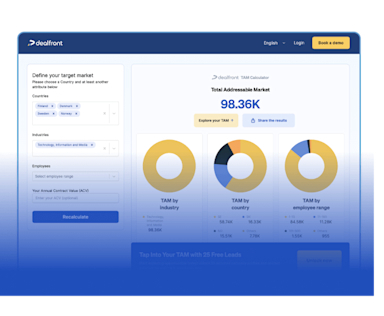
Calculate your Total Addressable Market (TAM) for free
Discover the true size of your Total Addressable Market (TAM) in seconds using the most accurate B2B database in Europe.
Get immediate results now
SEM (Paid Search) Manager @ Leadfeeder
Oscar Johnson is Performance Marketing Team Lead at Leadfeeder, where he leads paid acquisition and growth initiatives across global markets. With a background in performance marketing and search engine marketing, he specializes in scaling customer acquisition through data-driven campaign optimization.
Oscar has managed multi-market advertising programs and large paid media budgets while continuously improving targeting, attribution, and funnel performance. His experience managing B2B acquisition campaigns informs his perspective on audience targeting, paid marketing strategy, and optimizing the path from click to conversion.