

60-Second Summary
This curated shortlist highlights the top 10 website visitor identification tools for 2026, including Leadfeeder, RB2B, Warmly, Lead Forensics, Leadinfo, Albacross, 6sense, ZoomInfo WebSights, Vector and Snitcher. The right choice depends on company‑ vs person‑level ID, EU/GDPR coverage, and what you do with identified data after a visit.
Key takeaways: Choose company‑level tools (Leadfeeder, Leadinfo, Albacross, Lead Forensics) for org visibility and person‑level tools (RB2B, Vector, Warmly) for individual outreach; prioritize EU‑hosted vendors if GDPR matters; activation (CRM sync, ad audiences, workflows) drives long‑term value.
Standout strategies & tactics: Run each tool on your own traffic for at least two weeks, use identification plus activation (prioritization, enrichment, CRM routing, ad audience sync), consider real‑time engagement for immediate capture (Warmly), and use ABM/predictive platforms (6sense) when you need in‑market signals.
Real-world lessons & frameworks: Match rates vary widely by traffic mix (office vs remote, VPNs, mobile); be skeptical of vendor claims, involve legal/DPO for EU data questions, and measure identification on your site—not someone else’s.
Actionable selection framework: Ask four questions—company vs person level, EU/GDPR fit, data‑only or data+activation, and budget/traffic volume—then trial the top matches on your traffic before buying.
*This summary was created with AI assistance, using our original content.
Our picks for the best website visitor identification software in 2026 are Leadfeeder, RB2B, Warmly, Lead Forensics, Leadinfo, Albacross, 6sense, ZoomInfo WebSights, Vector and Snitcher. The right choice depends on whether you need company-level or person-level identification, whether EU and GDPR coverage matters, and what you plan to do with the data after a visit is identified.
Here at Leadfeeder, we built and maintain a website visitor identification software, so we know this category well. This is a curated, opinionated shortlist of the 10 B2B website visitor identification tools we think are genuinely worth evaluating, so it’s not a definitive or exhaustive ranking. As a result, we left out a few frequently-mentioned tools we don’t think are relevant to a serious B2B buyer, but we did include a couple that others under-discuss.
Keep in mind that Gartner research shows 67 percent now prefer a rep-free experience. That means most of the intent happening on your website is invisible unless you have a tool to surface it, making anonymous website visitor identification more important than ever.
Website Visitor Identification Tools Compared
You may notice that Clearbit (now Breeze Intelligence) and Apollo.io are absent.
Clearbit no longer exists as a standalone product since the HubSpot acquisition, while Apollo.io and UpLead are mainly contact databases that also offer website visitor features, so we did not include them here.
1. Leadfeeder

Our top pick is Leadfeeder. It identifies the companies visiting your site and helps you act on that interest by sending them to your CRM, ad audiences and alerts. It is built on more than 10 years of IP-to-company data: 45M+ IP-to-company mappings covering about 9M companies, and was built for B2B marketing teams (especially EU and GDPR-conscious ones) that want identified companies sent into their CRM, ads and workflows, not just a list of company names.
Leadfeeder's focus is what happens after identification. It helps you prioritize those accounts by ICP fit and intent, enrich the account record, route it to your CRM, sync it to ad audiences, and trigger workflows automatically. That cycle is where Leadfeeder puts its focus.
Strengths:
Identification tied to activation, with the ability to prioritize by ICP fit and intent, enrich, route to CRM, sync to ad audiences, and trigger workflows automatically
Built in Europe, with all data hosted in Europe, and published pricing from €79 a month billed annually (€113 billed monthly)
Strong CRM and ad-stack integrations
Free tier and 14-day trial, no card required
Paid plans start from €79 a month, billed annually, with a free Lite plan and a 14-day free trial of the full product (no card required). On G2, Leadfeeder holds a 4.3 out of 5 rating across roughly 860 reviews, with users consistently praising the interface and CRM integrations.
Limitations:
Like all IP-based tools, remote and consumer-ISP traffic is harder to identify
If your primary need is individual-level identification of US visitors, tools like RB2B or Vector are built for that
2. RB2B
RB2B is the tool that put person-level website visitor identification on the map for plenty of B2B teams. It identifies website visitors with global company-level identification also included on paid plans. The free tier (150 credits per month) makes it easy to test, which is a big reason it built a large following so quickly.
Strengths:
Company-level identification
Global company-level identification included on paid plans
Generous free tier (150 credits per month) to test the concept
Limitations:
Person-level removed in 2026, with no meaningful EU or GDPR coverage
Credit-based pricing means high-traffic sites can burn through allocation quickly
No built-in enrichment, sequencing, or outreach tools
3. Warmly
Warmly takes a different approach from most tools on this list. Instead of simply identifying who is on your site, this platform gives you tools to engage them while they are still browsing. That includes AI-powered chat, live video, calendar booking, and real-time visitor alerts.
It combines both contact-level and company-level identification with an orchestration layer that coordinates outreach across channels simultaneously. As a note, Warmly has been acquired by HubSpot, but their announcement stressed that for existing customers, it’s business as usual.
Strengths:
Real-time engagement options include AI chatbot, live video, and calendar booking while visitors are still browsing
Both person-level and company-level identification
Orchestration layer that triggers Slack alerts, email sequences, and LinkedIn outreach simultaneously
Limitations:
Paid plans start at $10,000 per year, though quarterly plans are available
Add-ons for their GTM Signals Package and Warm Experiences cost an additional $10,000 a year each
CRM integrations limited to HubSpot and Salesforce
Some users reported limited data
Leans heavily toward sales and SDR workflows, which may not fit marketing-led teams
4. Lead Forensics
Lead Forensics has been in the visitor identification category longer than most of the tools on this list. It has a large proprietary IP database, a reputation for hands-on customer support, and a traditional sales-led go-to-market model. If you are a mid-market team that values maturity, dedicated account management, and a product that has been through multiple market cycles, Lead Forensics is worth a consideration, though it can be more expensive than other tools on this list.
Strengths:
Large proprietary IP database with strong company-level match rates
White-glove onboarding and hands-on customer support
Mature product with years of B2B visitor identification experience
Limitations:
No published pricing; requires a sales conversation to evaluate
Some users report that the interface feels dated compared to newer tools
5. Leadinfo
Leadinfo is an EU-based company-level identification tool with clean UX and strong European traffic coverage. It’s a good fit for EU SMBs that want a straightforward, affordable visitor identification tool that covers the basics.
Strengths:
Transparent, published pricing: Starter at €69 per month, Scale at €159, Pro at €359
Fast setup with 14-day free trial, no credit card required
67+ native integrations, including major CRMs
Strong Benelux and DACH traffic coverage
Limitations:
Activation layer is basic compared to tools with deeper workflow automation and ad audience syncing
Add-ons (Autopilot, Leadbot) increase cost beyond the base price
6. Albacross
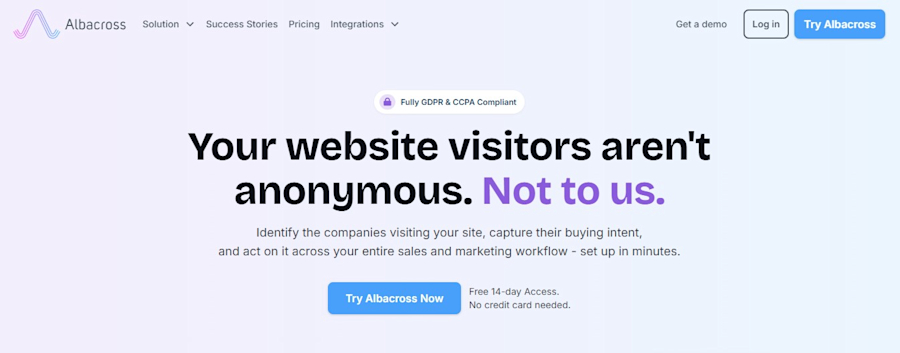
Albacross is a Swedish-built company-level identification tool with strong coverage of European traffic. A 14-day free trial is available with no credit card required, but there’s no permanent free tier. Pricing starts at €59.
Strengths:
Strong European data coverage
Transparent pricing: Starter at €59 per month (annual), Professional at €149, Organization at €375
Built-in LinkedIn and email sequence automation on paid plans
Limitations:
Credit system for verified contacts can run out quickly on higher-traffic sites
HubSpot integration requires Professional tier; Salesforce bi-directional integration requires Organization
7. 6sense
6sense is a different kind of tool compared to some of the other platforms on this list, as visitor identification is just one layer of a much broader enterprise ABM and predictive intent platform.
If you’re running a sophisticated account-based program and need to predict which accounts are in-market (instead of only seeing who visited), 6sense is built for that. However, it’s a significant investment in both cost and implementation complexity, so it only makes sense for teams with the resources to use it fully and who can manage a steeper learning curve.
Strengths:
Predictive intent model that identifies in-market accounts before they visit your site
Full ABM orchestration with campaign management and audience activation
Deep intent signal coverage across the web, not just your own site
Limitations:
Enterprise-priced with custom contracts, which can be overkill for teams that just want visitor identification
Complex to implement compared to competitors, and may require dedicated ops resources
Focus on company and account level contact information
8. ZoomInfo WebSights
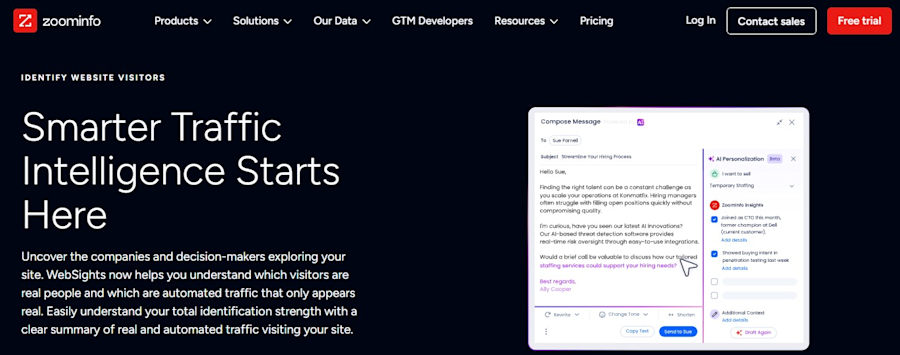
ZoomInfo WebSights is not a standalone visitor identification tool, but it’s the visitor identification module inside ZoomInfo's broader sales intelligence platform.
If your team already uses ZoomInfo for prospecting and contact data, WebSights adds a website intent layer on top of data you are already working with. Since ZoomInfo is such a popular tool, we’re adding to the list. If you don’t already use ZoomInfo, however, this is an expensive way to get visitor identification.
Strengths:
Seamless integration with the broader ZoomInfo sales intelligence suite
Access to ZoomInfo's contact and firmographic database for instant enrichment
Strong fit for teams already using ZoomInfo for prospecting
Limitations:
Not available as a standalone product; requires a ZoomInfo subscription
Expensive as a visitor identification solution if you aren’t already on the platform
Some customers report data decay on smaller accounts
9. Vector
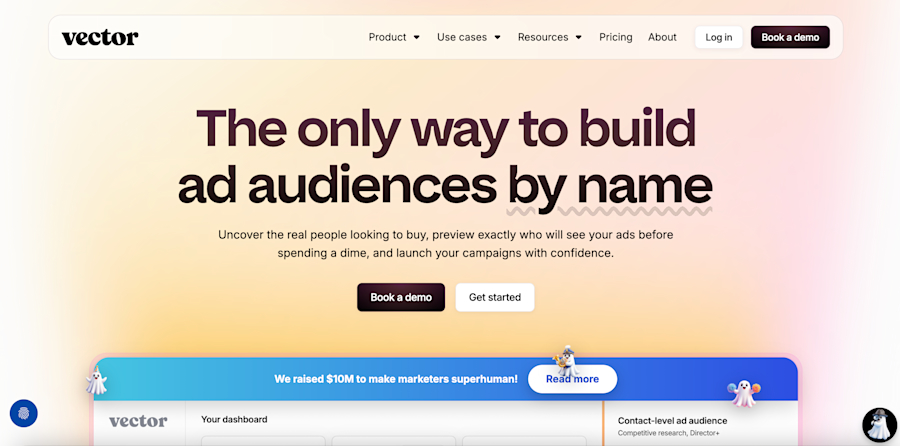
Vector is a YC-backed, contact-level marketing platform that uses digital fingerprinting and a proprietary publisher network to match US website visitors to individual profiles.
The Reveal plan’s usage-based pricing starts at $399 per month for 2,500 identified visitors and scales with volume ($599 for 5,000, $799 for 7,500, $999 for 10,000). A 14-day free trial is available.
Strengths:
Person-level identification of US visitors using an identity graph, not just IP
Ad audience building to sync identified contacts as dynamic audiences to LinkedIn, Google, Meta, and Reddit available with add-on purchase of Target
CRM integration with Salesforce and HubSpot
Limitations:
US-focused with limited international reach
Usage-based pricing means costs scale with traffic and can spike during campaign surges
Newer to market with a thinner review base than established players
10. Snitcher
Snitcher is a Dutch-built company-level visitor identification tool with a strong reputation for accuracy, transparent pricing, and no feature gating. Premium plans start at $49 per month and scale with the number of identified companies. A 14-day free trial with full feature access is available, no credit card required.
Strengths:
Entry price from $49 a month (checked [date]) with no features locked behind higher tiers
Native GA4 integration for tying visitor identification to analytics and attribution
Publishes a trust centre with privacy and security details
Unlimited team members on all plans
Limitations:
The basic pricing only includes company-level credits
Usage-based pricing scales with traffic, so costs grow as your site grows
This is an identification tool, not an activation platform, so you will need separate tools for outreach and enrichment
How to Choose the Right Website Visitor Identification Tool
Ten tools is a lot to evaluate. The good news is that most teams can narrow the list to two or three options by answering four questions. The answers map directly to which tools fit and which ones you can skip.
Do you need company-level or person-level identification?
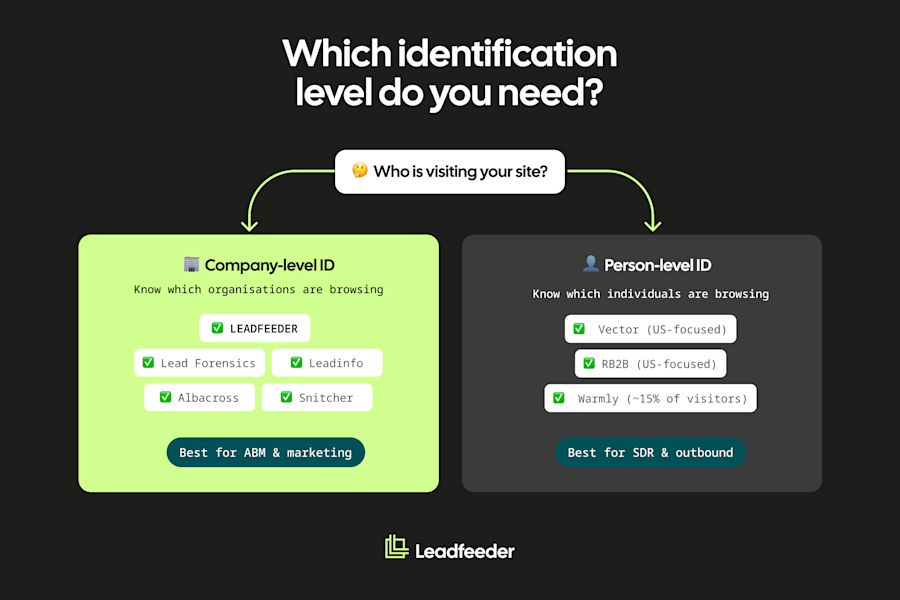
Company-level tools (Leadfeeder, Lead Forensics, Leadinfo, Albacross) tell you which organizations are visiting. Person-level tools (RB2B, Vector, Warmly) tell you which individuals are visiting. Company-level vs person-level identification is the most important fork in the decision.
Is EU traffic a priority?
If a significant share of your visitors are in Europe, check how each tool handles personal data and where its data is hosted, then decide with your DPO or legal counsel. Our guide to GDPR and visitor identification covers the questions to ask. Leadfeeder, Leadinfo and Albacross are built in Europe. This is general information, not legal advice.
Do you want data only, or data plus activation?
This is the question most buyers skip, and it is the one that matters most for long-term value.
Identifying a visitor is step one. What happens next involves prioritising that account, enriching it, routing it to the right rep, syncing it to ad audiences, and turning visitors into leads. All of this is where the real pipeline impact comes from.
Choose a tool that connects identification to action, not one that stops at a dashboard.
What is your budget?
The pricing range for website visitor identification platforms is wide. It includes:
Free tiers (RB2B, Leadfeeder)
Low-cost entry points (Snitcher from $49 per month)
Mid-market pricing (€69 to 700 per month for Leadinfo, Leadfeeder, Albacross, Vector, Warmly)
Enterprise-custom pricing (6sense, ZoomInfo, Lead Forensics)
Match the investment to your traffic volume and GTM maturity.
One more thing worth mentioning here is that you don’t want to buy a tool based on a demo with sample data. Whether you are testing paid or free website visitor identification tools, run each one on your own website traffic for at least two weeks before making a decision. You can start with Leadfeeder free.
A Note on Match Rates
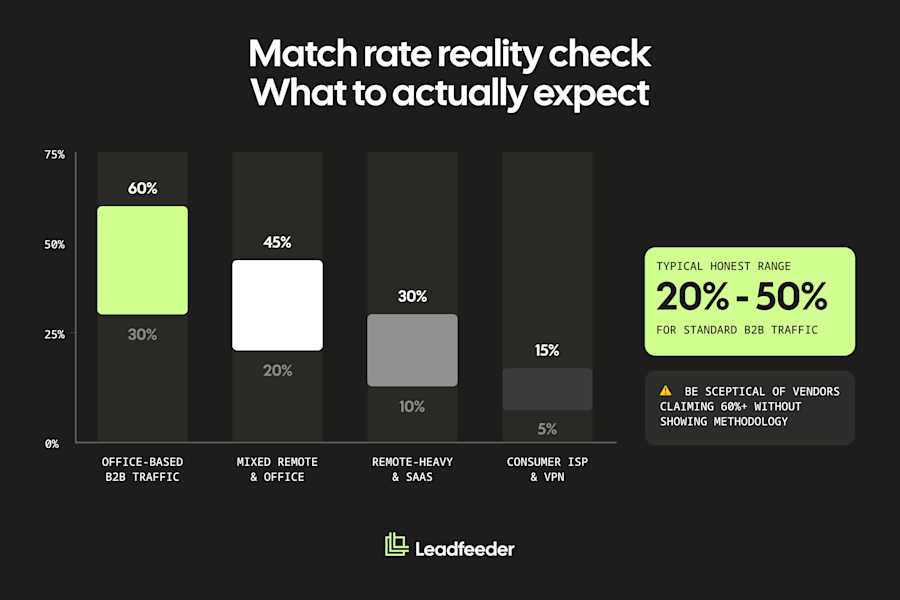
Every tool on this list claims a match rate, and those numbers deserve scrutiny. The reality of B2B website visitor identification software is that match rates vary significantly depending on your traffic mix.
In August 2026, Leadfeeder identified 38.0% of visits across our five core regions and 30.8% in the US and Canada. The range is wide because it depends on how much of your traffic comes from identifiable corporate IPs versus remote workers on consumer ISPs, VPNs, or mobile networks. A B2B site with mostly office-based visitors in established industries will see higher match rates than a SaaS site with heavily remote, global traffic using VPNs, for example.
Person-level tools can identify individuals but only in specific markets (primarily the US) and with their own accuracy trade-offs.
Be skeptical of any vendor claiming 60% or higher match rates without showing their methodology.
Ultimately, the only number that really matters is what the tool identifies on your traffic, not what it identifies on someone else's. Ask for a trial and measure it yourself.
Frequently Asked Questions for Web Visitor Identification Software
How accurate is website visitor identification software?
Website visitor identification accuracy varies by tool and traffic mix. Rates depend on how much of your traffic comes from identifiable company networks. In August 2026, Leadfeeder identified 38.0% of visits across our five core regions and 30.8% in the US and Canada. Person-level tools can achieve higher individual match rates in specific markets.
Do I need company-level or person-level identification?
Whether you need company-level or person-level identification depends on your GTM motion. Company-level suits marketing teams focused on account-based workflows, prioritization, and activation. Person-level suits SDR teams that want individual contact details for immediate outbound. Many teams use both.
Is website visitor identification GDPR compliant?
It depends on the tool and how you use it. An IP address can be personal data, so GDPR applies. Company-level identification is lower risk than identifying individuals, but it is not outside GDPR. Whether legitimate interest applies is a question for your legal team, and GDPR and ePrivacy are separate questions. This is general information, not legal advice. For details on how Leadfeeder specifically handles data privacy, see our GDPR overview.
How is visitor identification different from Google Analytics?
Visitor identification software differs from Google Analytics in what it reveals. Google Analytics shows you aggregate traffic data like page views, sessions, and behavior patterns. Visitor identification tells you which specific companies (or individuals) are behind that traffic so you can take action on it. They answer different questions and work well together. GA4 reports on users and sessions; Leadfeeder reports on companies. For example, GA4 tells you a session came from a LinkedIn campaign. It cannot tell you that the session was a 200-person manufacturer in your ICP.
What does website visitor identification software cost?
Pricing for website visitor identification software ranges from free tiers (RB2B, Leadfeeder) and low-cost entry points (Snitcher from $49 per month, Leadinfo from €69 per month) through mid-market (Leadfeeder Discover from €79 a month billed annually, up to several hundred a month for other tools) to enterprise-custom pricing (6sense, ZoomInfo).
The main cost drivers include traffic volume, identification level (company vs person), and whether activation features are included.
How long does it take to set up?
Most website visitor identification tools can be set up in just a few hours:
Installation is typically a lightweight JavaScript snippet that starts identifying visitors the same day.
CRM integrations and workflow configuration take one to two weeks to fully operationalize.
Free trials let you test match rates on your own traffic before committing.
What should I look for beyond identification?
The most important thing to look for beyond identification is what happens with the data after a visitor is identified. 67 percent of B2B buyers now prefer a rep-free experience, which means forms capture a shrinking share of intent. Prioritization, CRM enrichment, ad audience syncing, and workflow automation are the features that play a significant role in turning identification into pipeline.
Want to see which companies are visiting your website? Try Leadfeeder free for 14 days. Read our Terms here.