60-Second Summary
Selling still matters, but B2B loyalty is won through customer experience: usability, authenticity, human interactions, and convenience. These practical takeaways show how to turn a customer-centric mindset into concrete site, support, and journey changes.
Key takeaways: B2B CX is everyone’s responsibility—design for usability, communicate authentically, make support feel human, and add convenient personal touches to turn customers into advocates.
Standout strategies & tactics: Rotate employees through Customer Success, use live chat plus proactive follow-ups, produce quick how-to videos/GIFs, and apply Jobs‑to‑Be‑Done to solve customers’ real needs.
Real-world lessons & frameworks: Escape the curse of knowledge by observing real usage, watch for Hawthorne effects, use JTBD to map outcomes, and own mistakes—action on feedback builds trust.
Practical retention moves: Showcase authentic customer stories, add small personal gestures (shout-outs, swag), be transparent about product limits, and track every interaction to continuously improve experience.
*This summary was created with AI assistance, using our original content.
Selling matters, but it is not enough to build long-term loyalty in a market shaped by B2B customer experience trends, where customers have endless options and higher expectations than ever before.
For a practitioner's view on turning that mindset into actual site and journey changes, Ecesu Erol on experience optimisation is worth a read.
At every step of the B2B customer experience journey is a real person choosing whether your company is worth their time, trust, and money. That is why your B2B customer experience strategy is not just the responsibility of Customer Success, but the responsibility of every team and every employee in the business.
Note: Ready to discover your prospect's buying patterns? Learn about customer behavior when you sign up for our free 14-day trial.
What is B2B customer experience? Start with a customer-centric mindset
In a real customer-centric organization, B2B customer experience management belongs to everyone, not only the customer success team. You’ll need to think deeply about what your customers care about and need across every department.
1. Customers crave usability
Your customers crave usability in your design. It’s not enough to slap something together and call it an MVP.
Your designers and product managers need to understand your customers inside and out, think through how they act and what they care about, and then solve a key problem for them.
That’s why everyone at Leadfeeder — yes, everyone — works in Customer Success some of the time.
Everyone at Leadfeeder plays a part in support - everyone. Our marketing team, sales, leadership, and developers. They all have a connection, whether through live chat or by working directly with the team to solve problems.
Everyone lives and chats with real customers multiple times a week. Whether they’re in engineering or in design. They’re trying to escape the curse of knowledge.
Customer success relies on understanding and empathy, and our team doesn’t sit idly by. They are getting out of their silos and escaping the curse of knowledge.
THE CURSE. It’s real. When you talk to customers every day, you can’t hide from their pain points.
From where you thought it worked, but it doesn’t. Because you know how to use the product, of course, it makes sense to you.
Listening to your customers in focus groups, surveys, or listening loops is great, but it doesn’t allow you to fully experience the product the way they do.
That’s because of a sneaky little effect called the “Hawthorne Effect.” Basically, as soon as you know someone is watching, you ~perform~ a little more.
If someone is watching you over your shoulder, are you really doing the work the same way you normally would? Probably not. That’s the Hawthorne Effect at work.
One way to adopt a customer mindset is Clayton Christensen’s Jobs-to-Be-Done method.
This basically translates the nuts and bolts of your product into an idea or feeling that your customers actually want to capture.
It’s when a customer wants to change something in their life but can’t because of some obstacle or constraint. That’s where your product comes in.
What does your company do to make your customers’ lives easier? To achieve something greater?
Your “job to be done” is what makes your customer a better version of themselves. (Or let’s be real - look good for their boss!)
Too often, I let myself design to the lowest common denominator: me (or my deadline). Using live chat and other customer support is the best way to put yourself in your customer’s shoes so you can find the real issues and get them to the right solutions.
That’s exactly why we do it. It isn’t about deadlines or about pride. It’s about truly empowering your customers so they can shine.
No software or service will make sense to everyone right away. But with customer logic at its core, it should be easy to understand.
Here’s an example of how our team quickly put together a video for a customer who wasn’t sure how to fix a problem. Take this customer chat, for example, my colleague Pinja took:
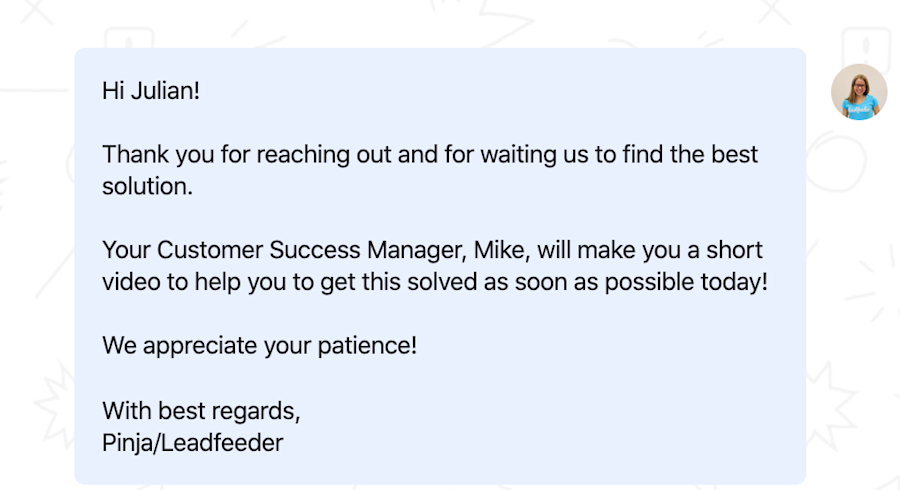
And then, usually, someone else on my team follows up to make sure things are a-ok. Mike here even included a fancy video of the issue and how to solve it, just in case.
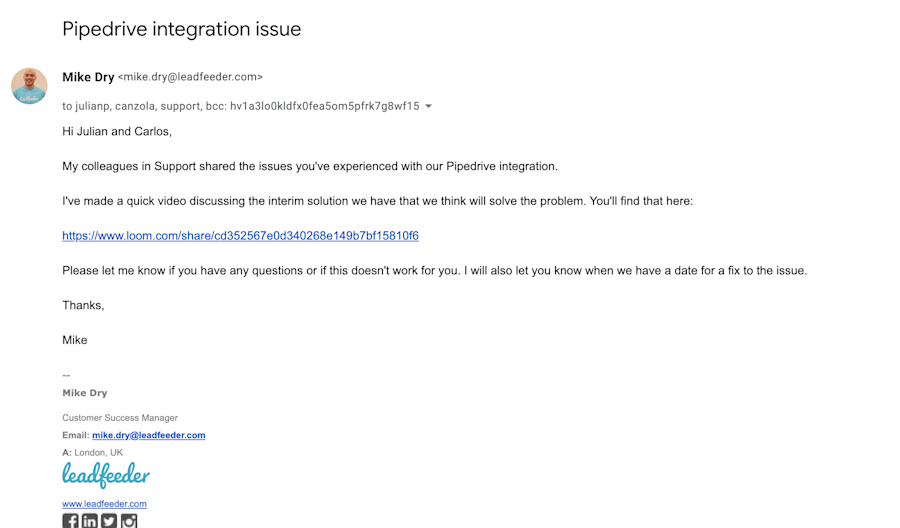
Your support team is there to swoop in and help any customer who needs it, so they can turn frustration into delight.
That may be with written documentation, videos, or GIFs, so there are answers and options when a question comes up. That’s the secret sauce.
2. Customers crave authenticity
Your customers want authenticity in the way you talk. Your marketing department should write the way they talk in real life.
Personally, I think FreshBooks does a great job of this. Just watch this customer success story.
https://www.youtube.com/watch?v=bZEvZKtJlwQ&feature=emb_title
FreshBooks lets Sarah, the customer, do the talking. And it’s so much more powerful.
Another brand that walks the walk is Patagonia. They actually want you to be more sustainable, which includes not buying from them.
This started way back in 2011 with their “don’t buy this jacket” campaign, which casually boosted revenue by 30%.
Authenticity isn’t just putting your customers first. It’s living your brand’s values, even if it doesn’t seem to make short-term sense. Because we’re all still talking about Patagonia, which is now a $1 billion company.
3. Customers want to talk to a human (even if it’s via a robot)
Your product shouldn’t be full of acronyms or jargon, because who talks like that? You need to be human — which means talking like one. That doesn’t necessarily mean cracking jokes or dropping emojis unless it fits your brand personality.
Lucky for me, our brand loves a good GIF.
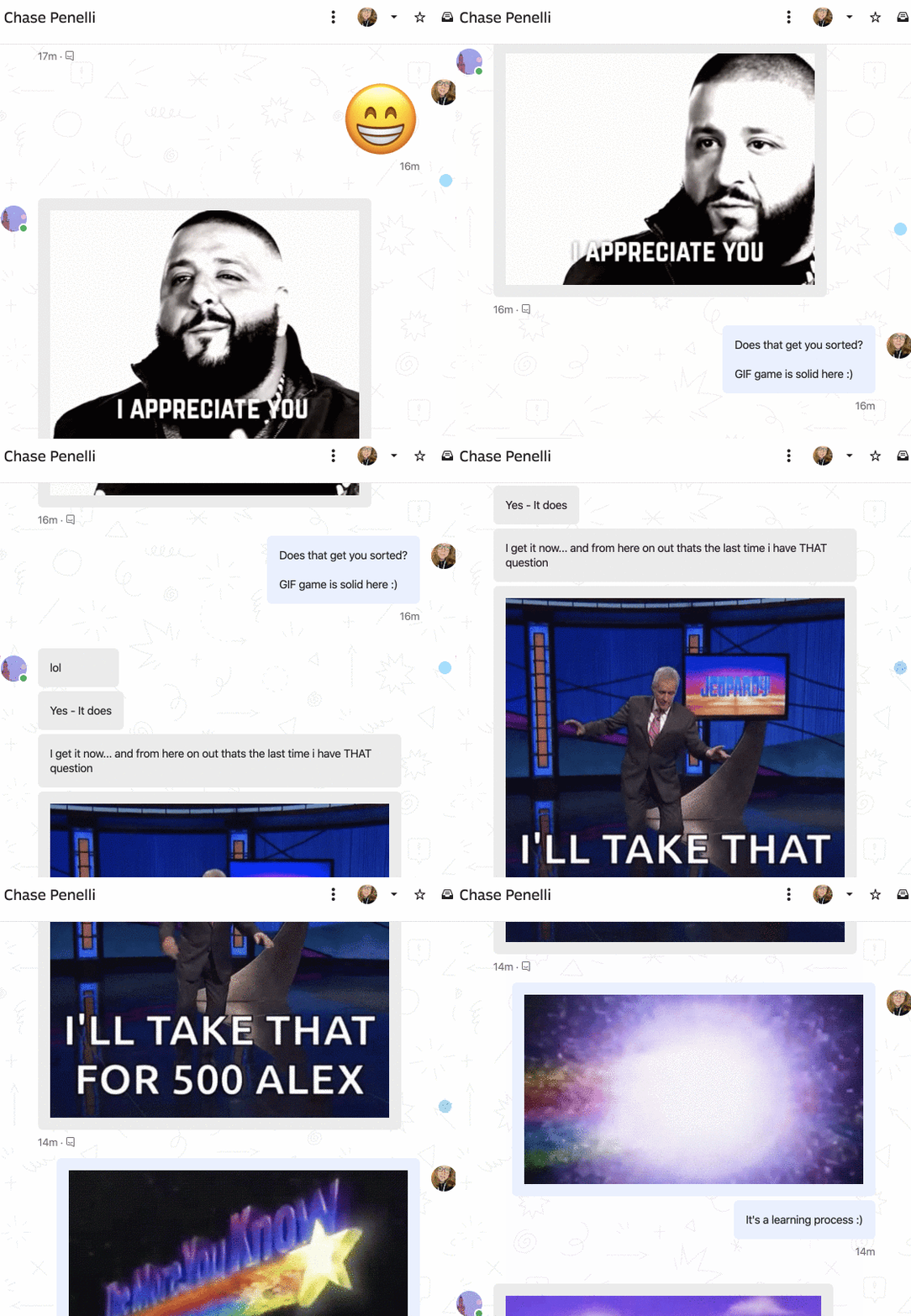
But it does mean listening to your customers' needs, making sure they feel heard, and being up-front about what your product does — and what it doesn’t.
That means paying attention to every single interaction. Every.single.one. You can see a snapshot of our Intercom scores below:
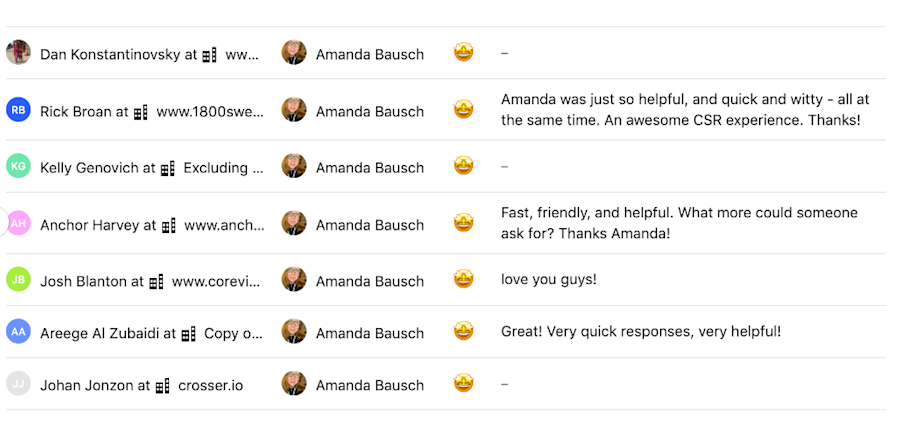
It means the customer feels like they are talking to a real person behind the chatbot or email when they ask for help. Or in our case,
4. Customers need convenience
Your customers need to feel heard and helped when they have a problem. Show your customers that you care by adding personal touches.
Some examples: quick videos, digging deeper into their end goal with questions, or even some small talk can elevate a mechanical “chat” to an actual experience.
That means showing them that you’re listening to feedback and taking action on it.
Even if it hurts. Even if that feedback could have been delivered more nicely. It doesn’t matter — your business 100% depends on it.
That means owning up to your mistakes and being honest about how you’ll make up for them. That means showing them you’re there to help.
Your product is not the center of their life — they have their own challenges to worry about, and it’s up to you to help solve them.
You can’t just throw a link to an article into an email and hope that a customer will click through.
Asking questions to get to the core issue is real customer support. That’s what it means to show them that you appreciate them.
Give your best customers shout-outs with case studies or on social media. Thank them for their feedback or for purchasing from you.
Heck, send them some swag! People love swag. It may seem silly, but it works.
Continue adding your personal touches to correspondence and marketing — because showing your customers you care is how you retain customers and build advocates for your business.
How to improve B2B customer experience: don't be like everyone else
The icing on the cake? Customer experience is something companies consistently struggle with.
There’s a reason why terrible customer experiences like being forcibly dragged off an airplane or having a troll simulate your support team go viral — don’t be like everyone else.
You do not need B2B customer experience statistics to see that it is still under-prioritized and underutilized, so B2B customer experience best practices remain an easy way to differentiate your business.
Because most brands don’t really care about their customers, even though they say they do. So for your brand, customer experience will be more important than anything else.
Today, customer experience is one of the most important criteria among B2B buyers. Price! Ultimately, your customer experience is your business. It’s up to you to make it the best it can be.
Note: Ready to discover your prospect's buying patterns? Learn about customer behavior when you sign up for our free 14-day trial.