60-Second Summary
Many teams work hard but can’t explain how their revenue engine actually works—where deals stall, which levers move the needle, or why performance swings month to month. This guide gives a practical framework to map revenue flow, apply simple compounding math, and run a focused 30–90 day plan to fix the biggest bottlenecks.
Key takeaways: Revenue generation is a system (product, positioning, GTM, pricing, retention, RevOps) not a single tactic; diagnose the funnel, map conversion rates, pick 2–3 levers (volume, conversion, deal size, retention), and assign cross-functional ownership to avoid siloed efforts.
Standout strategies & tactics: Strengthen sales fundamentals (stages, qualification, multi-threading), hold marketing accountable for pipeline contribution, run pricing A/B tests, invest in RevOps (data hygiene, standard stages, reporting), and execute focused 30–90 day experiments.
Real-world lessons & frameworks: Map your revenue engine on one page (stages, conversion rates, owners, reports), use the funnel flow (Awareness → Leads → Opportunities → Customers → Expansion → Renewal) to find bottlenecks, track key KPIs (ARR/MRR, NRR, pipeline coverage, win rate, CAC, churn), and fix misaligned incentives before scaling.
30–90 day playbook: First 30 days—map the engine, set KPIs, prioritize top constraints; days 31–60—run focused experiments (win-back, outbound refresh, pricing tests); days 61–90—standardize winning playbooks, templates, and review cadences so wins scale predictably.
*This summary was created with AI assistance, using our original content.
Marketers everywhere are running into this problem, and it’s not happening because your team isn't working hard enough. The real problem is that most companies can't actually explain how their revenue engine works. They don't know where deals get stuck, which levers matter most, or why February crushed it while March completely tanked.
This guide gives you the framework to fix that. You'll see how revenue actually flows through your business, simple math showing how tiny changes create massive results, and a 30-90 day plan to fix your biggest bottlenecks in revenue generation.
What Is Revenue Generation?
Revenue generation is the system of activities, processes, and teams that create and grow your company's income. It's everything from that first marketing touchpoint to renewal and expansion years later.
Let's clarify some terms people often confuse:
Revenue: Money you earn from sales and other income streams.
Profit: Revenue minus costs. You can have revenue but no profit.
Cash flow: Timing of money in and out. You can be profitable on paper but cash-constrained if customers pay slowly.
Let’s look at an example. A consulting firm closes a $100K project, which is $100K in revenue. They spend $60K delivering it, which means their profit is $40K. But they wait 60 days to get paid while covering payroll every week. That creates a cash flow problem, even though they're profitable.
Revenue Generation vs. Profit Generation vs. Cost Cutting
Most companies confuse these three approaches. They're related but serve different purposes, and picking the wrong one at the wrong time kills growth.
Revenue generation is about bringing more money in the door. You're increasing the number of customers, improving how many prospects convert, raising prices, or keeping customers longer. This is your growth engine. It's what you focus on when you're scaling, entering new markets, or trying to outpace competitors.
Profit generation is about keeping more of what you earn. You're optimizing pricing to capture more value, making operations more efficient, or shifting your product mix toward higher-margin offerings. Focus here when margins are getting squeezed or you need to show investors a path to profitability without sacrificing too much growth.
Cost cutting is about spending less. You're reducing headcount, cutting tools, renegotiating contracts, or eliminating programs. This buys you runway when cash is tight or you're in survival mode. But here's the trap: cost cutting creates a one-time boost to profit. Once you've cut the fat, there's nothing left to cut. You can't cost-cut your way to sustainable growth
Here's how they compare:
Cost cutting boosts profit short-term, but it rarely replaces sustainable revenue generation.
The mistake most companies make is defaulting to cost cutting when they should be fixing their revenue engine. If your win rate is 15% and should be 25%, cutting two sales reps won't fix that; it'll just mean fewer deals closed. You need to fix the conversion problem first.
Core Components of Revenue Generation
Revenue generation isn't one specific task. Instead it's made up of six components that need to work as a single system. When one breaks, the whole engine sputters.
These six components work as one system:
Product or offer: What you sell and the value it delivers
Market and positioning: Who you target and how you differentiate
Go-to-market: Your sales, marketing, and partnership motions
Pricing and packaging: How you capture value
Customer success and retention: Keeping and expanding accounts
Operations and RevOps: Process, data, and reporting infrastructure
When these align, revenue compounds, but they’ll hit bottlenecks in every direction if they’re not synching up.
The Revenue Engine Framework
Most companies track the marketing funnel but miss how revenue multiplies at each stage. Understanding how revenue actually flows through your business is the difference between guessing and building a predictable growth engine.
But here’s the best-kept secret: Revenue flows through predictable stages. It looks like this:
Awareness → Leads → Opportunities → Customers → Expansion → Renewal
Small improvements in each lever compound, because you’re getting more people further into the funnel successfully.
Here’s a breakdown of common bottlenecks, when they happen, and what you can do about them:
For example, if your pipeline looks healthy but your win rate is stuck at 12%, the problem isn't top-of-funnel. You're probably targeting the wrong customers or your sales team isn't qualifying hard enough.
Fix your ICP definition, tighten qualification criteria, and watch your win rate climb without changing anything else.
Mapping Your Current Revenue Engine
You can't fix what you can't see, which is a key issue teams struggle with in their revenue marketing. Most companies have no clear view of their revenue engine, which is why they keep hitting the same bottlenecks.
Here's how to map what you have today:
List your current channels and revenue mix (new vs. existing, products, regions)
Capture your funnel conversion rates (even rough estimates help)
Identify your biggest constraint (where are you losing the most potential revenue?)
You should get a one-page "revenue engine map" showing stages, conversion rates, owners, and key reports. Once you have this, you can make a plan to improve revenue generation.
Who Owns Revenue Generation?
Revenue generation fails when it's treated as one team's job. It's a cross-functional effort, and unclear ownership creates gaps that cost you deals.
The Cross-Functional Revenue Team
Every revenue team needs clear ownership. Here's who does what and why it matters:
Revenue isn't one team's job. Everyone owns the revenue number, and siloed efforts kill growth if your team doesn’t sync up. Here's who does what:
Leadership: Sets targets, allocates resources, decides priorities
Sales: Creates and converts pipeline, expands accounts, closes deals
Marketing: Generates demand tied to pipeline and revenue, not vanity metrics
Customer Success: Drives retention, expansion, renewals
Product: Delivers value, informs packaging, drives adoption
RevOps and Finance: Owns process, data, forecasting, reporting
Keep in mind that misalignment is the silent killer of revenue growth. When teams optimize for different metrics, everyone works hard but revenue stays flat. Here’s how to do that:
Create shared definitions: What counts as a lead? An opportunity? How do you calculate ARR?
Set a North Star metric: Pick one—ARR, MRR, or NRR. Everyone should know this number across all departments.
Establish cadence: Review pipeline weekly with sales and marketing, assess growth revenue across all teams monthly, and hold strategic planning quarterly.
How to Build a Revenue Generation Strategy
Most revenue strategies fail because they try to do everything at once. Focus wins. Here's how to build a strategy that actually moves the number.
Step 1: Diagnose Your Starting Point
You can't build a strategy without knowing where you are today. Run this diagnostic to find your biggest constraints.
First, check your revenue mix:
What percentage comes from new customers vs. existing?
Do you have customer concentration risk? (One customer >20% of revenue is dangerous)
Do you have channel dependency? (One channel >80% of pipeline is risky)
Then, check your funnel health by asking these questions:
Are you generating enough traffic and leads?
Is lead quality strong? (ICP-fit, not just volume)
Is your win rate healthy? (20%+ for B2B is the benchmark)
Is average contract value growing or shrinking?
Is churn rate under control? (<5% monthly for SaaS, <20% annually for services)
Finally, match symptoms to fixes using this guidance:
Step 2: Set Clear, Numeric Revenue Goals
Vague goals like "grow revenue" don't drive action. Here's how to set targets that create accountability.
Break annual targets into quarterly and monthly numbers:
Current ARR: $10M Target growth: 25% Target ARR: $12.5M
But don't forget churn: Expected churn: 5% = -$500K Net new ARR needed: $3M Monthly new ARR target: $250K
Be transparent about your assumptions, and remember that forecasts are directional, not precise. The point is having a realistic plan everyone can rally around.
Step 3: Choose Your Primary Revenue Levers
Trying to improve everything improves nothing. Pick two or three levers where small improvements create outsized impact.
The 4 main levers are:
Volume: Get more leads, add new channels, increase outbound activity
Conversion: Improve win rates, tighten qualification, speed up sales cycles
Deal size: Better packaging, upsells, move upmarket
Retention: Reduce churn, drive expansion, nail onboarding
How to choose: Pick two or three based on where your biggest bottleneck is and what effort vs. impact looks like. Don't try to fix everything at once. Focus wins.
Step 4: Turn Strategy into a 90-Day Roadmap
Strategy without execution is just a deck sitting in a folder. Here's how to turn strategy into shipped initiatives.
Build your roadmap:
Keep it focused. Three solid wins beat ten half-finished projects every time.
Step 5: Define Your Revenue Metrics
Most companies track everything and measure nothing that matters. Here's what you actually need to watch.
Track these KPIs:
MRR or ARR: Monthly or Annual Recurring Revenue
NRR: Net Revenue Retention (revenue retained after churn + expansion)
GRR: Gross Revenue Retention (revenue retained before expansion)
Pipeline coverage: Total pipeline ÷ revenue target (aim for 3-4x)
Win rate: Percentage of opportunities that close
CAC: Customer Acquisition Cost (sales + marketing spend ÷ new customers)
Payback period: Months to recover CAC from customer revenue
Churn rate: Customers or revenue lost per period
Build these reports:
Funnel conversion: Stage-by-stage drop-off rates
Cohort retention: How long do customers actually stay?
Channel performance: Which sources drive the best revenue (not just leads)?
Forecast accuracy: How close were we to plan?
Tie every metric to a decision. Dashboards without action are vanity projects.
Proven Revenue Generation Strategies
Generic advice doesn't work. Here are six strategies that actually move revenue, with tactical details you can implement this week.
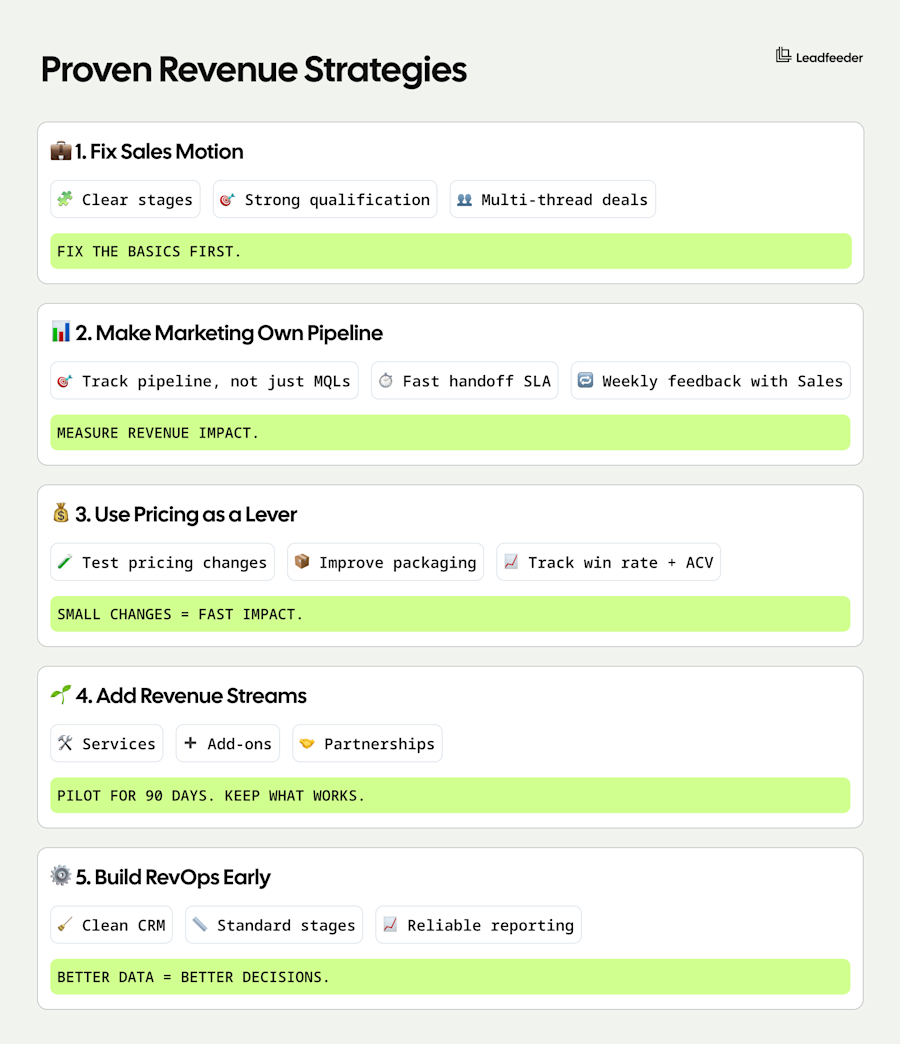
1. Strengthen Your Core Sales Motion
Most sales processes are broken by design—unclear stages, weak qualification, single-threaded deals. Fix these fundamentals first.
Define clear stages:
Lead (contact + basic qualification)
Opportunity (budget confirmed, decision process understood)
Negotiation (proposal delivered, procurement involved)
Use BANT or MEDDIC for qualification.
Qualify hard and disqualify fast; you don’t want to waste time on deals you can't win.
Finally, multi-thread your deals by mapping the entire buying committee. Get procurement involved early, not in week 10 when you're trying to close.
2. Make Marketing Accountable for Revenue
Marketing that only tracks MQLs can't prove impact. Shift to pipeline contribution instead.
If your pipeline target is $10M and marketing should source 40%, marketing needs to generate $4M in pipeline. Break that down by channel and track it weekly.
Set a clear lead handoff SLA, such as:
Five minutes or less response time for inbound
BANT qualification before passing to sales
A weekly feedback loop where sales tells marketing what's converting and what's not.
3. Use Pricing and Packaging as a Growth Lever
Most B2B companies haven't touched pricing in years, leaving millions on the table. Small pricing changes create immediate revenue impact.
Test new pricing using this method:
Pick a segment, form a hypothesis, such as "15% increase won't hurt close rate"
Run a 30-60 day A/B test
Track win rate and ACV
For example, move from one $99/month tier to three tiers: Starter ($49), Pro ($149), and Enterprise (custom). Most customers will choose Pro, giving you +50% ARPA.
4. Diversify Revenue Streams
Relying on one revenue model creates fragility. Test adjacent streams without losing focus.
Consider services, add-ons, partnerships, or marketplace models.
Run a 90-day pilot:
Target existing customers >$50K ARR
Offer something like premium onboarding for $5K
Track whether you hit 10 sales at 80%+ satisfaction.
If you get fewer than five sales, kill it and move on.
5. Improve Predictability with RevOps
Revenue operations isn't overhead—it's the difference between guessing and knowing what's coming.
Focus on data hygiene (clean CRM, no duplicates), process standardization (everyone follows the same stages), and reliable reporting.
Your minimum stack:
CRM + marketing automation + BI tool
Enforce required fields like lead source, ICP fit, stage, and close date
Track sources religiously using UTM parameters and attribution models
Merge duplicates weekly.
Bad data = bad decisions = lost revenue. Invest in RevOps early.
Common Revenue Generation Mistakes
These mistakes kill more revenue strategies than any external factor. Here's your checklist to avoid them:
Relying on one channel or big customer: If one customer represents >15% of revenue or one channel drives >80% of pipeline, you're one churn away from a crisis. Instead, add one or two new channels every quarter, build partner backup options, and set hard concentration limits.
Sales paid on bookings while CS owns retention: This creates bad-fit customers that churn fast. You should tie sales comp to collected revenue, not just signed contracts. Make both teams own NRR.
Marketing measured on MQLs while sales measured on revenue: Lead quality tanks when marketing optimizes for volume over fit. To resolve this, give marketing a pipeline target (e.g., 40% of total pipeline) and measure them on it.
Discounting heavily without guardrails: You're training customers to expect deals and eroding your margins. To combat this mistake, require VP approval for discounts >15%, create clear discount bands, train reps on value-based selling.
Scaling acquisition before fixing retention: If annual retention is <80%, you have a leaky bucket. To avoid this, narrow your ICP, improve onboarding to get customers to value faster, nail your messaging before you pour gas on acquisition.
Inconsistent win reasons across deals: If every deal closes for different reasons, you don't have product-market fit yet. Instead, interview recent wins to find the pattern, then double down on that specific use case and customer type.
If you're making any of these mistakes, fix them before adding more budget. Don't try to scale a broken engine.
30-90 Day Revenue Generation Action Plan
Most strategies die in the planning phase. This action plan breaks execution into manageable sprints with clear deliverables.
First 30 Days: Assess and Prioritize
The first month is about clarity—understanding what you have, where it's broken, and what to fix first.
Deliverables:
Revenue engine map
KPI definitions and baselines
Top three constraints identified
Chosen two or three levers to prioritize
Days 31-60: Implement Focused Experiments
Month two is about execution—running focused experiments that can show results quickly. For example:
Win-back campaign: Target 10% of churned customers, get 5 reactivations
Outbound refresh: New messaging, hit 15%+ response rate
Pricing test: 15% increase, maintain close rate >20%
Days 61-90: Standardize What Works
Month three is about scaling. The goal is to convert wins into repeatable playbooks that anyone can follow.
Convert winners into:
Playbooks
Templates
Training materials
Lock in rhythms:
Weekly pipeline review
Monthly revenue review
Quarterly planning
Your Revenue Generation Action Plan
Revenue generation is a system, not a single tactic. It's product, positioning, go-to-market, pricing, retention, and operations all working together. When one component breaks down, the whole engine sputters.
The four levers are Volume, Conversion, Deal Size, and Retention. Don't try to move all four at once. Pick two or three based on where your biggest bottlenecks are right now, and focus there for 90 days.
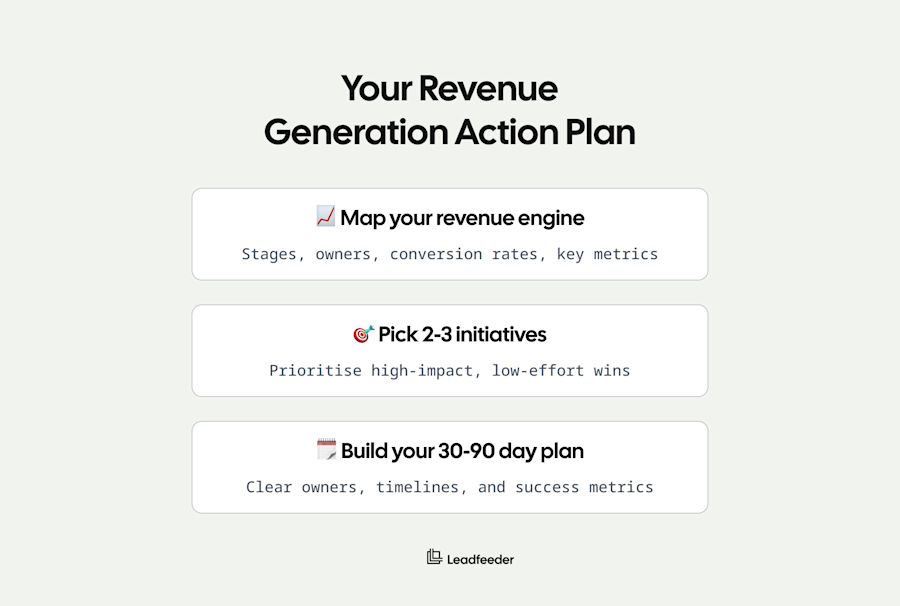
Your next steps:
Map your revenue engine: One page showing stages, conversion rates, owners, and the metrics you actually track
Pick 2-3 initiatives: Focus on highest impact, lowest effort improvements
Build your 30-90 day plan: Write down clear owners, specific timelines, and measurable success criteria
Small, focused improvements compound into significant revenue growth. But you need visibility into what's actually working.
Turn Website Traffic Into Revenue with Leadfeeder
Most B2B companies have no idea which companies are visiting their website or showing buying intent. Leadfeeder helps you identify anonymous website visitors, track engagement signals, and connect website activity directly to your pipeline so you can prioritise accounts that are actually interested and prove marketing's revenue impact.
Turn invisible website traffic into visible pipeline. Book your demo with Leadfeeder to see which companies are visiting, track their intent, and connect the dots to revenue.
Frequently Asked Questions
What are examples of revenue-generating activities?
Direct sales calls and demos
Inbound lead qualification
Email marketing campaigns
Customer success check-ins that lead to upsells
Partnership development
Pricing optimization tests
Product launches
Customer referral programs
Any activity that creates, converts, retains, or expands revenue
How long does it take to see results?
Quick wins (30-60 days): Pricing changes, win-back campaigns, discount policy changes
Medium-term (3-6 months): New channel development, retention improvements, sales process overhauls
Long-term (6-12+ months): Market entry, new product launches, fundamental positioning shifts
Focus on a mix of short and long-term initiatives so you're always seeing some wins.
What should sales and marketing spend be as percentage of revenue?
Early-stage (0-$1M ARR): 50-80%+ of revenue—you're investing heavily in growth
Growth-stage ($1M-$20M ARR): 30-50%
Mature ($20M+ ARR): 15-30%
SaaS companies: Often spend more (40-60%) due to LTV/CAC payback model
Services companies: Typically spend less (20-40%) due to tighter margins
Benchmark against similar companies at your stage and industry.
How do you balance short-term wins with long-term growth?
Use 70/20/10: 70% on proven engines, 20% on optimization, 10% on experiments. Review quarterly and adjust based on what's working.