60-Second Summary
As software markets expand, one-size-fits-all lead generation no longer works. Use a sales funnel (TOFU → MOFU → BOFU) plus visitor intelligence like Leadfeeder to attract, nurture, and convert higher-quality leads.
Key takeaways: Map and optimize the funnel—TOFU for awareness (SEO, ads, content), MOFU for nurture (ebooks, case studies), BOFU for conversion (demos, trials, discounts)—and focus on lead quality over volume.
Standout strategies & tactics: Build buyer personas, run targeted social ads, use lead magnets and optimized landing pages with A/B tests, leverage short-form video and SEO best practices, and collect testimonials and case studies.
Real-world lessons & frameworks: Align sales and marketing via CRM and shared data, prioritize qualified leads to lower TOFU spend, and iterate using metrics (traffic sources, keyword rankings, ad impressions/frequency).
Actionable insight: Use real-time visitor signals (e.g., Leadfeeder) to spot buying intent, act quickly with trials or demos, and continuously optimize content and channels to boost conversions.
*This summary was created with AI assistance, using our original content.
Many software businesses have seen huge growth as a result. But that also means you face more competition.
As consumers face more options, you have to find a new way to secure users. Following a traditional one-size-fits-all lead generation strategy doesn't just lead to stagnation. It leaves you in the dust.
A sales funnel is a tool that helps you visualize your lead generation like a pipeline. Leads enter the funnel when you've caught their attention, and you try to keep them in it until they make a purchase. At the top of the funnel (TOFU), meaning when people have just found out about you, you need to get in front of potential customers to build awareness and demand.
Once companies check out your site, Leadfeeder can collect accurate visitor data to help you turn them into customers. Keep reading to learn how to pull new traffic into the top of the funnel and convert that traffic into paying customers.
Stages of the sales funnel
The sales funnel maps a buyer's journey from first learning about your company to finally making a purchase. This lets you tailor your marketing campaigns according to the people they should reach.
1. Top of the funnel meaning
So what is top of the funnel marketing? The top-of-the-funnel stage is about awareness. Here, you use growth marketing to grab people's attention. For example, you might try inbound tactics like search engine optimization (SEO), paid advertising, and content marketing — like you’re reading here.
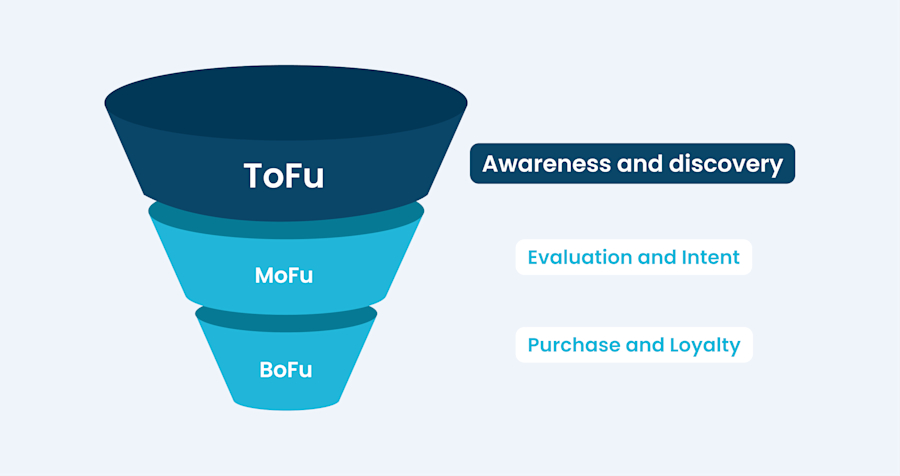
Identifying distinct customer personas is vital in top-of-the-funnel marketing. You should understand what your customers like and what they want so your advertisements can best capture their interest.
Many companies use this stage to collect information like contact numbers or email addresses on a landing page. Then, you can actively guide these people to the next stage of the sales funnel.
2. Middle of the funnel
The middle-of-the-funnel (MOFU) stage is for building interest with the people on your contact list. You can send out interesting long-form content, such as e-books, whitepapers, and case studies, to increase lead retention.
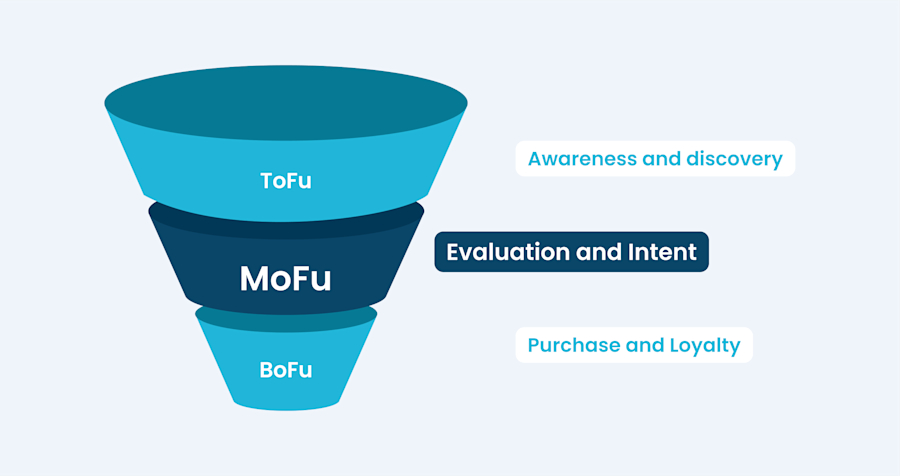
This nurtures your potential customers so that your business stays at the front of their minds until they're ready to make a purchase.
3. Bottom of the funnel
The bottom-of-the-funnel (BOFU) stage is when people make a purchase decision. As a result, it's also called the decision or action stage.
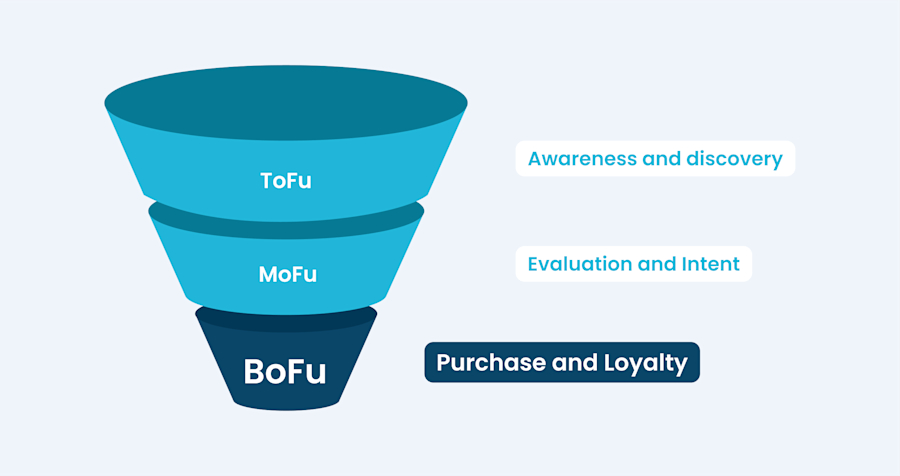
At this point, you've built a strong relationship with your leads. They trust your business and visit your site often. With Leadfeeder, you can spot behavioral patterns on your site that show when a visitor may be ready to make a purchase, with the right guidance.
BOFU marketing then makes this final push. Tactics like trial extensions, demos, consultations, and discount offers aim to reduce barriers to purchase.
What top of the funnel sales tasks should you focus on?
The top of the funnel focuses on generating high-quality leads — people interested in your product. TOFU sales tasks aim to generate leads and improve their quality to maximize the number of people who ultimately buy your product.
Some tasks include:
Creating buyer personas to better understand your leads
Offering free information to educate people who may be interested
Running targeted social media ad campaigns to reach the people who would be most interested in your product
Analyzing existing customer data to predict where future leads and opportunities may lie
How the sales and marketing teams work together at the top of the funnel
Many people think the difference between sales and marketing is a top of the funnel vs bottom of the funnel split. But they actually work hand in hand to make a seamless marketing funnel.
Marketing aims to draw people into the company, and sales reps get them to buy something. As a result, the sales team can help out with marketing at the top of the funnel in many ways.
1. Determining the right marketing strategy
Sales teams know how many leads actually make a purchase. This means they can help tailor your marketing strategy to reach the people most likely to buy from you.
2. Aligning around the sales process
Marketing is most effective when you structure your content around generating sales. For example, you could compare sales data with Leadfeeder insights to see whether those who watch your promotional videos go on to buy. If they do, you know to spread those videos more.
3. CRM alignment
Customer relationship management (CRM) software helps businesses automate their sales funnel tasks. It gives the marketing and sales teams a central platform for collaboration. Both teams have access to each other's data, enabling them to work toward a common goal.
4. Lead generation
Not all leads are equal. Some people are casually interested in your business but won't make a purchase. Others are qualified leads. These people's actions show their interest in becoming paying customers.
Sales and marketing teams analyze data on leads at different funnel stages to understand how to generate more qualified leads. After all, if you can get more people all the way through the funnel, you can spend less money on TOFU marketing.
5. Testimonials
Social proof is a powerful persuader. Testimonials from past customers who enjoyed your product carry much more weight than your standard advertisements.
Sales teams are responsible for securing powerful testimonials from happy, loyal customers. Marketing teams can then determine the best places to post these testimonials, such as specific landing pages, to generate the most interest.
6. Case studies
Case studies build trust between buyers and businesses. Sales teams compile data to convince prospects of your business's reliability.
The marketing and sales teams can work together to develop the best case studies. That way, your case studies can target different buyer personas.
If you use a case study for TOFU content, remember that your buyers are still in the awareness stage. Try using eye-catching graphics like logos from well-known clients that you’ve worked with to grab their attention. Overwhelming amounts of data could turn them away.
7. Focus on personas
Who are your ideal customers? What problems do they have? Where do they spend the most time online? Sales data can help you answer these questions and form your customer personas.
With personas that represent your target audience, you can create distinct marketing materials for each persona. That way, you optimize the content for each audience, helping you effectively communicate your value to every persona.
8. SEO
SEO is a powerful inbound marketing tool that helps your website rank higher on search engine results pages. Since the top Google result gets more than 27 percent of all clicks and the 10th result gets 10 times less, you always want to rank higher.
There are a few key SEO best practices that your marketing and sales teams can collaborate on:
Paragraphs and sentences should be short to account for mobile readers. If you think your content is hard to read, you can check its reading level with an online content grader — you should aim for an eighth-grade reading level.
Keywords are the queries people can search to find your content. Try to use your keywords frequently but naturally on your page — if algorithms suspect you of "keyword stuffing," they won't raise your ranking.
Visual elements like images, graphics, and videos make your content more engaging. An image’s alt text (the text that appears when you hover over the image) is another opportunity to include keywords.
If many other sites link to yours, search engines think your information is more reliable. These backlinks should naturally grow with time, but you can also secure more backlinks by making guest posts on other websites, etc.
9. Top of the funnel content marketing
If people enjoy the content you put out, they're more likely to follow you for future content. This also encourages search algorithms to rank your content higher, which raises your visibility. Marketing and sales teams should work together to make the most effective content.
90 percent of B2B content marketers prioritize articles that are shorter than 3,000 words. Readers can find these articles on your site after an online search, quickly read through them, and then check out your other ones.
Videos are another valuable way to easily share information, especially on social media platforms like TikTok and Instagram. If any of your personas use these platforms, your marketing and sales teams should experiment with short-form videos that address their pain points.
10. Lead magnets
Lead magnets are a great way to build a contact list. They're free pieces of content, like webinars or e-books, that you trade for an email address and other relevant personal information.
A good lead magnet is relevant to the audience you're targeting. It also needs to feel like it offers enough value that people would be willing to exchange their contact information for it.
Free trials are a great magnet for software companies, for example, because they allow users to interact with the product directly.
11. Creating the perfect landing page
Landing pages are the first web pages people see on your website. For example, you would host a lead magnet on a landing page and then send a download link to that page.
Making the perfect landing page takes some trial and error through A/B testing — trying out two options with key differences to identify which is more effective. Leadfeeder's real-time web page visitor insights help you identify the best indicators to track your success.
There are some common features among the best landing pages. Spot how many of them our homepage uses:
A catchy title and subheadings that speak to your target persona
Information about the product or magnet they clicked on
A list of benefits telling them why they should do what you're asking
Product features that show how they'll get those benefits
Information about your offer and pricing
Testimonials from clients who already bought and loved the product
Information about the company or team that worked on the product
12. Social media tasks
Social media advertising is powerful because of the number of targeting filters you can place on your campaign. You can home in on specific user personas with highly targeted content, thereby reducing your cost per click.
Maximizing a post's reach requires a number of small tasks, like:
Tagging both individual and business accounts
Using industry hashtags
Making use of features like Instagram Stories and YouTube Shorts
How top-of-the-funnel tasks ensure a smooth close
Capturing the right top of the funnel leads ultimately increases the number of people who convert into paying customers. Many TOFU metrics can help you optimize your conversion rate.
1. Traffic sources and mediums
Leadfeeder collects visitor information, such as traffic sources and mediums, so you can see the touchpoints visitors come from. This shows you which marketing channels and campaigns have been most successful. You'll also learn which ones haven't done well, so you know where to improve.
2. SEO keyword rankings
Tracking keyword rankings over time helps ensure you're using the right keywords to maximize your SEO efforts. As you notice patterns, you can also try to predict breakout keywords and create content around them in advance.
3. Ad impressions
Impressions tell you how many users see your ads. In most cases, an impression is a person's first experience with a brand. Increasing your impressions expands the reach of your TOFU content.
4. Ad frequency
Frequency tells you how often someone sees your ads. High ad frequency could indicate you're showing ads to the wrong people or causing audience fatigue. If it's too high, it's a sign you should vary your content to reach different people.
Focus on top-of-the-funnel growth to get more customers
As more competitors emerge, you hurt only yourself by refusing to update your lead-generation approach. By building a sales funnel, you can isolate your lead generation strategy at the top of the funnel to bring more eyes to your product.
Your marketing and sales teams can collaborate on TOFU tasks to seamlessly attract new leads and turn them into paying users. Sales data guides marketing efforts to focus on the type of people who will find your product most useful.
Leadfeeder would love to help you boost the reach of your TOFU content. We provide accurate visitor data so you can identify leads at different funnel stages. You can spot buying behaviors earlier and convert even more leads into customers.
Start your 14-day trial to see how much wider your reach can get.